

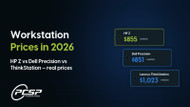
Workstation Prices in 2026: HP Z vs Precision vs ThinkStation
Posted by Konstantin Protasov on Dec 18th 2025
In December 2025 we published a piece on this page arguing that waiting for hardware to get cheaper in 2026 was a bad bet, because memory and storage supply were tightening. That was a forecast. Eight months later it can be checked against the receipts — and it turned out to be right by a much wider margin than we expected.
So this version does two things. First, it settles the score with actual numbers: what the components in a workstation cost then and what they cost now. Second — and this is the part most people arrive here for — it gives current prices for refurbished HP Z, Dell Precision and Lenovo ThinkStation machines by tier, what's available in quantity for fleet purchases, what used GPUs cost, and how far below new the whole thing lands.
The short version, priced August 21, 2026:
- The forecast held. A 32 GB DDR4 kit went from $60–$90 to about $250. The RTX 5060 Ti 16 GB went from $569.99 to $804.99 — in two months. Nobody who waited saved money.
- Refurbished workstations barely moved. Median price in our stock: $855 for HP Z, $851 for Dell Precision, $1,023 for Lenovo ThinkStation. Entry machines still start under $200.
- The three brands are priced within noise of each other at the same specification. Pick on configuration and availability, not badge.
- Fleet buyers have real depth: 264 identical ThinkStation P520 units, 166 Precision T5820s, 127 HP Z840s — the kind of matched quantity the new market rarely offers at any price.
- Used GPUs are where the savings are extreme right now: an RTX 3070 at $299.99 against an RTX 5070 at $899.99 street.
The Forecast, Checked Against the Receipts
Here is what the December 2025 article predicted, and what actually happened. We were right about direction on every line and wrong about magnitude on most of them — in the direction that hurts buyers.
One detail from the GPU data deserves to be pulled out, because it explains the entire year in a single comparison. Over the same two months, the 16 GB RTX 5060 Ti rose 41% while the 8 GB version of the same card rose 13%. Same GPU, same board partners, same demand — the only difference is how much memory is soldered to it. AMD, for its part, reportedly notified its board partners at the end of July of an increase of at least 10% on Radeon GPU and GDDR6 memory kits — not confirmed by AMD in a press release, but consistently reported from supply-chain sources.
Workstation Prices by Brand and Tier, August 2026
Everything below is live inventory on the day of writing, with quantities, so you can see both the price and whether it's a one-off or something you could buy ten of. Across the three brands our stock currently holds 5,334 HP Z units, 5,149 Dell Precision units and 4,391 Lenovo ThinkStation units.
What the medians actually tell you: HP Z and Dell Precision land within $4 of each other, which is not a meaningful difference — it's two large pools of similar corporate hardware priced by the same market. Lenovo's higher median is a mix effect rather than a premium: our ThinkStation stock is concentrated in well-equipped P520 configurations, so the middle of that pool sits higher. Compare like for like and the three brands are interchangeable on price.
HP Z vs Dell Precision vs Lenovo ThinkStation: Which to Choose
If the prices are equivalent, the choice comes down to practical differences. Having handled all three at volume, here's where they genuinely differ:
The Windows 11 note applies to a lot of what's on the market and deserves a click before you buy: the processor families in the Z440/Z640/Z840, Precision T5810/T7810 and every ThinkStation P520 are absent from Microsoft's supported list, while HP Z8 G4, Precision T7820/T7920 and Z2 G4 are fully supported. We mapped every model in the Windows 11 workstation compatibility list — worth checking against whatever you're about to order.
Buying in Quantity: What's Actually Available Matched
For anyone refreshing a team or a lab, the number that matters isn't the price — it's how many identical units exist. One image, one driver set, one spares kit, one training session. Here's what's currently sitting in matched quantity:
Two pieces of advice for fleet purchases that cost nothing and save a lot later. Buy 10% spare units, not spare parts — a whole cold machine at these prices costs less than the labor of diagnosing a dead one, and it doubles as a test bench. And lock the exact configuration before you order the first batch, because the second batch three months from now may not exist at the same spec: this inventory comes from corporate decommissioning, not a production line.
GPU Prices in 2026: New vs Used
Graphics is where the 2026 market has gone furthest from normal, and where the used option saves the most. New RTX 50-series cards are selling well above MSRP with prices still climbing; used professional and previous-generation gaming cards are not. Both columns below are current:
All of the used cards above are in our graphics card stock today — how to buy a used card without getting burned is its own guide. The used column is not a compromise for most professional work. A Quadro T1000 or Radeon Pro W6600 carries the ISV certifications that CAD packages actually check for, and a 24 GB P6000 holds models that a $900 RTX 5070 with 12 GB simply cannot. Where new cards genuinely win is efficiency and current-generation features — DLSS 4, AV1 encode, newer ray-tracing hardware — which matter for gaming and real-time rendering, and matter much less for a CAD seat or a batch render node.
Refurbished vs New: the 2026 Gap in Numbers
The refurbished discount is normally 40–60% against equivalent new. In 2026 it is wider, because new prices moved and used ones didn't. A concrete comparison at the entry of the professional range:
That's the honest trade in 2026: new buys you single-thread performance and a warranty from the manufacturer; used buys you cores, memory capacity and expansion for less money. Which is right depends entirely on the workload — the same trade we walked through for servers in how much a server costs in 2026. A CAD modeler working in a single-threaded kernel wants the fast new cores. A render node, a simulation box, a VM host or a developer machine running containers wants the twenty older ones and the 64 GB.
Where used wins outright is anything memory-hungry, because that's the component the shortage hit hardest. Adding 64 GB to a new DDR5 workstation costs several hundred dollars at today's prices; a refurbished machine typically arrives with it already installed, and expanding further uses DDR4 at roughly half the per-gigabyte cost of DDR5.
Should You Wait? What We'd Say Now
Having made this call once and been right, it's worth being careful about making it again. Here is the current evidence, with the uncertainty left in:
- Memory has no relief scheduled. Analysts expect DRAM to stay tight into late 2027 — new fab capacity takes years, and Samsung has signalled 2027 will be tighter than 2026. Anything memory-heavy will not get cheaper on a useful timescale.
- GPU pricing is still moving up, with RTX 50-series median prices rising as much as 40% between June and August 2026 and AMD reportedly adding a 10% increase on top.
- New system prices follow components with a lag, and both Dell and Lenovo have already passed through two rounds.
- The used market is the exception, and it's a temporary one. Refurbished prices are set by supply of decommissioned hardware, which is why they've been flat while everything else climbed. But used prices do track new ones eventually, and the refurbished discount is a percentage of a rising number.
So the same conclusion, for a slightly different reason than last December: if you know you need the machine within the next year, buying now is the low-risk option — not because a crash is impossible, but because every published supply forecast points the other way and the downside of being wrong is small. What we would not repeat is the urgency framing. Nobody needs to panic-buy. Just don't build a budget plan around hardware being cheaper in six months, because for two years running that assumption has cost people money.
Need a price for a specific spec — or forty of them?
Tell us the workload and the seat count and we'll quote matched units across all three brands, so you can compare like for like instead of listing for listing.
Browse workstations Request a bulk quoteWorkstation Prices: FAQ
How much does a workstation cost in 2026?
Refurbished: barebone chassis with a CPU from $168–$209, ready-to-run entry machines at $262–$425, mid-range CAD and content seats at $598–$757, and dual-socket high-end configurations at $1,006–$1,716. Median across our stock is $855 for HP Z, $851 for Dell Precision and $1,023 for Lenovo ThinkStation. New: a Dell Precision 3680 starts around $1,129 in a base configuration, with memory upgrades priced at 2026 DDR5 rates.
Which is cheaper: HP Z, Dell Precision or Lenovo ThinkStation?
At equivalent specification they are priced within noise of each other on the used market — HP Z and Dell Precision medians sit $4 apart in our current stock. Lenovo's median looks higher only because our ThinkStation inventory skews toward well-equipped P520 configurations. Choose on the specific configuration, parts availability and Windows 11 eligibility rather than on brand pricing.
What is the best budget workstation in 2026?
For office and light CAD, an HP Z2 G4 with a Core i7-9700 and 16 GB at about $425 — it's Windows 11 supported, small, and quiet. If you don't need Windows 11, a Dell Precision T5810 with a 6-core Xeon and 32 GB at $380 gives more memory for less money, and a Lenovo P520 at $262 is the cheapest ready-to-run route of the three.
Which workstations can I buy in bulk?
Currently matched in quantity: 264 Lenovo ThinkStation P520 barebones at $180, 166 P520s with 32 GB and 1 TB NVMe at $598, 166 Dell Precision T5820s with 64 GB at $684, 132 Precision T7820 dual-socket units at $1,153, 127 HP Z840s with 24 cores and 128 GB at $1,716, and 95 HP Z8 G4s from $1,374. For fleet purchases, buy about 10% spare whole units rather than spare parts, and lock the configuration before the first batch — this inventory comes from corporate decommissioning, not a production line.
How much can you save buying refurbished instead of new?
Normally 40–60% against equivalent new; in 2026 the gap is wider because new prices rose while used ones stayed broadly flat. Concretely, a refurbished Precision T7820 with 20 cores and 64 GB of ECC memory runs $791 against $1,129 for a base new Precision 3680 with a single Core i7 and 16 GB. New wins on single-thread speed and manufacturer warranty; used wins on cores, memory capacity and expansion.
Why did PC and workstation prices rise in 2026?
Memory. AI datacenter demand pulled DRAM and NAND production toward high-bandwidth memory and enterprise contracts, and server DRAM contract prices rose roughly 90% in Q1 2026 alone. The effect flows through everything: 32 GB DDR4 kits went from $60–$90 to about $250, the 16 GB RTX 5060 Ti rose 41% in two months while the 8 GB version of the same card rose 13%, and Dell and Lenovo each raised system prices twice.
What do used GPUs cost in 2026?
In our current stock: Quadro P400 2 GB at $33, Quadro P1000 4 GB at $55, Quadro T1000 4 GB GDDR6 at $214, Radeon Pro W6600 8 GB at $250, RTX 3070 8 GB at $300, Tesla T4 16 GB at $500, RTX 2000 Ada 16 GB at $650, RTX A4000 16 GB at $800–$940, and Quadro RTX 6000 24 GB at $1,092. For comparison, a new RTX 5070 has a median street price around $900 and the RTX 5090 sits near $4,700.
Will PC prices come down in 2027?
Unlikely for anything memory-heavy. Meaningful new DRAM fab capacity is not expected before late 2027 or 2028, and Samsung has indicated 2027 will be tighter than 2026. GPU prices were still climbing through August 2026. Refurbished system prices have stayed flat because they're set by the supply of decommissioned hardware rather than current component costs — but that decoupling is temporary, since used pricing tracks new with a lag.
Are older workstations still worth buying if they can't run Windows 11?
Often yes, but go in knowing it. HP Z440/Z640/Z840, Dell Precision T5810/T7810 and every Lenovo P520 use processors absent from Microsoft's supported list. They run Windows 10 with Extended Security Updates through October 2027, they run Linux indefinitely, and they're cheaper because of the limitation. If you need a supported Windows 11 seat, the HP Z8 G4, Dell Precision T7820/T7920 and HP Z2 G4 all qualify at modest premiums.
The Bottom Line
The December 2025 version of this article said waiting would cost money. It did: memory tripled, GPUs rose up to 41% in a single summer, and both major vendors raised system prices twice. The one part of the market that stayed still was refurbished hardware, because it's priced off machines that were built years ago rather than components bought this quarter.
That's the practical opportunity right now. A refurbished workstation with 20 cores and 64 GB of ECC memory costs less than a new single-socket box with 16 GB, matched units exist in the hundreds for fleet buyers, and a used professional GPU costs a third of the new card it replaces. The trade is real and worth naming: you give up single-thread speed and manufacturer warranty, and you check the Windows 11 list before ordering.
As for the next twelve months — every published forecast points to continued tightness through 2027, and the refurbished discount is a percentage of a number that is still climbing. That isn't a reason to panic. It is a reason not to plan around hardware being cheaper later.