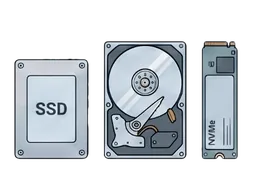
SATA Drives — 2.5″ & 3.5″ Hard Drives and SSDs
SATA is the universal drive interface — every desktop, workstation, and server backplane speaks it. A 6Gb/s SATA drive covers the widest range of jobs in the catalog: 3.5″ SATA hard drives for bulk capacity, 2.5″ hard drives and SSDs for laptops and small-form-factor bays, and M.2 SATA sticks for boot duty. Every drive we list is securely wiped to industry standards, SMART-tested, and listed with its hours of operation. Browse below, or see all hard drives, solid state drives and the full storage department.
Which SATA Drive Do I Need?
- 3.5″ SATA HDD — the capacity pick: best cost per terabyte for backup targets, NAS bays, and bulk server storage.
- 2.5″ SATA HDD & SSD — the small form factor: a 2.5″ hard drive fits laptops and SFF server bays alike, and swapping one for an SSD makes any machine boot in seconds.
- M.2 SATA — the gumstick format for motherboard slots and BOSS boot cards — same SATA interface, no cables.
Compatibility is the easy part: SATA drives run on native SATA ports and on SAS backplanes alike — the reverse is not true, so if your array needs dual-port 12Gb/s, see our SAS drives. Hot-swap bays still want the right tray or caddy, and a 2.5″ disk in a 3.5″ bay needs an adapter bracket — tell us your machine and we will match it.
Why Buy SATA Drives from PCSP
- Securely wiped: every drive is erased to industry standards before resale.
- Health-verified: SMART checks on every unit; hours of operation reported in the listing.
- 90-day returns: defective drives come back at our expense.
- Fast shipping: in-stock drives ship within 1–2 business days.
Quick Answers: Buying SATA Drives from PCSP
SATA or SAS — which do I need?
SATA is the universal choice: it works in desktops, workstations, NAS boxes, and on server SAS backplanes, at the best price per terabyte. Choose SAS when the array demands dual-port redundancy, 12Gb/s links, or sustained enterprise RAID duty. If the machine has only SATA ports, the decision is made for you — SAS drives will not run there.
Will a 2.5″ SATA drive fit in a 3.5″ bay?
Yes, with a 2.5-to-3.5 adapter bracket or the correct hot-swap caddy for your server family. The SATA connector itself is identical across both sizes. Tell us the machine and we will bundle the right hardware with the drive.
Are used SATA drives safe to buy?
Yes, when they are tested honestly. Every drive is securely wiped to industry standards, SMART-tested with hours of operation reported in the listing, and units that fail our checks never ship. Loose drives are covered by 90-day returns — defective units come back at our expense.
Should I pick an SSD or a hard drive?
SSD for anything a person waits on — boot volumes, applications, VMs: no moving parts and near-instant access. Hard drives win on capacity per dollar for backups, archives, and media libraries. Many builds use both: a SATA SSD to boot and 3.5″ hard drives for storage.