

Server Price Increases 2026: Lead Times and What to Do
Posted by Konstantin Protasov, PCSP on Aug 27th 2026
Open Dell's PowerEdge configurator today and three things hit at once. The starting price is far above what you budgeted last year. The memory options you wanted say “No longer available.” And the build you finally assemble is weeks out, if it is orderable at all.
This article is about the trajectory and the decision, not the sticker: what moved, who moved it and when, how well each claim is sourced, how long things take to ship, and what to do this quarter. If what you need is the static answer — what a server costs by class, new versus refurbished — that is our companion piece, How Much Does a Server Cost in 2026?, and it will serve you better than this one.
The short version, priced August 2026:
- Dell's configurator is the headline evidence. A 1U PowerEdge R660 starts at $23,298.99. One 64 GB RDIMM on that page is $9,958.78. A 1.92 TB NVMe drive is $15,700.74.
- Memory tiers are disappearing from the order form. On Dell's dual-socket R760 build page, the 32, 64 and 96 GB RDIMM options all read “No longer available” — only the base 16 GB module is still orderable, at $6,210.00 each. That build is marked Temporarily Out of Stock.
- The “Dell +17% on March 30” number does not survive checking. We could not trace it to Dell, CRN or any primary source. What is documented: a Dell server price increase in December 2025 and a Lenovo letter dated February 2, 2026 covering its server division.
- Lead times are two numbers, and nobody separates them. Standard PowerEdge and ProLiant configurations are reported at 6–10 weeks; AI/GPU systems at 32–52 weeks. Both are integrator-reported — no vendor publishes system-level lead times.
- It is not the tariffs. Every vendor statement names memory, and the Section 232 chip tariff explicitly exempts chips imported for US data centers.
- The alternative is priced and in stock. Our shelf holds 317 server SKUs, 3,879 units, median $1,504.89 — including a Dell R640 with two 20-core Xeon Golds and 512 GB of DDR4 at $2,787.28, under a third of what Dell charges for one 64 GB DDR5 module.
What Dell's Configurator Says on August 2026
Percentages get argued about. Configurator screens do not. Every figure below was pulled from Dell.com on August 23, 2026, and each is a public price anybody can check.
Two things deserve pulling out. The first is that “No longer available” string — quoted here exactly as Dell prints it. On the dual-socket R760 build page, the 32, 64 and 96 GB RDIMM options all carry it, and so does 128 GB. You cannot buy mid-tier memory on that configuration at any price — the only module still orderable is the base 16 GB, at $6,210.00 each, more than Dell asks for a 32 GB module on the R660. That is not a price increase; it is a product line quietly narrowing to whatever the vendor can still source.
The second is storage. Here is what one read-intensive U.2 NVMe drive costs as an add-on on the same page, with the per-terabyte arithmetic done:
One 3.84 TB drive costs more than most businesses spend on an entire server refresh. Fill eight bays and the drives alone clear $200,000. This is the memory and NAND squeeze arriving on an order form, with no percentage attached.
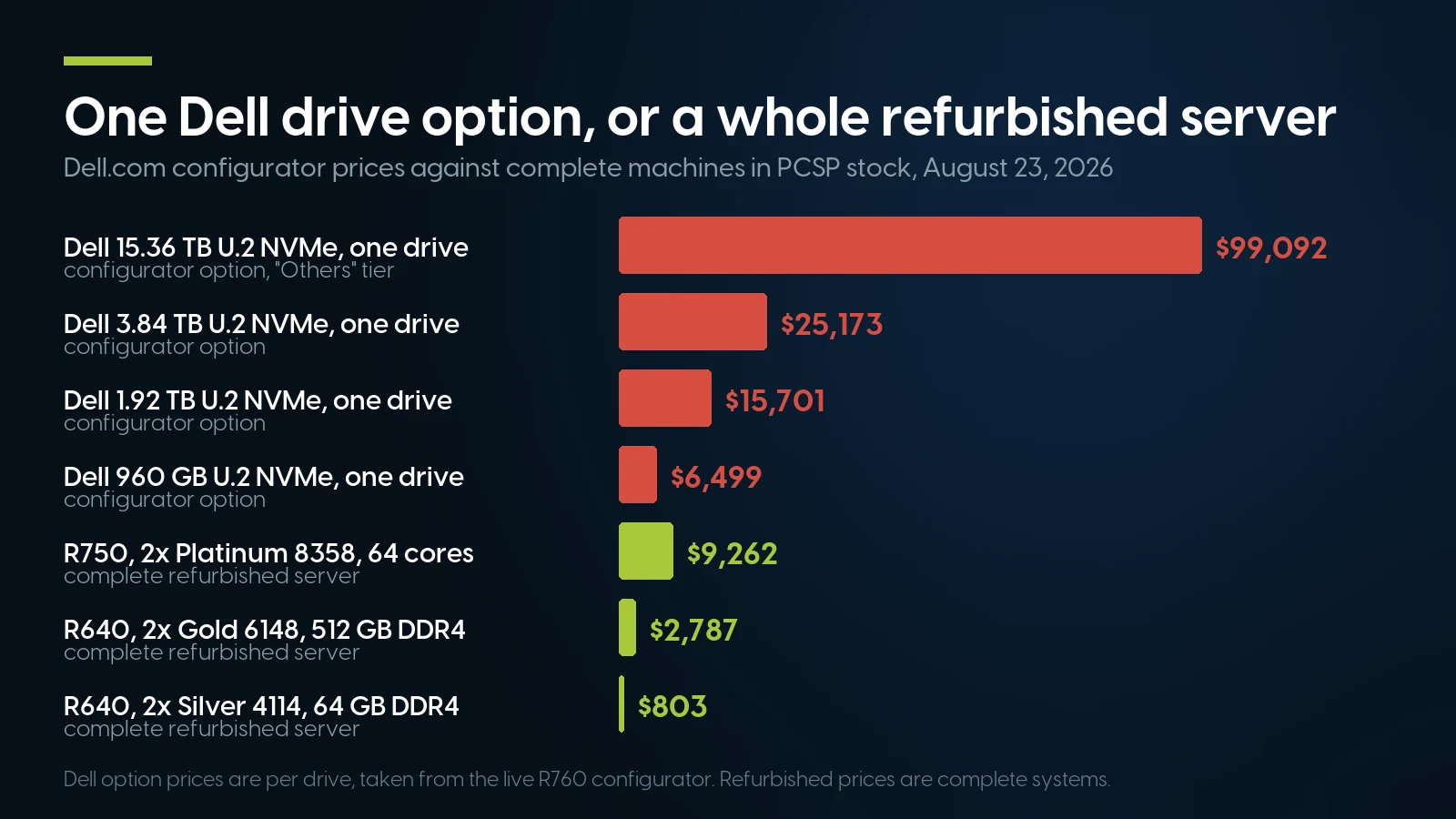
Dell option prices are per drive, from the live R760 configurator. The green bars are complete refurbished systems in PCSP stock. Both checked August 23, 2026.
HPE and Lenovo: What the Storefronts Show
Dell is the only one of the three exposing a real component-level configurator to the public. That matters when you read the other two, because their numbers are not the same kind of number.
HPE sells through the HPE Store and its Smart Choice purchase program, and what appears there are fixed, pre-configured bundles fulfilled by named third-party resellers — the listings we pulled on August 23, 2026 rotated between Nautilusnet, TXC Technologies LLC and BlueAlly as the seller. These are not raw HPE list prices, and there is no component upsell panel to isolate a memory or drive cost from. With that caveat attached:
- ProLiant DL380 Gen11 (2U) — “Starting at $13,685.00,” SKU P83314-005: Xeon Gold 6530 (32C), 64 GB, MR416i-o controller, 2×960 GB SATA SSDs, dual 1000W Titanium PSUs — marked Limited Availability.
- DL380 Gen11 SKU P71681-005 — Xeon Gold 6526Y (16C), 128 GB, NS204i-u boot device only, eight SFF bays otherwise empty — $15,625.00, In Stock.
- ProLiant DL360 Gen11 (1U) SKU P71678-005 — Xeon Gold 6526Y, 128 GB, boot device only — $15,007.00. A second config, P72992-005, lists at $15,936.00.
Note what the middle one omits: a 128 GB machine at $15,625.00 ships with no data drives at all. Populate those eight bays at 2026 NVMe pricing and the bundle price stops being the interesting number.
Lenovo is the more surprising case, and worth being precise about, because this is one day's browsing, not a corporate announcement. Searching lenovo.com's US store for the ThinkSystem SR650 V3 on August 23, 2026 returned no purchasable complete new system — only SR650 V3-branded option kits (processor kits from $1,273.05 for a Xeon Silver 4510 to $6,286.05 for a Gold 6544Y, a PCIe Gen5 riser at $2,209.00) plus Lenovo Press documentation. The family's current storefront listing is the successor: ThinkSystem SR650 V4, “Starting at $7,270.55.”
The 1U SR630 V3 shows a category headline of “Starting at $5,830.08.” Tracing that figure to the cent through Lenovo's own product search lands on a SKU tagged CERTIFIED REFURBISHED SERVER — a Xeon Gold 5418Y with 64 GB of TruDDR5 — while the category card shows no refurbished badge. The match is strong but circumstantial, so treat it as an observation rather than Lenovo policy: the cheapest SR630 V3 lenovo.com advertised to us that day appears to be refurbished.
The takeaway: a vendor page's entry price increasingly is not a new, complete, orderable machine — and when an OEM's own storefront leans on refurbished stock and superseded generations, the strategy below is the one the vendors already run.
Who Raised Prices, When — and How Well Each Claim Is Sourced
One number circulates everywhere on this topic: Dell raised prices 17%, effective March 30, 2026, PowerEdge included. We went looking for its origin across ChannelE2E, The Register, Tom's Hardware, DigiTimes and Blocks & Files and could not find one — CRN's archive is not reachable by the search tools we used, so that one we cannot claim to have cleared. What we did find: the figure traces back to aggregator and MSP-blog posts reproducing identical wording, with no press release, trade article or partner letter behind it. We are not using it, and neither should you. The dated facts below are less dramatic and much more useful.
The language matters more than the arithmetic. Dell COO Jeff Clarke told The Register in December 2025: “We have not seen costs move at the rate that we've seen. Demand is way ahead of supply.” Marco Andresen, COO of Lenovo's Intelligent Devices Group, in the same reporting: “There is an unprecedented cost increase widely in the industry, especially on memory and SSD.” IDC's Matt Eastwood called the magnitude of the move “unique.”
HPE was the most explicit. On its Q1 FY26 call, CEO Antonio Neri said HPE had “amended our quoting terms with a right to reprice existing orders for commodity cost increases between quoting and shipment” and told investors HPE expects elevated memory and storage prices to persist well into 2027. No percentage — a mechanism. That is what a vendor does when it does not know what its own bill of materials will cost in six weeks. Dell said the same in different words, on record: “We're compressing discounting. Our quotes are valid for the shortest period of time they've ever been.” Trade coverage also reported Dell warning commercial customers that ordering today for future delivery does not lock in current pricing; we could not reach the original article to confirm its wording or date.
The Mechanism: Memory Is Now More Than Half the Machine
One cause explains almost all of it. AI datacenter buildout pulled DRAM wafer capacity toward high-bandwidth memory and locked conventional supply into long-term agreements. Everything downstream repriced. Quarter by quarter:
- Q1 2026: TrendForce forecast, on January 5, server DRAM contract prices up more than 60% QoQ, conventional DRAM at 55–60%, NAND at 33–38%, client SSDs at “at least 40%.” The quarter came in well above that — see the H1 line below.
- Q2 2026: TrendForce forecast conventional DRAM contract prices up a further 58–63% QoQ, driven by high-capacity RDIMM demand for AI servers; it published no separate server-DRAM figure for the quarter.
- H1 2026 in aggregate: Gartner data cited by The Register has DRAM up 90–95% QoQ, NAND up 55–60%, and DRAM projected to rise 271% across 2026.
- Q3 2026: the first deceleration — TrendForce forecasts server DRAM up 13–18% QoQ, and is explicit about why: hyperscalers' long-term agreements cap the increase for those buyers while the open market moves faster. Deceleration is not reversal — TrendForce expects quarterly increases to continue through H2 2027.
The number to carry into a budget conversation is what that does to a server's bill of materials. Per Greyhound Research chief analyst Sanchit Vir Gogia, quoted in Network World's March 2026 report, memory and storage now account for over 50% of a standard server's cost, up from 25–40% previously — an analyst's figure, not a vendor's. That single shift explains the configurator screens above better than any vendor percentage: when half the machine is a commodity in shortage, the machine tracks the commodity.
Relief is not scheduled soon. Samsung, SK hynix and Micron have reportedly sold out their entire 2027 DRAM and HBM capacity, offering customers roughly 60–70% of requested volumes. New fabs run on a multi-year clock — Micron's first new Idaho DRAM production slated for mid-2027, SK hynix's M15X reaching full output around the same point, Samsung's P5 around 2028. Those dates come from trade coverage rather than vendor statements, but they are consistent across outlets and all point past 2027.
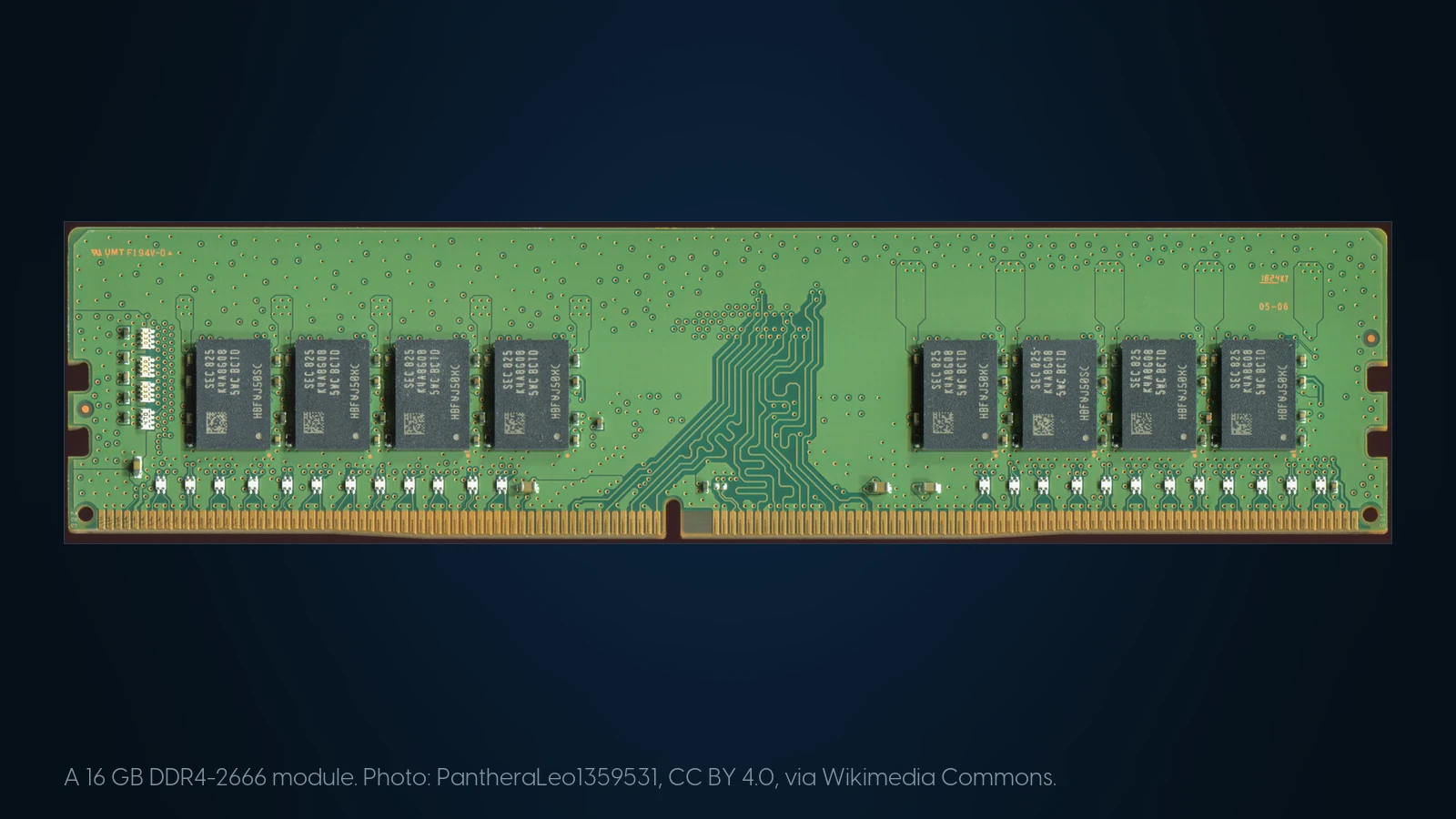
The component behind every price increase in this article. Photo: PantheraLeo1359531, CC BY 4.0, via Wikimedia Commons.
Lead Times: Standard Servers and AI Servers Are Not the Same Number
Almost every article on this subject quotes one lead-time range. There are two, they differ by roughly a factor of five, and mixing them makes both worthless for planning.
The component rows explain the system rows. A server is gated by its slowest part, and in 2026 that is rarely the CPU everyone worries about — it is a power-management chip that went from a six-month wait to a nine-month one. TrendForce cut its 2026 general server shipment forecast to +13% year over year, down from roughly 20%, while keeping AI server shipments at about +28%. General-purpose servers are not slowing because demand fell; they are slowing because the parts go somewhere else.
The second half of the problem is that your quote expires. Here is the line between confirmed and not. Confirmed: HPE amended its quoting terms in March 2026 to allow repricing between quote and shipment, and Dell said on record that its quotes are “valid for the shortest period of time they've ever been.” Channel-reported and not independently confirmed: that distributor quote validity fell from roughly 30 days to 4–7 days on constrained SKUs, with some quotes said to expire within 72 hours on high-density DDR5 builds. Those day-counts are consistent across integrator accounts but untraceable to a primary source — treat them as a pattern, not a statistic.
One genuinely good piece of news, and it is recent: as of August 6, 2026, HPE holds quoted prices valid until shipment for Compute, Storage and GreenLake Flex purchases up to $1 million — a customer-favorable reversal of the March language. If you are quoting HPE, ask which terms your quote carries.
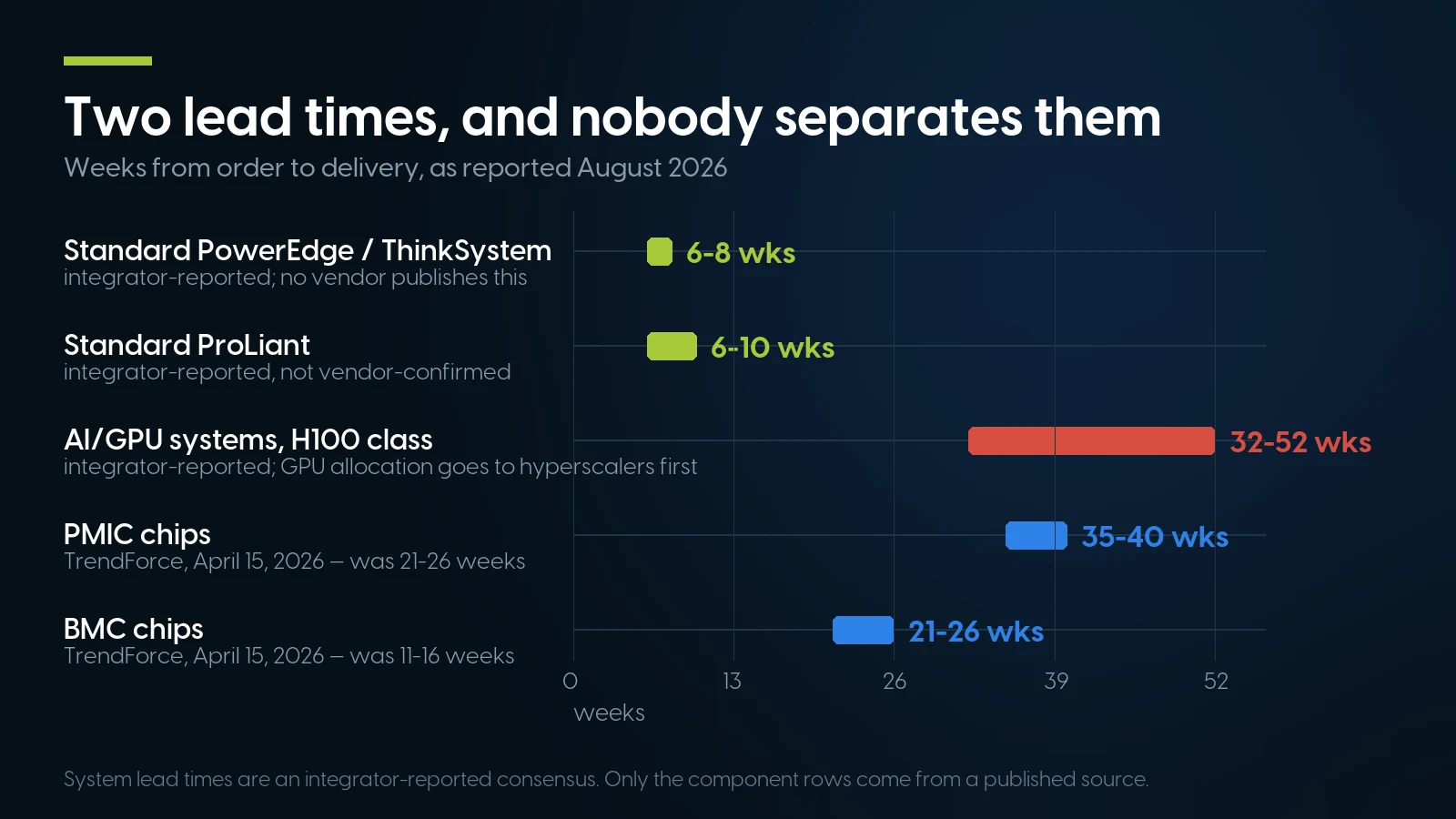
System lead times are an integrator-reported consensus — no vendor publishes them. Only the component rows come from a published source.
It Is Not the Tariffs
This is the most common wrong answer to “why are servers so expensive in 2026,” and getting the cause wrong means getting the timeline wrong.
The Section 232 semiconductor action imposed a 25% tariff on advanced computing chips, signed January 14 and effective January 15, 2026. It carries explicit exemptions — among them chips imported for US data centers, for US R&D, for US repair and replacement, and for US startups, each carried as its own duty-free tariff line. A large share of the equipment this article is about plausibly falls inside those carve-outs.
Meanwhile, every vendor statement above names the same cause, and it is not trade policy. Dell: costs moving faster than ever, demand ahead of supply. Lenovo: “especially on memory and SSD.” HPE: “memory and component cost inflation.” Not one says tariffs.
There is a real forward-looking risk, and it should be labeled as exactly that. A proposed “Phase 2” expansion of Section 232 would reportedly bring semiconductor manufacturing equipment, memory chips, and derivative products — potentially finished servers — under the tariff umbrella. As of August 23, 2026 it is not in effect. If it lands, it compounds an existing memory-driven increase rather than explaining one that already happened. Macro modeling published by ITIF and CSIS describes hypothetical scenarios, not observed 2026 prices.
Get a real price with a date on it
Send us the spec you were quoted — cores, memory, storage, ship date — and we'll price the same workload on in-stock hardware, with the quantity we actually hold on the shelf.
Browse servers in stock Request a quoteFour Alternatives, Ranked by What They Save
Ranked by size of saving, largest first. Every price below is PCSP live inventory, checked August 23, 2026, with the quantity we hold.
1. Refurbished and off-lease, current business generations. The largest saving by a wide margin, because this hardware was manufactured against 2018–2021 memory contracts, not this quarter's. Our shelf today holds 317 server SKUs across 3,879 units, median price $1,504.89, with 87 SKUs under $1,000. Representative configurations:
Put the fifth row next to this article's first table. A complete, tested, warrantied dual-socket server with 40 cores and 512 GB of memory costs $2,787.28. One 64 GB DDR5 module on Dell's R660 page costs $9,958.78. That is the 2026 argument in two numbers.
2. Previous-generation new, or current-generation barebones. If policy requires new hardware, it need not be the newest generation. Configure-to-order chassis let you supply memory and drives from a market you control rather than the vendor's option list: a Dell R750 24-bay CTO chassis is $3,784.99 with 27 available, a ProLiant DL360 Gen11 CTO is $3,484.99, and a Dell R650 8-bay 1U is $2,884.90 — against $15,007.00 for HPE's fixed Gen11 bundle.
3. Redeploy what you already own. The cheapest terabyte of RAM in 2026 is the one already racked. Consolidate first: pull memory from decommissioned nodes into the hosts that need it, move workloads off half-empty servers, buy only the delta. Where you do need modules, DDR4 ECC RDIMMs and LRDIMMs for Dell 13th–15th gen and HPE Gen9/Gen10 remain far cheaper per gigabyte than DDR5 on a vendor option list — the reasoning is in our piece on refurbished DDR4 server memory.
4. Waiting. Last, because the published evidence is against it. TrendForce's quarterly series, Gartner's 2026 projection and HPE's own guidance that elevated prices persist well into 2027 all point the same way. Waiting is defensible if your refresh genuinely is not due until 2028. It is not a cost-saving strategy for a machine you need this year.
The Support-Lifetime Question, Answered Honestly
The real objection to a previous-generation server is not reliability. It is “how long will it be supported?” The answer differs by vendor in a way almost nobody writes down.
HPE announces end-of-sale dates, behind a login. ProLiant end-of-life is announced through official Product Change Notifications — there is one in HPE's support center covering the DL345, DL360, DL365 and DL380 Gen10 Plus and the DL325/DL385 Gen10 Plus V2 families — which carry end-of-sale dates and need an HPE login to read. The end-of-service-life dates quoted online come from third-party maintainers: Park Place Technologies lists ProLiant DL380 Gen10 EOSL as March 31, 2028. That is a maintainer's date, not HPE's. (Correction, October 5, 2026: this paragraph was first headed “HPE publishes generation-level dates” and presented the Park Place date as following from HPE's notices.)
Dell does not. There is no public per-generation PowerEdge EOL/EOSL schedule. A Dell moderator said so plainly on Dell's own community forum in September 2024, and nothing has replaced it since: “There isn't any article or documentation on PowerEdge EOL/EOSL/EOSS dates.” Dell's guidance is a rule of thumb — roughly five to seven years from ship date — and the only authoritative answer for a specific machine comes from entering its Service Tag on Dell's support portal. You will find confident claims elsewhere that the R740 was retired in Q4 2023 with support to the end of 2028; we could not verify that and are not repeating it as fact.
Practically: for a Dell purchase, get the Service Tag before you commit and check the entitlement yourself — a two-minute lookup that converts an unknown into a date. For HPE, the generation's end-of-sale notice needs an HPE login, and end-of-service-life dates come from third-party maintainers. (Correction, October 5, 2026: this line first said “For HPE, look up the generation once and every unit is covered.”) In both cases, OEM end-of-support is not end-of-life; third-party maintenance providers routinely support hardware years past the OEM date, which is why those EOSL databases exist. Our used server buyer's checklist covers what else to verify before the purchase order.
Why So Much Good Hardware Is Hitting the Secondary Market Right Now
There is a reason the shelf above runs deep in Dell 14G/15G and HPE Gen10 specifically, and it is not the usual three-year refresh cycle. It is a licensing shock.
Broadcom's changes to VMware licensing after the acquisition pushed a large number of organizations into rethinking their virtualization platform on a compressed timeline. When a company re-plans its hypervisor, it re-plans its host fleet — consolidating onto fewer, larger nodes, or migrating to Proxmox, Hyper-V or Nutanix and rebuilding the cluster. Both paths retire perfectly serviceable hardware years before it would have aged out. Combined with routine lease expirations, that is why 14G/15G and Gen10 inventory with real remaining life is abundant in 2026 while everything new is scarce.
This is a supply window, not a permanent condition. If your own VMware renewal is what brought you here, our guide to switching from VMware to Proxmox covers the migration and how to spec hosts for it.
When Buying New Is Still the Right Call
We sell refurbished hardware, and it is still the wrong answer for a meaningful share of buyers. Where new wins, specifically:
- You need the newest cores and AMX. Sapphire Rapids and later added on-die matrix extensions that materially change inference throughput per socket. Intel's claim of a 2.9× average performance-per-watt improvement applies specifically to accelerator-optimized workloads — not a general-purpose multiplier, and independent HPC benchmarking finds modern Xeon idle power high enough that real energy-to-solution gains are workload-dependent. But if your workload is one of the accelerated ones, no amount of used 14G hardware substitutes.
- You need PCIe Gen5 and dense NVMe. Dell 14G and 15G are PCIe Gen3 and Gen4; 16G and ProLiant Gen11 are Gen5. For a database or analytics tier that saturates NVMe queues, or GPUs that want full Gen5 lanes, that is a hard architectural boundary.
- You are bandwidth-bound and DDR5 helps. DDR5 roughly doubles per-DIMM peak bandwidth, which is real for bandwidth-bound HPC and in-memory analytics — and with DDR4 trading at or above DDR5 in some configurations, the usual cost argument for staying on DDR4 is weaker than it was.
- Efficiency compounds at scale. Rack power cost is IT power (kW) × PUE × 8,760 hours × $/kWh. The US average commercial rate was 13.54¢/kWh in May 2026, the most recent month in EIA's published series, up 4.7% from 12.93¢ a year earlier — though March ran higher still at 13.92¢, so read the line as choppy rather than a straight climb. The regional spread matters more: roughly 7¢ in the cheapest states, around 26¢ in California and New England, about 43¢ in Hawaii. A standard rack draws 3–10 kW; aggregator estimates put a 60 kW AI-capable rack in a high-cost state above $200,000 a year in power alone. Not an audited figure — but at fleet scale in an expensive state, a generation of perf-per-watt pays for itself.
- Warranty and compliance require it. Healthcare, finance and government procurement rules frequently mandate current-generation hardware or a specific OEM support SLA. That is a requirement, not a preference, and no discount overrides it.
- Financing changes the shape of the cost. A large capex outlay at 2026 prices is what leasing exists for. We run an IT hardware financing route for the same reason the OEMs push theirs: when sticker prices spike, spreading them over three to five years is sometimes right even at a worse total cost.
The Risk in the Answer We Just Gave You
Refurbished pricing has held up this year because it is set by the supply of already-manufactured hardware, not by this quarter's DRAM contracts. That decoupling is real, and it is why the new-versus-used gap is unusually wide. It is also temporary, and it would be dishonest to sell it as anything else. Three specific ways this goes against you:
- Used prices track new prices with a lag. The refurbished discount is a percentage of a number that is still climbing. A 60% saving against a list price that rose 40% is not the deal it was two years ago, and the absolute dollars for a used server with 512 GB in it have moved even where the discount ratio looks unchanged.
- Used memory is the most exposed part. Secondary-market server RDIMM pricing has risen over the past year, and DDR4 is caught between demand from installed platforms and producers winding the line down. You will see specific percentage figures quoted elsewhere for used DDR4 and used enterprise SSDs since December 2025 — we could not verify any of them at source and are not repeating the numbers. The direction is well corroborated; the magnitudes are not.
- Depth is not permanent. The 40-unit and 38-unit quantities above exist because specific fleets were decommissioned. When the VMware-driven refresh wave passes, matched quantity gets harder to find, and the answer to “can I buy twelve identical ones in March?” becomes no.
Buying refurbished in 2026 is a strong decision on today's prices with today's supply. It is not a hedge against a market that stays this way, and should not be modeled as one in a three-year plan.
Server Prices and Lead Times: FAQ
Why are servers so expensive in 2026?
Memory. AI datacenter demand pulled DRAM capacity toward high-bandwidth memory and locked conventional supply into long-term agreements. TrendForce forecast server DRAM contract prices up more than 60% quarter over quarter for Q1 2026, and a further 58–63% for conventional DRAM in Q2; Gartner data cited in August 2026 has DRAM up 90–95% QoQ across the first half. Analyst estimates put memory and storage at over 50% of a standard server's cost, up from 25–40% previously.
Did Dell really raise server prices 17% in March 2026?
We could not verify that. The “17%, effective March 30, 2026” figure circulates widely, but we could not trace it to Dell, to CRN, or to any primary or trade source — it appears to originate in aggregator posts reproducing identical wording. What is documented: channel trade press reported that Dell raised server prices on December 10, 2025, with an on-record Dell quote that its quotes are now “valid for the shortest period of time they've ever been.”
How long are server lead times in 2026?
Two very different numbers. Standard non-GPU PowerEdge and ThinkSystem configurations are reported at 6–8 weeks and standard ProLiant at 6–10 weeks — integrator-reported consensus, not vendor-published. AI/GPU-configured systems are reported at 32–52 weeks. The component figures are firmer: TrendForce reported in April 2026 that PMIC lead times went from 21–26 to 35–40 weeks, BMC chips from 11–16 to 21–26 weeks, and PCBs and CPUs stretched to nearly a year.
Are tariffs causing the 2026 server price increases?
No, on current evidence. Section 232 imposed a 25% tariff on advanced computing chips, signed January 14 and effective January 15, 2026, but it explicitly exempts chips imported for US data centers, US R&D, US repair and replacement, and US startups. Every vendor quote on record attributes the increases to memory and component costs. A proposed “Phase 2” expansion could bring memory chips and finished derivative products under the tariff, but as of August 23, 2026 that is not in effect.
Should I buy a server now or wait for prices to drop?
If you need the machine within the next year, buy. TrendForce expects server DRAM contract prices to keep rising every quarter from H2 2026 through H2 2027, HPE told investors it expects elevated prices to persist well into 2027, and new fab capacity from SK hynix, Micron and Samsung is scheduled for mid-2027 through 2028. Waiting is defensible only if your refresh genuinely is not due until 2028.
How much does a server actually cost in 2026?
That question has its own answer, with full price tables by class: see our companion article, How Much Does a Server Cost in 2026? The short version, priced August 23, 2026: Dell's configurator starts a 1U PowerEdge R660 at $23,298.99 and a dual-socket R760 build at $53,250.15, the DL380 and DL360 Gen11 Smart Choice bundles we priced run $13,685 to $15,936, and refurbished dual-socket servers on our shelf run $242.93 to $9,261.72, against a $1,504.89 median across all 317 server SKUs we hold.
Why does Dell's configurator say memory is "No longer available"?
Because those SKUs cannot currently be sourced for that build. On Dell's dual-socket PowerEdge R760 build page on August 23, 2026, the 32, 64 and 96 GB RDIMM options all show that exact string — only the base 16 GB module is still orderable, at $6,210.00 each — and the build itself is marked Temporarily Out of Stock. On the R660 and the R760 entry page the 16 GB single-rank option is gone while 32 and 64 GB remain purchasable at $5,418.64 and $9,958.78 each. It is a product line narrowing to what the vendor can still get.
How long will Dell 14G and HPE Gen10 servers be supported?
The vendors handle this differently. HPE announces end-of-sale dates in Product Change Notifications that need an HPE login; the end-of-service-life dates quoted online come from third-party maintainers — Park Place Technologies lists ProLiant DL380 Gen10 end-of-service-life as March 31, 2028. (Correction, October 5, 2026: this answer first presented that date as tracking HPE's notices.) Dell publishes no generation-level EOL or EOSL schedule at all; guidance is roughly five to seven years from ship date, and the authoritative answer comes from entering a Service Tag on Dell's support portal. Third-party maintenance commonly extends past the OEM date.
Will refurbished server prices go up too?
Eventually, yes. Refurbished pricing is set by the supply of already-built hardware, which is why it stayed comparatively flat while new prices climbed — but used prices track new ones with a lag, and the discount is a percentage of a number still rising. Used server memory has moved up over the past year, and DDR4 is squeezed between installed-base demand and producers winding the line down. Specific percentage figures circulating for used DDR4 and SSDs could not be verified at source.
Sixty cores and 512 GB, in stock, this week
Tell us the workload and the node count. We'll spec matched units from stock, quote them with the quantity on hand, and you'll know the ship date before you sign anything.
2U rack servers 1U rack serversThe Bottom Line
The most useful evidence about 2026 server pricing is not a percentage from a press release. It is what the order forms say. Dell's configurator asks $23,298.99 for a one-socket 1U, prices a single 64 GB module above $9,900, prints “No longer available” against three standard memory tiers on its dual-socket build page, and marks that build out of stock. HPE sells fixed reseller bundles at $13,685 to $15,936, two of them 128 GB machines with no data drives at all. Lenovo's US store did not offer us a new, complete SR650 V3 at all. None of that requires a vendor to confirm anything.
The cause is memory, and the vendors say so themselves — not tariffs, whose one implemented action exempts chips bound for US datacenters. The timeline runs past 2027 because fabs do. And the lead-time conversation only works if you keep a standard ProLiant at six to ten weeks separate from an AI-configured system at thirty-two to fifty-two; averaging them produces a number that describes nothing you can order.
What to do is unglamorous. Get a quote with a validity period and a repricing clause you have actually read. Check the Service Tag or the generation EOSL date before you commit, not after. Look hard at previous-generation and off-lease hardware, abundant right now for a reason that will not last, and buy new where the workload genuinely needs Gen5, AMX or a compliance-mandated warranty. And if the question you came with was simply what a server costs, our price guide answers it directly.