

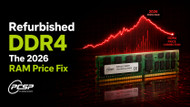
Refurbished DDR4 Server Memory: The 2026 RAM Price Fix
Posted by Konstantin Protasov, PCSP on Jun 16th 2026
Server memory just became the most volatile line item in IT. The most-cited benchmark says it best: a 32 GB DDR5 desktop kit that sold for under $100 in mid-2025 was quoted around $430 by early 2026 — roughly a 4–5× jump in a year. Consumer DDR5 is not the same SKU class as server RDIMM, but it is a visible proxy for the broader DRAM squeeze, and the server side tells the same story: a 64 GB DDR5 RDIMM that was contracting near $255 in Q3 2025 crossed $900 a year later. The cause is not a shortage of factories. It is that the entire memory industry has pivoted its capacity toward the AI buildout, and ordinary server RAM is the casualty.
There is a way to size, upgrade, or build a server right now while sidestepping most of that increase: buy refurbished DDR4 ECC server memory. DDR4 is not immune — it has risen too — but it is far less exposed than new DDR5, the platforms that use it (Dell 14th/15th-gen, HPE Gen10) are exactly the refurbished servers we stock, and the per-gigabyte cost still starts from a much lower base. This guide explains what is happening to prices, where DDR4 fits, how to choose the right modules for your exact platform, when DDR5 is still the better call, and which configurations give you the most capacity for the money.
Key takeaways
- Why is server RAM so expensive in 2026? AI demand pulled DRAM and HBM capacity toward DDR5; new server RDIMM prices roughly doubled in a year (a 64 GB DDR5 RDIMM went from ~$255 to over $900).
- Is DDR4 still worth buying in 2026? Yes — for capacity-driven workloads on Dell 14th/15th-gen and HPE Gen10 platforms, refurbished DDR4 ECC memory costs a fraction of new DDR5 per gigabyte and performs identically.
- Is DDR4 immune to the spike? No. Refurbished DDR4 has risen 30–50% too, but it starts from a far lower base and remains the value play.
- How do I choose the right module? Match the platform's speed (DDR4-2133 to 3200), type (RDIMM vs LRDIMM), rank, and chip organization — see the compatibility matrix below.
- Should I wait for prices to drop? For DDR4, no — supply is in end-of-life and rationed; if a build is planned for 2026, buying the matched kit now is the lower-risk move.
- When does DDR5 still make sense? For memory-bandwidth-bound workloads (in-memory databases, HPC, CPU AI inference) or when standardizing on new Dell 16G / HPE Gen11 platforms.
The 2026 Memory Crisis, in Numbers
This is not the usual quarter-to-quarter price drift. It helps to separate what has already happened from what analysts are forecasting:
Confirmed (actual contract prices):
- Server RDIMMs have already roughly doubled. Per Counterpoint figures reported by Network World, a 64 GB DDR5 RDIMM went from about $255 in Q3 2025 to $450 in Q4 2025 and crossed $900 in Q1 2026 — with new 32 GB DDR4-3200 server RDIMMs themselves now quoted near $400 as their own supply tightens.
- Consumer DDR5 4–5×'d in a year. A 32 GB desktop kit that sold around $80–95 in mid-2025 reached the $420–510 range by early 2026 — a different market from server RDIMM, but the clearest public signal of how far DRAM moved.
- The makers raised prices and rationed supply. Micron raised prices 20–30% and stopped quoting some SKUs; the major suppliers have committed substantial 2026 capacity to server and HBM customers, which limits spot availability for mainstream buyers and stretches lead times on the largest modules into months.
Forecast (analyst projections, not yet booked):
- TrendForce projected conventional DRAM contract prices up ~55–60% in Q1 2026 and a further ~58–63% in Q2 2026, with server DRAM among the steepest categories — the sharpest run in over a decade.
- Counterpoint projected that same 64 GB RDIMM crossing $1,000 in Q2 2026.
For anyone speccing or refreshing a server, the practical effect is the same either way: memory, historically 15–25% of a build, can now dominate the bill of materials when bought new.
Why Are RAM Prices So High in 2026? AI Ate the DRAM Supply
Memory fabs are finite. Every wafer a manufacturer commits to one product is a wafer it cannot use for another. Through 2025 and into 2026, three forces converged to pull that capacity away from mainstream server memory:
- HBM crowds out everything else. AI accelerators use High-Bandwidth Memory, which is enormously profitable and ties up far more manufacturing and advanced-packaging capacity per usable gigabyte than standard DRAM. Makers have reallocated leading-edge capacity to HBM, shrinking the supply available for conventional DDR5.
- AI servers buy DDR5 by the rack. The same data-center buildout also needs vast quantities of standard DDR5 for the host systems around those accelerators, so demand surged on the very product whose supply was being squeezed.
- DDR4 is on its way out. All three makers issued DDR4 end-of-life notices in 2025, planning to wind production down as they shifted lines to DDR5. They then extended DDR4 output into 2026 — not because supply loosened, but because prices spiked so hard that the remaining output was redirected almost entirely to server-grade customers. The long-term direction is unchanged: new DDR4 is shrinking, not growing.
That last point matters for buyers: with new DDR4 winding down and what remains rationed to big accounts, the DDR4 most buyers can actually get is increasingly refurbished memory pulled from decommissioned enterprise fleets. Reports put used DDR4 server modules from 14th/15th-generation systems 30–50% above their late-2025 levels — rising, but from a low base, and still well below new DDR5 per gigabyte. The refurbished channel has effectively become the accessible DDR4 supply.
Why Refurbished DDR4 Is the Smart Buy Right Now
DDR4 is not caught in the spike that is hammering new memory budgets, for four concrete reasons:
- It is the wrong generation to be expensive. The AI buildout consumes HBM and new DDR5. DDR4 is a previous-generation product the fabs are exiting — it is not what the hyperscalers are bidding up, so it has been spared the worst of the contract-price explosion.
- The supply is already made. Refurbished DDR4 comes from servers that were built years ago. It does not compete for a wafer that a fab would rather turn into HBM — it already exists, tested and in hand.
- The platforms it serves are the value play anyway. DDR4 runs on Dell 14th/15th-gen and HPE Gen10 servers — the same refurbished enterprise hardware that already costs 40–70% below new. Pairing a DDR4 platform with DDR4 memory keeps the entire build outside the AI tax.
- For many workloads, capacity matters more than peak bandwidth. For virtualization, file and backup services, lab clusters, and general business applications, having enough RAM to hold the working set matters far more than DDR4-vs-DDR5 bandwidth — those hosts are usually bottlenecked on storage, network, or core count first. And on a 15th-gen Ice Lake platform you get eight memory channels per socket even on DDR4, so aggregate bandwidth is well ahead of the six-channel systems it replaces. DDR5 earns its premium when the workload is genuinely memory-bandwidth-bound (in-memory databases, analytics/HPC, heavy software-defined storage, CPU-side AI inference, NUMA-sensitive code) — we flag that case explicitly later in this guide.
The honest caveat: refurbished DDR4 has risen too (30–50% off late-2025 lows), and as decommissioned fleets are the only new supply, it will keep firming — DDR4 is less exposed, not immune. But for buyers who can use a DDR4 platform, the cost-per-GB gap versus new DDR5 remains substantial, and it starts from a much lower base.
New DDR5 vs. Refurbished DDR4: The Real Cost Gap
The honest way to compare is by total capacity, holding the comparison apples-to-apples: the same gigabytes, noting the module strategy and the price basis for each side. The DDR5 column is a new-market spot quote; the DDR4 column is a tested-refurbished configured price (single module or kit, as noted) from our catalog. All numbers move week to week — treat them as the shape of the gap, not a price list.
A worked example makes the last row concrete. Outfit one 512 GB virtualization host as 16×32 GB: at ~$400–500 per new DDR5 RDIMM that is roughly $6,400–8,000 in memory alone — more than a fully configured refurbished PowerEdge R750 with CPUs and storage typically costs. The same 512 GB in refurbished DDR4 lands around $2,500–3,800. The gap (~$4,000+ on a single host) is the AI tax, made visible. Send us the capacity you're targeting and we'll quote the exact modules against current stock.
Which Servers Use DDR4 RAM? Dell & HPE Compatibility
DDR4 is not a niche legacy part — it is the memory standard for the two server generations that dominate the refurbished market in 2026. If you are buying refurbished, you are almost certainly buying a DDR4 platform:
- Dell PowerEdge 14th gen — R640, R740/R740xd, R440, R540, R940. Intel Xeon Scalable (1st/2nd gen), DDR4-2666/2933, six memory channels per socket.
- Dell PowerEdge 15th gen, Intel — R750, R650. 3rd-gen Xeon Scalable (Ice Lake), DDR4-3200, eight channels per socket, 16 DIMM slots per CPU. The newest DDR4 Intel platform and the current refurbished sweet spot.
- Dell PowerEdge 15th gen, AMD — R7525, R6525. EPYC 7002/7003 (Rome/Milan), DDR4-3200, eight channels per socket. Same speed and channel count as Ice Lake, different CPU class.
- HPE ProLiant Gen10 / Gen10 Plus — DL360 Gen10, DL380 Gen10, DL385 Gen10 (EPYC). DDR4-2666/2933/3200 SmartMemory.
- Lenovo ThinkSystem — SR630/SR650 and siblings, same Xeon Scalable DDR4 generation.
- Dell 13th gen / HPE Gen9 — R630/R730, DL360/DL380 Gen9. Xeon E5 v3/v4, DDR4-2133/2400, four channels per socket; the budget tier, where memory is cheapest of all.
Two practical takeaways from the table. First, the platform caps the speed: a DDR4-3200 module in a 14G host runs at 2933 or 2666, so don't pay for 3200 there. Second, channel count is where bandwidth actually comes from — the jump from four channels (13G) to six (14G) to eight (15G/EPYC) matters more for real throughput than the per-module MT/s rating. We stock DDR4 server memory for every one of these families; the most efficient way to buy is to give us the exact server model, so we match rank, speed, and organization and it posts at full capacity the first time.
A Quick Buyer's Guide to Server DDR4
Server memory has a few more variables than desktop RAM. Getting them right is the difference between a module that posts at full speed and one the server refuses to recognize.
RDIMM vs. LRDIMM vs. UDIMM
- RDIMM (Registered) — the default for almost every rack server. A register buffers the address/command lines for stability at scale. This is what you want for 8/16/32 GB modules in a PowerEdge or ProLiant.
- LRDIMM (Load-Reduced) — buffers the data lines too, which lets you run the largest modules (64/128 GB) and fill every slot for maximum capacity. Use it when you need 512 GB–3 TB in one host. You cannot mix LRDIMM and RDIMM in the same server.
- UDIMM (Unbuffered ECC) — entry-level towers and Xeon E platforms only. Don't put it in a Xeon Scalable rack server.
ECC is not optional
Every server module above is ECC (Error-Correcting Code) — it detects and corrects single-bit memory errors before they crash a workload or corrupt data. Non-ECC desktop memory will not work in these platforms. On our listings, server DDR4 is labeled "PC4 ... R" (registered ECC) or "... L" (load-reduced ECC).
Decoding the label: PC4-3200AA-R, 2Rx8
- PC4 = DDR4. (PC5 would be DDR5.)
- 3200 / 2933 / 2666 / 2400 / 2133 = the rated speed in MT/s. Higher is newer; the module runs at the slowest of (module, CPU, slot population).
- R = Registered (RDIMM), L = Load-Reduced (LRDIMM), E = Unbuffered ECC (UDIMM).
- 2Rx8 / 1Rx8 / 2Rx4 = ranks × DRAM width (chip organization). This affects how many you can install per channel at full speed — which matters when you populate two DIMMs per channel.
Population and mixing rules — the part that actually bites
Most "the server won't post" or "it only sees half the RAM" calls trace back to population rules, not bad modules. The vendor manuals (Dell, HPE, Lenovo) are the authority for your exact platform, but the rules that bite most often are:
- Match chip organization, not just capacity and speed. Two 32 GB modules can be electrically different (2Rx4 vs 2Rx8). Mixing organizations within a channel is where a server boots but ignores DIMMs, or won't train at all — keep x4 with x4 and x8 with x8.
- Never mix RDIMM and LRDIMM, and don't mix ECC with non-ECC. The buffer type must be uniform across the system.
- Follow the slot fill order. Boards populate in a defined sequence (A1, B1, C1… / white slots first); skipping it leaves channels empty and bandwidth on the table. When mixing capacities, the manual usually wants the larger DIMMs in the first slots of each channel.
- Mind 1 DPC vs 2 DPC. One DIMM per channel runs at the rated speed; populating two DIMMs per channel often clocks the whole bank down a grade (e.g. 2933→2666). If peak speed matters, leave the second slot per channel empty.
- Max capacity is CPU-dependent. Two CPUs in the same family can support different memory ceilings; check the specific SKU before planning a 1 TB+ build.
If that's more detail than you want to track, it's exactly the part we handle: give us the server model and target capacity, and we ship modules that match — same rank, organization, and speed, in the right fill order.
How to Buy DDR4 Without Wasting Money
Six rules keep a memory purchase from going sideways:
- Buy in channel-matched kits. 1st/2nd-gen Xeon Scalable (Dell 14G, HPE Gen10) have six memory channels per socket; 3rd-gen Ice Lake (15G) and EPYC have eight. Populate one DIMM per channel for full bandwidth — six identical modules per CPU on a six-channel PowerEdge R740, eight on an R750, not five or seven. Buying a kit sized to the channel count avoids a half-populated, bandwidth-starved host.
- Match speed, rank, and organization within a populate group. Mixed speeds all clock down to the slowest module; mixed ranks or chip widths (x4 vs x8) can refuse to train or hide capacity. Keep every module in a CPU's bank identical.
- Don't overpay for speed the CPU can't use. A 2nd-gen Xeon Scalable tops out at DDR4-2933 (often 2666 when fully populated). Buying DDR4-3200 for it wastes money — it will run at the lower rate anyway.
- Use LRDIMM only when you need the ceiling. For most 128–512 GB builds, 32 GB RDIMMs are the cost-per-GB sweet spot. Reach for 64/128 GB LRDIMMs only when you're filling every slot toward 1 TB+.
- Update firmware before a big install. Before adding high-capacity LRDIMMs or a specific DIMM revision to an older host, bring iDRAC/BIOS (Dell) or iLO/UEFI (HPE) current. Stale firmware is a common reason a server downclocks, ignores, or refuses otherwise-valid modules — a ten-minute update saves a day of head-scratching.
- Plan capacity against your 2026 roadmap. Refurbished DDR4 is firming (30–50% off late-2025 lows) and new DDR4 is in end-of-life, so availability is the real risk, not just price. If a host is already planned to need 384 GB this year, buying the full matched kit now reduces exposure to later price and stock changes — and to the awkward case where the exact matching module is gone when you go back for the rest.
Recommended DDR4 Memory From Our Catalog
We carry thousands of tested DDR4 ECC server modules and kits from Micron, Samsung, and Hynix, across every speed grade from PC4-2133 to PC4-3200. The configurations below are the ones that move most often for refurbished-server builds — typical configured pricing, in stock now. Prices shift with the market, so the live category page is always current.
Every module is tested before it ships, listed with its exact part number and rank, and backed by warranty. Buying memory and a server together? We'll install and validate it as one configured unit — request a quote with your model and target capacity and we'll spec the modules for you.
Will DDR4 Prices Drop in 2026? Should You Wait?
The instinct in any price spike is to wait it out. The supply signals suggest that's a weak bet for memory specifically:
- Major suppliers have committed much of their 2026 capacity to server and HBM customers, which limits spot availability for everyone else. Analysts model the new-memory peak in 2026, with at best modest relief late in the year — and prices staying well above 2025 levels even then.
- DDR4 supply only shrinks from here. New DDR4 is in end-of-life and what remains is rationed to large accounts; the refurbished pool grows only as fleets are decommissioned — it does not get manufactured back. Whatever happens to DDR5, scarcity on DDR4 trends one direction.
- For planned capacity, availability is the real risk. If a large-memory host is already on your 2026 roadmap, the matched modules are more available today than they're likely to be in a few quarters — and going back later for "the rest of the kit" often means the exact rank/organization is no longer in stock.
Waiting can still be the right call if the need is genuinely deferrable or the workload may move to a new DDR5 platform anyway (see the next section). But if a server build, refresh, or expansion is already planned for 2026, buying the full matched kit now is the lower-risk path on both price and availability.
When DDR5 Still Makes Sense
This guide argues for DDR4 because it fits most refurbished-server buyers — but not all of them. Paying the DDR5 premium is the right call when:
- The workload is memory-bandwidth-bound. In-memory databases, large-scale analytics and HPC, CPU-side AI inference, heavy software-defined storage, and NUMA-sensitive code can genuinely use DDR5's higher bandwidth. If your bottleneck is memory throughput rather than capacity, test before you assume DDR4 is fine.
- You're standardizing on a current platform. If the fleet is moving to Dell 16G / HPE Gen11 (Sapphire Rapids and later), buying DDR4 means buying for the platform you're leaving. Match the memory to the platform you'll run for the next cycle.
- You need a 5–7 year lifecycle or future expansion. A new DDR5 platform gives more runway, PCIe Gen5, and CXL memory expansion — worth the premium if this host has to last and grow.
- Per-socket memory density must be maximal. The very largest single-host footprints are reached more cleanly on current DDR5 platforms.
The honest framing: DDR4 wins on cost-per-GB for capacity-driven workloads on proven platforms; DDR5 wins on bandwidth, longevity, and standardization. Most SMB and mid-market refresh, virtualization, and lab builds fall in the first bucket — which is why DDR4 is the value play right now — but if your case is in the second, we build and stock current-generation platforms too, and we'll tell you honestly which side you're on.
Frequently Asked Questions
Is DDR4 still worth buying in 2026?
Yes — for the right workload. DDR4 ECC server memory remains the standard for Dell 13th/14th/15th-gen PowerEdge, HPE Gen9/Gen10 ProLiant, and AMD EPYC 7002/7003 platforms, and on those systems refurbished DDR4 costs a fraction of new DDR5 per gigabyte while performing identically for virtualization, file/backup, and general business workloads. DDR5 is worth the premium only when the workload is memory-bandwidth-bound or you are standardizing on a new platform. For most refurbished-server buyers in 2026, DDR4 is the value choice.
Will DDR4 RAM prices go down in 2026?
Not meaningfully for server DDR4. New DDR4 is in end-of-life as makers shifted capacity to DDR5 and HBM for AI, so the accessible supply is refurbished — which firms as fleets retire rather than being manufactured back. Analysts expect at best modest relief in new-memory pricing late in 2026, with prices staying well above 2025 levels. If anything, scarcity on DDR4 specifically trends upward.
Why are server RAM prices so high in 2026?
The AI buildout pulled memory-fab capacity toward High-Bandwidth Memory and new DDR5 for data-center accelerators, while makers wound down older lines. Actual server RDIMM prices roughly doubled over 2025–2026, and TrendForce projected conventional DRAM contract prices up a further ~55–60% in Q1 2026. Mainstream server memory bought new is caught in that squeeze.
Is refurbished DDR4 reliable, and does it raise failure risk?
No meaningful increase for tested stock. Enterprise DDR4 is ECC memory built for years of continuous data-center operation. Before sale, modules are visually inspected, validated by part number and rank, and memory-tested (extended diagnostics / burn-in) to weed out early failures; they ship listed with their exact part number and carry a warranty. For most server workloads they perform identically to new DDR4 of the same spec. (ECC also corrects single-bit errors in operation regardless of whether the module is new or refurbished.)
Can I put DDR4 in a DDR5 server (or vice versa)?
No. DDR4 and DDR5 are physically keyed differently and are not electrically compatible — a DDR4 module will not seat or run in a DDR5 slot, and the reverse is also true. A server takes one generation, not both. Most refurbished servers are DDR4: Dell 13th/14th/15th-gen PowerEdge and HPE Gen9/Gen10 ProLiant all use it; only the newest 16th-gen / Gen11 platforms use DDR5. Tell us the model and we'll confirm the exact memory it needs.
Is DDR4-3200 worth paying more for on a 14G / Gen10 server?
Usually not. 1st/2nd-gen Xeon Scalable platforms top out at DDR4-2666/2933, so a 3200 module simply downclocks to the platform's maximum — you pay the premium and get no benefit. Buy 3200 only for a 15G / Ice Lake or EPYC host that can actually run it; for 14G / Gen10, 2666 or 2933 is the right and cheaper choice.
How much cheaper is DDR4 than DDR5 right now?
At 32 GB, new DDR5 server modules have been quoted around $400–500, while tested refurbished DDR4 runs roughly $160–235 — commonly about twice as cheap per gigabyte, and the gap widens at higher capacities where new DDR5 carries long lead times. (Even new DDR4-3200 server RDIMMs now sell near $400, so refurbished DDR4 also undercuts buying the same generation new.)
What's the difference between RDIMM and LRDIMM?
RDIMM (Registered) is the standard server module and the right choice for most 8–32 GB configurations. LRDIMM (Load-Reduced) buffers the data lines so you can run the largest 64/128 GB modules and fill every slot for maximum capacity (512 GB–3 TB). You cannot mix the two in one server.
Can I mix different DDR4 speeds or brands in one server?
You can mix brands if the specs match, but mixed speeds all run at the slowest module's rate, and modules within a CPU's memory bank should share the same speed, rank, and chip organization (x4 vs x8) to train reliably — identical capacity and speed isn't enough on its own. Don't mix RDIMM with LRDIMM. The safe approach is a matched kit sized to the platform's channel count and installed in the manual's slot order.
Should I buy memory now or wait for prices to drop?
For DDR4 specifically, waiting is the weaker bet. New DDR4 is in end-of-life and supply is rationed to large accounts, so the accessible pool is refurbished — which firms as fleets retire rather than being manufactured back. If a build or expansion is already planned for 2026, buying the full matched kit now reduces exposure to later price moves and, just as important, to the matching module being out of stock when you return for the rest.
Do you sell memory pre-installed in the server?
Yes. Every system we ship is configured to order and tested as a unit, so the memory arrives verified at the correct capacity and speed for the platform — no rank rules or DIMM-placement guesswork on your end. Request a quote with your target capacity.
Selling Your Old DDR4? We Buy Memory, Too
The same forces that make refurbished DDR4 a smart buy make it a valuable thing to sell. If you're decommissioning servers — especially Dell 14th/15th-gen and HPE Gen10 — the DDR4 inside them is worth materially more in 2026 than it was a year ago, and that memory does not belong in the recycling bin. Through our IT asset buy-back program we'll quote a fair price on your servers, memory, and enterprise drives, handle NIST 800-88 data sanitization, and arrange pickup — turning a retired fleet into a credit against your next build instead of an e-waste line item. Reuse also keeps that hardware out of the waste stream, which is a clean line for the sustainability and ESG reporting many organizations now have to file.
Related Reading from PCSP
- DDR4 vs DDR5 Memory Pricing Trends — the generational price story behind the 2026 spike.
- What Every IT Buyer Needs to Know Right Now — planning procurement around the memory and storage shortage.
- Switching from VMware to Proxmox in 2026 — why high-RAM Proxmox hosts make refurbished DDR4 the build's best value.
- Server Buying Guide — how to scope CPU, memory, storage, and networking for your workload.
- Top 5 Benefits of Choosing Refurbished Servers — the financial and operational case for refurbished hardware.
- Local LLM Hardware Guide 2026 — sizing memory and GPUs for on-prem AI.
Sources
- Network World — "Server memory prices could double by 2026 as AI demand strains supply" (citing Counterpoint Research: 64 GB DDR5 RDIMM $255 in Q3 2025 → $450 in Q4 2025 → projected $700+ in 2026), 2026
- TrendForce — conventional DRAM contract-price projections (Q1 2026 ~55–60% QoQ, Q2 2026 ~58–63% QoQ; server DRAM among the steepest), and DDR4 end-of-life / extension reporting, 2025–2026
- TechRadar Pro — reporting on 32 GB DDR5 desktop-kit pricing and 2026 projections
- Tom's Hardware — DDR4 production end-of-life and extension coverage (Samsung, SK hynix, Micron), 2025–2026
- Refurbished-channel pricing data (ServerMonkey, RenewTech, Discount Computer Depot) and PCSP catalog configured pricing, 2026
- Dell PowerEdge and HPE ProLiant memory population guidelines — speeds, channels, and DIMM slot rules for 13G/14G/15G and Gen9/Gen10/Gen10 Plus
Server memory on our shelf today
Lowest listed price in each category and what is on the shelf right now — barebones chassis included, so a complete build costs more than the figure shown. This block is the one part of the article that refreshes itself; every price in the text above is dated where it stands.
Get the Capacity You Need — Without the AI Tax
The 2026 memory crisis is real, and on new DDR5 it can dominate a server's cost. DDR4 isn't immune to it — but it's far less exposed, and for capacity-driven workloads on proven Dell 14th/15th-gen and HPE Gen10 platforms, refurbished DDR4 ECC memory tests out identically for real workloads and costs a fraction of new DDR5 per gigabyte. For most refresh, virtualization, and lab builds, that makes it the value play; if your workload is bandwidth-bound or you're standardizing on a new platform, DDR5 may still be the right call — and we'll tell you which.
Tell us your server model and the capacity you're targeting, and we'll spec the exact modules — or build and validate the whole system as one configured unit — with current pricing within one business day.
Free shipping to the contiguous US • Same-day fulfillment on orders before 1:00 PM EST • Tested, warranty-backed memory