


Fiscal Year-End IT Budget: What Actually Ships by September 30
Posted by Konstantin Protasov, PCSP on Aug 31st 2026
Last September the Pentagon spent $93.4 billion on grants and contracts in a single month — more than any federal agency has ever spent in one month, in records going back to 2008 — and $50.1 billion of it landed in the final five working days. Of that September binge, $5.9 billion went to IT and telecom: $2.4 billion in IT-related goods and $3.5 billion in services, down to line items like 400 iPad Air M3 tablets for $315,200. The figures come from the spending watchdog Open the Books, which compiled them from federal spending records in March 2026, and were picked up by CNN.
That is what “use it or lose it” looks like at full scale. Annual federal appropriations expire at midnight on September 30, and money nobody obligated goes back — along with, most managers assume, a matching cut to next year's request. Every federal IT shop and every contractor invoicing against federal money runs some version of the September sprint. This year the sprint has a problem it has never had before: new-hardware quotes expire in days, get repriced between order and shipment, and sit behind memory lead times measured in forty-plus weeks. The old play — sign the PO on the 29th, take delivery whenever — assumed a vendor whose price would still exist when the paperwork cleared.
This article is the mechanics and the playbook: what “obligated” actually means, what the new $15,000 and $350,000 thresholds let you do, where refurbished hardware honestly fits in federal purchasing and where it does not, and a week-by-week plan for the four weeks between now and the 30th.
The short version, with September 30 four weeks out:
- The September rush is real and measured. Across FY2021–FY2025, agencies obligated $227 billion on September 30 alone, and roughly a third of the year's contract obligations are committed in the final 16 days of September — per an analysis of USASpending contract data by procurement-intelligence firm Valan.
- It is a small-purchase season, not just a mega-award season. The median contract signed on September 30 is $1,199, against $496 on October 7 — purchase-card territory (same Valan dataset).
- This is the first year-end under the $15,000 micro-purchase threshold — raised from $10,000 effective October 1, 2025 (FAR 2.101), with the purchase card designated the preferred method. The simplified acquisition threshold rose to $350,000 the same day.
- “Obligated by September 30” means signed, not delivered. But the loophole that made late signing safe is broken: Lenovo voided all outstanding quotes on January 1, Dell says it is repricing “every day,” and enterprise DRAM lead times exceed 40 weeks (Inventec, via DigiTimes).
- What actually ships: in-stock hardware. As of August 28, 2026, our shelf holds 251 in-stock rack-server configurations across 18 model categories and 668 workstation configurations from $74.98 — quoted same day, shipped from Michigan this week.
- Your real deadline is not September 30. It is your agency's internal cut-off memo, which typically lands days to weeks earlier.
The September Rush, Measured
The year-end spike is not procurement folklore; it is one of the better-documented patterns in federal spending. The cleanest recent numbers come from Valan, a procurement-intelligence firm that ran 68 million contract awards from USASpending.gov, SAM.gov and dozens of other federal sources through one question: what happens on the last day of the fiscal year?
- $227 billion was obligated on September 30 across FY2021–FY2025 combined — roughly $45 billion a year on the single final day. The next business day, across the same five years, totals $30 billion.
- Roughly one-third of annual contract obligations are committed in the final 16 days of September.
- The median September 30 contract is $1,199. A week into October it is $496. The year-end wave is dominated by thousands of small purchases, not a handful of mega-awards.
The academic anchor says the same thing with older data: economists Jeffrey Liebman and Neale Mahoney, working through 14.6 million federal contracts from 2004–2009, found that “spending in the last week of the year is 4.9 times higher than the rest-of-the-year weekly average.” Their study is titled “Do Expiring Budgets Lead to Wasteful Year-End Spending?” — and its less comfortable finding gets its own section later in this article.
IT is squarely inside the pattern, not an exception to it. The federal government, in GAO's standing phrase, “spends more than $100 billion on IT and cyber-related investments” each year — ITDashboard.gov puts the FY2025 IT budget at $102.31 billion. And that spending is back-loaded: Deltek's GovWin analysis found the 20 largest agencies spent 38% of their FY2024 IT contract dollars in the fourth quarter, against 15%, 20% and 27% in the first three; by mid-FY2025 the same analysts were pacing Q4 toward $49–50 billion in IT contract obligations — a record for any quarter.
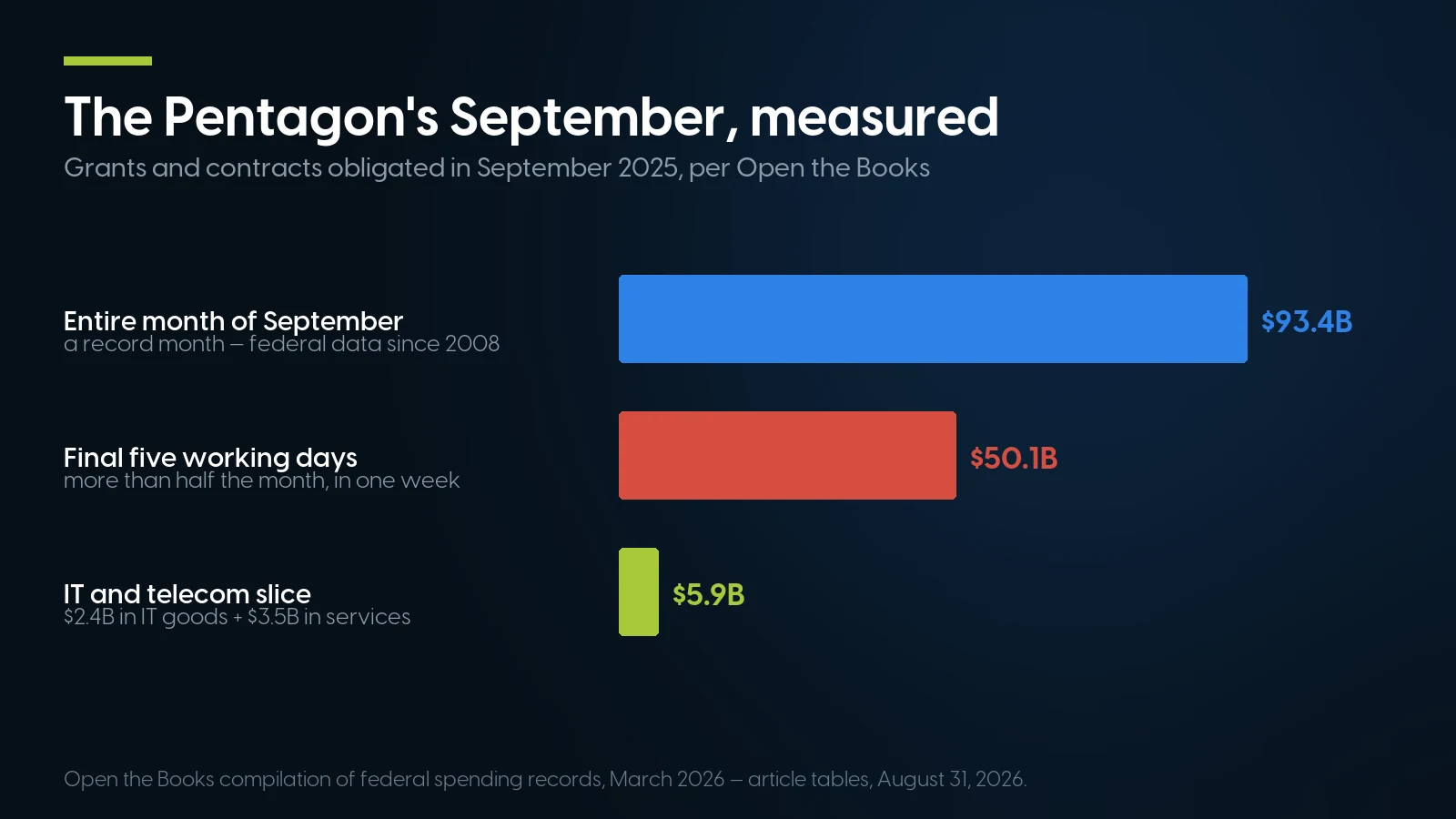
September 2025 at the Pentagon: a record $93.4B month, more than half of it committed in the final five working days, $5.9B of it IT and telecom. Source: Open the Books compilation of federal spending records; article tables, PCSP.
Carry one detail from that record September forward: alongside the $5.9 billion of IT and telecom sat $225.6 million of furniture, the most since 2014. When the alternative is handing money back, agencies buy what is purchasable. The rest of this piece is about making sure what is purchasable is also what you actually need.
“Obligated by September 30” Means Signed, Not Delivered — and Why 2026 Broke the Loophole
Start with the legal mechanics, because the whole month turns on one word. Under appropriations law, annual funds are “available for obligation only to fulfill a genuine or bona fide need of the period of availability” (31 U.S.C. § 1502), and an obligation is, in GAO's Red Book definition, “a definite commitment that creates a legal liability of the government for the payment of goods and services ordered or received.”
Translated out of fiscal law: the award or purchase order must be signed by September 30. Delivery and payment may happen later. A purchase-card micro-purchase obligates at the moment of purchase — at swipe. What the purchase must do is serve a genuine need of the fiscal year that is expiring, not a hypothetical need of the next one.
In any normal year, that distinction was the escape hatch. Sign the PO on September 29, let the OEM build the machine on its own schedule, receive it in November — perfectly proper. In 2026 that play has two structural problems, and neither is fixable with better paperwork:
- The quote dies before the PO clears. Lenovo voided all outstanding quotes effective January 1, 2026 — “all current quotations and prices will expire on January 1, 2026” — and reissued at higher prices. HPE cut quote validity to 14 days in the spring, stretched it to 30 in June, and only in August moved to holding quotes until shipment for deals up to $1 million (The Register, August 6, 2026). A quote that expires in 14–30 days does not survive most agencies' approval chains — and a dead quote is an obligation you cannot execute.
- The price moves between order and shipment. Dell vice chairman Jeff Clarke, on the record in late May 2026: “We're repricing, it feels like, every day. And I'm sure our customers feel that pain.” When the invoice arrives above the amount you obligated — out of an appropriation that expired ten weeks earlier — you have a conversation with your budget office that no discount was worth.
Hence the argument of this article. In 2026, the safe year-end purchase is the one where the price is fixed and the goods exist at the moment of obligation: hardware on a shelf, quoted at a number that does not move, shipped inside the week. That maps precisely onto the small-purchase pattern Valan found — a $1,199 median contract on September 30 is not an OEM configure-to-order build; it is somebody buying a thing that exists, on a card.
The New Thresholds: $15,000 on a Card, $350,000 Simplified
This September is the first fiscal year-end under new purchasing limits, and the change is material. Effective October 1, 2025, the FAR's inflation adjustment (final rule of August 27, 2025) raised the micro-purchase threshold from $10,000 to $15,000 and the simplified acquisition threshold from $250,000 to $350,000. Both numbers now sit in FAR 2.101. The micro-purchase exceptions run lower, not higher: $2,000 for construction, $2,500 for services subject to labor standards. IT hardware is supplies — the full $15,000 applies.
Around the threshold sit three rules worth quoting exactly, because they define what a September card purchase legally is:
- GSA SmartPay Smart Bulletin No. 002, echoing FAR 13.201(b): “The Governmentwide commercial purchase card shall be the preferred method to purchase and to pay for micro-purchases.” Not permitted — preferred. (Agencies may still set lower internal limits on individual cards, and many do.)
- FAR 13.203: “Micro-purchases may be awarded without soliciting competitive quotations” if the contracting officer — or an individual appointed under FAR 1.603-3(b), in practice the cardholder — “considers the price to be reasonable.” No quotes gathered, no competition run — a documented reasonable price is sufficient.
- The guardrails around it: the same section directs that micro-purchases “shall be distributed equitably among qualified suppliers” to the extent practicable, and FAR 13.003(c)(2) prohibits breaking one requirement into pieces to duck under the threshold. A $40,000 need is a simplified acquisition, not three swipes.
Now put the Valan median next to the new ceiling. The typical September 30 purchase is $1,199 — the card lane fits it twelve times over. And $15,000 buys dramatically different amounts of computing depending on where you point it: on a new-OEM order form it is less than one mid-range 2U server at current configurator pricing (our server cost guide walks the numbers); on the refurbished market it is a rack row. The exact arithmetic is two sections down.
Refurbished Hardware in Federal Purchasing, Honestly
We sell refurbished enterprise hardware, so treat this section as an interested party laying out the rules as written — with the two limitations stated as plainly as the permissions.
The FAR does not bar used equipment; it regulates disclosure. Under FAR Subpart 11.3, agencies “must not require virgin material… unless compelled by law or regulation or unless virgin material is vital for safety or meeting performance requirements of the contract.” For non-commercial buys, offerors must identify used, reconditioned or remanufactured supplies, which are used with contracting-officer authorization; for commercial products — which off-the-shelf servers and workstations are — the contracting officer may request that information “consistent with normal commercial practices.” Refurbished is a disclosed condition, not a prohibited one. A related door that surprises people: the Buy American restriction “does not apply to the acquisition of information technology that is a commercial product” (FAR 25.103(e)).
Limitation one: the GSA Schedule lane is closed. GSA retired the dedicated refurbished-IT Special Item Number (legacy SIN 132-9, briefly 33411REF) during the 2019–2020 consolidation of the Multiple Award Schedule. The stated reason was supply-chain provenance — in the words of GSA's Lawrence Hale at the time, “you can't guarantee the provenance of refurbished products”. That concern is legitimate, and the answer to it is not a workaround but documentation: serial numbers verifiable with the OEM, a written testing record, and a real warranty from the seller — the checks in our used-server buyer's guide exist precisely because provenance is the fair question. The practical consequence for a September buyer: the realistic federal path for refurbished hardware is an open-market micro-purchase (up to $15,000, on the card) or a simplified acquisition (up to $350,000) — not a Schedule order.
Limitation two: refurbished is not automatically TAA-compliant. The Trade Agreements Act governs GSA Schedule orders of any size (it is a contract-level requirement) and open-market supply contracts at or above $174,000, the WTO GPA threshold for CY2026–2027 (Federal Register, effective March 13, 2026). TAA origin turns on where the product was manufactured or “substantially transformed” — and repair, testing and repackaging generally do not qualify. A server assembled in China does not become TAA-compliant by being refurbished in Michigan, and we will not tell you otherwise. Below $174,000 and off Schedule — which is where the card lane and most simplified buys live — TAA is not the governing restriction; at or above it, check origin the way you would for any product, case by case.
The Lead-Time Math Against a Hard Deadline
Here is the supply-chain picture a September buyer is ordering into, each figure with its source and date:
- Enterprise DRAM lead times exceed 40 weeks, and memory-and-CPU supply gaps threatened third-quarter server shipments — Inventec, one of the major Taiwanese server ODMs, via DigiTimes, July 16, 2026.
- Memory components run “8 to 52 weeks depending on the product,” with standard DRAM modules often in the 30–40-plus-week range — VersaLogic supply-chain brief, updated August 5, 2026. IT reseller SHI had already tracked DRAM order lead times going from 25 weeks to 45-plus by December 2025.
- The prices behind the waits are still climbing. TrendForce forecasts server DRAM contract prices up another 13–18% in Q3 2026, with quarterly increases continuing through the second half of 2027; Gartner data cited by The Register puts contract DRAM up 90–95% quarter-over-quarter in the first half of 2026. HPE CEO Antonio Neri told investors in March that DRAM and NAND now make up “more than half of the materials cost” of a traditional server and that HPE expects elevated prices “to persist well into 2027.”
System-level lead times follow from the components. In our August deep-dive on server prices and lead times, the integrator-reported consensus was 6–10 weeks for standard non-GPU configurations — the best case — and 32–52 weeks for AI-configured systems, with configure-to-order builds on constrained memory tiers commonly stretching into multiple quarters. Now run the September arithmetic on the best case: a PO signed September 15 with an eight-week build ships in mid-November — legal, if the obligation is clean, but at a price the vendor may re-set in between (Dell's own words: repricing “every day”), against an appropriation that no longer exists to cover the difference.
Against that, the in-stock alternative is almost boring: the price on the quote is the price, the serial numbers already exist, obligation and shipment land in the same week. This is the rare year in which “ships from stock” is not a convenience feature but the difference between money spent and money returned.
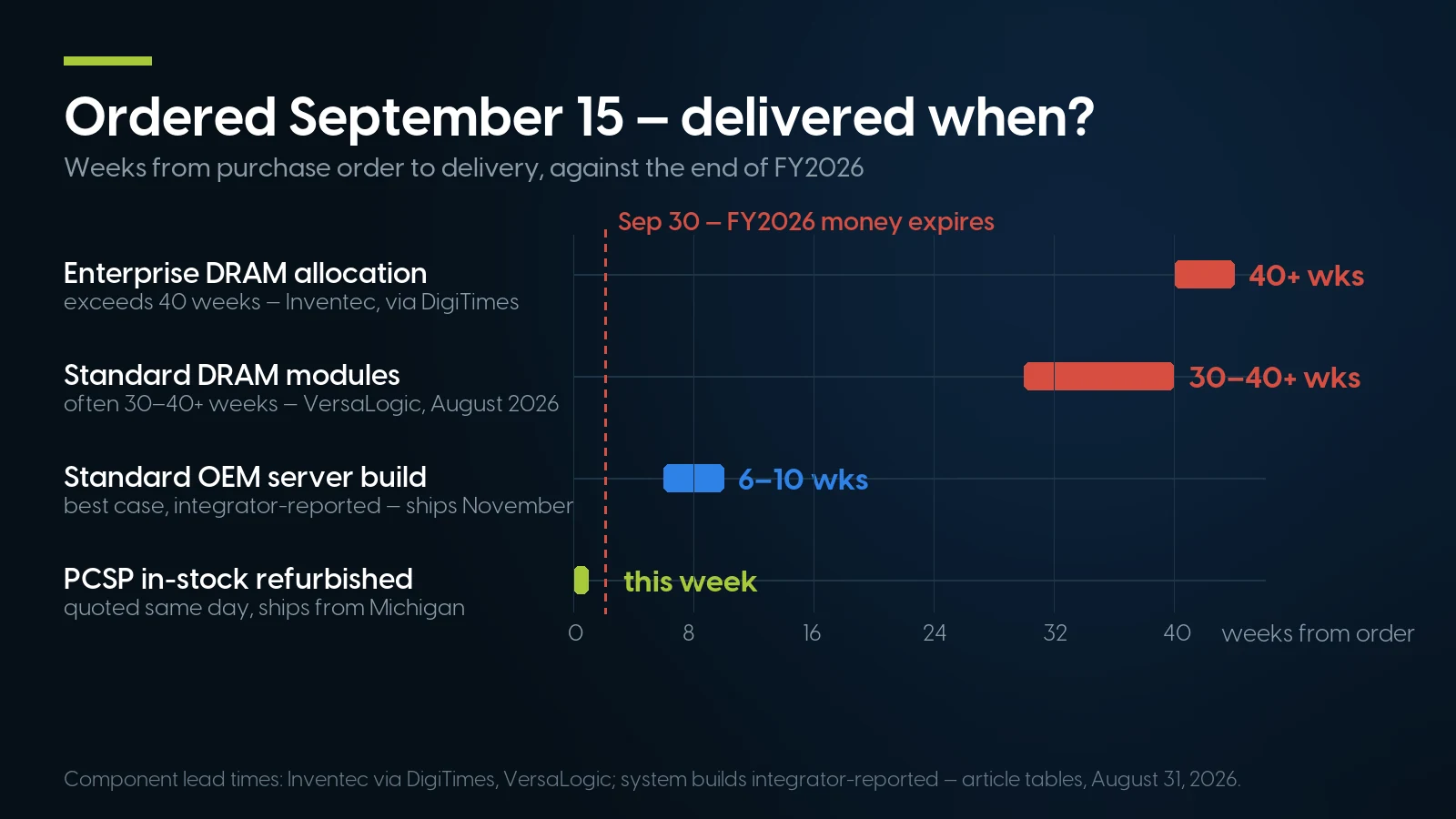
Order on September 15, and only one bar lands inside FY2026. Component lead times per Inventec (via DigiTimes) and VersaLogic; system builds integrator-reported. Source: article tables, August 2026, PCSP.
Get a quote that is still valid on September 30
Send us the spec and the ceiling you are working under — we quote same day, from live stock, with the quantity on hand and a price that does not move between quote and shipment. Free shipping anywhere in the US, from our Michigan warehouse.
Browse servers in stock Request a same-day quoteWhat Is Actually on the Shelf, Priced August 28, 2026
Everything in this section is live PCSP inventory, checked August 28, 2026 — models, from-prices and configuration counts, so you can sanity-check a September plan against hardware that exists rather than a catalog page. Depth first: 18 rack-server model categories hold in-stock, buy-now configurations — 251 configurations in total. The deepest:
Six more categories hold at least one in-stock configuration each — R740xd, R830, DL360 Gen9, DL360 Gen10 Plus, plus current-generation singles for shops whose policy requires them: a ProLiant DL360 Gen11 at $3,484.99 and a PowerEdge R650 at $2,884.90.
Now the table this whole article has been building toward — what one card swipe buys under the $15,000 micro-purchase ceiling, using ready-to-ship configurations and the quantity physically on the shelf:
Live BC inventory, checked August 28, 2026. One requirement split across swipes to stay under the ceiling is prohibited (FAR 13.003(c)(2)) — the multi-unit rows are one purchase each.
Workstations are the deepest shelf in the building — 668 in-stock configurations from $74.98 in the refurbished workstations catalog, which matters for the CAD seat, the lab bench and the video bay that also die with the fiscal year: HP Z4 G4 from $184.98 (91 configurations), Lenovo P520 from $134.98 (81), Dell Precision T5820 from $134.98 (75), HP Z840 from $354.99 (44), dual-socket Precision T7920 from $1,271.84 (43), HP Z2 G4 from $74.99 (33) — plus five more model lines behind them.
Components ship from the same shelf: DDR4 server memory from $33.96 across 91 in-stock listings (nearly 3,000 modules in the RAM catalog overall, from $14.99), hard drives from $12.58 (1,319 drives), SSDs from $17.99 (992 drives) — all checked August 28, 2026. For scale: five days earlier, Dell's own configurator was asking $9,958.78 for a single new 64 GB DDR5 module.
And the honest gaps, so you do not plan around hardware we do not have. Desktops are nearly sold out — 13 in-stock SKUs total, essentially the OptiPlex 5050 batch above and eight HP Z2 G9 tower configurations ($474.95–$1,618.42, seven units each); if you need a hundred desktops by the 30th, we are not your September answer. Tower servers — Dell T-series, HPE ML — are at zero in stock right now, and current-generation rack units exist as singles, not fleets. What we are deep in is exactly what the tables show: 13th–15th generation Dell, HPE Gen9/Gen10, Lenovo SR630, and workstations.
The Four-Week Plan: August 31 to September 30
September 30, 2026 is a Wednesday. Between publication and that midnight sit four working weeks, one of them shortened by Labor Day (Monday, September 7). Here is the sequence that survives contact with an approval chain — adjusted, always, to whatever your agency's own cut-off memo says.
One deliberate omission from that table: haggling. September is when every seller of anything runs a “year-end special.” The purchases that hold up are the ones specified in Week 1 against a real need, priced from stock, and documented — not the ones invented on the 28th because a discount appeared.
The Other Calendars: Schools Just Got Money, Corporate Is Next
September's demand is not one deadline; it is three budget calendars overlapping in the same month, pulling on the same finite pile of in-stock hardware.
Schools and states are spending fresh money, not dying money. Forty-six states begin their fiscal year on July 1 (NCSL), and most K-12 districts run the same July–June year, cutting their new-year purchase orders through July, August and September — education-sales trackers put the bulk of district purchasing in that summer window. So while federal buyers race an expiration, a district IT director is executing a budget that is eight weeks old — same month, opposite force, identical requirement: hardware that ships before the semester is over, whether that is a lab of workstations or the student-machine question in its own right. Texas, one of the four exceptions, starts its state fiscal year on September 1 — Texas agencies enter this month with the freshest money in the country.
Corporate calendar-year buyers get the same squeeze in December. Public data for the corporate “Q4 flush” is thin — nothing with federal-grade methodology exists, and we will not dress up marketing surveys as statistics. The mechanism is the one every budget owner knows: unspent line items do not roll over, and underspending this year invites a smaller number next. What 2026 adds is evidence the pull-forward is already happening: IBM's second-quarter revenue miss — reported at roughly $660 million below consensus — was attributed to enterprise clients redirecting late-quarter spend toward servers, storage and memory ahead of price increases. If your year ends December 31: the lead times do not care about your calendar, TrendForce has memory prices still rising through that quarter, and a December 20 purchase order meets the same empty OEM shelf a September 20 one did. Run the four-week plan in October.
When Spending the Money Is the Wrong Answer
An article urging you to spend a budget in four weeks owes you the case against doing it, and the case is strong enough to have its own literature.
Year-end spending really is lower quality, and IT is the worst offender. The Liebman–Mahoney study quoted earlier did not stop at the 4.9× spike; matching year-end purchases against a federal database of project quality ratings, it found that “IT projects that were procured in the last week of the fiscal year were between two and six times more likely to have a lower quality rating.” That is the strongest empirical criticism of everything this article describes, and it deserves a straight reading: rushed September buying produces bad outcomes often enough to measure. The mitigation is in the plan above — buy from a shortlist written in Week 1, buy standard configurations with warranties, and let anything that only exists as a late-September idea die on the vine.
If the need is not real, the purchase is not proper. The bona fide needs rule is not decoration: annual funds serve “a genuine or bona fide need of the period of availability.” Hardware bought against a workload, a refresh schedule or a documented backlog qualifies. A pallet of equipment bought purely so a number reaches zero does not — and a refurbished discount does not fix a fiscal-law problem. Some money should go back. If your honest inventory in Week 1 finds no need, that is the finding.
And sometimes the right purchase is new, on Schedule, at OEM prices. If the contract is TAA-governed — any Schedule order, or an open-market supply buy at $174,000 and up — country-of-origin rules apply to refurbished gear exactly as to new, and the compliant path may be a new TAA-eligible product. If your accreditation, insurer or program office mandates current-generation hardware with an unbroken OEM warranty chain and a named support SLA, that is a requirement, not a preference, and no percentage saving overrides it. And if the workload genuinely needs DDR5 bandwidth, PCIe Gen5 or this year's cores, the when-new-wins list from our pricing deep-dive applies in September as much as in March — you will simply be ordering into next fiscal year's delivery window, and should obligate accordingly.
Fiscal Year-End IT Buying: FAQ
What does “use it or lose it” mean in federal budgets?
Annual appropriations are available for obligation only during their fiscal year, which ends September 30; whatever is not obligated by then expires and returns. Because managers widely assume unspent money invites a smaller budget next year, agencies spend heavily in September — measurably: across FY2021–FY2025, $227 billion was obligated on September 30 alone, per a Valan analysis of USASpending data, and last-week spending runs 4.9 times the normal weekly average per NBER research.
Does hardware have to be delivered by September 30, or just ordered?
Just obligated — the award or purchase order signed, or the card purchase made, by September 30. GAO defines an obligation as a definite commitment creating a legal liability of the government; delivery and payment may occur later, so long as the purchase serves a genuine need of the expiring fiscal year. The 2026 catch is not delivery, it is pricing: OEM quotes now expire or get repriced between order and shipment, which is why in-stock hardware with a fixed price has become the safe way to obligate.
Can I buy refurbished servers with a government purchase card?
The FAR does not prohibit it. Refurbished IT is permitted with disclosure under FAR Subpart 11.3, and micro-purchases up to $15,000 “may be awarded without soliciting competitive quotations” if the price is considered reasonable (FAR 13.203), with the purchase card the government's preferred method. Your agency's internal card policy and single-purchase limit govern the specifics. Keep the dated quote, serial numbers and warranty terms in the file as your documentation.
What is the micro-purchase threshold for fiscal year 2026?
$15,000 for supplies, including IT hardware — raised from $10,000 effective October 1, 2025, by the FAR inflation adjustment, making this September the first fiscal year-end under the higher limit. The exceptions run lower: $2,000 for construction and $2,500 for services subject to labor standards. The simplified acquisition threshold rose from $250,000 to $350,000 on the same date. Both figures are in FAR 2.101.
Does the FAR allow refurbished IT equipment at all?
Yes. FAR Subpart 11.3 says agencies must not require virgin material unless compelled by law or regulation or unless it is vital for safety or performance. For non-commercial acquisitions, used or reconditioned supplies must be identified and authorized by the contracting officer; for commercial products such as off-the-shelf servers, the contracting officer may request that information consistent with normal commercial practices. Separately, the Buy American restriction does not apply to IT that is a commercial product, per FAR 25.103(e).
Is refurbished hardware TAA-compliant?
Not automatically, and be wary of anyone who says otherwise. TAA origin depends on where the product was manufactured or substantially transformed, and refurbishing — repair, testing, repackaging — generally does not change origin. TAA governs all GSA Schedule orders regardless of size and open-market supply contracts at or above $174,000 for 2026–2027. Below that threshold and off Schedule, where micro-purchases and most simplified buys live, TAA is not the governing restriction.
Why isn't refurbished IT equipment on GSA Schedule anymore?
GSA retired the dedicated refurbished-equipment Special Item Number (legacy SIN 132-9 / 33411REF) during the 2019–2020 Multiple Award Schedule consolidation, citing supply-chain provenance — the concern that the origin and history of refurbished units could not be guaranteed. That leaves open-market purchasing — the $15,000 card lane and the $350,000 simplified lane — as the realistic federal path for refurbished hardware, backed by seller documentation: verifiable serials, testing records and warranty.
Can OEM hardware ordered in September even ship this fiscal year?
Often not, and pricing is the bigger risk than the calendar. Enterprise DRAM lead times exceed 40 weeks per Inventec via DigiTimes, standard DRAM modules often run 30–40-plus weeks per VersaLogic, and integrator-reported system lead times start at 6–10 weeks for standard builds — so a mid-September order ships in November at the earliest, and configure-to-order builds on constrained memory commonly stretch into quarters. Meanwhile Dell describes repricing effectively daily, so the invoice may not match the number you obligated. In-stock hardware avoids both problems.
Do schools and school districts face the same September 30 deadline?
Mostly no. Forty-six states begin their fiscal year on July 1, and most K-12 districts run the same July–June calendar — so in September a district is spending fresh money and cutting new-year purchase orders, not racing an expiration. The September 30 deadline applies to federal money, including federal funds passed through to states and schools under their own program rules. Texas is the notable exception among states: its fiscal year starts September 1.
What if my company's fiscal year ends December 31?
The same mechanics arrive in Q4 without the FAR: unspent budgets do not roll over, and the 2026 supply chain does not care about your calendar. Memory prices are forecast by TrendForce to keep rising through 2027, and IBM's Q2 revenue miss was reportedly driven by enterprise clients pulling hardware spend forward ahead of price increases. The practical advice compresses to one line: run the four-week plan in October, not December — a December 20 purchase order meets the same empty OEM shelf a September 20 one did. A calendar-year buyer has a second December deadline on top of the shelf: Section 179 and bonus depreciation need the machine placed in service by the 31st, not merely ordered.
Four weeks is enough — when the hardware already exists
Send the shortlist — models, specs, quantities, and the ceiling you are buying under. You get a same-day quote from live stock with a fixed price and this week's ship date, so the obligation you sign matches the invoice that arrives.
Servers in stock Workstations in stockThe Bottom Line
The September rush is real, measured, and older than anyone reading this — $227 billion obligated on the year's final day across five years, a third of contract obligations in sixteen days, a Pentagon month of $93.4 billion. None of that is new. What is new in 2026 is that the traditional escape hatch — sign late, take delivery whenever — assumed OEM quotes that held still and build queues measured in weeks. This year the quotes reprice daily and the memory inside the machines is allocated forty-plus weeks out.
So the playbook inverts. The purchases that actually convert an expiring budget into working equipment are the unglamorous ones: standard configurations that exist on a shelf, quoted at a fixed price, obligated cleanly — on the card up to $15,000, through simplified acquisition up to $350,000 — and shipped while the fiscal year that paid for them is still alive. The purchases that fail are the exotic ones invented in the last week, which the quality research says go bad two to six times more often, and the configure-to-order builds whose invoice arrives months after the appropriation that was supposed to cover it has expired.
Find the cut-off memo. Write the shortlist. Quote everything this week. And if part of the honest answer is that the money has no genuine need behind it — send that part back, and spend the rest on hardware that ships.