

When Will RAM Prices Go Down? Why They Are So High in 2026
Posted by Konstantin Protasov, PCSP on Nov 2nd 2026
It depends which RAM, and the answer splits. On October 30, 2026, the open-market spot price of a branded 16Gb DDR4 chip was $82.80 on DRAMeXchange, TrendForce’s price service: 11% below its September 4 peak. Desktop DDR4 kits have cost about the same since February. Almost everything else is still rising, only more slowly. TrendForce, a market-research firm, expects fourth-quarter contract prices for conventional DRAM to rise 10–15% after 13–18% in the third quarter; DDR5 chip spot is up 13% since September 2; and used DDR4 server modules kept getting dearer: one reseller’s 32 GB DDR4-3200 module costs 60% more than in January, and we raised a third of our DDR4 listings on October 20. No memory maker forecasts a fall.
We sell used DDR4 server memory, so read the last sections with that in mind. Every price below names its source and date, our own catalog is quoted as of November 1, 2026, and one section is about when new DDR5, or waiting, is the better buy. Why DDR4 and DDR5 differ per gigabyte is the subject of our DDR4 vs DDR5 price guide; this one is about direction and timing.
The short version, checked November 1, 2026:
- Contract prices are still rising, more slowly. TrendForce’s chain for conventional DRAM: +58–63% in the second quarter (July 3 table), +13–18% estimated for the third, +10–15% forecast for the fourth. Micron said on its September 30 call that its average DRAM price, HBM included, rose by a “high-teens percentage” last quarter, with “a more moderate rate of price increases” ahead.
- Branded 16Gb DDR4 chips and desktop DDR4 kits have plateaued. Branded DDR4 16Gb spot: $93.50 on September 4, $82.80 on October 30; the 8Gb chip still edged up, to $46.86. PCPartPicker’s average for a 2×16 GB DDR4-3200 kit has hovered near $290 since February.
- DDR5 is still climbing. DDR5 16Gb chip spot went from $54.25 to $61.50 between September 2 and October 30; PCPartPicker’s 2×16 GB DDR5-6000 average from about $580 in August to about $650.
- Used DDR4 server memory has not eased. TechMikeNY, a refurbished-server and parts reseller, priced a 32 GB DDR4-3200 RDIMM at $249.95 on January 23 and $399.95 on November 1. On October 20 we raised 30 of our 94 DDR4 listings by 14–30%; DDR4-3200 stayed at $11.75 per gigabyte.
- When prices fall, nobody who would know says. Micron: supply “much tighter in calendar 2027 and 2028.” SK hynix: demand above supply “through 2030.” TrendForce: substantial new output not before 2028. The new fabs with dates start in 2027, Micron’s first in mid-2027.
- What we sell, and what we do not. Our DDR4 server memory is priced by speed grade, from $7.00 per gigabyte for DDR4-2400 to $11.75 for DDR4-3200 (November 1). We sell no DDR5, no SODIMM and nothing above 64 GB per module.
RAM Price Chart, 2025–2026: One Spot Table, Read on 28 Dates
DRAMeXchange prints a “DRAM Spot Price” table on its homepage: the average price per chip in each day’s trading session, with the page’s own “Last Update” date. The Internet Archive holds captures of that page through 2025 and 2026. We read 28 dated versions, from December 31, 2024 to the live page of October 30, 2026, and kept the same three rows throughout.
DRAMeXchange (TrendForce) homepage, DRAM spot table, session average in US dollars per chip, by the page’s own update date (GMT+8); Internet Archive captures from January 1, 2025 to October 31, 2026 and the live page read November 1, 2026. Twelve of the 28 dates shown. Row names are unchanged throughout; the page added separate lower-grade “eTT” rows in December 2025.
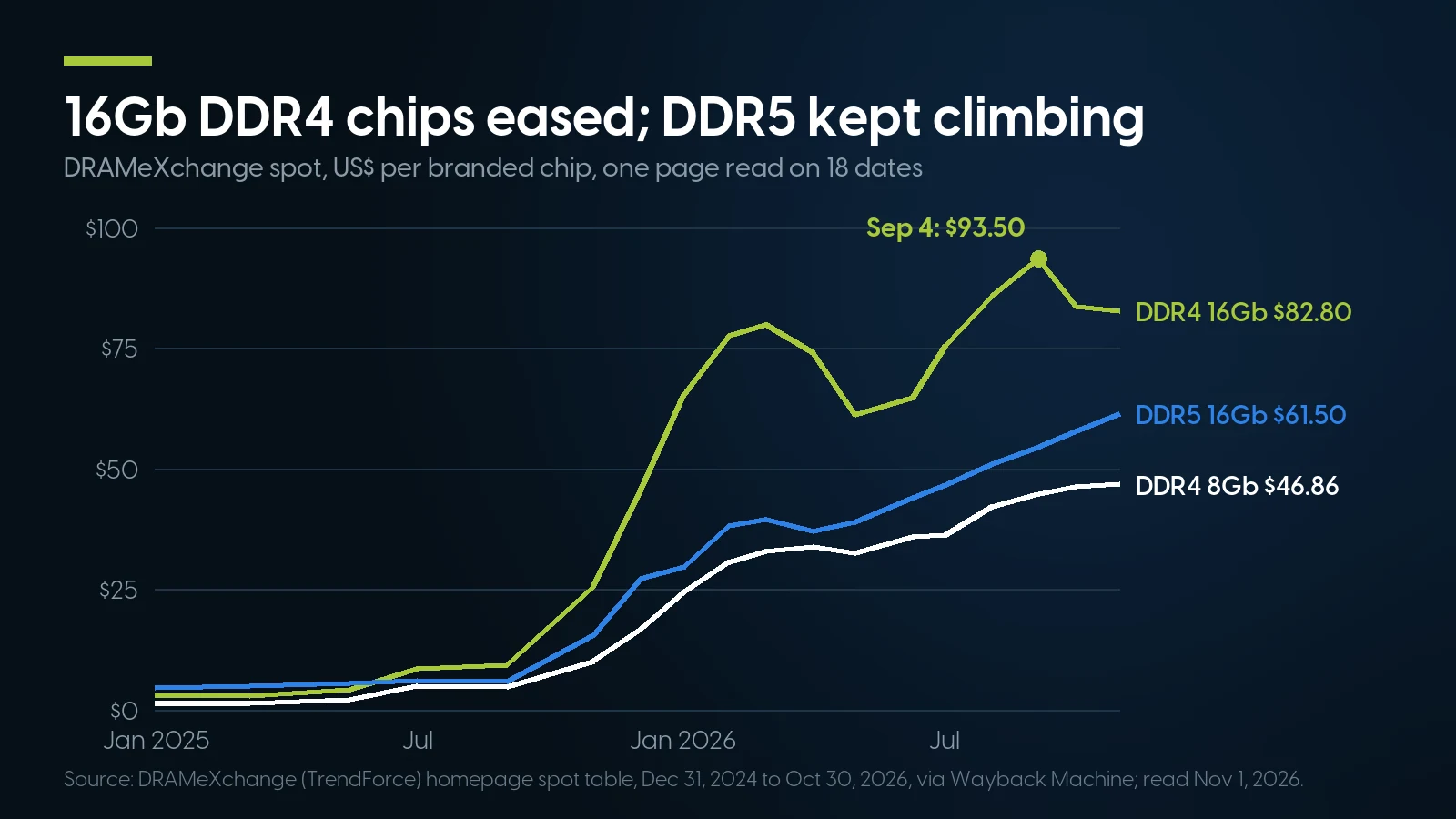
Branded 16Gb DDR4 chips peaked at $93.50 on September 4, 2026 and stood at $82.80 on October 30; the 8Gb DDR4 chip ($46.86) and the 16Gb DDR5 chip ($61.50) kept rising. DRAMeXchange spot table, session average in US$ per chip, 18 of the 28 page dates; these are chip prices, not module prices.
What spot is. The price at which chips change hands that day between dealers and module makers in the open market. In TrendForce’s weekly spot reports the buyers are module makers: on October 21, “downstream module houses are strictly controlling capital and inventory, limiting actual order releases.” Nobody is bound to buy at it, which is why it can fall while contract prices still rise.
What spot is not. It is not the contract price that PC makers, server makers and cloud companies pay under quarterly and long-term deals (see “four prices” below), and it is not the price of a stick. A 16Gb chip holds 2 GB, but never multiply it into a module: the same page priced a finished 16 GB DDR4 desktop module (UDIMM) at $164.20 on October 26, far below eight branded chips. The headline DDR4 row is branded chips in a thin market, with a daily high of $116.00 and a low of $45.60 on October 30, and the page prints a cheaper, lower-grade “eTT” row beside it ($13.70). Which chips the module row assumes, DRAMeXchange does not say.
What the series shows. DDR4 moved first. Its 16Gb chip doubled between May 15 and July 1, 2025, while DDR5 rose about 10%; TrendForce later wrote (September 22, 2026) that module makers built up DDR4 chip stocks in the second quarter of 2025, “spurred by tariffs and the end-of-life (EOL) plans of DRAM suppliers for DDR4.” Then everything exploded: from October 2, 2025 to February 27, 2026 the DDR4 16Gb chip rose 5.8 times and DDR5 4.9 times. DDR4 fell back 23% by April 30, climbed again to a peak of $93.50 on September 4 in the daily captures, and has eased since. DDR5 dipped about 6% by April 1 and kept climbing. Over the whole period, the DDR4 16Gb chip rose about 26 times and DDR5 about 13 times, and a branded DDR4 chip now costs 1.35 times a DDR5 chip of the same density (our arithmetic).
The module table tells the server side. Its DDR4 RDIMM 16 GB row, the registered server stick, went from $44.50 in December 2024 to $160.00 on October 20, 2025, then was dropped from the page. The DDR5 RDIMM 32 GB row that replaced it went from $395.00 on November 24, 2025 to $2,165.00 on October 26, 2026, 5.5 times, though it barely moved in October.
Why Did RAM Prices Go Up? AI Servers, in the Makers’ Own Words
Sort the explanations by who is speaking. What the memory makers said in their own results is evidence; an analyst’s estimate is a forecast; a newspaper’s sources are a report.
The makers name servers and AI. Samsung’s third-quarter release of October 29, 2026: “Strong demand momentum for servers led to higher market prices across all applications.” SK hynix’s, a day earlier: prices of key products “have risen on the back of growing demand for AI memory,” with DRAM results “driven by a significant increase in sales of server DDR5 while HBM4 shipments began in earnest.” Micron, announcing on December 3, 2025 that it would leave the Crucial consumer business: “The AI-driven growth in the data center has led to a surge in demand for memory and storage.”
AI memory and ordinary memory come off the same wafers. HBM, the stacked memory on AI accelerators, is made from DRAM wafers too. TrendForce wrote on September 29 that AI server demand is “keeping HBM and conventional DRAM in competition for limited advanced-process and wafer capacity.” How much capacity HBM takes is an estimate: a Samsung executive put it at about 20% of the industry’s wafer capacity now and nearly 30% next year, as relayed by Reuters and TrendForce News on September 29. Press reports put an HBM gigabyte at three or four times the wafer area of ordinary DRAM; the multiplier is not settled, so we print neither as fact.
Servers get first call on what is left. TrendForce’s September 30 outlook says suppliers “continue to prioritize advanced-process capacity for high-performance server products,” that cloud companies and server makers are buying more “to meet growing RDIMM demand for general servers supporting agentic AI workloads,” and that “Server DRAM is therefore expected to remain undersupplied in 4Q26.” Making more is a construction problem: Micron said on September 30 that “clean-room additions are required to augment node-transition supply growth” — new factory floor, the first of Micron’s producing from mid-2027 (see “who says what” below).
It is not a tariff on memory. Tariff fears helped the 2025 DDR4 stock-building TrendForce describes above, but by our reading of their texts neither the January 2026 Section 232 chip tariff nor the July Section 301 duties applies to memory modules or DRAM chips; our GPU price report sets out the texts.
DDR4 end of life: who announced what, and when
Micron is the only maker whose DDR4 notice we found in its own words. On its June 25, 2025 call, CEO Sanjay Mehrotra said Micron had sent end-of-life notices for DDR4 and LPDDR4 to customers “in high-volume segments like mobile, client, data center, and consumer, several months ago with final shipments occurring in two to three quarters from now” — that is, by early 2026 — while still supplying automotive, industrial, defense and networking customers. “We are now on allocation for these products,” he added.
For Samsung, a customer, Advantech, relayed in 2025 that Samsung “has issued End-of-Life (EOL) notifications for DDR4 ICs in certain market segments.” The dates in circulation for Samsung (orders until June 2025, shipments until mid-December) and SK hynix (orders until October 2025, shipments until April 2026) come from a Taiwanese newspaper, Commercial Times, relayed by TrendForce News on July 9, 2025; neither company published them in anything we found. And the plans bent: TrendForce wrote on July 7, 2025 that “surging DDR4 demand in Q2 has prompted some to postpone their EOL timelines.”
What remains is a smaller supply from Taiwan. TrendForce says the consumer DRAM market, where legacy DDR4 now sits, is “heavily reliant on Taiwanese suppliers” (September 30), and its September 7 release names Nanya, Winbond and PSMC as serving demand the three majors “can no longer fully serve.” The newest DDR4 we found is Winbond’s: an 8Gb chip on a 16nm process, launched December 3, 2025 “for long-lifecycle industrial and embedded applications,” with a 16Gb version in development; Commercial Times, relayed by TrendForce News in October 2025, reported its Kaohsiung fab expanding DDR4 supply. None of the three majors announced new DDR4 capacity. Which servers take which DDR4 modules is in our refurbished DDR4 server memory report.
Contract, Spot, Retail, Used: Four Prices for One Stick of RAM
“RAM prices” means at least four different numbers, quoted by different sources for different buyers. Before setting one against another, check which it is.
TrendForce and Micron as linked above; DRAMeXchange homepage; Newegg product page, October 10 as printed in our DDR4 vs DDR5 guide; PCPartPicker memory price trends; TechMikeNY storefront and Internet Archive capture, and PCSP storefront, read November 1, 2026; Dell R760 configurator pages (base model, from $22,799.02; dual-socket build, from $55,830.30), which describe their prices as “Dell’s pricing for online purchases only.”
Long-term contracts are often banded, not free-floating. Micron said on September 30 that three quarters of the revenue it expects from its long-term “Strategic Customer Agreements” has a defined pricing framework, a majority of it with “pricing bands with floor and ceiling prices”; SK hynix describes its long-term agreements with 14 customers as “a mechanism that reflects market conditions within a price range agreed upon with customers.” TrendForce adds that for some suppliers, increases will “lag the market average due to pricing mechanisms stipulated in long-term agreements.” So a contract percentage says little about what a buyer without a contract pays, and nothing about a retail stick: never apply TrendForce’s +10–15% to the price of a kit.
Even inside one row the range is wide: Dell lists one new 16 GB DDR5 module for its R760 server at $3,175.73 on one configuration page and $6,210.00 on another.
Are RAM Prices Going Down Yet? Branded 16Gb DDR4 Chips, and Little Else
Where prices eased. The branded DDR4 16Gb chip fell from $93.25 on September 7 to $83.78 on September 24 in DRAMeXchange’s daily captures, then went sideways: $83.69 on September 30, $82.80 on October 30. TrendForce’s weekly spot report, as relayed by TrendForce News on September 23: “Spot prices of DDR4 2Gx8 branded chips have corrected downward noticeably, yet no clear buying interest has emerged in the market.” Desktop DDR4 kits stopped rising earlier: PCPartPicker’s 2×16 GB DDR4-3200 average reached about $290 in February and has stayed between about $275 and $295 since (read off its chart, to within $10–20). One used-memory tracker ticked down too: DatacenterDisk, which follows Amazon offers, put the median DDR4 ECC server module at $8.91 per gigabyte on November 1, against the $9.17 our DDR4 vs DDR5 guide printed on October 10. Those are asking prices, new and refurbished mixed.
Where they did not. The DDR4 8Gb chip, which TrendForce calls the “mainstream” one, set new highs in October, if slowly: up 0.55% to $47.04 in the week of October 27, per the October 28 report. The cheaper eTT grade of the DDR4 16Gb chip rose from $11.30 on August 24 to $13.70, and DDR5 16Gb eTT by 26% over the same weeks. Branded DDR5 rose 6.2% in October alone; TrendForce’s October 21 report: “For DDR5, supply remains tight and suppliers are clearly reluctant to sell.” On contracts, TrendForce expects even consumer DRAM prices “to continue rising—albeit at a slower pace.” In stores, the Corsair 32 GB DDR4-3200 kit above went up 4.0% in three weeks, and PCPartPicker’s 2×32 GB DDR5-6000 average from about $1,330 in September to about $1,420 in late October.
Used server DDR4 kept rising. The Internet Archive holds TechMikeNY’s product pages from earlier in the year: its 16 GB DDR4-2666 RDIMM was $104.95 on February 7 and is $139.95 on November 1 (+33%); its 32 GB DDR4-3200 RDIMM went from $249.95 on January 23 to $399.95 (+60%). Our own 16 GB DDR4-2666 RDIMM went from $107.99 to $127.99 on October 20. Retired servers, not fabs, supply this market, and we found no source that forecasts it.
So the honest answer is “some, at the chip level.” Spot is where a buyer can walk away first; since early September that has happened clearly only for the branded 16Gb DDR4 chip, and what server and PC buyers pay has been flat at best.
When Will RAM Prices Go Down? Who Says What
Nobody with first-hand knowledge has given a date, and the three companies that make most of the world’s DRAM all expect the shortage to last through 2027; Micron and Samsung say it gets tighter first.
Micron call transcript, SK hynix and Samsung results releases and TrendForce’s July 30 release as linked earlier in this article; TrendForce August 25 release and Notebookcheck as linked in the table.
Bernstein’s is the only named forecast of an actual fall we found, and it reaches us through a news site quoting a post on X, from one bank, for a series whose definition we cannot see. Read it as one opinion, not a consensus.
New capacity, with the makers’ own dates
From Micron’s September 30 call: HBM packaging in Singapore with “initial output expected in early calendar 2027”; the first Idaho fab, ID1, “on track to commence wafer output in mid-calendar 2027”; meaningful shipments from Tongluo, Taiwan, in mid-2027; a Japan expansion and the second Idaho fab in late 2028; New York in 2030. Micron’s own caveat: “Production from new DRAM and NAND fabrication facilities takes time to ramp and gradually becomes more meaningful starting a few quarters after initial output.” SK hynix says it will ramp its M15X fab “to maximum capacity by the end of the year to increase HBM4 production” and that its Yongin Phase 1 site enters full-scale operation next year. Samsung’s release names no new memory fab and no dates; it puts 2026 capital spending at about KRW 84.4 trillion, KRW 76.8 trillion of it in the chip division, invested “for new fabs and other infrastructure.” None of the three describes any of it as DDR4 capacity.
What would have to happen
This is our reasoning, not a forecast. AI spending would have to slow: so far the opposite, as TrendForce raised its forecast for 2027 capital-spending growth at nine leading cloud companies from 50% to 60% on October 14. Buyers would have to walk away: Micron expects “potential double-digit overall unit declines” in PCs and phones this year, and memory per server is growing more slowly than it expected: “a modestly lower rate of content growth than prior expectations amid tight memory supply.” Branded 16Gb DDR4 spot is what that looks like at the chip level. New fabs would have to ramp, which by the makers’ dates starts in 2027 and, by TrendForce’s estimate, means 2028 for volume.
What nobody knows
- When supply catches up with demand. Micron says it has no line of sight.
- Whether any quarter before 2028 brings a contract price cut. No maker and no analyst release we read forecasts one.
- Where used DDR4 server memory goes. It depends on how many servers are retired and resold, and no source forecasts that.
If you read a confident “RAM prices will fall in 2027,” check who said it and in which document.
What Used DDR4 Server Memory Costs Now: Our Shelf, Honestly
As of November 1, 2026, our DDR4 server memory category holds 94 purchasable listings, all priced, from $27.99 for a 4 GB module. Fifty-five of them are lots and kits, most re-selling the same stock as the single modules, so their unit counts overlap; below we name listings and the depth of each instead of adding them up. Our price list is set mostly by speed, not capacity: every DDR4-3200 RDIMM costs $11.75 per gigabyte, whether it holds 8, 16 or 32 GB.
PCSP catalog. September 20 as printed in our server RAM sizing guide; October 12 to November 1 from our own listing-price history. Dollars per gigabyte = price ÷ capacity.
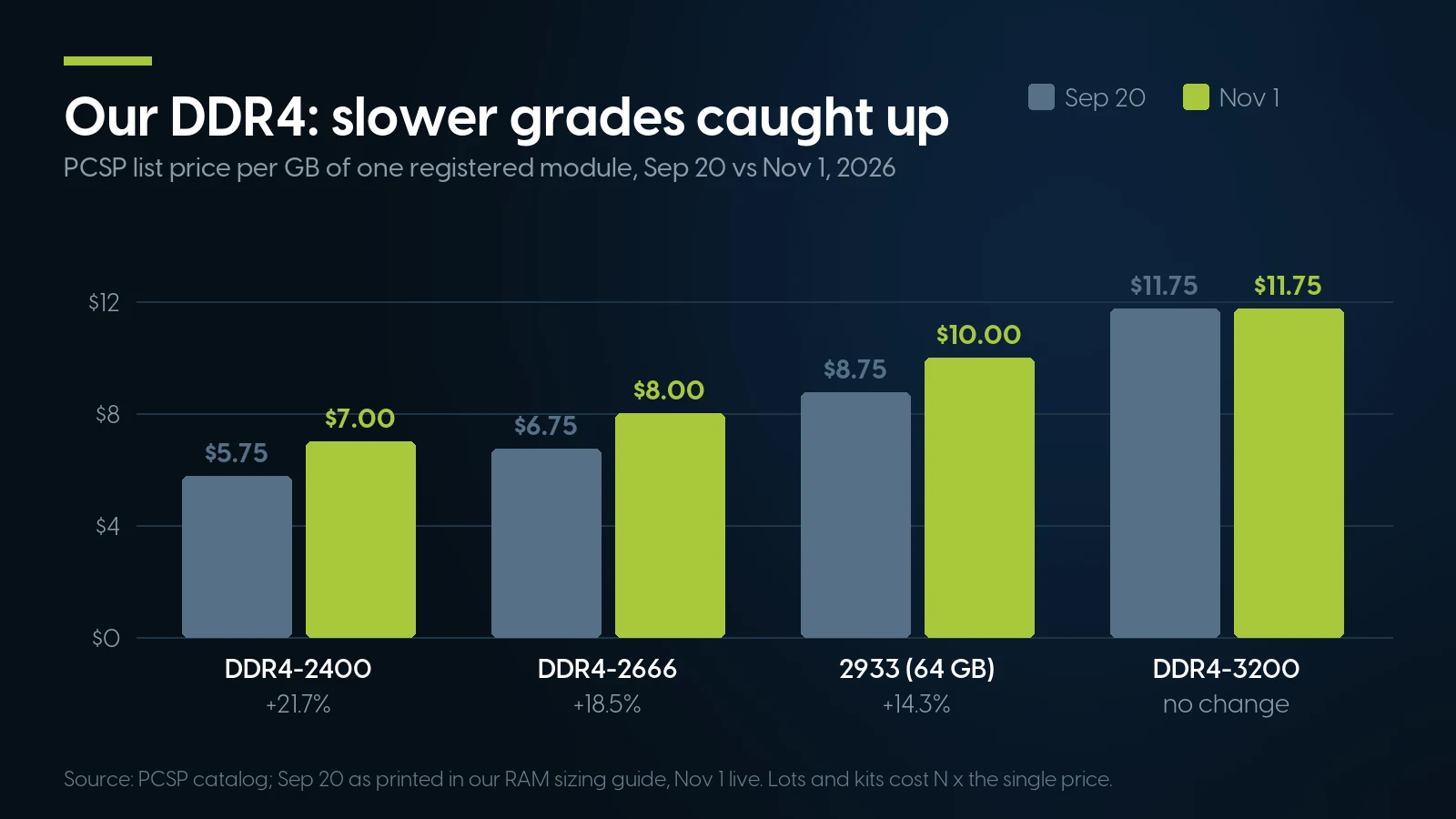
On October 20 our slower DDR4 grades caught up with DDR4-3200, which stayed at $11.75 per gigabyte: DDR4-2400 +21.7%, DDR4-2666 +18.5%, the 64 GB DDR4-2933 module +14.3%. PCSP list prices, September 20 as printed in our RAM sizing guide and November 1, 2026.
We repriced on October 20, upward. Between October 12 and November 1, 32 of the 94 listings changed price and all 32 went up: 30 on October 20, by 14–30%, and two ECC UDIMMs on October 30. None went down, and DDR4-3200 did not move. The slow grades caught up with the fast one: in September a gigabyte of DDR4-3200 cost 2.04 times a gigabyte of DDR4-2400; on November 1, 1.68 times. The 64 GB build our sizing guide priced on September 20, four 16 GB DDR4-2666 modules for $431.96, costs $511.96 today.
How deep the shelf is. The deep listings are 16 GB DDR4-3200: a Micron module (MTA18ASF2G72PDZ-3G2) with 254 units, an SK hynix (HMA82GR7DJR8N-XN) with 165, and four more with 71, 44, 14 and 6. In 32 GB DDR4-3200 one listing is deep, the SK hynix HMA84GR7CJR4N-XN with 64 units; the other four hold 12, 8, 1 and 1. A “Lot of 4” costs exactly four singles — $751.96 for four 16 GB DDR4-3200 modules — so a lot buys availability, not a discount; for volume, ask through our wholesale server memory page.
What we do not have. No DDR5 at all, no SODIMM, and nothing above 64 GB per module, with only three 64 GB listings (3 units, 6 units and one without a stock count). LRDIMMs and ECC UDIMMs are a handful of listings each; which type your machine takes is in our ECC RAM guide. Of 573 visible DDR4 listings, 479 are out of stock.
Registered DDR4, priced by speed grade
16 GB DDR4-3200 RDIMMs, the grade we stock deepest. The Micron 16 GB PC4-3200AA-R (MTA18ASF2G72PDZ-3G2): From $187.99 · 254 in stock, refreshed nightly. Memory bought on its own carries a 90-day warranty; orders ship within 1–2 business days.
See this module Browse DDR4 server memoryWhen New DDR5, or Waiting, Is the Right Call
We sell used DDR4, so here is where it loses.
A DDR5 machine. A DDR4 module does not fit a DDR5 slot: the key notch sits in a different place. Dell’s R760 configurator, for one, offers only DDR5 RDIMMs, at 5600 and 6400 MT/s. If your server or desktop is DDR5, nothing on our shelf applies: you are paying DDR5 prices, and the only question is when.
A warranty on the module itself. Kingston’s warranty page gives its memory modules, ValueRAM, Kingston FURY and Server Premier among them, a “Product Lifetime Warranty,” subject to definitions that differ by country, and not for a module sold second-hand. Micron said it “will provide continued warranty service and support for Crucial products” after leaving the consumer business; Crucial’s warranty page gives Crucial memory a limited lifetime warranty, which does not apply to modules bought from unauthorized third-party resellers. A module bought from us on its own carries 90 days.
More than 64 GB per module, or one part number across a fleet. We have nothing above 64 GB per module and only three 64 GB listings. Our deepest 32 GB DDR4-3200 listing holds 64 modules; if a validation plan or a support contract demands one part number in more slots than that, buy matched memory from the server’s maker.
Speed the host cannot use. A Xeon E5 v4 runs memory at 2400 at most: Intel lists the E5-2650 v4 at 2400 and the E5-2620 v4 at 2133. A DDR4-3200 module in one is at best a DDR4-2400 module that cost 1.68 times as much per gigabyte on November 1.
Waiting, when there is no deadline. With a working machine and no date to meet, waiting is reasonable, but it is a bet, not a plan. On DDR4 desktop kits it has cost nothing since February, and branded 16Gb DDR4 chip spot is easing. On DDR5 it has cost money: PCPartPicker’s 2×16 GB DDR5-6000 average rose about 12% from August to late October. Nobody on record says when waiting pays. If the work starts now, buy now, and buy only the capacity it needs.
Where we win: registered DDR4 for the Dell, HPE and Lenovo servers and the workstations that take it, at a price per gigabyte set by speed grade, with 90-day returns — and inside a configured system, our one-year warranty covering parts, labor and shipping, extendable up to five years.
DDR4 server memory and the machines that take it, on our shelf today
Lowest listed price in each category and what is on the shelf right now — barebones chassis included, so a complete build costs more than the figure shown. This block is the one part of the article that refreshes itself; every price in the text above is dated where it stands.
- DDR4 server memoryRegistered ECC, priced by speed grade; floor is a 4 GB moduleFrom $27.99 · 85 in stock
- Dell PowerEdge R6401U, DDR4 RDIMM · floor is a build-your-own baseFrom $487.68 · 134 in stock
- Dell PowerEdge R7402U, DDR4 RDIMM · floor is a build-your-own baseFrom $291.99 · 89 in stock
- HPE ProLiant DL380 Gen102U, DDR4 RDIMM · floor is a build-your-own baseFrom $303.74 · 63 in stock
- Dell Precision T5820Xeon W tower, DDR4 RDIMM · floor is a build-your-own baseFrom $134.98 · 38 in stock
- Lenovo ThinkStation P520Xeon W tower, DDR4 RDIMM · floor is a build-your-own baseFrom $159.98 · 66 in stock
Tell us the server and the capacity you need
We will match the modules to the processor’s memory speed and the slots, and say so when the answer is DDR5. Orders ship within 1–2 business days.
Ask for a quote All server memoryThe Bottom Line
RAM prices went up because AI servers want more memory than the makers can produce, and in late 2026 most of them are still going up, more slowly: contract prices by a forecast 10–15% in the fourth quarter, DDR5 chips by 13% since early September. The exceptions are the branded 16Gb DDR4 chip, 11% off its September 4 spot peak, and desktop DDR4 kits, flat since February. Used DDR4 server modules did not follow; they kept rising through October, including ours. No maker forecasts a fall, and the new factories with dates start in 2027.
If your machine takes DDR4, buy the speed its processor runs and only the capacity the work needs; our server RAM & memory category prices it by speed grade. If it takes DDR5, or you want a lifetime warranty on the module, buy new — and we would rather say so than sell the wrong stick.
RAM Prices in 2026: Frequently Asked Questions
When will RAM prices go down?
No memory maker and no analyst release we read gives a date. Micron said on September 30, 2026 that supply will be much tighter in 2027 and 2028 and that it has no line of sight to balance; SK hynix expects demand to exceed supply through 2030; TrendForce expects substantial new output only in 2028. The one named forecast of a fall, Bernstein’s for 2028, is reported second-hand.
Why are RAM prices so high?
AI servers want more memory than the makers can produce. Samsung said on October 29, 2026 that strong server demand led to higher market prices across all applications; HBM for AI accelerators competes with ordinary DRAM for the same wafers; and new factory space with dates arrives from 2027. The three biggest makers have also been winding down DDR4, leaving a smaller supply of it.
Are RAM prices going down yet?
Only in places. The branded DDR4 16Gb chip on DRAMeXchange’s spot table fell 11% from its September 4 peak to $82.80 on October 30, 2026, and desktop DDR4 kits have been flat since February. DDR5 chip spot rose 13% from September 2 to October 30, TrendForce forecasts contract prices up 10–15% in the fourth quarter, and used DDR4 server modules kept rising.
Will RAM prices go down in 2027?
No maker says so. Samsung expects 2027 AI-driven demand to far exceed industry supply, Micron expects tighter conditions in 2027 and 2028, and TrendForce expects contract prices to stay broadly elevated in 2027. The new fabs with dates start output during 2027, Micron’s first in mid-2027, and Micron says new output becomes meaningful only a few quarters after it starts.
Is DDR4 RAM being discontinued?
By the three largest makers, largely yes. Micron said in June 2025 that it had sent end-of-life notices to high-volume customers, with final shipments two to three quarters later, while still supplying automotive, industrial, defense and networking customers. Samsung’s notice was relayed by a customer and SK hynix’s dates are press reports. Taiwanese makers such as Nanya and Winbond still serve DDR4 demand, and used modules come from retired servers.
What is the difference between contract and spot RAM prices?
Contract prices are negotiated between memory makers and large buyers such as PC makers, server makers and cloud companies, quarterly or under long-term agreements, often with price bands; TrendForce’s public releases forecast their change in percent, not in dollars. Spot prices are what chips and modules trade for that day in the open market, mostly among dealers and module makers. Neither is the price of a retail kit or a used server module.
Should I buy RAM now or wait?
If the work starts now, buy now, and only the capacity it needs. Waiting has cost DDR5 buyers about 12% since August on PCPartPicker’s averages and has saved DDR4 desktop buyers nothing since February. Used DDR4 server modules kept rising: our 16 GB DDR4-2666 RDIMM went from $107.99 to $127.99 on October 20, 2026. Nobody on record says when waiting will pay.