


Hyper-V vs Proxmox vs ESXi: What Licensing Costs in 2026
Posted by Konstantin Protasov, PCSP on Oct 5th 2026
Comparisons of Hyper-V, Proxmox and ESXi usually price the hypervisor. On a used two-socket server the hypervisor is the cheap part. The bill is set by what runs inside it, and by a number fixed the day you bought the box: how many physical cores it has.
Microsoft counts cores for Windows Server, and it counts them on the physical server whatever hypervisor sits underneath. Broadcom counts cores too, with a higher floor per processor, and publishes no price. Proxmox counts occupied CPU sockets and ignores cores. Put those three rules on a refurbished Dell PowerEdge R640 with two 20-core Xeons, which we list at $1,254.25 as of October 5, 2026, and Windows Server 2025 Standard for two virtual machines costs $2,940 at Microsoft’s list price. Datacenter costs $16,927.50.
This article prices the license on five machines from our shelf and says where “the license costs more than the server” stops being true. What to run is in our Proxmox workloads guide, leaving VMware in our migration guide, and Windows Server 2022’s lifecycle in its own article. Every license price below is the vendor’s own list price, with its date.
The short version, checked October 5, 2026:
- Three vendors, three counting units. Microsoft licenses every physical core, at least 8 per processor and 16 per server. Broadcom bills at least 16 cores per CPU. Proxmox bills per occupied socket. A server with two 10-core CPUs is 20 cores to Microsoft, 32 to Broadcom and 2 sockets to Proxmox.
- Windows guests are licensed on the host’s cores on any hypervisor. Moving Windows Server VMs to Proxmox or ESXi changes nothing on the Windows line; only non-Windows guests take it to zero.
- On the five machines below, the license costs more than the server. Standard for two VMs is 1.3 to 2.3 times the hardware price; Datacenter is 7.2 to 13.5 times. It stops being true for Linux guests and for builds whose memory and drives cost more than the cores.
- Datacenter becomes cheaper from the 11th Windows VM on one host, at any core count, at 2025 list prices. Microsoft’s own FAQ still says 13.
- “Free” means three different things. Hyper-V is free as a Windows role, but the Windows Server license is not; the last standalone Hyper-V Server is 2019. Free ESXi exists only as 8.0 U3e, “for non-production use”. Proxmox is free open-source software, and its maker does not recommend the free repository for production.
- Most of our 14G and Gen10 shelf is a Windows Server 2022 machine. First-generation Xeon Scalable is not on Microsoft’s Server 2025 processor list, the prerequisite for system certification, and Dell’s Server 2025 matrix leaves out the R640 and R740.
Hyper-V vs Proxmox vs ESXi: What Each One Charges For
Each vendor counts something different on the same box, and that decides which machine is cheap to run.
Microsoft counts physical cores. The Product Terms (edition of October 1, 2026) say: “The number of Licenses required equals the number of Physical Cores on the Licensed Server, subject to a minimum of 8 Licenses per Physical Processor and a minimum of 16 Licenses per Server.” Microsoft’s glossary separates hyper-threads from physical cores, so they do not count.
Broadcom counts physical cores with a higher floor. Its counting article, KB 313548 (updated June 17, 2026), bills VMware Cloud Foundation and vSphere Foundation on “the total number of physical CPU cores across all ESXi hosts”, and adds: “You must license a minimum of 16 physical cores for each CPU (physical processor) in your ESXi hosts, even if a CPU has fewer than 16 cores.” Broadcom’s vSphere 8 licensing page sets the same 16-per-CPU minimum for per-core vSphere subscriptions.
Proxmox counts sockets. Its pricing page: “A subscription is required for every occupied physical CPU socket. The number of CPU cores does not affect the price.”
Rules as read October 4, 2026: Microsoft Product Terms and the Windows Server 2025 licensing guidance minimum table (1 processor × 10 cores = 16 licenses); Broadcom KB 313548; Proxmox pricing FAQ.
A low-core box is penalised by Broadcom, a high-core box by Microsoft, and neither by Proxmox. The 2×8 R640 and the 2×24 R640 cost the same to put on a Proxmox subscription; to Broadcom the first is 32 cores; to Microsoft the second is three times the first.
Is Hyper-V Free? Is ESXi Free? Is Proxmox Free?
Hyper-V: the hypervisor is free, the Windows on top is not
Microsoft says the Hyper-V role “is included with Windows Server and Windows, eliminating additional hypervisor licensing costs” (Hyper-V overview, updated August 5, 2025). On a server you pay for Windows Server by the core and get Hyper-V with it. On a PC it needs Windows 10 or 11 Pro or Enterprise; “The Hyper-V role can’t be installed on Windows 10 Home or Windows 11 Home,” per Microsoft’s install page, and client Hyper-V carries no Windows Server rights.
The free standalone product is a different thing. Microsoft’s lifecycle catalogue lists Hyper-V Server releases up to 2019 and nothing later. Hyper-V Server 2019 left mainstream support on January 9, 2024 and gets extended support until January 9, 2029. It is still on the Evaluation Center, described as “a free product”. It includes no license for Windows guests: every Windows Server VM on it is licensed on the host’s cores.
ESXi: free only as 8.0 Update 3e, and only for non-production
Broadcom ended VMware’s perpetual licenses and listed “VMware vSphere Hypervisor (free edition)” as end of availability in its January 22, 2024 announcement. A free build came back with ESXi 8.0 U3e in April 2025. The release notes now say: “No Broadcom support is available for this offering and it is for non-production use. vSphere Hypervisor cannot connect to vCenter”, with “a maximum of 8 virtual CPUs per virtual machine.” A Wayback capture of April 11, 2025 shows the notes without those restrictions; they appear by May 29, 2025.
Broadcom’s KB 399823 (updated May 18, 2026) adds the rest: up to two physical CPUs per host, no vMotion, DRS, HA or VADP-based backups, read-only APIs, and names home labs and dev/test as what the free version is “ideal for”. The same KB calls 8.0 U3e “a fully production-ready release, regardless of whether it’s used with a paid or free license”. That describes the build; the release notes describe the free offering, and they say non-production. Later 8.0 updates, through U3k of July 29, 2026, carry no free-edition text; we found no Broadcom statement that free users get them, nor any free ESXi 9.
Proxmox: free software, paid repository
Proxmox VE is released under the GNU AGPLv3 (admin guide, version 9.2.13). The subscription agreement answers the question directly: “You have the freedom to download, use, and modify the software for private or business use. So yes, you can.” It continues: “We do not recommend using the No-Subscription Repository for production servers.” Every feature, clustering and live migration included, is available at every level; what a subscription buys is the enterprise repository, which the admin guide calls “suitable for production use”, and support tickets.
Windows Server 2025 Core Licensing: Every Physical Core, Whatever the Hypervisor
Five rules decide the Windows line, and none depends on the hypervisor.
1. The licenses belong to the physical server. Microsoft’s brief on licensing Windows Server with virtualization says: “regardless of whether the workloads are running in physical OSEs or VMs, each server must have the appropriate number of licenses assigned to it prior to the workload running on it.” The brief names VMware ESX/ESXi as an example of “a hypervisor on bare metal”. It does not name Proxmox or KVM, but the rule is not written per product. A Proxmox or ESXi host running Windows Server VMs needs Windows Server licenses for all of its physical cores, as a Hyper-V host would, unless you license by VM (see “Licensing by VM” below). Proxmox removes the Windows line only when the guests are not Windows Server.
2. Disabled cores still count. Microsoft’s licensing FAQ: “All physical cores on all physical processors on a server must be sufficiently licensed, even if they have been disabled.” Turning off half the cores of a 2×20 R640 in the BIOS leaves a 40-core license bill; only fewer physical cores reduce it.
3. Standard covers two VMs per full set of core licenses. The Product Terms: “Standard edition permits use of the server software in two OSEs on the Licensed Server,” and assigning the full core count again allows “two additional OSEs”. Datacenter “permits use of the server software in any number of OSEs”. On a Hyper-V host Standard also allows “one Running Instance of the server software in the Physical OSE … (in addition to two Virtual OSEs), if the Physical OSE is used solely to host and manage the Virtual OSEs.” On ESXi or Proxmox that allowance simply goes unused; the VM count per license set is the same. And you license for the peak: “Even if you typically only need two OSEs, you must still license for the peak”, says Microsoft’s guidance.
4. One edition per server. “All physical cores on a given server must be licensed with the same version and edition,” per the FAQ, so you cannot cover 16 cores with Datacenter and the rest with Standard.
5. Licenses move between servers no more than once every 90 days. The Product Terms for all software: a license may be reassigned “but not less than 90 days since the last reassignment of that same License”, with exceptions such as permanent hardware failure or loss. The virtualization brief spells out the consequence for live migration: when licensed by physical cores, “the underlying Windows Server licenses generally remain with the physical server to which they were assigned. There is no option to reassign licenses on a short-term basis.” VMs may move freely between hosts that are already licensed. In a three-node Proxmox, ESXi or Hyper-V cluster where any Windows VM can fail over to any node, every node must be licensed for the most Windows VMs it may ever run, which often makes Datacenter on every node the cheaper choice.
Licensing is the same on every hypervisor; support and activation are not. Microsoft’s support policy (updated February 12, 2026) covers Windows Server on hypervisors validated in its SVVP programme. The SVVP catalogue lists vSphere 8.0 through 9.1, Red Hat and Nutanix AHV, not Proxmox VE; otherwise Microsoft “does not test or support” its software there, beyond investigating for Premier-level customers. Automatic VM Activation, a Datacenter Hyper-V feature, “doesn’t work with other server virtualization technologies”, so ESXi and Proxmox guests need KMS, Active Directory or MAK activation.
Core licenses come in 2-packs and 16-packs, priced the same per core, per Microsoft’s licensing guidance. Windows Server Essentials covers single-socket servers only, so it is not an option on any machine in this article.
The License Bill on Five Used Servers, at Microsoft’s List Price
Microsoft’s pricing page (read October 5, 2026) lists Windows Server 2025 Standard at a suggested MSRP of $1,176 and Datacenter at $6,771, both “for 16 core licenses”, in US dollars, and notes that prices “may vary from country to country”. That is $73.50 and $423.19 per core, the same figures our Windows Server 2022 article uses. Three formulas, applied to every machine below:
- Core licenses L = max(16, physical cores, 8 × CPUs). For every machine here, L is simply the physical core count.
- Standard = ceil(Windows VMs ÷ 2) × L × $73.50.
- Datacenter = L ÷ 16 × $6,771 ($423.19 a core), any number of VMs.
Hardware: PCSP catalog, October 5, 2026; cores from Intel’s specification pages. Licenses: Microsoft’s Windows Server 2025 pricing page, read October 5, 2026 ($1,176 Standard, $6,771 Datacenter per 16 cores), Microsoft list price before any reseller discount, CALs excluded.
On these five machines the Windows license costs more than the server. Standard for just two VMs is 1.3 to 2.3 times the hardware; for six VMs it is 3.8 to 7.0 times; Datacenter is 7.2 to 13.5 times. The 40-core R640 is the clearest case: $1,254.25 of hardware, $2,940 to run two Windows Server VMs on it, $16,927.50 to run as many as you like. At the extreme, a Dell R630 with two 22-core Xeon E5-2699 v4 lists at $429.95, but with no memory and no drives, and we have 2 units: 44 cores make Standard for two VMs $3,234 and Datacenter $18,620.25, 43 times the price of the box.
Where the line stops being true. It is a statement about Windows Server guests on cheap compute, not about servers:
- Linux guests on Proxmox carry no Windows line at all. The same 40-core R640 then costs $1,254.25 plus whatever Proxmox subscription you choose, from nothing to a yearly fee per socket (next table).
- Builds whose memory and drives cost more than the cores. A Dell R740 with two 8-core Silver 4110s, 128 GB and eight 1.2 TB drives lists at $1,547.58 (3 units), above the $1,176 Standard license for its 16 cores. An R640 with two 24-core Platinum 8160s and 512 GB lists at $3,586.29, $58.29 more than Standard for two VMs on its 48 cores, though still far below Datacenter’s $20,313.
- A license you already own. Under the Product Terms a volume license assigned to a server you are retiring can be reassigned to its replacement, once per 90 days, and then the comparison is hardware against nothing. An OEM license that came with the old server follows its OEM terms unless Software Assurance was added within 90 days of purchase, per Microsoft’s licensing guidance. Check which programme the license came from before counting on it.
A Windows Server license bought outright is a one-time cost; Proxmox and Broadcom subscriptions are yearly.
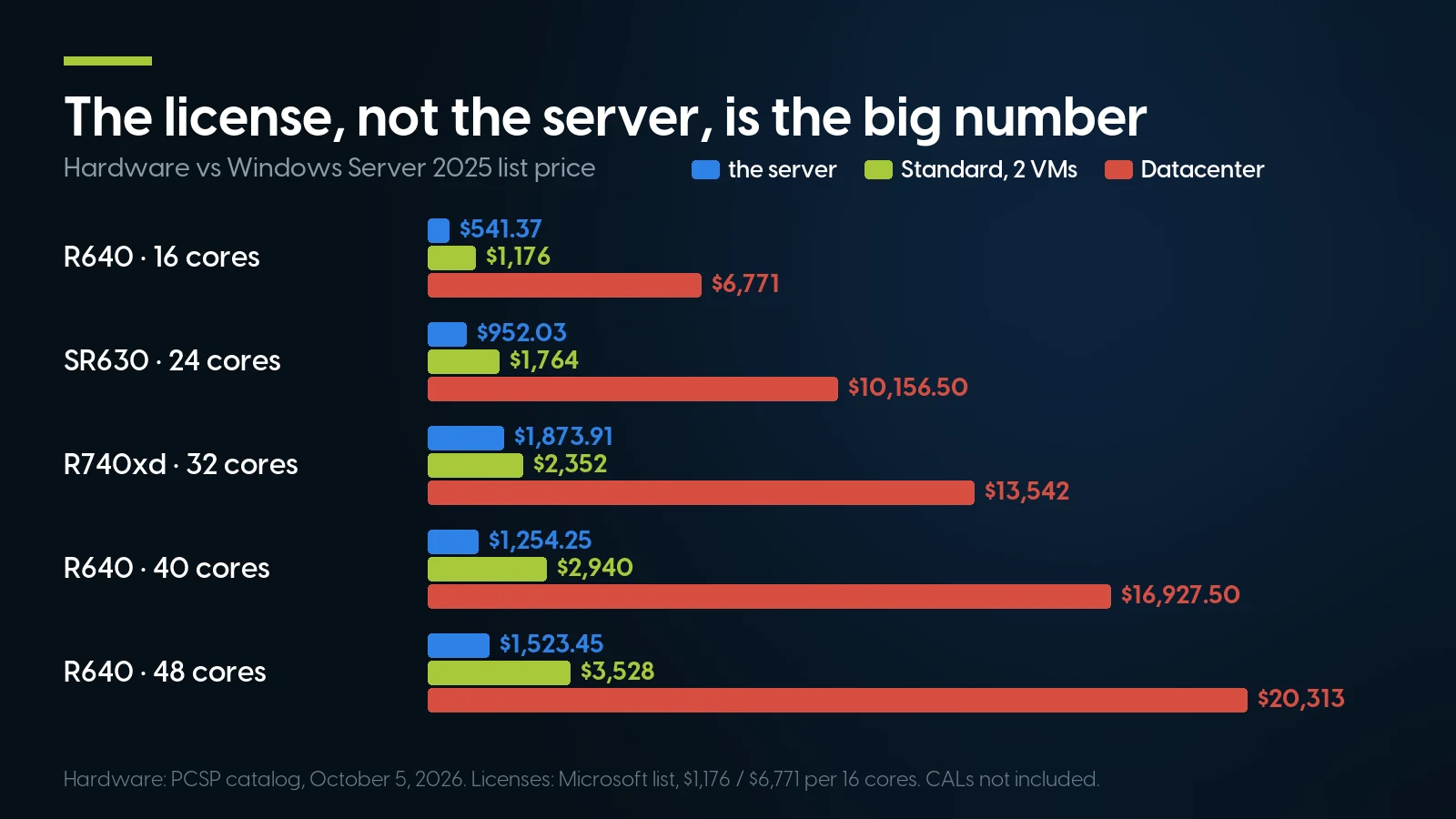
Same dollar scale for all three bars: Standard for two VMs is 1.3 to 2.3 times the server, Datacenter 7.2 to 13.5 times. Hardware: PCSP catalog, October 5, 2026; licenses at Microsoft list price, CALs not included.
Broadcom KB 313548 (updated June 17, 2026); Broadcom publishes no per-core price. Proxmox pricing page, read October 5, 2026: €120, €370, €550 and €1,100 per occupied socket per year. Windows Server guests on either still need the licenses above.
Proxmox prices are net, “VAT is added where applicable”, for one year from purchase, so four years of Basic on a two-socket box is €2,960. And the cheapest tier is not aimed at a business: the pricing page labels Community “For non-production use”, for home labs, training and evaluation, without support tickets. Basic is the first tier with tickets: three a year, one-business-day response. And “all nodes in a cluster must use the same subscription level”.
Windows Server Standard vs Datacenter: Which Is Cheaper
Both editions scale with the core count, so it cancels out; the number of Windows Server VMs on one host decides. At 2025 list, Datacenter costs 5.76 times Standard:
Microsoft list prices read October 5, 2026; the 40-core column is the R640 with two Gold 6148s from the table above. Green marks the cheaper edition. CALs excluded.
Datacenter wins from the 11th Windows Server VM on a host, at any core count. Ten VMs on Standard cost $5,880 per 16 cores, below Datacenter’s $6,771; eleven need a sixth set at $7,056. On the 40-core R640 that is $14,700 against $16,927.50 at ten VMs, and $17,640 against $16,927.50 at eleven.
Microsoft’s own FAQ gives a different line: “For a server with 13 or more OSEs … Datacenter edition is recommended”. That figure fits the 2019 price list, when Datacenter was $6,155 and Standard $972 per 16 cores (2020 capture), a ratio of 6.33 at which Datacenter becomes cheaper from the 13th VM. Standard has since risen faster than Datacenter, and at today’s list the arithmetic gives 11.
Three things move the line in practice:
- Clusters. With licenses tied to each host for 90 days, a node must be licensed for every Windows VM that can fail over to it, not for the VMs it runs on a normal day. That pushes clustered hosts towards Datacenter sooner than a single host.
- Growth. You license for the peak, so a host planned for eight VMs that may reach twelve is already a Datacenter host.
- Licensing by VM. Since October 2022, customers with Software Assurance or subscription licenses can license individual Windows Server VMs instead: the Product Terms require “a minimum of 8 Licenses per Virtual OSE” and allow reassignment within a server farm “as often as needed”; Microsoft’s guidance adds a minimum of 16 per customer. This option suits ESXi and Proxmox clusters, but it does not cover a Windows host OS, and Microsoft publishes no Software Assurance price, so we cannot price it here.
Microsoft also sells Windows Server 2025 pay-as-you-go through Azure Arc at $33.58 per core per month on the pricing page, which notes that “Unlimited virtualization is not available through pay-as-you-go for on-premises Azure Arc enabled servers.” Microsoft Learn adds that each VM needs its own license and an internet connection is required. It bills each enrolled VM’s cores, with “no minimum CPU core count”, not the host’s. Two 4-core VMs cost $268.64 a month, which passes Standard for two VMs in the fifth month on a 16-core host and in the eleventh on the 40-core R640: a way to rent Windows for months, not a cheaper permanent license.
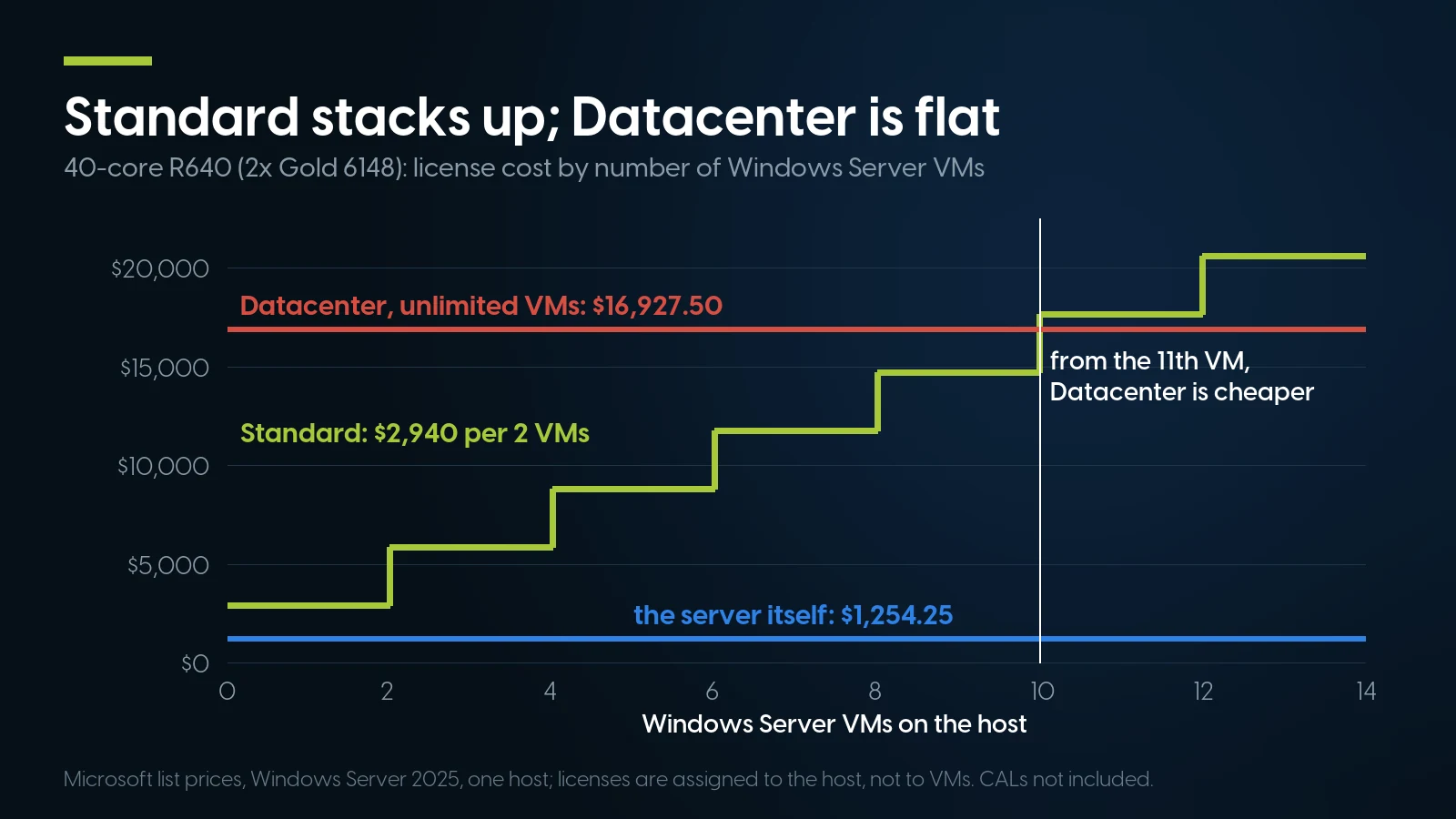
On one 40-core host Standard climbs $2,940 per two VMs and passes Datacenter at the 11th VM. Microsoft list prices; licenses stay with the host, so a cluster is sized for its peak.
Tell us the VM count before you pick the core count
Send the guest list — how many Windows Server VMs, how many Linux, which hypervisor — and we will spec the machine whose cores fit the license you plan to buy, not the one with the most cores per dollar. PowerEdge R640 listings from $372.49, barebones chassis included, refreshed nightly. Configured systems carry a free 1-year warranty on parts, labor and shipping.
Browse PowerEdge R640 Request a quoteWindows Server CALs: When You Need Them, and the Price Nobody Lists
The core license lets the server run. A Client Access License (CAL) lets people or devices use it. The Product Terms put it plainly: “all server software access requires CALs or CAL Equivalent Licenses”, except where the terms say otherwise.
User or device. “A user CAL allows access to corresponding version of the server software or earlier versions of the server software from any device by one user. A device CAL allows access … from one device by any user.” User CALs suit people with several devices, device CALs shared machines. A CAL covers its own version and earlier ones, so Windows Server 2025 needs 2025 CALs, and Microsoft’s licensing guidance says each user CAL lets one user reach “instances of the server software on their licensed servers”: the count follows headcount, not hosts or cores.
When you do not need them. The exceptions in the Product Terms, quoted: “CALs are not required for access by another Licensed Server.” “CALs are not required to access server software running a Web Workload or HPC Workload.” “CALs are not required for access in a Physical OSE used solely for hosting and managing Virtual OSEs.” So a Hyper-V host that only hosts needs no CALs of its own; the people using the Windows VMs on it do, and they need the same CALs whether those VMs sit on Hyper-V, ESXi or Proxmox. We found no exception for administrators in the current terms.
Outsiders and remote desktops. External users can be covered by an External Connector, “Required for each physical server (any number of OSEs) that is accessed”, per the licensing guidance. Remote Desktop Services needs its own RDS CAL on top, “Also required for use of Windows Server to host a graphical user interface”. Under Azure Arc pay-as-you-go, Microsoft says, “there are no client access licenses (CALs) required for standard functionality. However, Remote Desktop Services (RDS) CALs are still required.”
The price. Microsoft’s Windows Server pricing page lists no CAL price. It says only “CALs are required for every user or device accessing a server”. Any CAL figure you see is a reseller’s price, and it varies by programme and seller, so we do not print one. Ask for it on the same written quote as the core licenses, so the full Windows bill is known before you choose an edition.
ESXi and vSphere on a Used Server: Billable Cores, No Price List
Paid VMware is a subscription counted in cores, and the one number Broadcom does not publish is the price. The vSphere page (read October 4, 2026) lists three subscription choices: vSphere Standard, described as “Basic server virtualization for development and testing environments”; vSphere Enterprise Plus; and vSphere Foundation, which adds VCF Operations, Kubernetes and “vSAN (.25 TiB per core)”. The page prints no price; its route to buy is “Contact sales”. Essentials and Essentials Plus are not listed. Perpetual licenses ended with Broadcom’s December 11, 2023 move to subscriptions.
So for ESXi the honest column in our table is the billable core count. On a used two-socket server, the 16-core-per-CPU minimum in KB 313548 means anything with fewer than 16 cores per processor bills as 32 cores: the 2×8 R640 and the 2×12 SR630 are billed for the same 32 cores as the 2×16 R740xd. Get the price as a written quote for your exact core count, term and edition.
What the channel reported, and what Broadcom documents. In March 2025 The Register reported a distributor’s email raising the minimum per order line from 16 to 72 cores from April 10, 2025, plus a 20% surcharge on late renewals; VMware did not respond to the paper. On April 10 heise reported, citing a distributor and a revised reseller price list, that 16-core purchases were possible again. We found no Broadcom document announcing or withdrawing a 72-core minimum; its counting article, updated in June 2026, still says 16 cores per CPU. Treat the late-renewal surcharge as distributor-reported, not as a Broadcom term.
What may change this month. On September 2, 2026 The Register quoted Broadcom executives promising an upgraded vSphere Standard, suited to users who operate “around 128 cores”, with more details likely at VMware Explore in Germany in mid-October 2026, per the paper. As of October 5 there is no published SKU, price or date. If you are pricing VMware for a small host this month, ask for a quote after that event as well as before it.
Free ESXi changes nothing on the Windows line. A host running Windows Server VMs on 8.0 U3e still owes Microsoft the full core license above, and has no Broadcom support behind it.
Which OS and Hypervisor Versions the Server Vendors Support
Windows Server 2025 certification starts at second-generation Xeon Scalable. Microsoft’s Windows processor requirements (updated September 3, 2026) list Server 2025 processors from x2xx Xeon Scalable parts, while Server 2022’s list still includes first-generation x1xx. In Microsoft’s words the list “does not in itself determine Microsoft support” and is “a prerequisite for system certification”. First-generation Silver 41xx, Gold 51xx/61xx and Platinum 81xx, and Xeon E5 v3/v4, are not on it. HPE’s white paper on implementing Server 2025 on ProLiant (February 2026) supports second- to fifth-generation Xeon Scalable, “so this excludes x1xx processors”. Dell’s Windows Server support matrix (December 2025) has no Server 2025 entry for 14G servers such as the R640, R740 and R740xd, and its Server 2025 PERC driver lists only 15G and newer systems.
So most of our 14G and Gen10 shelf is a Server 2022 machine, or a Server 2025 machine without OEM support. Server 2022 gets security updates until October 14, 2031; the details are in our Windows Server 2022 article. The list prices above are for 2025 licenses. Microsoft’s licensing guidance gives volume licenses downgrade rights to 2022 or earlier, but HPE’s Server 2025 QuickSpecs (September 21, 2026) adds a catch for its OEM downgrade kits: for Microsoft support, the server must meet the processor requirements of both versions, which a first-generation Xeon does not.
Every machine in the license-bill table is first-generation. Our one second-generation HPE in stock is a DL360 Gen10 with two 24-core Gold 6248Rs, on a platform its vendor lists for Server 2025: HPE’s Windows Server certification matrix lists the DL360 and DL380 Gen10 for 2012 R2 through 2025. HPE’s white paper also sets a minimum system ROM and gives no Server 2025 support to the S100i or SR100i software RAID; this machine has a Smart Array P816i-a. Lenovo’s OS interoperability guide marks Server 2025 only as “Tested” on the SR630 with second-generation Xeon Scalable, meaning hardware-level support only; the SR630 in our table is first-generation.
ESXi 8 covers all of these; VCF 9 is narrower. Dell’s ESXi 8.x matrix (March 2026) lists the R640, R740 and R740xd with first- and second-generation Xeon Scalable for ESXi 8.0 through 8.0 U3, booting from a hard drive or BOSS card, with no SD-card boot in any 8.x row. HPE’s ESXi matrix lists the DL380 Gen10 for ESXi 8.0 through 8.0 U3 and for ESX 9.0 and 9.1. Lenovo’s SR630 product guide goes up to ESXi 8.0 U3. For VCF 9, Broadcom’s KB 428874 (updated September 21, 2026) supports first-generation Xeon Scalable (Skylake-SP) only “in Deprecated Mode for VCF 9.x”, installed through an override procedure, and says that support “will not be extended to VCF releases beyond VCF 9.x”. Broadcom’s CPU table (updated September 29, 2026) marks second-generation parts deprecated in 9.x and the Xeon E5-2600 v4 in the R630 discontinued, which means the installer blocks it. ESXi 8.0 also dropped the driver for Mellanox ConnectX-3 network cards.
For Proxmox, the documents we used publish no per-model hardware list, so we make no compatibility claim either way; a subscription key is bound to one server’s ID and host architecture.
When a Used Server Is the Wrong Buy for This Decision
We sell the hardware in these tables; here is where it is the wrong answer.
A Windows-heavy estate on a high-core box. With a dozen Windows Server VMs, the license is the purchase: $20,313 of Datacenter on a $1,523.45 R640. Size the core count to the measured CPU load of the VMs, and if a server with fewer, faster cores carries that load, it can be the cheaper machine all-in even when it costs more as hardware, new or used. We have no benchmark that settles that for your workload.
Windows Server 2025 with OEM support. That needs a second-generation or newer Xeon on a platform its maker lists for 2025, and our shelf of those is thin. As of October 5, 2026: the DL360 Gen10 with two Gold 6248Rs, 1 TB of memory and two SSDs ($7,318.41, 1 unit), two PowerEdge R650 configurations (a 16-core Silver 4309Y at $4,854.85 and a 56-core Gold 6330 at $5,948.79, 1 unit each) and one PowerEdge R750 configuration with two 32-core Platinum 8358s ($9,261.72, 4 units). Dell’s matrix lists the R650 and R750 for Server 2025; both R650s use S150 software RAID, so confirm that controller with Dell first. The R750’s 64 cores cost $4,704 in Standard for two VMs and $27,084 in Datacenter. Our DL360 Gen10 Plus category is sold out. If Server 2025 with vendor support for five years or more is the requirement, a new or late-generation server bought from the OEM may be the better route.
A business that needs VMware support behind the host. Free ESXi has none, and Broadcom’s KB 428874 says that where customers have no support terms from Intel or an OEM, “such customers bear the risks for usage of these servers.” Our one-year warranty covers the hardware; it is not a Dell, HPE or Broadcom support contract. If an auditor or insurer requires a vendor-supported stack, price that first.
Two VMs and a small office. At two Windows VMs, any server up to 16 cores pays the same $1,176 for Standard, so the cheapest adequate machine wins and more cores buy nothing. A one-socket server with up to 16 cores counts as one Proxmox socket and 16 Microsoft cores. Windows Server Essentials, for up to 25 users and 50 devices on a single-socket server with up to 10 cores, is sold only through OEM hardware partners at no published price; if it fits, a small new server may cost less in total than any machine here.
Two-socket hosts on our shelf today
Lowest listed price in each category and what is on the shelf right now — barebones chassis included, so a complete build costs more than the figure shown. This block is the one part of the article that refreshes itself; every price in the text above is dated where it stands.
- Dell PowerEdge R64014G · 1U · our deepest dual-socket shelfFrom $372.49 · 45 in stock
- Dell PowerEdge R740xd14G · 2U · drive-heavy hostsFrom $404.99 · 5 in stock
- HPE ProLiant DL380 Gen10Gen10 · 2U · build with second-gen Xeons for Server 2025From $303.74 · 5 in stock
- Lenovo ThinkSystem SR6301U · first-generation ThinkSystemFrom $134.99 · 32 in stock
- Dell PowerEdge R75015G · 2U · in Dell’s Server 2025 matrixFrom $4,384.99 · 3 in stock
Planning Server 2025, or Proxmox with Linux guests?
For Server 2025 we will quote a second-generation Xeon with a Smart Array or PERC controller on a platform its vendor lists, or tell you we do not have one. For Linux guests on Proxmox, core count stops costing license money. ProLiant DL380 Gen10 listings from $303.74 and PowerEdge R750 from $4,384.99, barebones chassis included, refreshed nightly. Free ground shipping over $35 in the contiguous US.
Browse refurbished servers Request a quoteThe Bottom Line
On a used two-socket server, the hypervisor is not where the money goes. Hyper-V, ESXi and Proxmox each cost nothing in some form, and none of them changes what Windows Server costs: every physical core of the host, disabled ones included, licensed in sets of two VMs on Standard or without limit on Datacenter from the 11th VM. On the five machines in our table that license is worth more than the server, by up to 13.5 times under Datacenter.
So decide the guests first. Linux guests on Proxmox make cores nearly free, and the cost becomes a per-socket subscription you may or may not need. Windows guests make every core a line item, so buy the cores you will license. VMware adds a third count, 16 cores per CPU, at a price only a quote will tell you, and a new vSphere Standard is promised, with details reported for mid-October. And if Server 2025 with vendor support is the requirement, our 14G machines and anything with a first-generation Xeon are Server 2022 machines, or Server 2025 without OEM support.
Hypervisor Licensing: FAQ
Is Proxmox free?
Yes. Proxmox VE is open-source software under the GNU AGPLv3, and Proxmox says you may download, use and modify it for private or business use, with every feature available. A subscription buys access to the enterprise repository and support. Proxmox does not recommend the free No-Subscription repository for production servers. Subscriptions cost €120, €370, €550 or €1,100 per occupied CPU socket per year, net of VAT, whatever the core count.
Is ESXi still free?
Only as ESXi 8.0 Update 3e, released in April 2025. Broadcom’s release notes say the free vSphere Hypervisor has no Broadcom support and is for non-production use, cannot connect to vCenter and allows at most 8 virtual CPUs per VM. Broadcom’s KB adds a limit of two physical CPUs per host and no vMotion, HA or VADP-based backups. Every other ESXi and vSphere offering is a paid subscription.
Is Hyper-V free?
The Hyper-V role comes with Windows Server and with Windows 10 or 11 Pro and Enterprise at no extra cost, but on a server you pay for Windows Server by the core. The free standalone Hyper-V Server stopped at the 2019 release, which has extended support until January 9, 2029. Windows Server VMs running on it still need Windows Server licenses for every physical core of the host.
Windows Server Standard vs Datacenter: which is cheaper?
It depends on how many Windows Server VMs one host runs, not on its core count. Standard covers two VMs per full set of core licenses; Datacenter covers any number. At 2025 list prices, $1,176 and $6,771 per 16 cores, Standard is cheaper up to 10 VMs and Datacenter from the 11th. In a cluster, license each host for every VM that can fail over to it.
Do Windows VMs on Proxmox or ESXi need a Windows Server license?
Yes. Microsoft assigns Windows Server licenses to the physical server whatever hypervisor runs on it, so a Proxmox or ESXi host running Windows Server VMs needs licenses for all its physical cores, Standard for every two VMs or Datacenter for unlimited, plus CALs for the users. Customers with Software Assurance or subscription licenses can instead license each VM. Proxmox removes the Windows license only when the guests are not Windows Server.
Do I need to license disabled cores?
Yes. Microsoft’s licensing FAQ says all physical cores on all physical processors must be licensed even if they have been disabled. Hyper-threads do not count; the minimum is 8 cores per processor and 16 per server.
Do I need CALs for virtual machines?
Users or devices that access Windows Server need CALs, whether it runs on hardware or in a VM, and on any hypervisor. A Hyper-V host used only to host and manage VMs needs none of its own. User CALs cover a person on any device, device CALs a device used by anyone. Microsoft publishes no CAL list price.
Can a used Dell R640 run Windows Server 2025?
Dell’s BIOS 2.22.2 for the R640 and R740 adds Server 2025 support, but Dell’s Windows Server support matrix and its Server 2025 PERC driver leave out the R640, R740 and other 14G servers, and Microsoft’s Server 2025 processor list, a prerequisite for system certification, starts at second-generation Xeon Scalable. Treat a 14G server or any first-generation Xeon machine as a Windows Server 2022 machine, or as a Server 2025 machine without OEM support.