

HPE ProLiant Generations Explained: Gen8 to Gen11 (2026)
Posted by Konstantin Protasov, PCSP on Oct 6th 2026
HPE does not publish an open end-of-life date for a ProLiant server. Its end-of-life notice for the DL360 and DL380 Gen10 is a Product Change Notification behind an HPE Support Center sign-in, under a title marked “(Revision)”; what was revised is behind the sign-in too. What HPE does publish, dated and open, is firmware for the management chip in every ProLiant. The last iLO 4 release, for Gen8 and Gen9, is 2.82 of March 2, 2023. iLO 5, on Gen10 and Gen10 Plus, got 3.22 on September 25, 2026, its eighth release since August 2025.
That firmware clock says more about which generation to buy than the launch year. This guide is built from HPE’s QuickSpecs, firmware pages and operating-system matrices, plus asking prices from our shelf and three other stores. It follows the 1U DL360 and the 2U DL380 from Gen8 in 2012 to Gen11 in 2023, with Gen12 in one paragraph. The processors inside each rung have their own guide, and the Dell ladder is in our PowerEdge generations guide.
The short version — HPE, Microsoft and Broadcom documents read October 5, our shelf priced October 6, 2026:
- HPE prints no open end-of-support date for Gen8 through Gen11. It prints firmware: no iLO 4 release since March 2023, a Gen9 BIOS fix in September 2024, iLO 5 and iLO 6 releases on September 25, 2026.
- HPE certifies each generation up to a ceiling: Gen8 to Windows Server 2016 and ESXi 6.5 U3, Gen9 to Server 2019 and ESXi 7.0 U3. Gen10 reaches ESX 9.1, and Server 2025 only with a second-generation Xeon, a current System ROM and a Smart Array card instead of the S100i.
- Gen10 Plus is a new board, not a Gen10 with newer chips, and the used price jumps there: the same minimal DL380 build costs $323.50–$998.24 as a Gen9 or Gen10 at three other stores and $3,749.42–$5,514.50 as a Gen10 Plus.
- “800 W Flex Slot Platinum” is three different option kits across Gen9, Gen10 and Gen10 Plus to Gen12, and Gen8 uses another family altogether.
- Our shelf, as of October 6, 2026, is Gen9 and Gen10: a complete DL380 Gen9 at $750.67, a complete DL380 Gen10 at $2,500.39, DL380 builds from $243.93 (Gen9) and $460.19 (Gen10). DL360s are builds, a barebones chassis and one 48-core Gen10 at $7,318.41.
- What we do not have: no Gen8 server at all; no Gen10 Plus in stock (45 listings, all at zero), so Gen10 Plus, Gen11 and Gen12 are by quote only; no ML350 or DL20 in stock.
- What to buy: Gen10 with second-generation Xeons and a Smart Array card for Windows Server 2025, or for VMware up to VCF 9.x; Gen9 for Linux and labs you patch yourself; Gen10 Plus or Gen11 new, by quote, or as Dell equivalents.
HPE ProLiant Specs by Generation: DL360 and DL380, Gen8 to Gen11
Every cell comes from HPE’s QuickSpecs for that generation’s DL360 and DL380. The date is Version 1 of HPE’s QuickSpecs, not the announcement; the documents now run to Version 77, so the date on the cover is not the launch. Memory ceilings are the DL380’s; the DL360 matches them.
HPE QuickSpecs: DL360p Gen8 (Version 64) and DL380p Gen8 (Version 72), both September 28, 2015 and stamped “Retired”; DL360 Gen9 (V48, July 1, 2019); DL380 Gen9 (V47, December 2, 2019); DL360 Gen10 (version 74, May 18, 2026); DL380 Gen10 (V77, June 16, 2025); DL360 Gen10 Plus and DL380 Gen10 Plus (July 28, 2025); DL360 Gen11 and DL380 Gen11 (September 8, 2026); the P440ar QuickSpecs (February 2018). Links on our domain open HPE’s PDFs archived in our spec-sheet library. Read October 5, 2026.
Read down the columns and there are four breaks: DDR4 at Gen9; six memory channels and iLO 5 at Gen10; PCIe 4.0, eight channels and OCP 3.0 at Gen10 Plus; DDR5 and PCIe 5.0 at Gen11. One catch: a DL380 Gen11 takes all 32 modules only with an 8- or 16-drive front, 16 with 24 drives.
How to read a ProLiant name
A ProLiant carries its generation as a suffix, not as a digit in the model number: a DL380 Gen9 and a DL380 Gen10 share a name and nothing on the board. DL is HPE’s rack line, ML its tower line; no HPE document we found decodes the letters. In HPE’s titles the AMD models end in 5 — DL325, DL365, DL385 — though HPE does not state it as a rule. Gen12 is sold as “HPE ProLiant Compute”.
By processor family the rungs line up with Dell’s: Gen8 with 12G, Gen9 with 13G, Gen10 with 14G, Gen10 Plus with 15G, Gen11 with 16G. That is all the equivalence is: HPE spends a “Plus” where Dell raises the generation number, the AMD lines are named differently, and memory ceilings differ chassis by chassis.
HPE ProLiant End of Life: What HPE Publishes, and What It Locks
The end-of-life dates HPE sets live in Product Change Notifications, and the Gen10 one answers “Sign In Required”. The closest thing in public is an HPE employee’s reply on HPE’s own forum on May 25, 2024, giving the DL360 Gen10 Plus an end-of-life announcement on December 1, 2023, discontinuance on May 31, 2024 and obsolescence on June 30, 2024, under a disclaimer that it is not an official statement. All three are end-of-sale milestones, as is the banner on the current Gen10 and Gen10 Plus QuickSpecs: the products “are no longer available for sale.” No HPE document we could open gives an end-of-support date for any DL360 or DL380 generation; the dates quoted online come from third-party maintainers.
The clock HPE does publish openly is firmware:
HPE Support Center version lists for iLO 4, iLO 5, iLO 6, the Gen9 System ROM, the Gen9 SPP and the Gen10 and 10 Plus SPP; HPE bulletin HPESBHF04699 for the Gen9 ROM. Read October 5, 2026.
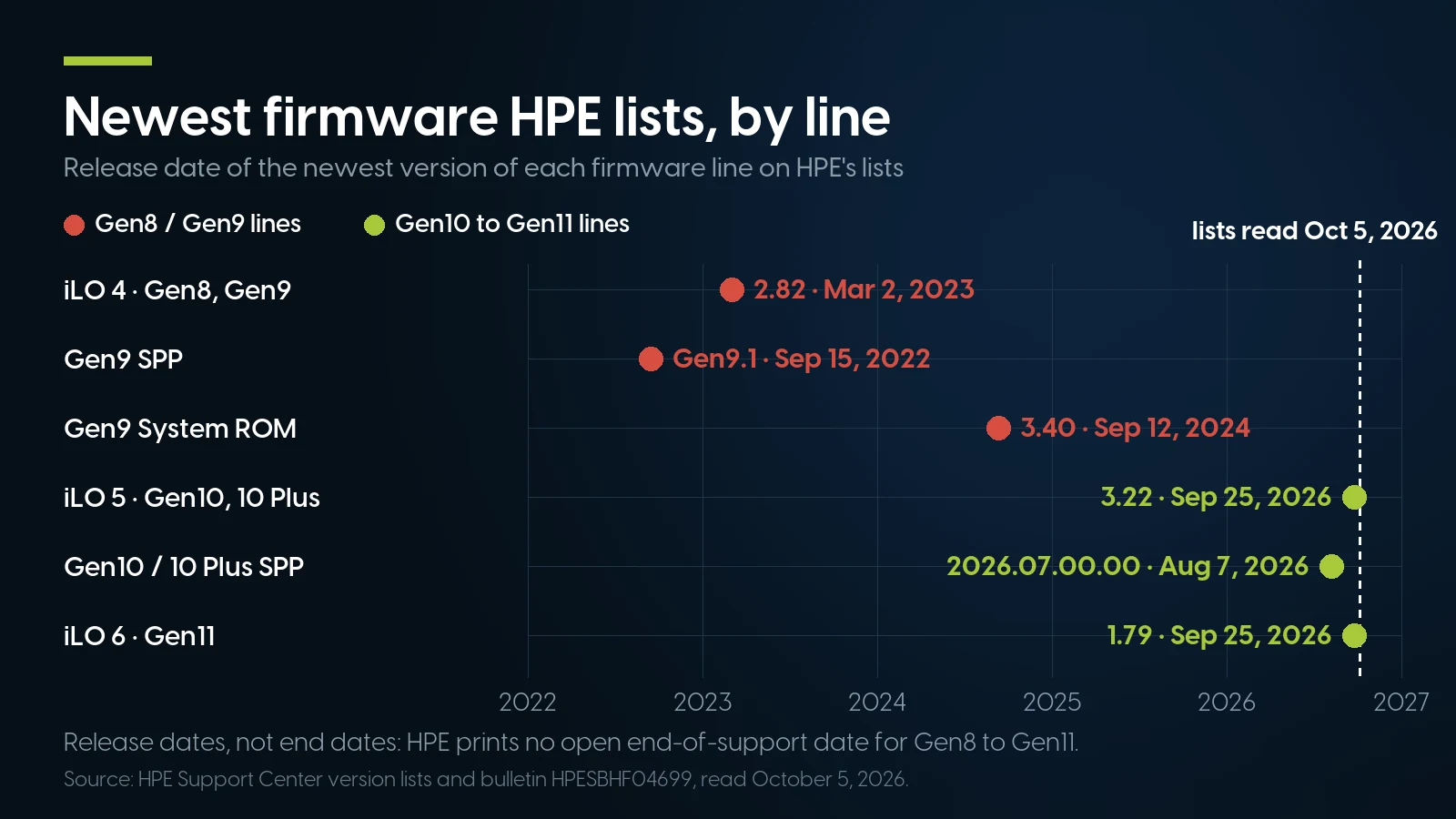
Gen8 and Gen9 firmware last shipped in 2022–2024; iLO 5 and iLO 6 on September 25, 2026. Release dates, not end dates.
Read the iLO 4 row carefully. HPE has not said iLO 4 support ended; no release has appeared since March 2023, and the newest iLO 4 bulletin on the DL360 Gen9 alert list, HPESBHF04456 of March 13, 2023, is the one 2.82 fixed. HPE’s SPP support policy (Rev. 4, June 2026) calls Gen9 and older “post-production”, “limited to security updates”, supported “as long as HPE supports that server generation” — without a date. Intel’s processor clock has run out: E5 v3 servicing ended December 31, 2021 and v4 June 30, 2022, per Intel’s dates in our Xeon guide.
Can you download ProLiant firmware without a support contract?
Partly; HPE’s own documents disagree on the rest. HPE’s SPP validation note (2017, still served) says “An active warranty or HPE support agreement is required to download” the Service Pack, and calls the BIOS System ROM “entitled”, while “ProLiant safety and security firmware, iLO, controller components, and drivers are available on the HPE support Center without entitlement validation.” HPE’s newer support policy, Rev. 4, a PDF created June 22, 2026, prints “Entitlement required: No” and “Login required: Yes” for every generation from Gen12 back to “Gen9 and older” — and on page 3 says “The SPP is accessible for products with an active warranty or covered by an HPE Support Agreement.” Neither document is marked superseded, and we have not tested a download. iLO and controller firmware are the safe part; for the SPP and System ROM, sign in and check before relying on either reading. Logins and licences are in our iDRAC and iLO guide.
What HPE certifies each generation to run
HPE Windows Server certification matrix, VMware ESXi matrix and archived-products ESXi matrix; HPE’s Windows Server 2025 white paper (Rev. 11, February 2026); Broadcom KB 318697 (September 29, 2026) and KB 428874 (updated September 18, 2026). Read October 5, 2026.
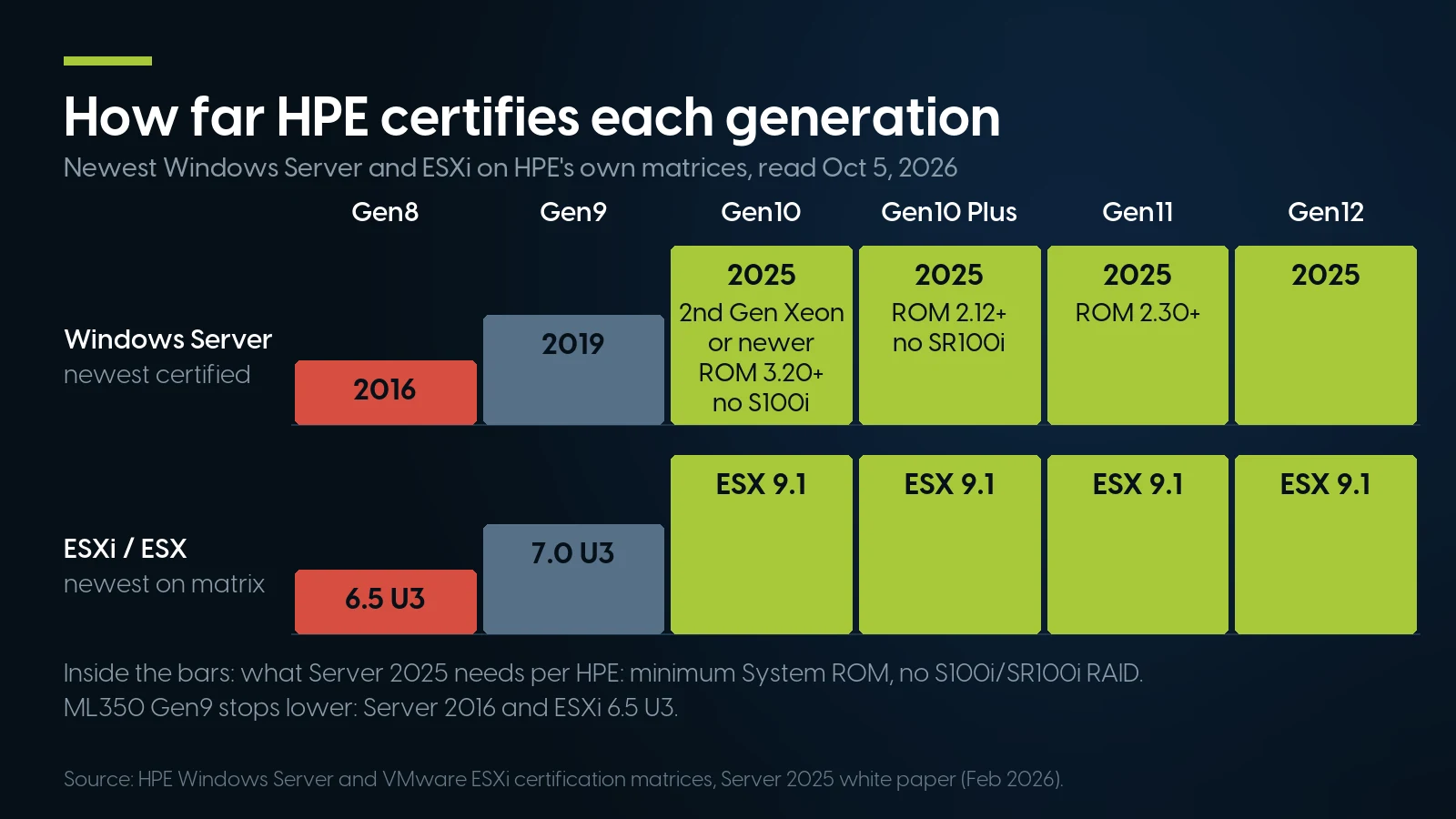
Gen10 is the first rung HPE certifies for Server 2025, with conditions, and for ESX 9.1. Sources as in the table above.
Certification is a list, not a lock. Microsoft’s processor requirements (August 2026) list second- to fifth-generation Xeon Scalable (x2xx to x5xx) and Xeon 6 for Server 2025, not first-generation x1xx, and say the list “does not in itself determine Microsoft support” but is “a prerequisite for system certification”. HPE’s white paper is blunter about the old rungs: “HPE ProLiant Gen9 and older servers are not supported on Windows Server 2025.” It also excludes first-generation chips by name and notes that “Support for SR100i and S100i software RAID has not been provided for Windows Server 2025.”
iLO 4, iLO 5, iLO 6: Which iLO Each Generation Has
The QuickSpecs name the controller: iLO 4 on Gen8 and Gen9, iLO 5 on Gen10 and on Gen10 Plus (not iLO 6), iLO 6 on Gen11. Gen12 brings iLO 7, which HPE’s February 12, 2025 release describes as adding a dedicated security processor it calls a “secure enclave”.
HPE firmware revision histories on the iLO component pages linked above; HPE iLO 4 2.81 user guide (September 2022). “—” = not covered by the HPE documents we read. Read October 5, 2026.
On Gen9, an iLO 4 older than 2.70 offers only the Java and .NET consoles, so updating iLO is the first job. The licence decides when you see the console at all. HPE’s iLO 6 licensing guide (August 2024) gives the free Standard tier the remote console “Pre-OS only for all servers except BL and WS”; the full console, virtual media, directory login and two-factor authentication are Advanced features. The other tiers in old listings are gone: HPE discontinued Scale-Out on February 5, 2018 and Essentials on January 31, 2019, and folded Premium Security Edition into Advanced with iLO 5 1.40. On a rack ProLiant in 2026 there are two tiers, Standard and Advanced. An Advanced key is not transferable; an iLO 5 factory reset erases one not installed at the factory, and the iLO 4 guide says a reset clears all license data; our iLO guide covers that, default passwords and ports.
The security record is why the firmware row matters. HPESBHF03769 (August 23, 2017) disclosed CVE-2017-12542, a remote authentication bypass with code execution in iLO 4 before 2.53, rated 9.8 by HPE. Ripple20 (July 13, 2020) was fixed in iLO 4 2.75 and iLO 5 2.18. iLO 5 had its own authentication bypass, CVE-2023-50272, in 2.63 to before 3.00, disclosed December 19, 2023. An iLO 4 on 2.82 has every fix HPE shipped; anything found since has none published. Keep any iLO off public addresses.
Gen8 and Gen9: Skip the DL380p, Budget With the DL380 Gen9
Gen8: not even cheap
Every page of the Gen8 QuickSpecs is stamped “Retired”. It is DDR3 on E5-2600 and v2 processors, whose Intel servicing ended June 30, 2020, certified to Windows Server 2016 and ESXi 6.5 U3, with Gen9’s stopped iLO 4 clock. Its power supplies are a different family, Common Slot, with a strict rule: “All power supplies inside a server must be exactly the same model.” We list no Gen8 server, and there is no price case for one: TechMikeNY asked $79.95 for a DL380 Gen9 chassis on October 6, 2026.
Gen9: the budget floor, past most of its clocks
Gen9 brought DDR4, 3 TB on 128 GB LRDIMMs, up to six NVMe drives and the Flex Slot power supply, and its 2016 refresh took the same boards to 22-core E5-2600 v4 chips. The storage choices need reading. The entry B140i is chipset SATA RAID that “will operate in UEFI only mode” and “defaults to AHCI”. The P440ar runs “RAID or HBA mode”, one or the other: HPE’s storage guide warns that HBA mode “will disable any drives configured using a Smart Array until the configuration is cleared”, as our RAID controller guide quotes.
Its ceilings are Server 2019 and ESXi 7.0 U3, past Broadcom’s general support since October 2, 2025; its iLO and Service Pack have been static since 2023 and 2022, and only the BIOS moved in 2024. None of that stops a DL380 Gen9 running Proxmox, Linux, TrueNAS or a backup target where you own the patching.
Our Gen9 shelf, as of October 6, 2026, is one model with depth. The ProLiant DL380 Gen9 category has 13 priced listings but three distinct complete configurations. The cheapest is $750.67: two 8-core E5-2640 v3, 64 GB, eight 600 GB drives, a P440ar and a 331FLR, listed three times over one shared seven-unit pool. The next is $1,470.80 with two 10-core E5-2660 v3 and 192 GB; every complete Gen9 we list runs E5 v3, not v4. The 8-bay build-your-own page builds from $243.93 complete: two E5-2630 v3, 16 GB, a P440ar and one 300 GB SAS drive. The DL360 Gen9 exists here only as a build, a 4-bay 3.5-inch one from $266.92 with a P440ar, a 10 GbE FlexibleLOM and one drive.
Gen10 (DL360, DL380 Gen10): the Used Sweet Spot, If You Pick the Parts
HPE revealed Gen10 on June 5, 2017. Xeon Scalable brought six memory channels per socket and up to 28 cores, and iLO 5 is still released every two months. The controllers changed too: the SR Gen10 cards run RAID and HBA side by side, a mixed mode that HPE’s configuration guide (January 2021) says “occurs by default, and cannot be disabled.” The P408i-a and P816i-a need HPE’s Smart Storage battery or hybrid capacitor, “sold separately”; the E208i-a has no cache and builds RAID 0, 1, 5 and 10.
Gen10 is the oldest ProLiant certifiable for Windows Server 2025, on three conditions in HPE’s white paper: a second-generation Xeon (Bronze, Silver, Gold or Platinum x2xx), System ROM 3.20 or later, and no S100i software RAID, where HPE’s workaround is a hardware RAID card; HPE also documents the S100i as “Windows only”, SATA-only and UEFI-only. VMware splits them less: Broadcom supports both generations in VCF 9.x “in Deprecated Mode”, sends first-generation installs to a procedure attached to KB 428874, and lists Cascade Lake as discontinued in the next major release, so neither outlives 9.x. HPE’s ESXi matrix lists Gen10 for ESX 9.0 and 9.1 with the note “HPE will continue to support server with Skylake processor as mentioned in your support contracts.”
Our Gen10 shelf, as of October 6, 2026, is two complete machines and a set of builds. The deepest is a complete DL380 Gen10 at $2,500.39: two 12-core Gold 5118, 128 GB, eight new 1 TB SATA SSDs, a P408i-a and a 560FLR-SFP+ for 10 GbE, 21 in stock. The Gold 5118 is a first-generation chip, so on HPE’s terms that machine is a Server 2022 host, not a Server 2025 one, and HPE does not support field upgrades from first- to second-generation chips. The second-generation option is a 1U DL360 Gen10 at $7,318.41 — two 24-core Gold 6248R, 1 TB, a P816i-a and two 512 GB SSDs — one unit. The 8-bay build-your-own DL380 Gen10 builds from $460.19 with two Silver 4108, 16 GB, an E208i-a and one 300 GB SAS drive; its processor list covers both generations, so pick an x2xx part for Server 2025. We build and test those ourselves, but where a board first shipped with x1xx chips HPE treats the swap as unsupported, so an HPE support contract may not cover it. The DL360 Gen10 also comes as a barebones chassis at $264.99 with no processor, memory, drive or controller, and a 4-bay build from $402.93 on the onboard S100i with one 250 GB SATA drive, or $420.44 with an E208i-a. That $17.51 buys the hardware RAID HPE names as its Server 2025 workaround for the S100i.
The DL380 Gen10 is our deepest HPE shelf
Five priced DL380 Gen10 listings as of October 6, 2026: four build-your-own pages and a complete machine, two Gold 5118 with 128 GB and eight new 1 TB SSDs — From $2,500.39 · 21 in stock. One-year warranty on every configured server; free ground shipping over $35.
Browse the ProLiant DL380 Gen10 Build your own DL380 Gen10Gen10 vs Gen10 Plus: a New Board, and the Price Cliff
HPE says the DL360 Gen10 Plus “complements Gen10 reach”. It is a different server under a similar name. Eight memory channels and 32 slots instead of six and 24; DDR4-3200; PCIe 4.0; OCP 3.0 networking where Gen10 had FlexibleLOM; the SR100i and tri-mode controllers instead of the S100i; its own 800 and 1600 W Platinum power supply kits; and a separate System ROM family in HPE’s Server 2025 paper. No Gen10 board takes a third-generation Xeon, so a Gen10 cannot be upgraded into a Gen10 Plus.
This is where used prices jump. The same minimal DL380 8-bay build — the two cheapest processors offered, 32 GB, the cheapest hardware RAID controller, two power supplies and the cheapest drive — priced on each store’s own configurator on October 6, 2026:
Configurator asking prices, October 6, 2026; not sale prices. Cheapest parts per store, so chips, controller and drive differ: 2× E5-2630 v3 to E5-2680 v3 on Gen9 and Silver 4108 to Gold 5120 on Gen10; an E208i-a in our Gen10 build and at NewServerLife, a P408i-a as the cheapest hardware RAID at TechMikeNY and SaveMyServer; a 300 GB to 1.2 TB SAS drive, with TechMikeNY’s separate $8.95 caddy; NewServerLife’s Gen10 Plus includes its required $89 OCP card. 32 GB is the least memory the other three sell; ours starts at 16 GB.
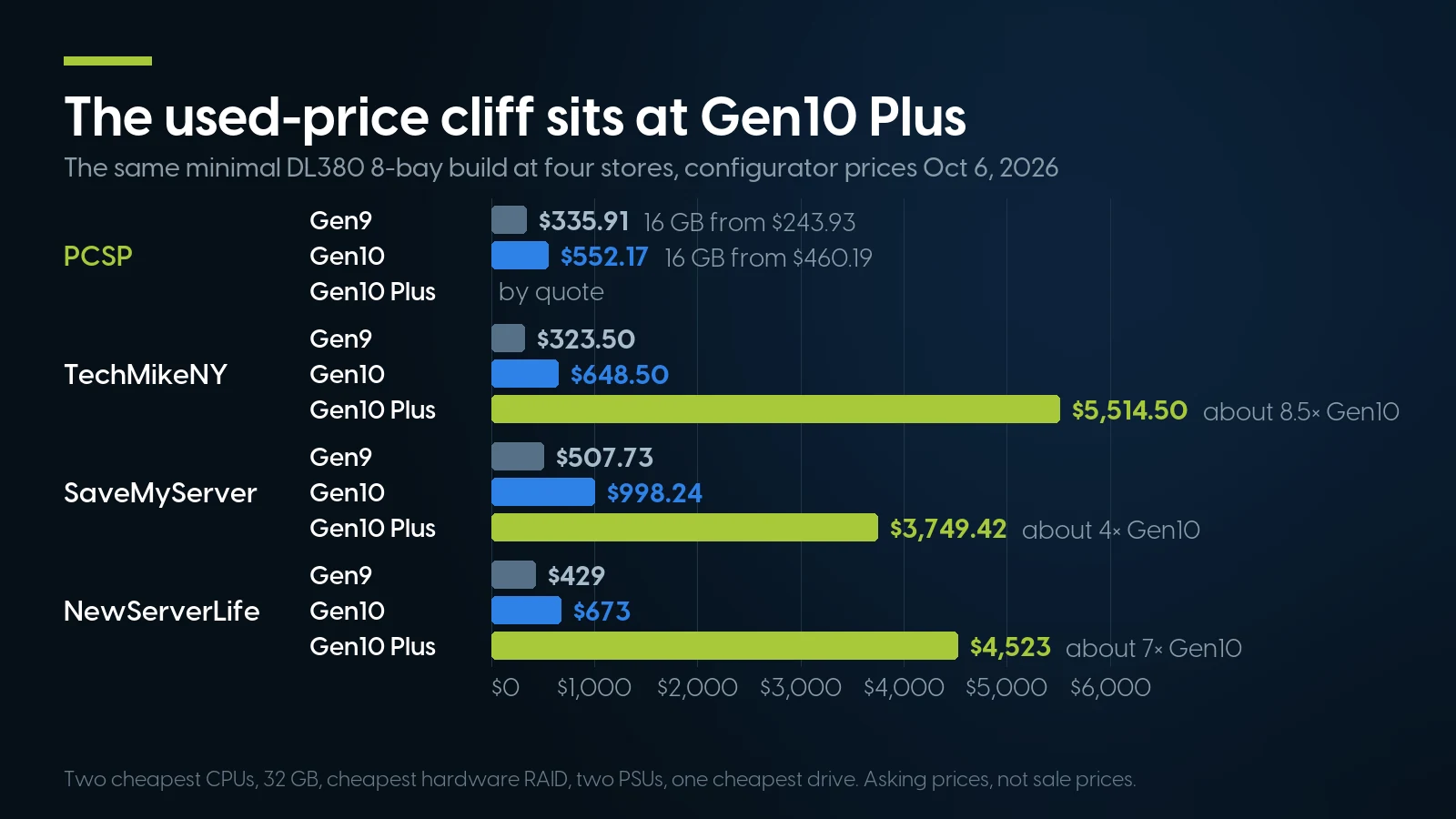
The same build costs about four to eight and a half times as much as a Gen10 Plus as a Gen10 at the same store. Store configurators, October 6, 2026.
At the three other stores the build costs $323.50 to $507.73 as a Gen9, $648.50 to $998.24 as a Gen10 and $3,749.42 to $5,514.50 as a Gen10 Plus, about four, seven and eight and a half times its Gen10 price at the same store. Ours is $335.91 as a Gen9 and $552.17 as a Gen10, the lowest Gen10 of the four, and a Gen10 Plus by quote. It is the shape our Dell guide found between 14G and 15G: the step comes with PCIe 4.0, not age. It is worth paying for NVMe-heavy databases, vSAN or Ceph and memory-bandwidth-bound work; for file, directory, backup and general virtualization a Gen10 does the same job.
Where we are not the cheapest. On the minimal Gen9 build above, TechMikeNY is $12.41 below us at 32 GB; ours is the only one sold with 16 GB, from $243.93. SaveMyServer’s saved DL380 Gen10 at $1,701.20 has two 24-core Platinum 8160, against 24 cores in total in our $2,500.39 machine, which carries twice the memory and eight new 1 TB SSDs instead of four SAS hard drives. For cores, theirs is the better buy. Its $519.31 DL380 Gen9 has newer 12-core v4 chips than our $750.67 machine, with half the memory, no drives and a 180-day default warranty against our one year.
Our Gen10 Plus shelf is empty; we quote one to order. The DL360 Gen10 Plus category holds 45 listings, every one at zero stock, and there is no DL380 Gen10 Plus category at all. The Dell equivalent, 15G, is thin too as of October 6, 2026: four priced PowerEdge R650 listings, the cheapest configured one, without storage, at $4,854.85, and three priced R750 listings, a complete one with two 32-core Platinum 8358, 128 GB and eight 600 GB SAS drives at $9,261.72.
Gen11 and Gen12: DDR5, iLO 6, and a CPU Upgrade HPE Rules Out
HPE announced Gen11 on November 1, 2022, AMD models orderable from November 10; the Intel DL360 and DL380 Gen11 QuickSpecs start on January 10, 2023. DDR5 RDIMMs are the only memory, slots are PCIe 5.0, a network card is a required choice, and the built-in RAID is Intel VROC, with no S100i.
One sentence in both Gen11 QuickSpecs matters to anyone buying used to upgrade later: the firmware for fifth-generation Xeons “is not compatible with the DL380 Gen11 system board shipped with the 4th Generation” chips, and “Field upgrade from the 4th Generation Intel® Xeon® Processors to the 5th Generation is not supported.” A Gen11 that shipped with x4xx processors stays on x4xx processors. Read the second digit before you pay for the headroom.
Gen11 on our shelf is by quote only. The DL380 Gen11 and DL360 Gen11 pages are configurators marked “available by quote only”; no other store we checked priced a Gen11 either. The Dell rung with prices is 16G, as of October 6, 2026: a complete PowerEdge R760 with two Gold 5416S and 256 GB of DDR5 at $7,274.99, and an R660 with two Gold 6438Y and 128 GB at $9,749.99.
Gen12, in one paragraph
HPE announced eight “HPE ProLiant Compute Gen12” servers on February 12, 2025, on Intel Xeon 6 with iLO 7, six of them, including the DL360 and DL380, “available Q1 2025”. HPE’s matrices list Gen12 for Windows Server 2022 and 2025 and ESXi 8.0 U3 through ESX 9.1. It is not a used product yet: our 15 Gen12 pages are quote-only placeholders.
DL20 and ML350, one line each
The DL20 is not a small DL360: the DL20 Gen11 QuickSpecs (August 3, 2026) give it one Xeon 6300, Xeon E or Pentium socket and four UDIMM slots to 128 GB; we have no DL20 in stock. The ML350 is the tower, a 4U box that takes 5U when racked; HPE certifies the ML350 Gen9 only to Server 2016 and ESXi 6.5 U3, and our one ML350 Gen10 build-your-own unit is out of stock as of October 6, 2026.
Power Supplies and Cards That Do Not Cross Generations
HPE’s Flexible Slot Power Supplies QuickSpecs (Version 23, September 21, 2026) still advertises a “Common form factor across all ProLiant Gen9 and Gen10 servers”, and then contradicts the slogan. The same 800 W label is three option kits:
HPE Flexible Slot Power Supplies QuickSpecs, Version 23; Gen8 kit from the DL380p Gen8 QuickSpecs; Gen9 and Gen10 kits from the DL380 Gen9 and DL360 Gen10 QuickSpecs. Read October 5, 2026.
Whether a Gen9 supply works in a Gen10, HPE does not say; its Gen10 QuickSpecs list only Low Halogen kits. The two Low Halogen 800 W kits carry the same spare part, P39385-001, in HPE’s current table; what HPE rules on is which kit each server is qualified with. Match the part numbers HPE lists for your server, not the wattage. Our Gen9 800 W supply (720479-B21, spare 754381-001) was $15.95 with 280 in stock on October 6, 2026, in our power supply category. What the wattage on a server supply does and does not promise is in our power supply guide.
Network cards follow the board: FlexibleLOM through Gen10, while the Gen10 Plus and Gen11 QuickSpecs list OCP 3.0 slots and no FlexibleLOM slot, so a 331FLR or 560FLR has nowhere to go. Controllers too: the P440ar is Gen9, the E208i-a, P408i-a and P816i-a Gen10. As a part, the E208i-a was $27.50 with 125 in stock on October 6, the cheapest way off the S100i.
When a Used ProLiant Is the Wrong Buy — Including From Us
Our HPE shelf is Gen9 and Gen10, so here is the case against both, and against the shelf.
A Windows Server 2025 host on HPE needs Gen10 or newer with second-generation Xeons. Gen9 is out on HPE’s own paper, and so is any Gen10 on first-generation chips or the S100i — which describes our deepest complete DL380 Gen10. If 2025 is the plan, take the Gold 6248R DL360, build with an x2xx processor and a Smart Array card, or ask us to quote one.
If policy requires a management controller with current vendor firmware, Gen8 and Gen9 fail it. iLO 4 has had no release since March 2023: tolerable on an isolated lab network, not for a regulated estate or an auditor.
PCIe 4.0 NVMe, DDR5 or more cores per socket mean Gen10 Plus or Gen11, which we cannot supply from stock. HPE’s QuickSpecs give 22 cores per socket on Gen9, 28 on Gen10, 40 on Gen10 Plus and 64 on Gen11. For those, take a quote, a Dell R650, R750, R660 or R760 from the rungs above, or a new server.
A vendor support contract or guaranteed firmware access means buying through HPE. A refurbished server carries the seller’s warranty — ours is one year on configured systems, 90 days on parts — not HPE entitlement, and HPE’s documents disagree on whether its Service Pack needs one.
And where our shelf is thin. No Gen8. No complete DL360 Gen9, and one complete DL360 Gen10 beside the builds and a barebones chassis. Three distinct complete DL380 Gen9 configurations, all E5 v3, under 13 listings. No ML350 or DL20 in stock; Gen10 Plus, Gen11 and Gen12 by quote.
Tell us the operating system and the drive count. We will tell you the generation.
Gen9 and Gen10 DL380s from stock and on the configurator; Gen10 Plus, Gen11 and Gen12 quoted to order; Dell 15G and 16G where HPE is empty. One-year warranty on every configured server, extendable to five years; free ground shipping over $35.
Browse HPE ProLiant servers Ask for a quoteThe Bottom Line
A ProLiant’s generation sets three things that matter more than its launch year: whether HPE still ships its iLO firmware, what HPE certifies it to run, and which parts fit. On those, Gen8 is finished; Gen9 is a budget machine for owners who patch it themselves, with an iLO silent since March 2023; Gen10 is the used sweet spot, provided the processors are second generation and the controller is a Smart Array card. The price does not step with age but between Gen10 and Gen10 Plus, where PCIe 4.0 and eight memory channels cost thousands of dollars more.
Our shelf has the same shape: no Gen8, Gen9 and Gen10 DL380s in stock, Gen10 Plus, Gen11 and Gen12 by quote. As of October 6, 2026, a complete DL380 Gen9 is $750.67 here and a complete DL380 Gen10 $2,500.39.
HPE ProLiant Generations: Frequently Asked Questions
Is the HPE ProLiant DL380 Gen9 end of life?
HPE publishes no open end-of-support date for it. Its pages show firmware: the last iLO 4 release is 2.82 of March 2, 2023, the last Gen9 Service Pack is from September 15, 2022, and the Gen9 System ROM got security update 3.40 on September 12, 2024. HPE certifies the DL380 Gen9 up to Windows Server 2019 and ESXi 7.0 Update 3. End-of-support dates quoted online come from third-party maintainers, not HPE.
Is the HPE ProLiant DL380 Gen10 end of life?
End of sale, yes: the current DL380 Gen10 QuickSpecs (June 2025) say the products “are no longer available for sale.” HPE’s Gen10 end-of-life dates sit in a Product Change Notification behind an HPE sign-in. Support continues: iLO 5 got firmware 3.22 on September 25, 2026, the Gen10 and Gen10 Plus Service Pack was updated on August 7, 2026, and HPE lists Gen10 for Windows Server 2025 and ESX 9.1.
What is the difference between HPE Gen10 and Gen10 Plus?
A new board. Gen10 runs first- and second-generation Xeon Scalable on 24 slots, six channels and PCIe 3.0 with FlexibleLOM networking; Gen10 Plus runs third-generation Xeon Scalable on 32 slots, eight channels of DDR4-3200 and PCIe 4.0 with OCP 3.0, uses the SR100i instead of the S100i, and needs its own 800 and 1600 W Platinum power supply kits. Both use iLO 5. A Gen10 cannot be upgraded into a Gen10 Plus.
Which iLO version does each ProLiant generation have?
iLO 4 on Gen8 and Gen9, iLO 5 on Gen10 and Gen10 Plus, iLO 6 on Gen11, iLO 7 on Gen12. iLO 4 has had no release since 2.82 in March 2023, and its HTML5 console needs firmware 2.70 or later; iLO 5 and iLO 6 both got releases on September 25, 2026. On the free Standard licence the remote console works only before the operating system loads.
Can an HPE ProLiant Gen9 run Windows Server 2022 or 2025?
Not on HPE’s lists. HPE’s Windows Server matrix certifies the DL360 and DL380 Gen9 up to Windows Server 2019, and its Server 2025 white paper states that Gen9 and older servers are not supported on Windows Server 2025. That is certification, not a promise that setup fails, but drivers and support become yours to solve. For Server 2025 on HPE, start at Gen10 with second-generation Xeons.
Can I use a Gen9 Flex Slot power supply in a Gen10, or the other way round?
Not a Gen10 supply in a Gen9: HPE states that Low Halogen supplies, the Gen10 kits, are not compatible with Gen9 servers. HPE does not state the reverse either way and lists only Low Halogen kits for Gen10. For 800 and 1600 W Platinum, Gen10 Plus, Gen11 and Gen12 must use the P38995-B21 and P38997-B21 kits, and Gen8 uses Common Slot supplies, a different family. Match the option number, not the wattage.
Is HPE Gen10 the same as Dell 14th generation?
By processor family, yes: both run first- and second-generation Xeon Scalable with six memory channels on PCIe 3.0, as Gen9 matches 13G and Gen10 Plus matches 15G. Boards, controllers, power supplies, management controllers and support clocks are each vendor’s own, and HPE uses “Plus” where Dell raises the generation number.
Which used HPE ProLiant generation should I buy?
Gen10 with second-generation Xeons and a Smart Array card for Windows Server: HPE certifies it for Server 2025 and ESX 9.1, and iLO 5 is still updated, though Broadcom supports neither Gen10 processor family beyond VCF 9.x. Gen9 for Linux, Proxmox, labs and backup targets you patch yourself. Skip Gen8. Gen10 Plus costs several times more used and Gen11 is scarce; buy them new, by quote, or look at the Dell R650, R750, R660 or R760.