

Refurbished 10 Gigabit Ethernet Switch: Real 2026 Costs
Posted by Konstantin Protasov, PCSP on Sep 22nd 2026
A 10 Gb port is not the expensive part of a 10 Gb network. On our own shelf, priced as of September 20, 2026, a 48-port gigabit switch with six 10 Gb SFP+ uplinks is $149.99 with 204 in stock, and six optics to light those uplinks are $6.31 each, $37.86 the set. The whole thing is $187.85 — the least interesting number here.
The interesting numbers have dates on them. A Cisco Catalyst 4500-X gives you thirty-two 10 Gb ports for $499.99 and reached its last date of support on October 31, 2025; Cisco's own data sheet rates it at 330 W and 65 dBA. At the commercial electricity rate the US Energy Information Administration published for June 2026, running it costs $410.20 a year against $85.77 for a new switch of the same class — three years of that gap being nearly twice what the switch costs. The invoice is the small number.
This is the switch end of our guide to SFP+ transceivers and server network cards, which settles which module fits which port and why the strict end of a 10 GbE link is usually the card rather than the switch. Read that one for compatibility; this one prices the upgrade and everything attached to it.
The short version — vendor documents read September 20, 2026, our own shelf September 22:
- Our depth is gigabit access with 10 Gb uplinks, not 10 Gb everywhere. Only nine rack listings put 10 G or 40 G on the ports, and they hold thirteen units between them.
- Four vendor bulletins, four support clocks, three already run out. The Nexus 5672UP went obsolete May 31, 2026, the Catalyst 4500-X hit last date of support October 31, 2025, and the fiber Catalyst 3850 can no longer go under a Cisco contract. A Juniper EX4300-48T runs to 2029.
- The license does not come with the hardware. Cisco's transfer policy prices a transfer at the cost of a new license, and all 21 Meraki units on our shelf are dark without a subscription — the one we could price costs more than four times the switch.
- Electricity decides more of these than the purchase price does. 330 W against 69 W is $324.43 a year; one Juniper chassis is 37.8 dBA without PoE and 51.0 dBA with it.
- The cheap transceiver is the wrong transceiver. Our optics floor is $1.99 and the parts there are 4 Gb and 8 Gb Fibre Channel, which never bring a 10 GbE link up; the Ethernet optic priced here is $6.31.
- What we do not have: no DAC or twinax, no single-mode, no LR/ER, no BiDi, no MPO, no QSFP optic, no 25 G or 40 G optics, nothing above 10 GbE, no stacking cables and no 10GBASE-T switch — every 10 G port we sell is SFP+, and loose parts carry the 90-day parts warranty.
Where 10 GbE Earns Its Keep, and Where It Does Not
A gigabit port moves 125 megabytes a second at the theoretical ceiling. One SATA SSD saturates it; a person reading email does not, and will not notice a thousand dollars spent making their desk ten times faster. Three places do hit the wall: the trunk between an access switch and whatever it feeds; the links between hypervisor hosts and their shared storage, where a live migration moves a virtual machine's whole memory image; and the backup window, where the limit is arithmetic: 900 GB takes a little over two hours on a saturated gigabit link and about thirteen minutes on a 10 Gb one.
So the honest upgrade on used hardware is gigabit to the desk, 10 Gb in the uplinks and between the machines that move data — also the shape of our shelf. For the hosts at either end, our used server buying guide covers grading and warranty, and the Proxmox write-up what a small cluster needs from its network.
The Bill of Materials: Six Builds, Priced End to End
Every figure below is our live catalog on September 20, 2026, and both ends of a fiber link need a module, so the rows say which builds pay for that twice. The optic is an AMC Optics E10GSFPSR-AMC, 10 G SR 850 nm multimode, $6.31 with 590 in stock.
PCSP live catalog, September 20, 2026. New equivalents captured the same day: a 24-port MikroTik CRS326, $599.00 unlit and $750.44 lit with 24 of our optics; a 48-port TP-Link TL-SG3452X with four uplinks, $559.99 at Newegg; an 8-port TP-Link TL-SX3008F, $239.99 at Walmart Business. No row includes patch leads, rails or ears.
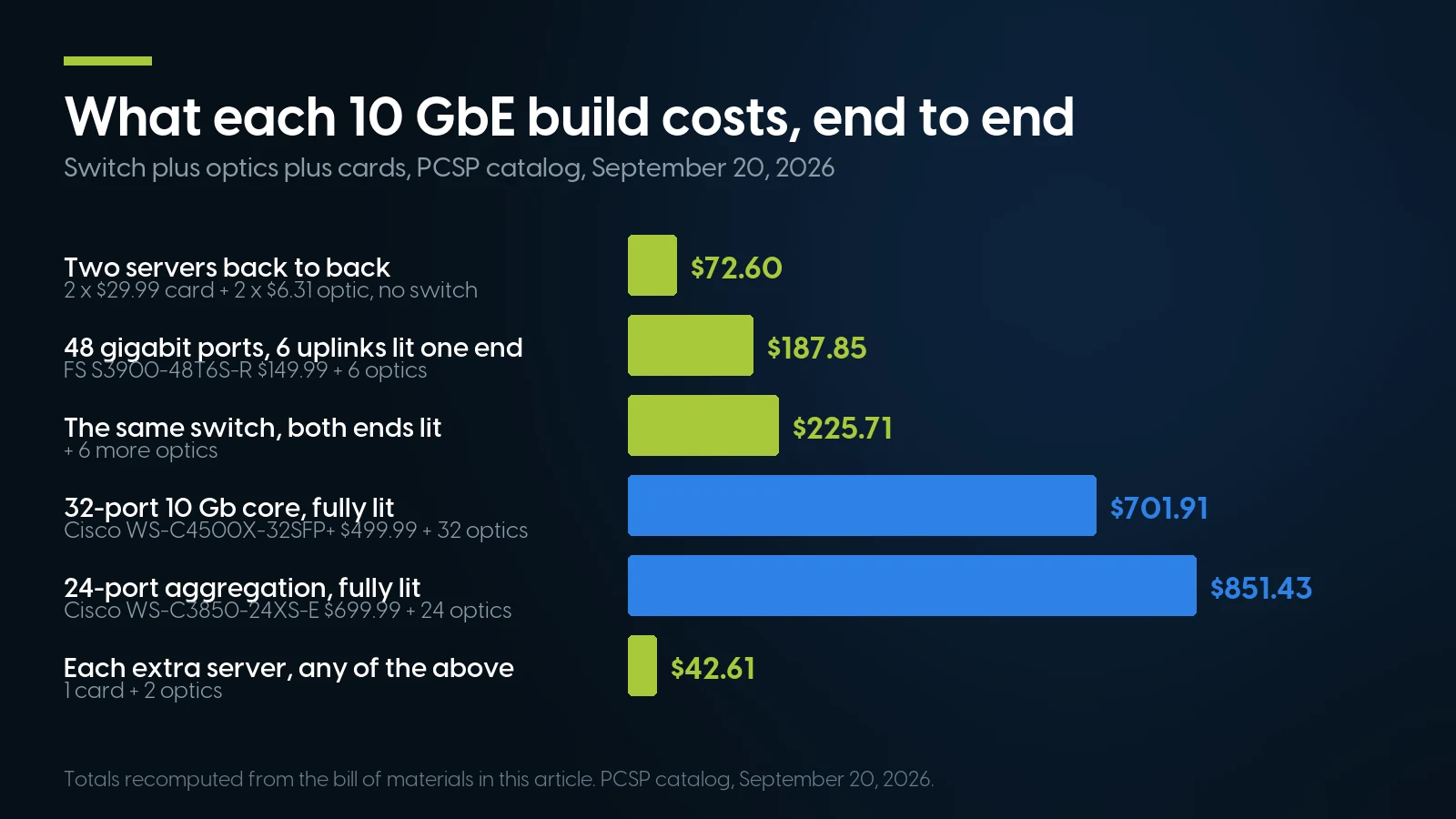
Every build priced from the bill of materials above. The switch is rarely the biggest line: lighting 32 ports costs $201.92 in optics. PCSP catalog, September 20, 2026.
The top three rows are where used hardware wins outright, and the FS switch behind them is the one line we can supply in quantity: 204 units, plus lots of three at $399.99 and five at $499.99, or $133.33 and $100.00 a unit. Switch lots discount; optic lots do not — four of the $6.31 module is $25.24, exactly four times the single price.
The bottom two rows stop being a price list. A 32-port used Cisco core, fully lit, is $701.91; a new 24-port MikroTik, lit with the same optics, $750.44. Forty-nine dollars apart on the invoice, $324.43 a year apart on electricity: the used switch is cheaper for about eight weeks, and it is one of two units, past support.
The card in the server, and whether it will still have a driver
The per-server row uses an HPE 631SFP28 at $29.99 with 202 in stock — PCIe 3.0 x8, the deepest ordinary PCIe card we hold. The cheaper 10 Gb cards below it fit one server family each: the $14.99 Dell Broadcom 57412 is a rack daughter card, the $9.49 57810S-K a blade mezzanine for the M620 and M630. Between those two Dell parts the $5.50 is the most consequential money on the shelf: the 57810 rides bnx2x, the 57412 rides bnxt_en. Red Hat's hardware-enablement chapter for RHEL 10, read September 20, 2026, lists bnx2x as unmaintained — “no longer tested or updated on a routine basis,” and such devices “should no longer be used in production, and it is possible they will be disabled in the next major release.” bnxt_en is not in that table, and neither, the good news nobody prints, are ixgbe and i40e: Intel X520, X540, X550 and X710 cards are live on current Linux.
Age shows up elsewhere. Intel's product change notice 118605-01 of February 8, 2023 put the last X520 shipment on April 22, 2023 and names the X710-DA2 as its replacement; it also dates the original end-of-life announcement to October 22, 2021, and Intel's five-year warranty rule for discontinued adapters runs from there — by our arithmetic, closing on the X520 this October. On the hypervisor side, Broadcom's KB 391170 gives ESX 9.0 two tiers: “Restricted” devices “will be removed in the next major release,” End-of-Life devices “will not be claimed and will not be recognized by ESX 9.0” at all.
A 24-Port Fiber Switch, Used: What Is Actually on the Shelf
Our switch category held 54 priced listings on September 22, 2026 across 621 tracked units, plus 29 quote-only: 25 Cisco build-your-own pages and four $1.00 placeholders.
Sixteen of the 54 are not switches: fourteen Dell EMC VEP4600 listings, 1U x86 appliances with a 16-core Xeon D-2187NT and ESXi or Ubuntu preinstalled at $799.99 to $1,849.99, plus a Cisco Aironet 3802i access point and a Catalyst 6500 forwarding daughter card. That leaves 38 switch listings, three of them DIN-rail industrial: call it 35 Ethernet switches for a normal room, not 54, and only nine rack-mount listings put 10 G or 40 G on the ports. The shelf moves faster than an article: a run of Catalyst 3850 listings — the 12-port fiber model, three 24-port variants and the last LAN Base 48-port units — sold out on September 21, the day after the builds above were priced.
PCSP live catalog, September 22, 2026. “Per 10 G port” is price divided by native 10 G ports, before the $6.31 optic at each end. These nine listings hold thirteen units: a price here is one machine in one configuration, not a line.
Three traps live here, none visible from a title.
- The $49.99 floor is a blade module — a Dell 7N58N Force10 MXL I/O Aggregator, one unit, which plugs into a PowerEdge M1000e blade enclosure and does nothing in a two-post rack. Our cheapest standalone switch is the TP-Link TL-SG3428 at $99.99; the cheapest rack switch with a 10 Gb uplink is a Cisco WS-C3750E-48PD-SF at $89.99 with five units.
- A 40 G switch is not a cheap 10 G switch. The QFX5100-24Q at $219.99 looks like the table's bargain until Juniper's data sheet gives it no native 10 GbE port: 10 G comes only out of a QSFP+ breakout cable, and we stock neither those nor 40 G optics.
- Two identical prices, two opposite airflows. Our two Nexus 5672UP listings are both $149.99 and differ only in which way the air goes — port-side against fan-side intake, red handle against blue in Cisco's shorthand. Buy the wrong one and it exhausts into your cold aisle.
What has depth is the other shape entirely: the FS S3900-48T6S-R, 48 gigabit RJ45 ports and six 10 Gb SFP+ uplinks, $149.99 with 204 units. Behind it a TP-Link TL-SG3428 at $99.99 with 99, whose four SFP slots are gigabit, not 10 G, per TP-Link's own specification page; a Juniper EX4300-48T at $89.99 with 18, its four uplinks 40 G QSFP+ we cannot light; and a reverse-airflow Supermicro SSE-G3648BR, four real 10 G SFP+ uplinks, $124.99 with two.
show version, show license or its platform equivalent, and a photograph of the rear panel. Those settle which image is on it, which feature tier it is licensed for, and whether it has the stacking connector, airflow direction and power supplies you assumed. All three are free to ask for; none appears in a listing title.48 gigabit ports, six 10 Gb uplinks: $149.99, with 204 on the shelf
Stackable, 51 W, 45 dB — and, if gigabit is all you need, a 24-port TP-Link JetStream beside it, From $99.99 · 99 in stock. Priced listings in the category run from $49.99 to $4,099.99 and include blade modules and DIN-rail units; the section above says which you can rack. Those figures refresh nightly.
Browse refurbished switches Ask for a same-day quoteThe Support Clock You Inherit
You are not buying a switch. You are buying a switch frozen on the day it was decommissioned, with a countdown that started before you heard of the part number. Every date below is from the vendor's own bulletin, read September 20, 2026.
Vendor bulletins read September 20, 2026: Cisco end-of-life notices for the Nexus 5672UP, Catalyst 4500-X, copper 3850 and fiber 3850; Juniper's EX and QFX tables; the Meraki end-of-life table, whose date is “the last date a product will be affirmatively supported by Cisco Meraki.”
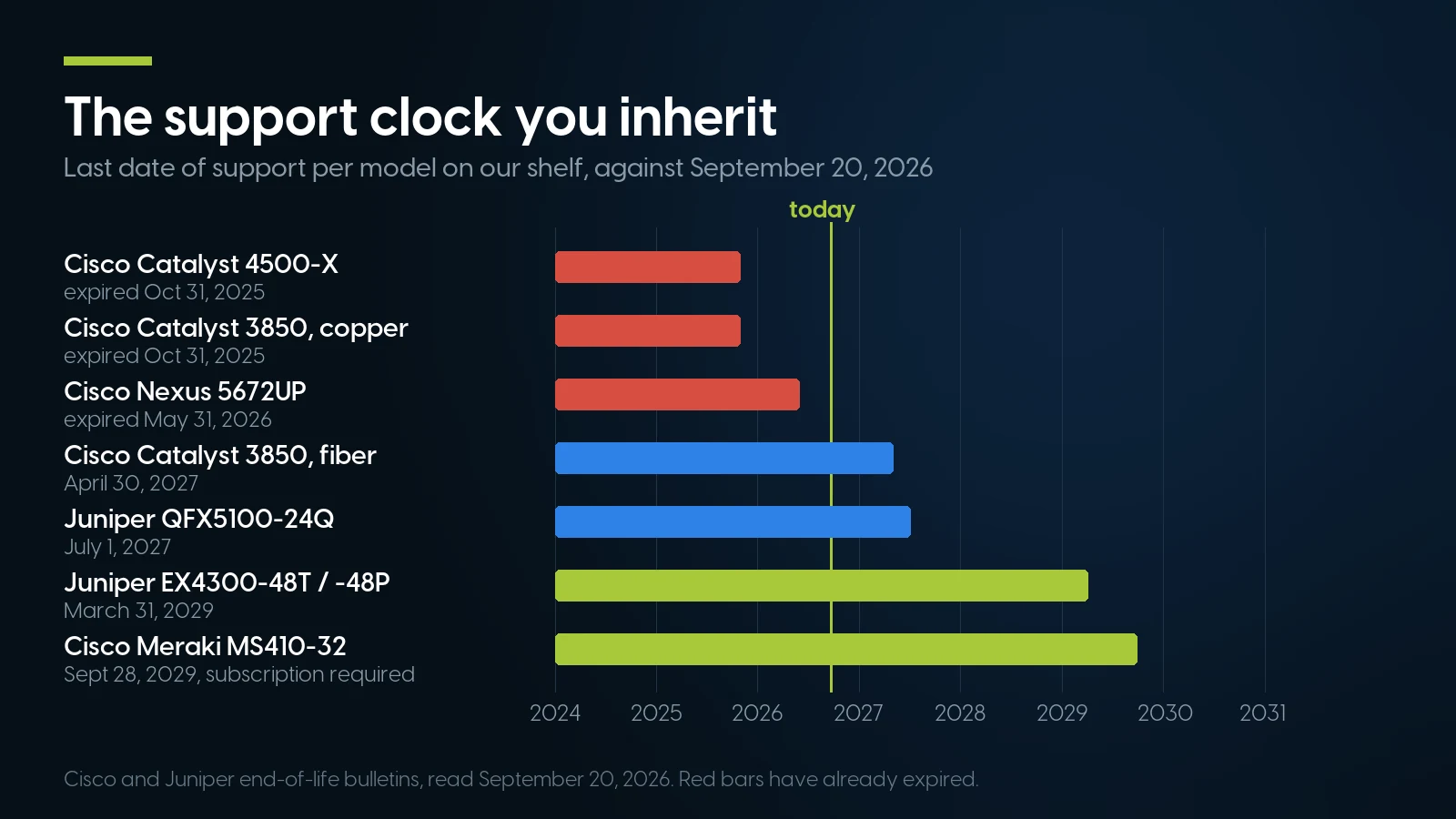
Three of the seven have already run out. Vendor end-of-life bulletins, read September 20, 2026.
What “no support” actually looks like
Not a switch turning off — an absence in a document. On August 5, 2026 Cisco published its IOS XE security hardening advisory covering releases 17.9 through 26.1. Its sentence about our hardware: “Cisco Catalyst 3650 and 3850 Series Switches do not run any of these releases and therefore were not evaluated as part of this review.” The box is not declared insecure; it is simply not in the room when the review happens.
The carve-out is real, and manual. Cisco's Security Vulnerability Policy states that “any customer who does not hold a support contract must contact Cisco by telephone and request that a support case be opened on an exception basis.” Advisory cisco-sa-cat3k-dos-ZZA4Gb3r of September 27, 2023 — a CVSS 8.6 denial of service on the 3650 and 3850, no workaround — says Cisco “has released free software updates” and tells contract-less customers to phone TAC with the serial number as evidence of entitlement. The fix is free; the download is not automatic. After last date of support even that stops: the PSIRT “will continue to accept vulnerability reports but will not analyze, fix, or disclose potential vulnerabilities.”
Ordinary downloads need the contract outright: Cisco's software downloads FAQ says certain software “cannot be downloaded by a Registered Guest user… you need to have a valid Technical Support Services Agreement,” and Juniper's installation documentation requires “a Juniper Networks user account and a valid support contract” before you fetch Junos. Juniper publishes one thing Cisco does not — a last software version per product: the EX4300-32F's is Junos 21.4, which makes “supported until 2029” a different promise from what it sounds like.
The practical reading is not all bad. A used Catalyst or EX arrives with whatever image its last owner left on it, and you can run it, back it up and operate it as long as the hardware lasts. What you cannot reliably do is update it, so buy the box for what it does the day it lands. Third-party maintenance firms do sell coverage on post-support gear; we have not verified their terms.
Licensing: the Half of the Price That Is Not in the Title
On a Catalyst the letter ending the part number is the license: WS-C3850-24XS-E is IP Services, the -S beside it IP Base. Every 3850 on our shelf is now an -E: the last LAN Base unit, a WS-C3850-48PW-S at $109.99, sold out on September 21. That letter decides whether the switch can run OSPF.
Tiers from the vendors' own documents, read September 20, 2026: Cisco's Catalyst 3850 and 4500-X data sheets, the Nexus 5600 data sheet, the Juniper EX4300 data sheet and the Meraki licensing FAQ. Configurations on our shelf: PCSP catalog, September 20, 2026.
Cisco's answer on transfer, and the switch's
These two disagree, and both belong here. Cisco's Software Transfer and Re-Licensing Policy, version 3.3, last modified February 3, 2026, permits a transfer only where law requires it, where one of seven narrow scenarios applies — affiliates, mergers, financed software, managed services, government prime contractors, outsourcing and transfers within Europe, none of them an ordinary second-hand sale — or where Cisco consents and you pay a Transfer License Fee, “equal to the fee for a new individual license.” Its relicensing programme page is blunter: used equipment “is not covered under the Cisco standard warranty. Nor can you place it under a Cisco service and support contract unless it is relicensed by Cisco and has passed our inspection.”
The switch's position is different. On the 3850 the feature tier is right-to-use and honour-based: Cisco's configuration guide documents license right-to-use activate {ipbase | ipservices | lanbase}, an on-screen EULA and a 90-day evaluation license, after which “at the next reload your switch image will return to its default license.” The box will let you type the command; the policy says you do not hold the right. A seller who mentions only the first is not telling you the whole thing.
Meraki: 21 units, every one needing a subscription you must buy new
We hold twenty Meraki MS350-48LP PoE+ switches across four listings from $139.99 to $169.99, plus one MS410-32-HW at $568.99. Good hardware, sharpest trap here, all four reasons in Meraki's own documentation.
- The license is not optional. Meraki's licensing FAQ: “Yes, every Meraki hardware component requires a cloud license to be managed,” and non-compliant hardware “will be non-operational.” The guidelines give 30 days of grace, then the network is “shut down until proper licensing is applied.”
- It costs more than the switch. A five-year enterprise license for the MS410-32 is listed at $3,898.60 by license resellers, one selling it at $2,577.76 on September 20, 2026 — reseller-listed figures, since Cisco publishes no Meraki price list. Taking the lower, $568.99 of hardware plus $2,577.76 of subscription is $3,146.75 over five years, $629.35 a year.
- The warranty does not come with it. Meraki's page on second-hand devices: any warranty “will not be transferred to a new owner if it is sold between third parties… should the device fail, it will not qualify for an RMA.” And only authorised Meraki vendors may resell them.
- And one failure nobody can fix. Same page: a device must “not be associated with any other dashboard account” before you can add it, and “Meraki Support cannot remove the device or help contact previous device owners.” If the last owner never unclaimed the serial, the switch is a brick.
We are not delisting them: somebody already running Meraki wants a $139.99 MS350. Nobody else should buy one expecting it to work.
Ethernet Switch Stacking: What It Buys and What the Cables Cost
Stacking turns several switches into one managed device with one configuration, on paper the best reason to buy two cheap used switches instead of one expensive one. Three things to check, and the third is the one people miss.
Bandwidth and members. Cisco's StackWise-480 on the Catalyst 3850 is 480 Gbps across up to nine members. The 4500-X does not stack at all — it does VSS, two chassis, up to 1.6 Tbps. Juniper's Virtual Chassis on the EX4300 is 320 Gbps across up to ten. The FS S3900-R stacks eight members and up to 384 access ports, per FS's own data sheet. The TP-Link TL-SG3428 does not stack at all.
The ports it consumes, which is the one that changes a design. The FS S3900-48T6S-R stacks over ports 49 to 54 — its six 10 Gb SFP+ uplinks — so a stacked pair loses two of six on each switch before anything else is connected. Juniper's arrangement is the mirror image and no friendlier: the two rear QSFP+ ports form the 320 Gbps backplane, and the data sheet is explicit that “dedicated Virtual Chassis ports cannot be used in Ethernet mode.”
The cables, never included, and we do not sell them. Cisco's stacking spares are their own part numbers — STACK-T1-50CM=, -1M=, -3M= — and StackPower, which pools power supplies across up to four switches, needs different cables again. A 50 cm StackWise-480 cable was listed at $124.21, marked to $77.08, at a networking reseller on September 20, 2026, and two of them close a two-member ring: roughly the price of a managed switch on our own shelf. Juniper's ordering table carries “QSFP+ DAC for Virtual Chassis ordered separately” against every EX4300 SKU, and FS recommends direct-attach or active optical cables under three metres. We stock no stacking cables and no DAC.
And a case where Cisco contradicts itself. The 3850 data sheet, Table 1, marks the 12XS, 24XS and 48XS “No” for both StackWise-480 and StackPower. The hardware installation guide says something narrower: the models that do not support StackWise-480 are “WS-C3850-48XS-S, WS-C3850-48XS-E, WS-C3850-48XS-F-S, WS-C3850-48XS-F-E” — only the 48XS. Both were current on September 20, 2026. We will not pick a side: if your plan depends on stacking a pair of 12XS or 24XS units, get a photograph of the rear panel first.
Watts, Decibels and the Closet Problem
A 1U enterprise switch was designed for a room where nobody sits, cooled by somebody else's air conditioning and billed to somebody else's account. Both assumptions break in a small office.
Watts and acoustics from each vendor's own data sheet, September 20, 2026: Cisco's 4500-X and 3850 sheets (Table 15 weighted averages, which exclude PoE entirely; Cisco gives one blanket “48dBA at 30°C” for the range where Juniper publishes per model), Juniper's QFX5100 sheet, FS's S3900-R sheet and MikroTik's CRS309 and CRS326 pages. A new 8-port Ubiquiti USW-Aggregation is 36 W and $44.75 a year on the same arithmetic: watts × 8,760 ÷ 1,000 × $0.1419, the US commercial rate for June 2026 from the EIA's Electric Power Monthly.
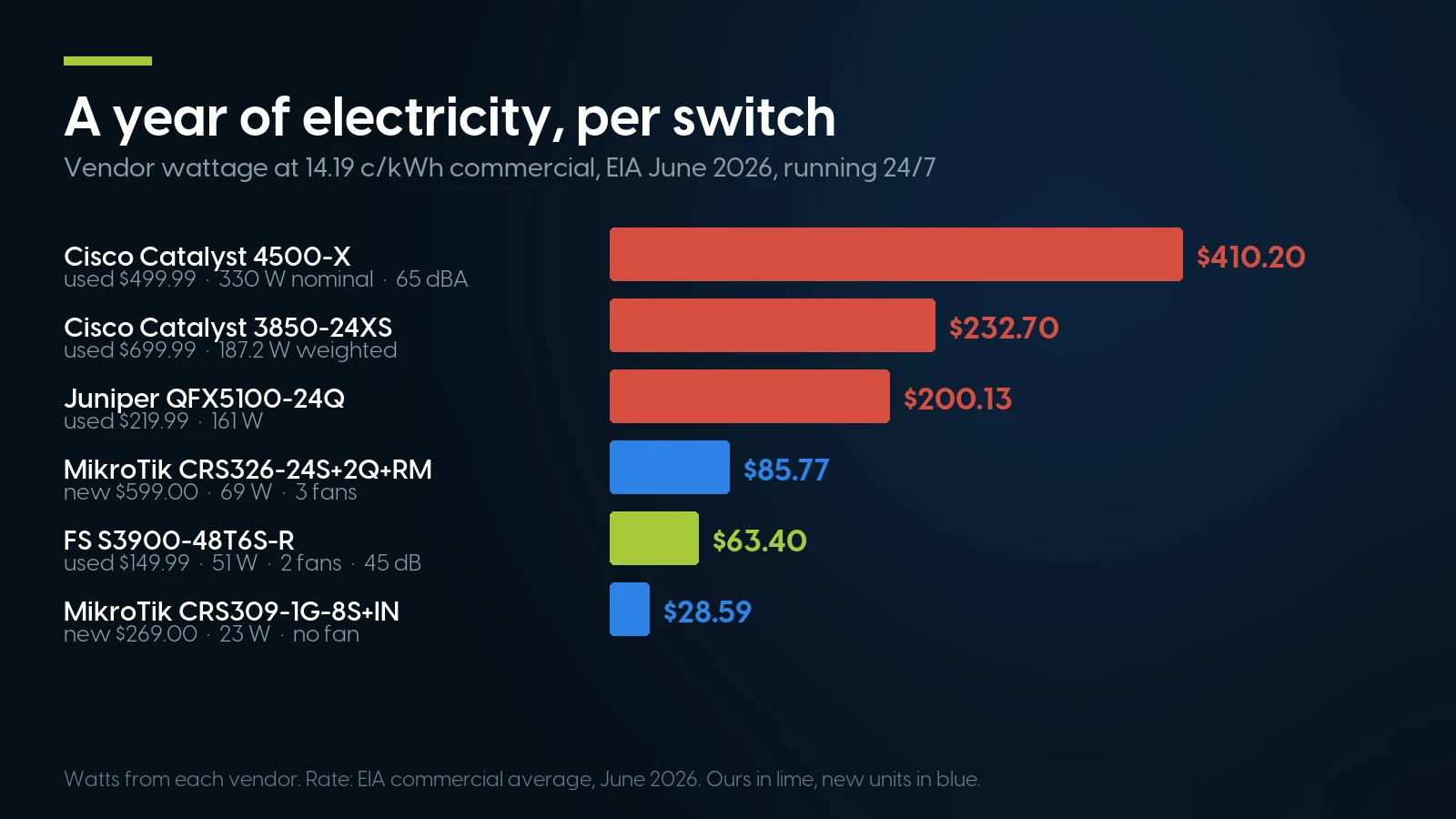
Three years of the 4500-X’s electricity costs more than twice its $499.99 purchase price. Vendor wattage at the EIA commercial average for June 2026.
65 dBA is the number that ends the office-cupboard plan — Cisco's own maximum for the 4500-X, roughly a vacuum cleaner two metres away, all night. The comparison that decides most purchases is the first row against the fourth: $410.20 a year against $85.77 is $324.43, and three years of it is $973.29, nearly twice what the used Catalyst costs to buy. The MikroTik is new, warrantied and has two 40 G ports; the Cisco has eight more 10 G ports, an expired support clock and a fan wall. Which is right depends on who pays the electricity bill. Our home lab server guide runs the same arithmetic on servers, and the power supply guide covers what a wattage label promises.
One honest gap: Cisco publishes power-supply ratings for the Nexus 5672UP but no chassis draw and no acoustic figure we could find, so it is absent from the table rather than guessed at.
PoE: 16 listings, and a 13-decibel tax
There are 16 PoE listings: four Catalyst 3850-48U UPOE units from $164.99, four Meraki MS350-48LP holding twenty units between them, four Juniper EX4300-48P from $100.99, a WS-C3750E-48PD-SF at $89.99 with five, a WS-C3650-48FQ-L at $179.99 with two, and two industrial Cisco units — and the four Meraki listings carry the licensing problem above.
What PoE costs is watts and noise. Juniper publishes acoustics per SKU, and the same chassis in the same rack unit is 37.8 dBA as the EX4300-48T and 51.0 dBA as the EX4300-48P — 13.2 dB louder for the supply and fans the PoE budget needs. Cisco's 3850 sheet gives the other half: a 48P delivers 435 W of PoE on its standard 715 W supply, or 1,535 W with a second 1100 W supply; a 48F or UPOE 48U delivers 800 W or 1,900 W. None of it is in the weighted averages above, which are measured with no PoE load. Per port, Juniper states 15.4 W of 802.3af, 30 W for PoE+ and up to 95 W for PoE++ — budget by what the devices draw, not by what the switch can deliver.
Copper or Fiber: 10GBASE-T, DAC and the 30-Metre Rule
Ten gigabit over ordinary RJ45 sounds like the obvious answer, because gigabit over ordinary RJ45 was. Cisco's own 10GBASE-T SFP+ module FAQ quantifies the difference: the module runs 10 Gbps up to 30 metres on Cat6A and draws 2.5 W doing it, and the FAQ warns that “the maximum power consumption of this transceiver (2.5W per port) imposes certain restrictions during deployment.” At 1 Gb the same module runs 100 metres on Cat5e.
Set that against Cisco's 10GBASE SFP+ data sheet, read the same day: a 10GBASE-SR optic is 1 W and reaches 300 m on OM3 or 400 m on OM4, while a passive twinax direct-attach cable is 0.1 W over one to five metres. Juniper prices the same tax at switch scale: a QFX5100-48S with 48 SFP+ ports draws 150 W, a QFX5100-48T with 48 10GBASE-T ports 335 W — 2.2 times, same generation, same port count.
Where that leaves our shelf is a dead end worth naming. Every 10 G port we sell is SFP+ and we have no 10GBASE-T switch, so a copper 10 G card — an Intel X540-T2 at $36.99 with nine in stock — needs either a 10GBASE-T SFP+ module we do not stock or a switch from somewhere else. The textbook answer inside one rack, a passive direct-attach cable, we cannot sell either. Everything we do sell is 850 nm multimode SR on duplex LC; the transceiver guide has the ladder from 26 m to 400 m.
When Our Shelf Is the Wrong Answer
We sell everything here, so here is the case against buying it.
You may not need 10 GbE at all, and we sell nothing for the alternative. A fanless eight-port 2.5 GbE unmanaged switch was listed at $59.99 at Newegg on September 20, 2026: two and a half times gigabit over the Cat5e already in the walls, no optics, no console cable, no rack. Where the complaint is “copying files is slow” that is often the right answer, and our switch category contains no 2.5 GbE product of any kind.
A small office with no rack and nobody to hold the console cable. Every enterprise switch here assumes a rack, a serial session and somebody who knows what a VLAN is. Without that person, a new MikroTik CRS309 at $269.00 with eight SFP+ ports, 23 W and no fan, or a Ubiquiti USW-Aggregation at $269.00 with a browser interface, is quieter, warrantied, current — and over three years cheaper outright than a $499.99 Catalyst 4500-X once electricity is counted.
Anything where the support clock matters. If an auditor, an insurer or your own policy requires a vendor-supported switch, three of the models above are already out, and the fiber 3850 cannot go under a new Cisco contract even though its security support runs to April 2027. Buy new, or buy the Juniper EX4300, which runs to 2029.
The Meraki units. Twenty-one switches that are dark without a subscription, lose their warranty on resale and cannot be claimed if the previous owner left them in their dashboard. For people who already run Meraki.
Anything you need in quantity at 10 G. Nine listings holding thirteen units is not a catalogue to deploy from, and the only 10 G-capable line we can supply in number is the FS S3900, whose ten-gigabit ports are uplinks. For a rollout use the quote path and expect us to source rather than ship from stock.
And the absences, listed rather than glossed. No 25 G or 40 G optics, so the 40 G uplinks on the EX4300, the QFX5100, the Nexus and the FS S5850 cannot be lit from our catalog at all, and the 25 GbE cards we sell cheaply — the HPE 631SFP28 the bill of materials uses, $29.99 with 202 in stock — will never run above 10 G here. No DAC or twinax, no single-mode, no LR or ER, no BiDi, no MPO, no QSFP optic, nothing above 10 GbE. No stacking cables. No 10GBASE-T switch. No rails, ears or spare supplies as separate line items — several listings say “no ears” or “module blank” in the title, and that is part of the price. And the trap that catches people hardest: the $1.99 floor in our transceiver category is 4 Gb and 8 Gb Fibre Channel, which will sit in a 10 GbE port, power up, report itself politely and never bring the link up.
The 10 GbE parts on our shelf today
Lowest listed price in each category and what is on the shelf right now — barebones chassis included, so a complete build costs more than the figure shown. This block is the one part of the article that refreshes itself; every price in the text above is dated where it stands.
- Switches1 GbE access with 10 G uplinks, plus a few SFP+ coresFrom $49.99 · 64 in stock
- SFP+ transceiversMostly 8 Gb Fibre Channel — 10 G SR from $6.31From $1.99 · 233 in stock
- Server network cardsPCIe, FlexibleLOM, rNDC, UCS MLOMFrom $6.17 · 104 in stock
- Cables and accessoriesCords, risers, rails, bracketsFrom $7.49 · 173 in stock
- Refurbished serversThe machines these cards go inFrom $69.99 · 261 in stock
Tell us the two ends of the link. We will price the middle.
10 G SR optics at $6.31 with 590 on the shelf, a dual-port HPE 631SFP28 PCIe card at $29.99, and server network cards from $6.17. Free ground shipping over $35, 90-day parts warranty, same-day shipping on in-stock orders before 1:00 pm EST (Mon–Fri). Those figures refresh nightly; everything dated in the text above does not.
Browse SFP+ transceivers Browse server network cardsThe Bottom Line
The hardware is almost free. Forty-eight gigabit ports with six ten-gigabit uplinks, every uplink lit, is $187.85; a ten-gigabit link between two servers, cards and optics included, is $72.60. Nothing new comes close, and neither build is a compromise.
The enterprise boxes above them are a different transaction. A $499.99 Catalyst 4500-X burns $410.20 a year against $85.77 for a new switch of the same class, lost its last date of support in October 2025, is rated at 65 dBA and carries a feature license Cisco's own policy says did not transfer to you. In a rack you already cool it is still an enormous amount of switching for the money — but buy it with the dates in front of you.
So: put 10 GbE where the data actually moves, buy the switch for what it does the day it lands, get show version and a photograph of the rear panel before you pay, and count the watts before the savings. If the honest answer is a $59.99 fanless 2.5 GbE switch from somebody else, take it and spend the difference on the servers at either end.
Moving to 10 GbE on Used Gear: FAQ
How much does it cost to add 10 GbE to a server?
$42.61 per server on our September 20, 2026 prices: a dual-port HPE 631SFP28 at $29.99 plus two 10 G SR optics at $6.31, one for the card and one for the switch port at the far end. Two servers talking only to each other need no switch at all — two cards and two optics is $72.60 plus a duplex LC lead. Check the card’s form factor before its speed; that is what decides whether it fits.
What is the cheapest way to get 10 Gb uplinks on a 48-port switch?
A 48-port gigabit switch with six 10 Gb SFP+ uplinks at $149.99, plus $6.31 an optic: $187.85 with all six lit at one end, $225.71 with both ends lit. The nearest new equivalent we could price the same day was a TP-Link TL-SG3452X at $559.99, with four uplinks rather than six.
Do used Cisco switches still get security updates?
It depends on the model’s dates, and several common ones are past them. Cisco’s policy says a customer without a support contract must telephone Cisco to open a case on an exception basis: the fix is free, but you request it advisory by advisory. After last date of support the PSIRT will accept reports but “will not analyze, fix, or disclose” them. The Catalyst 4500-X passed that date on October 31, 2025 and the Nexus 5672UP on May 31, 2026.
Can I stack two refurbished switches?
Usually, and the cables are never included. StackWise-480 does 480 Gbps across up to nine Catalyst 3850s on STACK-T1 cables, one of which was listed at $124.21, marked to $77.08, on September 20, 2026 — two close a ring. Juniper’s Virtual Chassis does 320 Gbps across ten EX4300s. The FS S3900-R stacks over its own 10 Gb uplinks, so a stacked pair loses two of six. We sell no stacking cables.
Can I use a Meraki switch bought second hand?
Only with a new subscription, and sometimes not even then. Meraki says every hardware component requires a cloud license and that non-compliant hardware is non-operational, with 30 days of grace. Warranty does not transfer to a second-hand buyer and a failed unit gets no RMA. Worst of all, a device still claimed in a previous owner’s dashboard cannot be added to yours, and Meraki support will not remove it.
Do I need 10GBASE-T or SFP+?
SFP+, on a used budget. Cisco’s own FAQ gives its 10GBASE-T SFP+ module 30 metres of reach on Cat6A and 2.5 W of power, against 1 W and 300 to 400 metres for a multimode SR optic, and Juniper shows the same tax at switch scale: 150 W against 335 W for the same 48-port platform. We stock no 10GBASE-T switch and no 10GBASE-T module, so a copper card from us needs a switch from somewhere else.
Do you sell 24-port fiber switches?
Yes, but read the depth before planning around it. On September 22, 2026 the shelf held a Cisco WS-C3850-24XS-E with twenty-four 10 Gb SFP+ ports at $699.99, a WS-C4500X-32SFP+ at $499.99 and a 48-port FS S5850-48S6Q at $1,949.99 — every one of them one or two units. The line we hold 204 of is a gigabit switch with six 10 Gb uplinks.