

SFP+ Transceivers and Server Network Cards in 2026
Posted by Konstantin Protasov, PCSP on Sep 14th 2026
An SFP+ cage is one hole, and at least four incompatible things fit in it. The cheapest modules on the internet — the $2 ones, sold fifty to a lot — are overwhelmingly 8 Gb Fibre Channel, and nobody says so. On our own shelf, priced as of September 18, 2026, 80.6% of the deduplicated module pool is Fibre Channel and only 18.4% is Ethernet.
The manufacturers draw the line in public. Coherent's page for the FTLF8528P3BCV calls it an “8G Fibre Channel (8GFC) 150m SFP+ Optical Transceiver” for “Fibre Channel links up to 8.5 Gb/s,” compliant with FC-PI-4 — and names no Ethernet standard anywhere. Finisar's datasheet for the 10 G part, the FTLX8571D3BCL, lists both “10GBASE-SR/SW 10G Ethernet” and 10 G Fibre Channel. Same shape, same 850 nm laser, different answer. The protocol lives in the exact part number, not in the connector.
This is the network twin of our guide to SAS, SATA and NVMe drives: the same question at the other end of the server, and the same one our power supply guide asks about the label on a PSU. Below — what plugs into what, what “coded for Cisco” physically is, which cards fit which machine, and what it costs new against used.
The short version — vendor documents read September 14, our shelf re-checked September 18, 2026:
- Four out of five modules on our shelf are Fibre Channel. Deduplicated by manufacturer part number the pool is roughly 9,000 modules across 72 part numbers: 7,219 Fibre Channel (80.6%), 1,649 Ethernet (18.4%, all 10 GbE), 84 dual-protocol.
- The price cliff is openable. HPE's own store that day: $328.39 for a 10 G SR SFP+, $1,038.19 for a 25 G SFP28 SR, $192.70 for a 1.2 m DAC, $1,640.73 for a 32 Gb FC HBA. Our 10 G SR floor is $4.79; the one we hold 590 of is $6.31.
- “Coded for Cisco” is 35 bytes of EEPROM — vendor name, OUI and part number at address A0h, bytes 20–55. The strict end is usually the server: Intel says other brands of SFP+ optics “will not work” with the X520 series.
- On cards the form factor is the constraint, not the speed. 967 of our 2,201 cards — 44% — are FlexibleLOM, rNDC, blade mezzanine, mLOM or OCP 3.0 parts that fit one server family and nothing else.
- ConnectX-3 is finished on two platforms. ESXi 8.0 removed
nmlx4_en; RHEL 10 removedmlx4. We have two ConnectX-3 cards left on the shelf and we are telling you not to put them in a 2026 hypervisor. - Refurbished network switches: 58 priced models, $49.99 to $4,099.99, deepest at a 48-port gigabit switch with six 10 Gb SFP+ uplinks, $149.99, 204 in stock. Catalyst 9300 and Nexus are genuinely quote-only.
- What we do not have: no DAC or twinax, no single-mode, no LR/ER, no BiDi, no MPO, no QSFP optic, nothing above 10 GbE. These are parts: the 90-day parts warranty applies, not the one-year system warranty.
Most Cheap SFP+ Modules Are Fibre Channel, and Almost Nobody Says So
The SFP form factor is old enough to vote: SFF-8472 Rev 12.5a (SNIA SFF TWG, January 16, 2026) traces its management interface back to “the SFP MSA document dated September 14, 2000.” Twenty-six years of standards poured into one mechanical opening, and the opening never changed. An SFP cage, an SFP+ cage and an SFP28 cage are the same hole, and the module either matches the protocol at both ends or it does nothing.
Coherent's page for the FTLF8528P3BCV claims compliance with FC-PI-4 Rev 8.00 and SFF-8472, compatibility with SFF-8432 and SFF-8431, and no IEEE 802.3 clause at all; Finisar's sheet for the FTLX8571D3BCL opens with “10GBASE-SR/SW 10G Ethernet,” specified for 9.95 to 10.5 Gb/s. The arithmetic follows: 8 Gb Fibre Channel signals at 8.5 Gb/s, a 10GBASE-SR link at 10.3 Gb/s, and there is no 8 Gb Ethernet to negotiate down to. The module powers up, reports itself on the management bus, and never brings the link up.
What that looks like on our own shelf
Our transceiver category holds 233 purchasable listings — not 233 products and certainly not 233 modules, because 176 of them are “Lot of N” multipacks re-listing the same stock at a different pack size. Grouped by manufacturer part number the shelf collapses to 72 distinct parts and roughly 9,000 modules, the only figure worth quoting.
PCSP live catalog, September 18, 2026, category SFP transceivers, deduplicated by manufacturer part number so a “Lot of 25” listing is not counted as extra stock. Protocol comes from the standard named in each part number, never from the form factor. Counted other ways the Fibre Channel share moves but the story does not: 61.4% by SKU, 74.6% by listing, 78.8% if you expand every lot. A part coded HP and the same part coded HPE count as two.
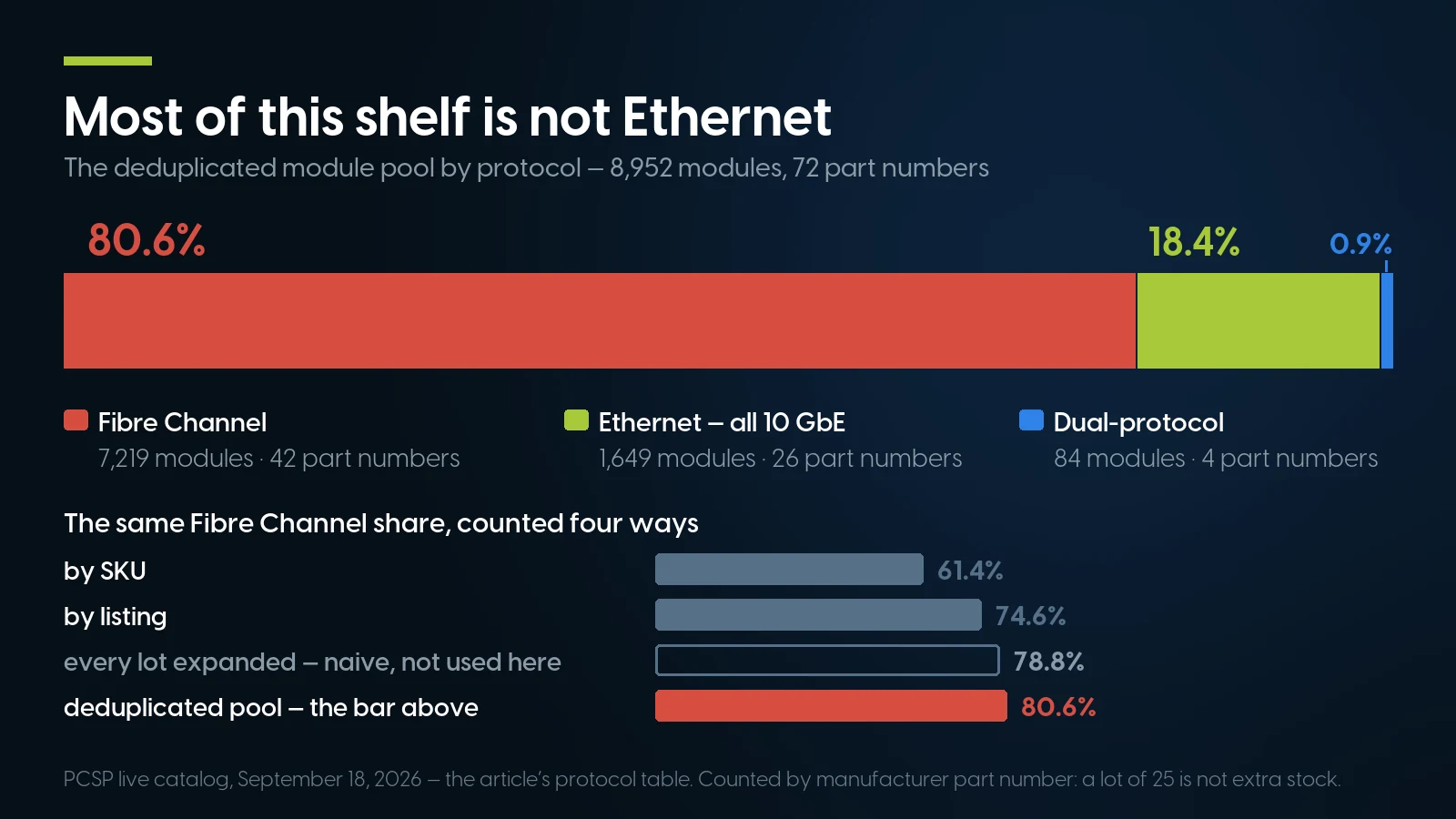
Four in five modules on our shelf are Fibre Channel. PCSP catalog, September 18, 2026.
The exceptions are real, and they are thin
- 10 G is where the protocols meet. One module legitimately carries both — the FTLX8571D3BCL above, and the Avago AFBR-709SMZ family we list as “10G SR/SW” at $5.89.
- At 16 G it is a suffix. The Avago AFBR-57F5UMZ-EP1 is sold as 16GFC/10GE at $7.89; the AFBR-57F5MZ-ELX beside it, same generation and laser, is Fibre Channel only at $5.79.
- At 4 G it is one letter. Coherent's FTLF8524P2xNy datasheet defines it: L is Fibre Channel only, V is rate-selectable and adds “1.25 Gb/s 1000Base-SX Ethernet.” Our 4 G parts end in V.
Do not plan around them: not one of our twelve dual-protocol listings reaches twenty units — four part numbers, 84 modules in all. Physics, not a shelf.
And a trap inside the trap: 29 of our Fibre Channel listings carry the letters “SR” in the title — “8G SR/SW,” “16G SR” — because that is the seller's shorthand for short-wave, which is also what SR means in Ethernet. Five manufacturer part numbers, about 515 modules once the repeated lots are collapsed, and every one is Fibre Channel.
Our deepest single part is exactly that: an HPE AJ718A 8 G short-wave Fibre Channel SFP+ at $2.19, 1,410 in stock. Excellent for a Fibre Channel SAN — a Brocade or Cisco MDS fabric switch, a QLogic or Emulex HBA. Not a 10 GbE optic, and it never will be.
What New Costs and What Used Costs: Four Receipts
Every new price below came from HPE's own US store on September 14, 2026 — not list prices in the Cisco sense, since each page is fulfilled by a reseller and carries HPE's footnote, “Prices may vary based on local reseller.” Ours are from our live catalog the same day.
New prices: HPE Store US, captured September 14, 2026, listed price fulfilled by a reseller. Used prices and stock: PCSP live catalog, September 18. No Cisco list price appears anywhere here: the global price list is behind a bot challenge.
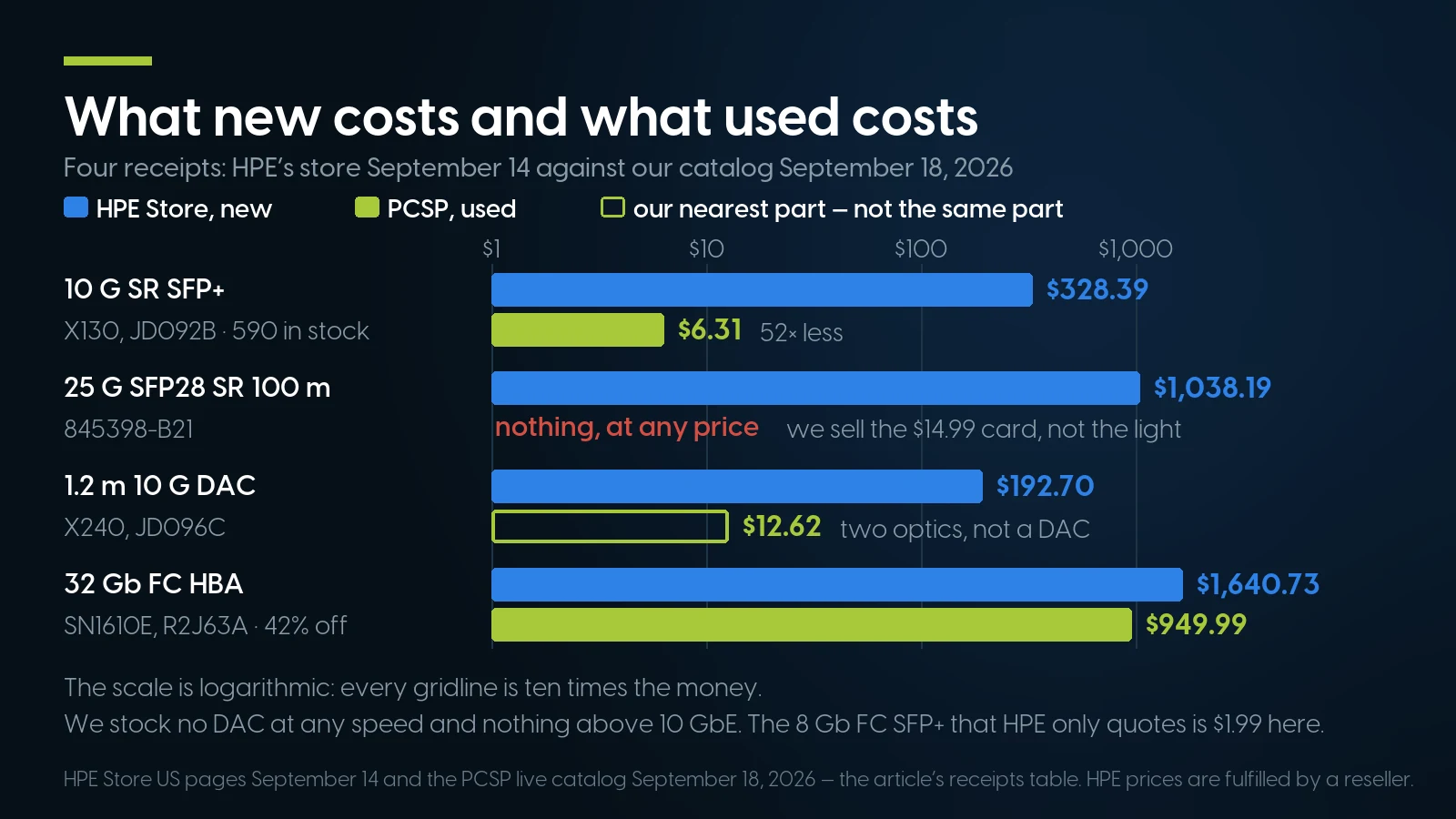
The optic is 52× cheaper used; the current HBA only 42%. HPE Store September 14, PCSP September 18, 2026.
The 10 G row is the one that changes behaviour. $328.39 against $6.31 is a 52× spread, 68× against the $4.79 floor. Nothing about the optic differs: HPE sells a part it still manufactures, supports and warranties, and we sell one somebody decommissioned. The 32 Gb HBA row proves it backwards — where the part is current and used supply thin, the gap collapses to 42%.
Per module, by protocol and speed: the cheapest Fibre Channel listings with real depth are $1.99 at 4 G and 8 G and $5.79 at 16 G; the cheapest Ethernet one is $6.31, or $4.89 per module in a lot of four. The $4.79 10 GbE floor has three units behind it. And in 25 G, 40 G, 100 G, single-mode and DAC the figure is not a price but an absence: zero purchasable in every one of those classes.
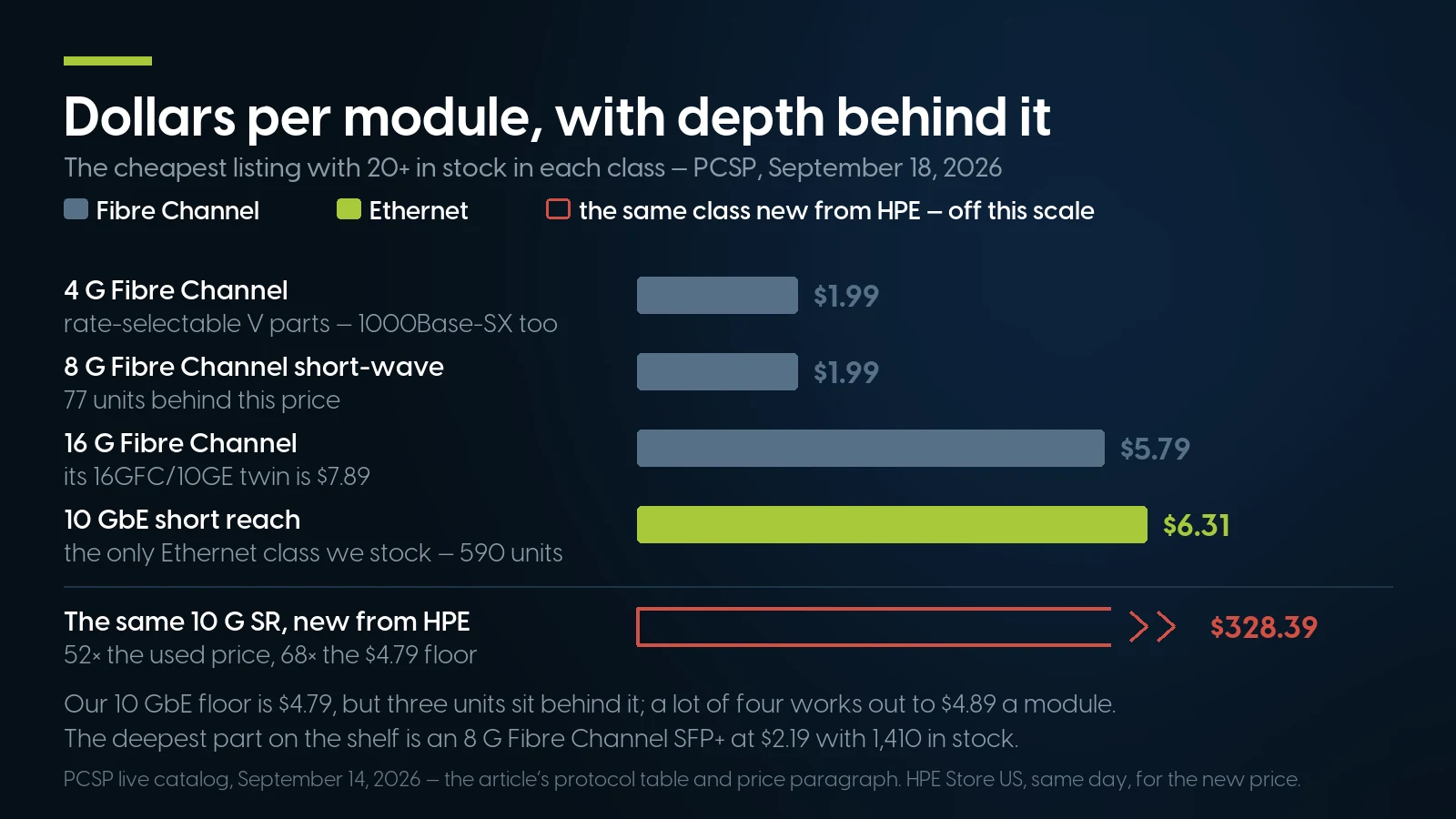
Under $6.31 a module for every class with real depth. PCSP September 18, HPE Store September 14, 2026.
Our lots are not a discount. Of 139 multipack listings with a single-module twin, 137 price at exactly the pack size times the single price, to the cent: a lot of 100 of the $2.19 module is $219.00. A lot buys availability, not a lower unit price. And what sets that price is supply, not capability — our 8 G Fibre Channel modules cost a third of our 10 GbE ones because a generation of SAN fabrics came out of service at once.
Ten-gigabit optics at $6.31, with 590 of them on the shelf
850 nm multimode short reach, single modules and lots to 50 — 90-day parts warranty, same-day shipping before 1 pm EST. That price and count refresh nightly. Tell us the switch and the card; we will tell you the coding.
Browse SFP transceivers Ask for a same-day quote“Coded for Cisco” Is 35 Bytes of EEPROM
Vendor locking sounds like a licensing scheme. Mechanically it is a string comparison. Every module in the SFP family carries a 256-byte identification EEPROM at address A0h, and the fields a host checks sit at bytes 20–35 (vendor name), 37–39 (OUI) and 40–55 (part number). Sixteen, three and sixteen: thirty-five bytes out of 256. Those bytes are identity, not optics: they do not change the laser, the receiver, the diagnostics or the reach.
Vendors describe the mechanism themselves. Dell's networking transceivers spec sheet (© 2026): the “Dell product specification encoding feature allows Dell Networking platforms to recognize certified and supported transceivers.” Cisco's unsupported-transceiver article, updated March 13, 2026, shows the switch logging gbic-invalid and err-disabling the port, then names two commands to bring it up: no errdisable detect cause gbic-invalid and service unsupported-transceiver. The single-command advice on forums leaves the port disabled.
The twist: the strict side is usually the server
Everyone worries about the switch. In practice the switch is the forgiving end and the network card refuses. Intel says so in print. Its Ethernet SFP+ Optics product brief carries the sentence flat: “Other brands of SFP+ optical modules will not work with the Intel® Ethernet Converged Network Adapter X520 Series.” That is the X520 — one of the most common used 10 GbE cards there is, and one we sell three variants of.
The Linux driver documents the same rule and the way round it. The ixgbe documentation says an 82599-based adapter shipped with Intel optics “only supports Intel optics and/or the direct attach cables listed below,” and that on older 82598 parts, “if you plug in a different type of module, the driver will not load.” The parameter allow_unsupported_sfp, default 0, permits untested modules “as long as the type of module is known to the driver” — a permission, not a universal adapter. Intel's 700-series documentation says some X710-family adapters “only support Intel Ethernet Optics modules.” Order of questions for a used 10 GbE build: card, then optic, then switch.
What coding costs, on two pairs from our own shelf
- Oracle coding: 5.2×. The Avago AFBR-57F5MZ-ELX 16 G short-wave module is $5.79 with 195 in stock as a plain Avago part and $29.99 with 78 in stock when the title also carries Oracle's part number 7023053. The manufacturer part number is identical in both.
- Third-party clone against the coded original: 41%. Every Intel-branded E10GSFPSR listing in our catalog is sold out; what is in stock is AMC Optics’ third-party clone at $6.31, 590 units — a different company's module coded to satisfy the same host, and never to be called the Intel part. The genuinely Intel-coded module survives under a title omitting the E10GSFPSR string, as FTLX8571D3BCVIT1 at $8.89, twelve units.
Those two numbers are the honest bracket: coding is worth something, rarely an order of magnitude, never what a boxed OEM module costs. And a third case that is not about coding at all: the same Finisar 4 G part number, FTLF8524P2BNV, sits on two listings whose titles differ by one suffix. Four days before this went out they were $1.99 and $14.99 at the same time; today both are $1.99. Read the whole listing, and the price of the one beside it.
The warranty argument, printed from both sides
Third-party sellers say the warranty is unaffected. FS.COM — one of the largest, and a party with an obvious interest — prints a note on its own transceiver page, captured September 14, 2026 (served to us in Russian; the translation is ours), saying a third-party module does not void the warranty on the network equipment and that all network equipment makers publish guidance to that effect.
Juniper, on its own public hardware-planning page, writes something harder to square with that: “JTAC does not provide support for third-party optical modules and cables that are not qualified or supplied by Juniper Networks. … Any damage to the host equipment due to the use of third-party optical modules or cables is the users’ responsibility. Juniper Networks will accept no liability for any damage caused due to such use.” (Juniper, supported transceivers and cables, checked September 14, 2026.)
Arista answers a narrower question cleanly: in its 100G optics FAQ, non-Arista transceivers are “fully interoperable” provided they meet the industry specification. Interoperable is not supported, and that gap is the risk. We found no HPE statement of its own here, so we claim none. Our reading, as a seller of used coded optics: on a lab or a second site, coding is a compatibility detail and nothing more; on a production fabric under a TAC agreement, buy the vendor's optic.
Optical Basics That Decide Whether the Part Works At All
Four properties settle almost every optics question: fibre type, wavelength, connector, and whether both ends match. The fibre sets the reach, not the module. Finisar's datasheet for the FTLX8571D3BCL prints the ladder for one 10 G SR module: 26 m on 160 MHz·km 62.5 µm fibre, 33 m on OM1, 66 m on 400 MHz·km 50 µm, 82 m on OM2, 300 m on OM3; Cisco's 10GBASE SFP+ data sheet adds 400 m on OM4. A 15× spread, decided by the patch cord. 850 nm means SR, SX or SW, multimode, VCSEL — that is every optic we sell; 1310 nm is LR and LX, single-mode, ten kilometres; 1550 nm is ER and ZR. Different lasers, different glass, no adapter.
Connectors split the same way. Duplex LC serves every SR, LR and ER module in the SFP family. Parallel four-lane optics — 40GBASE-SR4, 100GBASE-SR4 — use MPO/MTP-12 ribbon and cannot reach a duplex-LC plant without a breakout cassette; a 40 G BiDi module, multiplexing two wavelengths onto each strand, can. And both ends must be the same type: every reach figure assumes a matched pair. BiDi is the designed exception, asymmetric on purpose — a D half and a U half, and two of the same half never link.
What plugs into what
Sources, checked September 14, 2026: Dell networking transceivers spec sheet (© 2026); Cisco 10GBASE, 25GBASE, 40GBASE and Gigabit SFP data sheets; Arista 100G Transceivers and Cables Q&A. And one thing not to buy: OM5 patch cords bought to future-proof a 10 or 25 G link — the TIA Fiber Optics Tech Consortium gives 40GBASE-SR4 the same 150 m on OM4 and OM5.
DAC and twinax: advice, not an offer
Inside one rack, direct-attach copper is the textbook answer: two SFP shells wired together with shielded twinax and an ID EEPROM, no laser, 1–5 m passive and 7–10 m active at 10 G per Cisco's data sheet. On the used market that rule inverts. HPE's store wants $192.70 for a 1.2 m X240 DAC; two used 10 G SR optics come to $12.62, and you supply the fibre. We do not sell DACs: the four twinax listings that ever existed here are sold out, and our cable categories hold SAS, NVMe and power leads.
Auditing a used module before you trust it
The same SFF-8472 page that carries the vendor string carries digital diagnostics at address A2h: temperature, voltage, transmit bias and receive power, with alarm thresholds written at manufacture. On a switch, show interface transceiver reads it; on Linux, ethtool -m does. A link that is up but near the receiver sensitivity floor is reporting a dirty connector or a tired VCSEL before it drops frames. The wider checklist for used hardware is in our used server buying guide.
Server Network Cards: the Form Factor Is the Constraint, Not the Speed
Ask which server network card to buy and the first answer is almost never a speed. It is a shape. Our network card category holds 112 purchasable listings, of which 89 are mainstream server network cards; the rest are storage HBAs, array modules and things that are not network cards at all. Of the 2,201 cards behind them, 967, or 44%, fit exactly one server family — the cheapest, deepest end of the shelf:
- HPE FlexibleLOM (FLR for rack, FLB for blade): a proprietary edge connector on the system board, not a PCIe slot. HPE retired it at Gen10 Plus for OCP 3.0: the DL380 Gen10 Plus user guide carries an “Installing an OCP 3.0 adapter card” procedure and no FlexibleLOM procedure at all — so a Gen9 card does not fit a Gen10 Plus server, or the reverse. Ours: a 640FLR-SFP28 at $14.99 with 329 in stock, a 562FLR-T at $18.99 × 53, a 534FLR-SFP+ at $13.85 × 34, a 544FLR at $8.31 × 28.
- Dell rNDC and bNDC: Dell's PowerEdge R640 Technical Guide lists that machine's I/O as “Up to 3 x PCIe Gen slots plus a dedicated PERC and rNDC slot,” because daughter cards “allow you to choose the right network fabric without using up a valuable PCI slot.” Ours run $14.99 to $49.99.
- Blade mezzanine (Dell M-series and MX, HP BladeSystem): a Broadcom 57810S-K for the M620 and M630 is $9.49 with 55 in stock; a QLogic FastLinQ QL41262HMKR for MX is $19.00 × 79.
- Cisco VIC and mLOM: Cisco's VIC 1340 data sheet calls it “designed exclusively for the M4 generation of Cisco UCS B-Series Blade Servers.” We hold 55 at $19.99 and 41 UCSB-MLOM-40G-01 at $6.17. At six dollars they look like the bargain of the category; they fit a UCS chassis and nothing else.
How to tell from a listing — and where listings fail you
Bracket height first. The R640 guide is explicit that three of that machine's four risers carry “Low Profile, Half Length” slots and only one takes full-height cards. In a 1U server, “High Profile” on a listing usually means it will not fit.
Then the host family — where our own catalog is the cautionary tale. Not one of our five FlexibleLOM listings names a ProLiant generation, and exactly one of our nine Dell rNDC listings names a Dell one; the 640FLR-SFP28, our second-deepest card at 329 units, has no “Gen9,” no “Gen10,” no “DL” in its title. Worse, seven of those fourteen listings say “High Profile” — a PCIe bracket height, on a card with no PCIe bracket. In fairness, the blade mezzanine and Cisco MLOM listings do name their hosts.
So: read the listing, not the title. With both sides showing: we list an HPE 544FLR at $8.31, 28 in stock, whose title begins “InfiniBand” and then specifies two 10 Gb SFP+ Ethernet ports in the same line. Both cannot be true; it is a FlexibleLOM adapter with SFP+ cages. When a title contradicts itself, trust the OEM part number — 656090-001 here. For how two 1U platforms differ on these options, our SR630 versus R640 write-up compares them.
OCP 2.0 and OCP 3.0 are not the same connector
OCP NIC 3.0 mounts on a card-edge connector — the 4C+ connector, sixteen PCIe lanes — and is serviced from outside the chassis; the small form factor is 76 × 115 × 11.50 mm, per ServeTheHome's guide. OCP 2.0 used a mezzanine connector and mounted flat on the board inside. To be exact: opencompute.org refuses our requests, so we have not read the design specification and are not quoting a clause from it. What we can show is that vendors ship them as different products — NVIDIA's notice LCR-000821 lists MCX4421A-XCQN “for OCP2.0, Type 1” and MCX4621A-XCAB “for OCP 3.0.”
One measure of how fast this end of the market moves: the HPE adapter searched for most in our logs, the Ethernet 10Gb 2-port 562SFP+, now carries “RETIRED … no longer available for sale” in HPE's own QuickSpecs c04605575. We have one — which is why it appears here and not in a link.
Will It Still Work in 2029? The Driver Question
A used network card can be mechanically perfect and still be a dead end, because the part that fails first is the driver — and two independent platforms dropped the same popular family. VMware removed ConnectX-3 at ESXi 8.0: Broadcom's KB 318385 lists nmlx4_en with one sentence — “The driver does not exist in ESXi 8.0” — and warns that an upgraded host “may lose network access.” Red Hat removed it at RHEL 10: per the 10.0 release notes, “the mlx4 driver for the Mellanox ConnectX-3 network interface controller (NIC) is removed. You must use another NIC that is compatible with newer drivers.” NVIDIA said it with its wallet first: notice LCR-000795 of June 20, 2021 put ConnectX-3 Pro EN at last-time-buy February 28, 2022, reason “Low market interest.”
And here is where we argue against our own shelf
The easy version of this advice is “we do not sell ConnectX-3, so the warning is free.” That would be false. We sell it: one listing and two cards — an HPE 546SFP+ at $24.99. The $17.99 Mellanox MCX312C-XCBT beside it sold out while this was being checked. Two further FlexibleLOM listings are ConnectX-3-generation hardware whose titles never say so, including that 544FLR line, 28 cards deep, at $8.31.
So the advice costs us something, and it stands: do not buy a ConnectX-3 for a machine that will run ESXi 8 or later, or RHEL 10 or later. For a homelab, or any machine whose OS you control and will not upgrade, it is a good $9 card. For anything you intend to patch through 2029 it is a trap with an excellent price tag.
Two refinements. ConnectX-4 is not in the same position: NVIDIA discontinued manufacture of several ConnectX-4 Lx 10 GbE part numbers in LCR-000821 — a supply decision, not a driver removal. And check the card, not the family: Broadcom's KB 391170 defines two ESX 9.0 tiers, “Restricted” devices getting “Best effort to provide fixes and/or workarounds” and “End of Life” devices that “will not be recognized by ESX 9.0.” Open those spreadsheets against your part number.
What we do stock: Intel X520, X540, X550 and X710-family cards; Broadcom 57810, 57412/57414/57416 and 5719/5720; QLogic FastLinQ; one Mellanox ConnectX-4 100 GbE at $249.99 with 69 in stock. Zero Intel E810. Zero ConnectX-5 or ConnectX-6. Our NIC silicon is a generation behind current — which is why it costs $15 instead of $600.
Refurbished Network Switches: What We Actually Have
A transceiver article silent on switches is dodging the obvious question. Our switch category shows 190 listings on September 18, 2026. Twenty-five are build-your-own Cisco quote builders at $0.00 and four are $1.00 Catalyst 9200 placeholders — quote paths, not prices. The remaining 58 are real, priced, tracked switches holding 604 listings between $49.99 and $4,099.99.
What that contains: Cisco Catalyst 2960X, 3750E, 3850, 4500X and a rugged IE3400; Juniper EX4300-48T and -48P, deepest at $89.99 with 18 in stock; a Dell Force10 MXL at $49.99; Meraki MS350 PoE+ models. The two deep lines are not enterprise brands: a TP-Link TL-SG3428, 24 gigabit ports and four SFP slots, $99.99 with 99 in stock, and an FS S3900-48T6S-R, 48 gigabit ports with six 10 Gb SFP+ uplinks, $149.99 with 204 in stock.
That last one is the pairing this article has been building toward: a 48-port switch with six 10 Gb uplinks at $149.99, plus six of our $6.31 modules at $37.86, lights every uplink for a fraction of one OEM optic. Both ends of a link need a matching module, so double it for a switch-to-switch run — and both must be Ethernet parts.
Two caveats. Depth on the enterprise rows is one or two units, often one: those Catalyst and Juniper listings are individual machines in individual configurations, not a line we can supply in quantity. And the Catalyst 9300 and Nexus families are genuinely quote-only — the $0.00 build-your-own listings, whose catalog structure is being rebuilt as we write. We will not print a price that would be wrong by the time you read it; use the quote path.
When Our Shelf Is the Wrong Answer
We sell everything described here, so here is the case against buying it from us.
The headline one: most of our depth is Fibre Channel. “233 listings” and “roughly 9,000 modules” sound like a large optics business; for an Ethernet buyer they are not. That shelf is about 1,700 modules across 25 part numbers, all 10 GbE, and 590 of them — more than a third — sit on one third-party SKU. If it sells out, our 10 GbE shelf thins in a week.
A production network under a vendor support contract. Juniper's published position, quoted above, is that third-party optics get no JTAC support and damage to the host is the user's responsibility; Intel's brief says other brands will not work with an X520 at all. When an outage becomes a support case, the optics are the first thing asked about.
Anything needing current-generation 100 or 400 G. We hold zero ConnectX-5, zero ConnectX-6, zero Intel E810, no 400 G and no QSFP optic at all. We do sell a 100 GbE ConnectX-4 at $249.99 and three Cisco 40 Gb mLOM cards, 130 of which fit only a UCS chassis — and not one module for any of them. If you are building east-west fabric for the kind of machine in our used GPU server buying guide, buy the network elsewhere and use us for the chassis.
Anything at 25 GbE, the sharpest hole in the shelf. We stock 919 cards whose titles say 25 GbE or SFP28, from $14.99, and not one 25 G optic. The HPE part that fits them is $1,038.19. A 25 GbE build bought from us is a $15 card and a $1,038 optic from somebody else — arithmetic that often still works, but not the deal the card price suggests.
Single-mode, long-haul, or anything past a building. Every optic we sell is 850 nm multimode short reach: 223 of the 233 listings say 850 nm and the other ten are short-wave parts that are also 850 nm. No LR, no ER, no 1310 or 1550 nm, no BiDi, no CWDM, no MPO. If the run leaves the building, we are the wrong shop.
A switch you need in quantity: forty-seven priced models at a median depth of one or two units is not a catalogue to deploy from. And the small print: parts carry the 90-day parts warranty, not the one-year system warranty; a lot is a convenience, not a discount; and the twelve dual-protocol modules that solve the Fibre Channel problem most elegantly are the ones we have fewest of.
Optics and network cards on our shelf today
Lowest listed price in each category and what is on the shelf right now — a transceiver floor is a Fibre Channel part, not a 10 GbE one. This block refreshes itself; every price in the text above is dated where it stands.
- SFP transceiversMostly 8Gb Fibre Channel, some 10GbEFrom $1.99 · 233 in stock
- Server network cardsPCIe, FlexibleLOM, rNDC, UCS MLOMFrom $6.17 · 112 in stock
- SwitchesPriced refurbished, plus quote-only CiscoFrom $49.99 · 58 in stock
- Cables and accessoriesCords, risers, rails, bracketsFrom $7.49 · 174 in stock
- Refurbished serversThe machines these cards go inFrom $69.99 · 305 in stock
Tell us the server and the switch. We will tell you the part number.
89 mainstream server network cards, from a $6.17 UCS mLOM to a $249.99 100 GbE ConnectX-4 — FlexibleLOM, rNDC, blade mezzanine and standard PCIe. Free ground over $35, 90-day parts warranty. Both figures refresh nightly.
Browse server network cards All networking hardwareThe Bottom Line
An SFP+ cage is a hole, not a promise. The protocol lives in the manufacturer part number, and the datasheet behind it is the only document that settles the question — which is why our cheapest, deepest module, an 8 Gb Fibre Channel SFP+ at $2.19 with 1,410 in stock, is a bargain for a SAN fabric and useless on a 10 GbE switch. Four in five of our modules are in that category.
Once the protocol is right, the rest is mechanical and cheap. A 10 G SR optic HPE prices at $328.39 is $6.31 used with 590 available; “coded for Cisco” is 35 bytes of EEPROM and costs 41% here, not an order of magnitude; the strict end of a 10 GbE link is usually the Intel card in the server; and a used card's expiry date is printed in a driver release note, not on the silicon.
What used inventory cannot do is get ahead of itself. We have no 25 G optic for the 832 25 GbE cards we sell, no DAC, no single-mode, nothing above 10 GbE in glass. If your build needs that, buy it new and spend the rack's savings on it — which is what a used-parts shelf is for.
SFP+ Transceivers and Server NICs: FAQ
Will a cheap 8GFC SFP+ transceiver work in a 10GbE switch port?
No. An 8 Gb Fibre Channel SFP+ signals at up to 8.5 Gb/s and its datasheet names Fibre Channel standards only — Coherent's page for the FTLF8528P3BCV cites FC-PI-4 and no IEEE 802.3 clause. A 10GBASE-SR link runs at 10.3 Gb/s, and the port does not negotiate down because no 8 Gb Ethernet exists. The module powers up, reports itself on the management bus, and never brings the link up.
What is the difference between SFP, SFP+, SFP28 and QSFP?
SFP, SFP+ and SFP28 share one cage and one electrical lane; the difference is the rate it runs at, roughly 1, 10 and 25 Gb/s. QSFP, QSFP+ and QSFP28 are a larger cage with four lanes, so 4×10 G is 40 Gb and 4×25 G is 100 Gb. Arista's optics FAQ says the same QSFP form factor was renamed at each speed, with the electrical interface upgraded for 100 G. Because the cages are shared, the form factor tells you nothing about protocol — only the part number does.
Do I need a transceiver coded for my switch brand?
Usually for the host that reads it. Coding is a vendor name and part-number string at bytes 20–55 of the module's SFF-8472 EEPROM, which the host compares against a list. Cisco err-disables an unrecognised module with a gbic-invalid error and documents two commands to bring it up. The stricter end is often the server: Intel states that other brands of SFP+ optics will not work with the X520 series, and the Linux ixgbe driver gates them behind a parameter requiring the module type to be known to the driver.
How far does a 10GBASE-SR module reach on OM1, OM3 and OM4 fibre?
The fibre decides it, not the module. Finisar's datasheet for the FTLX8571D3BCL gives 26 m on 160 MHz-km 62.5-micron fibre, 33 m on OM1, 66 m on 400 MHz-km 50-micron, 82 m on OM2 and 300 m on OM3; Cisco publishes 400 m on OM4 for its own 10 G SR part. OM5 is not worth paying for here: TIA gives 40GBASE-SR4 the same 150 m on OM4 and OM5.
Which server network card fits my server?
Start with the shape, not the speed. HPE FlexibleLOM cards use a proprietary board connector and were replaced by OCP 3.0 at Gen10 Plus, so a Gen9 card will not fit a Gen10 Plus machine. Dell rNDC and bNDC cards use the dedicated daughter card slot in Dell's PowerEdge guides. Cisco VIC and mLOM cards fit UCS chassis and nothing else. Only standard PCIe cards are portable, and then bracket height matters: most 1U risers are low-profile.
Should I buy a Mellanox ConnectX-3 in 2026?
Not for a machine you intend to keep patched. VMware's ESXi 8.0 removed the nmlx4_en driver and warns of lost network and storage access on upgraded hosts; Red Hat removed the mlx4 driver in RHEL 10.0 and tells users to move to another NIC. NVIDIA had already ended production, with last-time-buy in February 2022 for low market interest. We stock two ConnectX-3 cards at $24.99 and we still say this: buy one for a homelab, not for a production host with a 2029 horizon.
Do you sell refurbished network switches?
Yes — 58 priced models between $49.99 and $4,099.99 as of September 18, 2026, including Cisco Catalyst 2960X, 3750E, 3850 and 4500X, Juniper EX4300, Meraki MS350, a Dell Force10 MXL, a 24-port TP-Link with four SFP slots at $99.99 and a 48-port switch with six 10 Gb SFP+ uplinks at $149.99 with 204 in stock. Most enterprise models are single units in specific configurations, so for any quantity use the quote path. Cisco Catalyst 9300 and Nexus are quote-only builds with no listed price.