

Server Power Supply Guide 2026: 2000W Makes 1000W on 120V
Posted by Konstantin Protasov, PCSP on Sep 14th 2026
The number stamped on a server power supply is not a property of the supply. It is a promise about the wall it is plugged into. Dell publishes the arithmetic by part number: in Dell KB 000198364 of January 30, 2025, a 2000 W supply delivers 1,000 W on a 90–140 V AC circuit, a 1600 W delivers 800 W, a 2400 W delivers 1,400 W. Dell’s explanation is four words: “This is by design.”
Some supplies do not derate at all. They refuse. Of the 700 W part for 16th-generation PowerEdge servers, number 3D09N, Dell KB 000225989 of May 21, 2026 says: “If the input voltage is low, such as 110 V AC, the power supply LED is off, and the server does not power on.” Cause: “Working as designed.” We can prove it twice over — two part numbers from Dell’s table are listings in our own catalog, and the cheapest Titanium supply we sell is a 200–240 V-only unit that no cord we stock can feed.
The short version, checked September 14, 2026:
- The label is the high-line number: 2000 W becomes 1,000 W and 1600 W becomes 800 W on 90–140 V AC. Some parts are high line only, and then the symptom is a dead server, not a slow one.
- Our cheapest Titanium is $14.99 with 157 in stock — a Dell 57TFT 750 W rated 200–240 V — while every cord we stock ends in a US 120 V plug.
- HP workstations print the opposite number. The Z840’s “1125 W” supply makes 900 W below 105 V and 1,450 W above 180 V.
- Price per watt is inverted: the cheapest 1600 W works out at $0.59 per 100 W and the cheapest 500 W at $1.80.
- Two searched part numbers do not exist. There is no 685 W Precision 5820 (it ships 425 W or 950 W), and “R760xl” is the OEMR XL R760, whose AC list is 700 / 800 / 1100 / 1400 / 1800 / 2400 / 2800 W.
- A step up the 80 PLUS ladder is worth about $22 a year on one 400 W server. What prices these parts used is whether a US office can plug them in at all.
What the Wattage on a Server Power Supply Actually Promises
Open the power-supply page of a current Dell service manual and you will not find a wattage. You will find a matrix. The PowerEdge R760 service manual gives each supply separate columns for 200–240 V AC, 100–120 V AC, 277 V AC, 336 V DC and −48 to −60 V DC, and most rows are populated in only some of them. The number on the handle is the best of those columns. Against a mismatched pair Dell gives the cause verbatim — “1100 W or higher PSUs present as a lower wattage on low line than high line. This is by design” — and the resolution: “ensure both PSUs receive the same voltage input.”
Dell KB 000198364, last modified January 30, 2025; the source also carries a DC column. Two of these part numbers, VWWF1 and FR0KX, are listings in our own catalog; only VWWF1 is purchasable today.
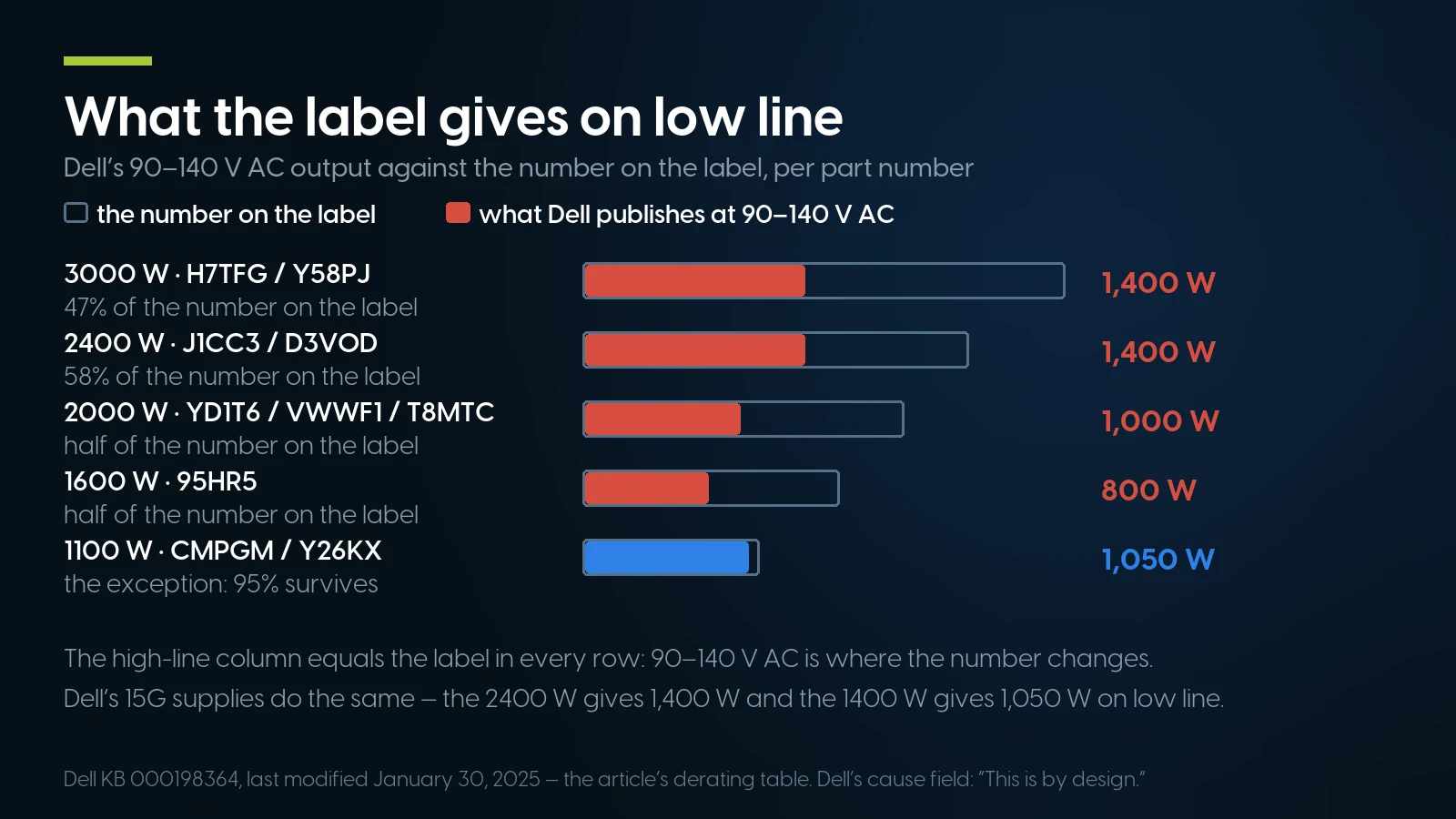
3000 W becomes 1,400 W on low line. Dell KB 000198364, January 30, 2025.
Dell puts it in human terms in KB 000202926 of February 10, 2025, where supplies “automatically detect if they are plugged into high line power (~220 V) or low line power (~110 V)… like a 2000W PSU only being able to output 1000W of power in a low line power environment” — and in the scenario that is the best anecdote here precisely because Dell wrote it: “Occasionally, customers move their servers to a new office location without realizing that they are moving from a high line power environment to one with low line power. This results in the server no longer being able to power on.”
Nor is this new hardware behaving oddly. The PowerEdge R740 technical specifications print high-line and low-line columns side by side: the 495 W and 750 W Platinum units are 100–240 V and identical in both, while the 1600 W drops to 800 W and the 2400 W to 1,400 W. One row has its low-line cell left blank — the 750 W Titanium, “200–240 V AC, autoranging” — and the same row appears in the R730 owner’s manual, a 2014 machine.
The circuit is a limit before the supply is: US practice holds a continuous load to 80% of the breaker rating, so a 15 A 120 V circuit carries 1,440 VA continuous and a 20 A one 1,920 VA (IAEI Magazine, Schneider Electric). The connector is the visible tell: Dell’s R760 cable table maps 700 W to 1400 W supplies to a C13 cord, 1800 W to C15, 2400 W to C19 and 2800 W to C21.
Our Own Shelf, Including the Part That Embarrasses Us
Our power supplies category holds 99 listings that can be bought as of September 16, 2026. That is not the number to quote: seven are not power supplies at all, five are distribution boards and eight are retail ATX units. The honest figure is 79 server and workstation power supplies holding 932 units, and the cheapness is concentrated — 33 listings under $20 hold 69.9% of the units (720 of 1,030); under $25 covers 75.1%.
The deepest Titanium-rated supply we sell is a Dell 57TFT PowerEdge 750 W EPP hot-swap at $14.99 with 157 units, and its title carries the warning: 200-240V. It is the only one of the 99 listings stating any input-voltage restriction; the other 98 say nothing, which is not the same as “universal.”
Now the awkward part. Every power cord we stock is a NEMA 5-15P to IEC C13 — the ordinary US 120 V wall plug. Three listings sit in accessories: a single 6-foot cord at $14.99 with 317 units, a lot of two at $12.99 and a lot of four at $19.99, 554 units between them. There is no C19 or C20 wall cord in the catalog; the only C19 item is a splitter with three units, and both APC rack PDUs we list are sold out. So, plainly: the cheapest Titanium power supply in our store cannot be run from anything else in our store. Here is the deep-stock end of the shelf and what each part says about its input.
Seven rows covering eight of the twelve PCSP listings that hold 20 or more units, priced September 16, 2026; the last row groups three, and the four not shown are an Intel 1100 W, an EMACS 500 W and two HP units. Input notes come from the vendor documents cited here, never inferred from a part number. Unit counts are per part number and must not be added together.
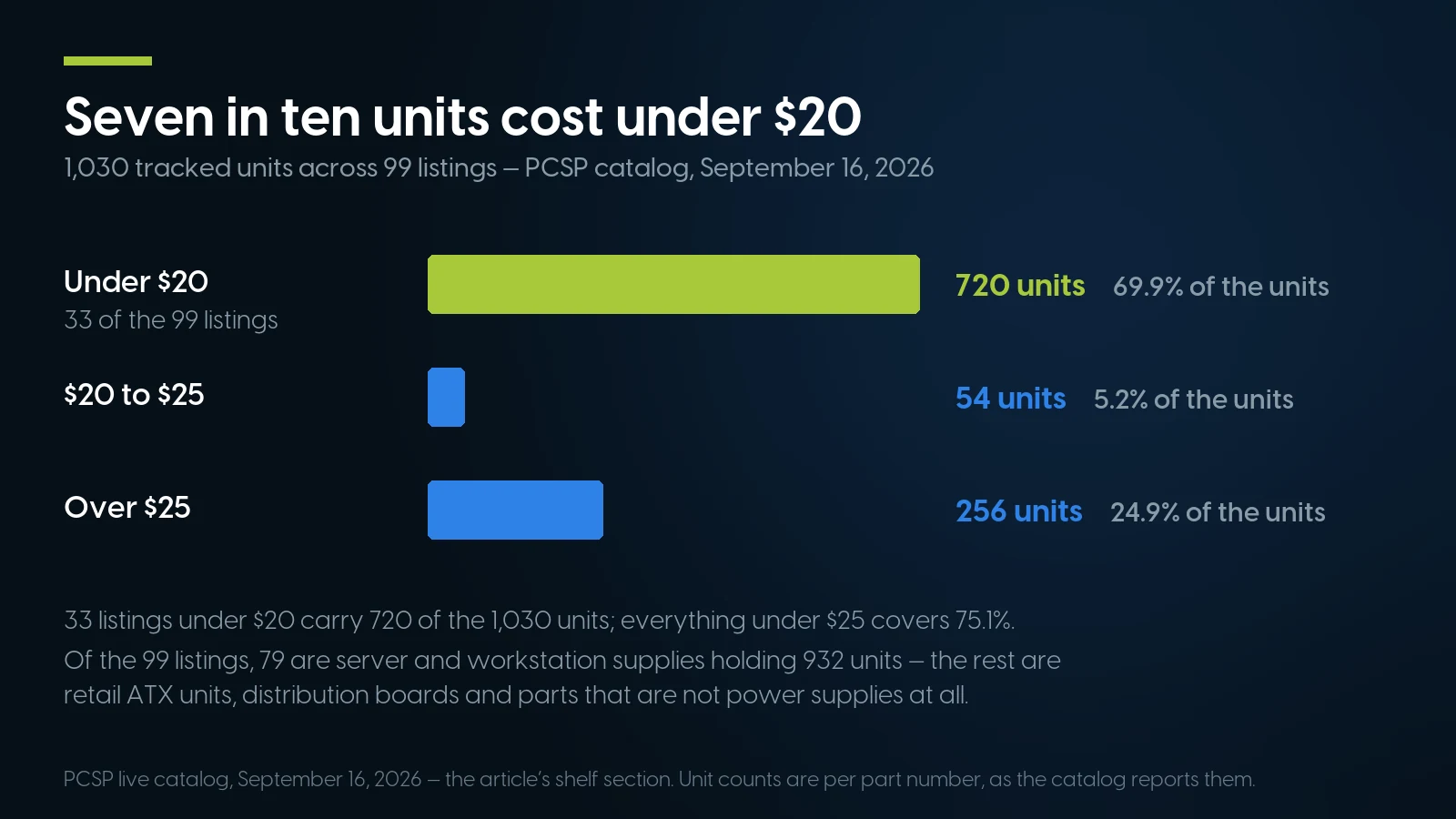
Depth is cheap: 720 of 1,030 units under $20. PCSP catalog, September 16, 2026.
Why the Titanium Costs Less Than the Platinum, and the 1600 W Less Than the 500 W
On our shelf a Dell 750 W Titanium costs $14.99 and a comparable Dell 750 W Platinum costs $23.74. The higher badge is the cheaper part. The cheapest Platinum listing is $11.37, but it is a single unit; the cheapest Platinum with real depth is the HPE Gen9 800 W at $15.95 with 280 units, the deepest power-supply part number we hold.
The obvious explanation — junk, end of life, a recall — is not supported by anything we could find. The 750 W Titanium has aged out of Dell’s own store (its APD 450-AEES page redirected to a generic accessories shell on September 14, 2026), but the class is neither obsolete nor cheap new: Dell sells the current 16G equivalent, a 700 W Titanium, 200–240 V only, at $420.92. Three dealers list our exact part between $29.95 and $55.00 the same day — TechMikeNY at $29.95, whose own title spells out “200-240V AC Input Only; NOT 110V”, The Server Store Parts at $37.99 and Flagship Technologies at $55.00. On failures we say only what we can prove: no vendor advisory and no documented failure mode was found as of September 14, 2026 for this part or the other deep-stock supplies here. That is an absence of evidence, recorded as such.
What prices these parts is the market that can use them: a 200–240 V-only supply is worth full money with a 208 V rack feed and close to nothing on a 120 V office circuit. Efficiency does not price a used power supply. Usability does. Sort by watts and the same force appears as an inversion.
PCSP live catalog, September 16, 2026. $ per 100 W = price ÷ watts × 100 on the cheapest listing in each band; wattage read from the listing title only. Two further listings above 1600 W hold one unit each and eleven state no wattage; lot listings are priced per lot.
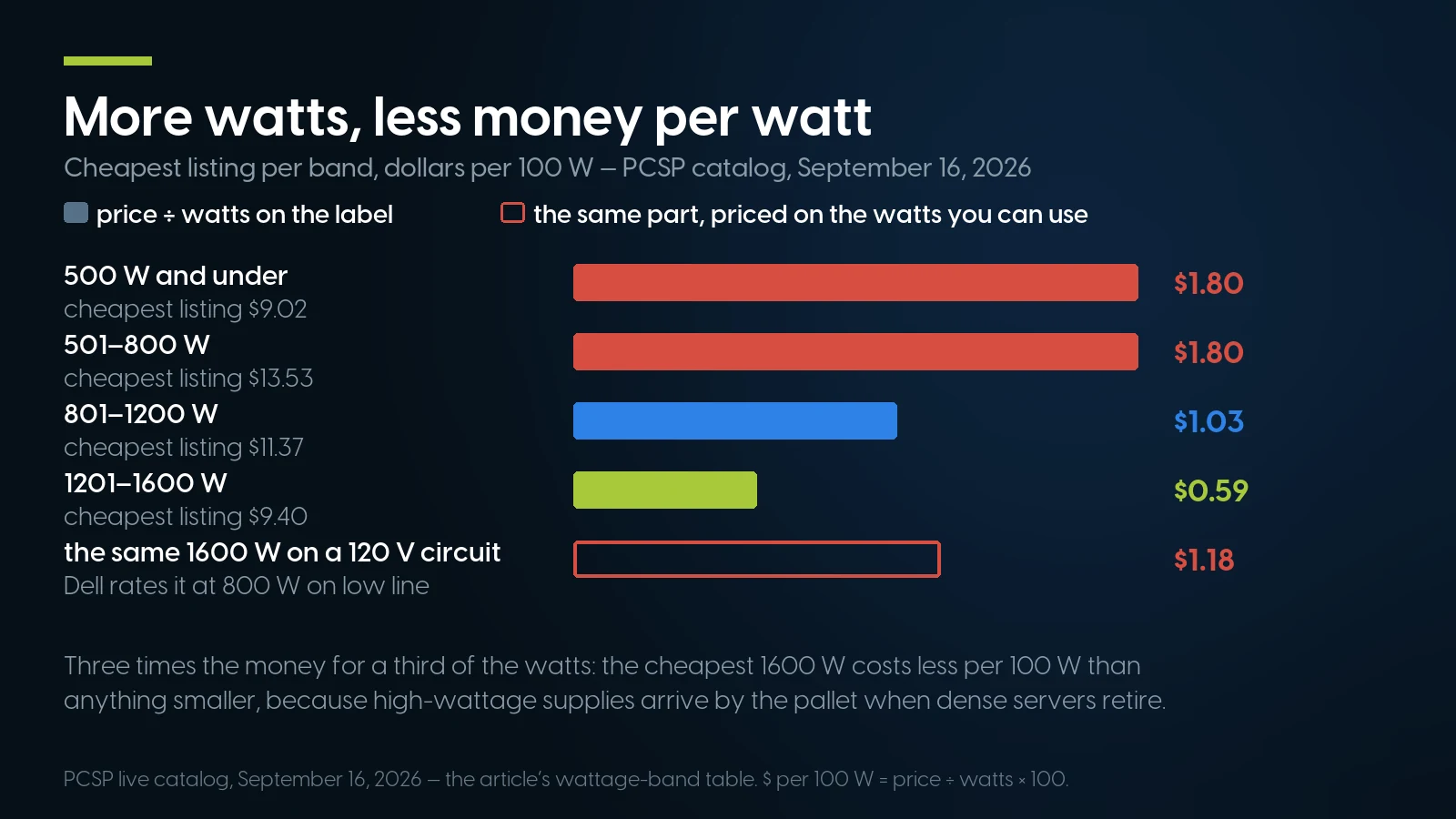
$0.59 per 100 W at 1600 W, $1.80 at 500 W. PCSP catalog, September 16, 2026.
Three times the money for a third of the watts. The used market prices what is being decommissioned: high-wattage Dell supplies arrive by the pallet when a generation of dense two-socket servers retires, while small ones trickle out of a narrower installed base. Our catalog has that shape — 70 of the 98 tracked listings hold five units or fewer, and four part numbers hold more than half the category.
Dell Precision 5820 Tower Power Supply: 425 W or 950 W. There Is No 685 W
This is the most-searched power-supply question we see, and most versions of it contain a wattage Dell never offered — “425w 685w 950w”, “685w psu part number”, “1125w power supply”. The 685 W variant alone accounts for roughly 3,000 impressions in the four weeks to August 10, 2026 in our search data and converts nothing, because there is nothing to convert to.
Dell’s Precision 5820 Tower owner’s manual gives the wattage as “425 W or 950 W with Xeon W Series CPUs / 950 W with Core X Series CPUs”, input 100 VAC–240 VAC. The spec sheet adds the certification: “425W* or 950W (input voltage 100VAC - 240VAC) –90% efficient (80PLUS Gold Certified)”, the asterisk resolving to “Not available on the 5820 Tower with Core X I9 and I7 CPUs.” Two options, and on the fastest CPUs, one.
Dell Precision 5820 Tower owner’s manual and spec sheet, read September 14, 2026, plus Dell’s store listing for V7594. The 3W8F7 part number and the T5810/T7810 attribution of the F68EF-00 come from our own catalog.
The consequence is a budget, not a trivia answer: the same spec sheet caps graphics at “up to 600W with maximum of up to 2 x 300W double width graphics cards”, so a 5820 carrying two 300 W cards is a 950 W machine by construction. For the rest of the Precision line, our Precision tower guide has the ladder. We hold both 425 W part numbers in single digits and the 685 W T5810/T7810 supply in twos, which is why this section links to no product page; the Precision T5820 machines are a different story, at 19 purchasable listings.
PowerEdge R760 (and “R760xl”) PSU Specifications: The Real Option List
Start with the naming, because half the traffic on this question is chasing a document that does not exist. “R760xl” is not a separate server. Dell’s support code oth-r760xl resolves to a page titled “Support for OEMR XL R760” — the OEM-Ready, extended-lifecycle build of the ordinary R760 — and the manual Dell serves under it is the ordinary PowerEdge R760 Installation and Service Manual. There is no separate R760xl manual to find.
Dell PowerEdge R760 Installation and Service Manual, “PSU specifications”, read September 14, 2026 — the document Dell also serves for the OEMR XL R760. Its notes state the derating: 2400 W PSUs on low line are “degraded to 1400 W”, 1400 W and 1100 W PSUs to 1,050 W.
Read the popular search strings against that table and each is slightly wrong: “700w 1100w 1400w 1800w 2400w” drops the 800 W and the 2800 W, and “1100w 1400w 1800w 2400w” drops three. The full AC list is 700 / 800 / 1100 / 1400 / 1800 / 2400 / 2800 W, plus 1400 W and 3200 W in 277 VAC/HVDC and 1100 W in −48 V DC, and “The PowerEdge R760 system supports up to two AC or DC power supply units (PSUs).” Three of the eleven rows cannot be used on a 120 V circuit at all and four more are cut to 1,050 or 1,400 W; the 3200 W that appears in so many searches is 277 V AC or 336 V DC only. Dell’s KB 000225989 confirms the 700 W row by part number: 3D09N “supports only high line voltage… It does not support 110 V AC.”
Two sibling facts. Dell splits these hot-plug bays into “Redundant 60 mm” (700–1800 W) and “Redundant 86 mm” (2400 W and up), so a jump from 1,800 to 2,400 W is a different module. And the GPU-dense R760xa offers only 2400 W, 2800 W and 3200 W: graphics, not cores, forces a big supply. Our R760 support hub carries it too.
Send us the part number off the label. We will tell you what it needs from the wall.
HPE Gen9 800 W Platinum at $15.95 (280 in stock), Dell 57TFT 750 W Titanium at $14.99 (157, and 200–240 V only), the 925 W HP Z640 supply at $29.99 (22) — priced September 16, 2026, 90-day parts warranty.
Browse power supplies Ask for a part matchHP Workstations Print the Low Number: One Label, Three Wattages
Everything above describes a convention. HP’s workstation division adopted the opposite one, in a footnote almost nobody reads. From the HP Z440, Z640 and Z840 Maintenance and Service Guide: “The 1125 W power supply can also supply 1275W of output power when the input voltage is greater than 105V. If the input voltage is less than 105V, the maximum power that can be drawn is 900W… The 1125W Power Supply can also supply 1450W of output power when the input voltage is greater than 180V under all conditions.”
One label, three numbers: 900 W on a sagging 100 V line, 1,275 W above 105 V, 1,450 W above 180 V — a 61% spread, and HP printed the middle one. The Z8 G4 QuickSpecs repeat it, naming the supplies “1125W/1275W*/1450W*” and “1450W/1550W*/1700W*”, and warn that the 1450 W chassis “requires a 20A outlet in an environment with 100V/110V. Site modification may be required.”
On a workstation the binding constraint is cables, not watts. The HP Z4 G4 QuickSpecs describe the supplies by what they can feed: 465 W “with no 6-pin graphics power cables”, 750 W “with 2x 6-pin”, 1000 W with “4x 6+2-pin graphics power cables… to enable support for dual high end graphics solutions.” The PSU option is the GPU option; connector traps on ex-mining cards are in our used GPU guide. Elsewhere in the family the Z440 takes a 700 W Gold or 525 W Bronze, the Z640 a 925 W Gold, the Z840 an 850 W or the 1125 W above. Our HP Z generations guide walks that ladder model by model. Our Z440 support hub has that model’s PSU and slot map.
What we can supply is narrower than the documentation suggests: six purchasable listings name an HP Z platform and only two have depth — the 925 W for the Z640 at $29.99 (22 units, machine sold out) and the Z8 G4 1125 W at $54.99 (20 units, machine in stock). Workstation supplies are where used prices stay high — CPU Medics listed the Z840’s 1125 W at $279.00 to $299.00 on September 14, 2026 — because the parts are model-specific and the machines still work. We also list a Lenovo 900 W P520/P720 supply in twos, described from our catalog rather than a Lenovo document.
80 PLUS, Stated Correctly: At What Load, at What Voltage, Worth How Much
“94% efficient” is not a fact about a power supply. It is a fact about one at a stated load point and a stated input voltage. CLEAResult, which runs the programme, requires supplies to be “80% energy efficient or greater at 10%, 20%, 50% and 100% of rated load with a true power factor of 0.9 or higher”. And there is more than one table: a workstation supply is certified against the 115 V Internal Non-Redundant table, a hot-plug server supply against the 230 V and 277 V Internal Redundant one below.
CLEAResult’s current thresholds for 230 V and 277 V Internal Redundant supplies, read September 14, 2026. CLEAResult marks its 10% figures below Titanium “suggested”. Bronze and Silver sit below Gold (85% and 89% at 50% load) and Ruby above Titanium at 96.5%; Platinum and Titanium carry a power-factor floor of 0.95.
Three things there surprise almost everyone. A server PSU’s badge was earned at 230 V: no 115 V redundant table exists, so a “Platinum” hot-plug supply on a US office outlet runs outside its own certificate, and we cannot say what that costs because the measurement does not exist. Titanium’s 100% threshold (91%) is identical to Platinum’s and lower than Platinum’s own 50% figure. And Titanium is the first level with a 10% load requirement, the certifying body conceding that redundant supplies spend their lives lightly loaded.
Now the money. The EIA’s Electric Power Monthly, Table 5.6.A, released August 26, 2026, puts the June 2026 average US retail price at 14.19 ¢/kWh commercial and 18.34 ¢ residential. A watt drawn continuously for a year is 8.76 kWh, so those are $1.24 and $1.61 per watt-year — both right, for different questions: our home-lab guide uses $1.61 because a basement machine is billed residentially, and a business article has to use $1.24.
At those thresholds, a server drawing a constant 400 W of DC output needs 434.8 W of AC input on a Gold supply (34.8 W wasted, $43.24 a year), 425.5 W on Platinum (25.5 W, $31.74) and 416.7 W on Titanium (16.7 W, $20.72) — input = 400 ÷ efficiency, annual cost = wasted watts × 8,760 h × $0.1419. Cooling adds to every figure; we apply no PUE multiplier, having no sourced number for it.
Gold to Titanium is 18.1 W, 158.7 kWh and $22.52 a year; Gold to Platinum is $11.50. On one server that pays for nothing; it matters at rack scale, and when the Titanium unit is the cheaper part on the shelf. To check a badge rather than trust a sticker, CLEAResult publishes every certified supply and its test report. On our own catalog: 61 of the 99 listings state no grade at all, three state Titanium and 28 state Platinum, but only 21 of those 28 carry an explicit 80 PLUS mark. We do not infer a grade from a part number, and neither should any listing you read elsewhere.
Part Numbers, Not Wattages: Fitting, Pairing and Hot-Swapping a Used Supply
Server supplies are proprietary per vendor and often per generation. Workstation supplies are worse: HP calls the Z8 G4 units a “Custom PSU”, each carries a model-specific spare number, and a standard ATX unit is not a substitute.
The most expensive trap is a form factor that fits and is not supported. HPE’s Flexible Slot Power Supplies QuickSpecs (version 22, February 16, 2026) advertises the Flex Slot as a “common form factor across all ProLiant Gen9 and Gen10 servers” that “allows multiple server platforms to share power supply spares” — then states: “Low Halogen Power Supplies are not compatible with HPE Gen9 Servers.” The Gen10 kits (865408-B21, 865414-B21, 865438-B21, 830272-B21 and their spares) are Low Halogen parts, yet reseller listings for those spares still advertise “Gen9/Gen10/Gen11”.
That lands on our listings. The cheapest supply in our category, $9.02, is an HPE 500 W numbered 866729-001 — the number HPE’s own table prints under that Gen10 Low Halogen kit — while its title says only “for HPE ProLiant”; our 280-unit 800 W is the Gen9 720479-B21. The catalog contradicts itself elsewhere: of two Lenovo 750 W supplies for the same x3550/x3650 M5 machines, one is titled “ThinkSystem” and one is not — different Lenovo lines. Lenovo at least puts the voltage in the name — 750W (230V) Titanium, 1600W (230V) Platinum — and warns “115V customers… select a power cable that is rated above 10A.”
So the procedure, in the order that saves money:
- Read the part number off the label of the supply you have — the Dell DPN, the HPE spare and option numbers. Not the wattage.
- Match it against the vendor’s list for your exact chassis generation — Dell enumerates 14G/15G/16G parts in KB 000198364, HPE its Flex Slot numbers in the QuickSpecs above.
- Read the input-voltage line, not the badge. A blank low-line cell means no.
- Check the physical class and the cord. Dell’s 60 mm and 86 mm bays are different modules; a C19 supply on a 120 V circuit has nowhere to go.
Then the pair. HPE: mixing supplies “may limit or disable some power supply features including support for power redundancy… all power supplies within the same server should have the same output and efficiency ratings.” Lenovo: “If 2 are installed, power supplies must be identical.” Dell flags a mismatch in “efficiency, feature set, health status, and supported voltage”, and KB 000127944 gives the symptom: “the PSU handle flashes green five times and turns off.” One supply in a two-bay chassis, though, is supported by all three.
Replacement has one hard rule — “remove and replace only one power supply at a time in a system that is powered on” — and one exception, cabled supplies on some PowerEdge 14G to 17G systems, which “are always nonredundant and cannot be removed without opening the chassis.” Nor is the management controller proof: HP advisory c04727920 records that on iLO 4 firmware 2.20 and earlier a supply installed during POST calibration may be marked redundant when it is not.
When the Power Supply Is Not Your Problem
A dead server is blamed on its power supply more often than the supply deserves. Where the handle LED is off, or blinks green and then goes out, Dell KB 000152161 says “this is likely an environmental issue rather than a power supply failure… check the label for its voltage requirements.” Dell’s KB 000127944 agrees: PSU0003 means the supply “is not receiving input power”, and “This event is usually the result of an issue external to the server…”
- Read the handle LED. Green is operational; flashing green then off is a mismatch; flashing amber is a problem with the supply; not lit means “the power is not connected”.
- Off, or green-then-off? Check the label’s voltage range against the outlet, try another cord and outlet, bypass the UPS or PDU. This catches the office move and the 200–240 V bargain part.
- Solid green or blinking amber? Auxiliary power is present, so iDRAC or iLO is up. Pull the Lifecycle Log before touching hardware.
- Swap test. “If the replaced PSU exhibits the same issue as the original, it is likely that the power distribution board (PDB) or the motherboard is faulty.” Chasing a fault that stays with the bay wastes the most money here.
- Did you just add hardware? Dell: “the customer may have installed hardware that pushes the server’s power needs beyond that of a single PSU. Again, disabling PSU redundancy can allow the server to come online.”
Only after all of that is it “likely that the power supply unit has failed.”
Two anchors for the sizing question underneath it, both SPEC-published and audited. A PowerEdge R760 with two 32-core Xeon Gold 6430s and the two 1500 W supplies its disclosure lists, tested January 8, 2026 on a 208 V line, drew 748 W at 100% load and 251 W at idle — 24.9% of its installed 3,000 W. A PowerEdge R740 with two Xeon Platinum 8280s ran the same benchmark in 2019 on a single 750 W Titanium and drew 432 W. For the CPU side by generation see our Xeon guide; for sizing, HPE’s Power Advisor has an input-voltage selector.
Where a Used Power Supply Is the Wrong Call, Including From Us
We sell these parts, so here is the case against them.
- Production redundancy under an SLA. Dell will not support a mismatched pair, HPE says supplies should share output and efficiency ratings, Lenovo says they must be identical. If you cannot prove the match from the label, buy two.
- A machine still inside vendor warranty or a support contract. Dell’s safety text warns that damage from servicing it has not authorised is not covered. If the box is covered, open a case: the free part beats the $15 part.
- When the failure is the chassis, not the supply. A fault that stays with the bay is a distribution board or a motherboard, and a second used supply will not fix it.
- When you are on 120 V. The $14.99 Titanium will not start a server on a US office circuit; the $9.40 Dell 1600 W becomes an 800 W; the Cisco UCS 1200 W becomes an 800 W. None of that is a defect, and all of it is a reason to check your outlet before your basket.
And then the gap in our own shelf, which is large and specific. We sell these machines and we do not sell their power supplies:
PCSP live catalog, September 16, 2026. “Purchasable” means stock on hand; sold-out listings still render on the site. Machine counts are listings, not units. The two “from” prices refresh nightly; every other figure is the count on the date above.
For every row there, buy new from the OEM or an authorised channel rather than hunting the used market for the wrong halogen spec or generation. Dell still sells the Precision 5820’s 950 W new at $149.99 with a warranty; for a production workstation that must not stop that is the correct purchase, and our $19.00 425 W is a spare. The used market is strong one generation back: Dell 12G–14G, HPE Gen9, Cisco UCS C-series.
One last caution. On counterfeits the only verifiable check is CLEAResult’s certification database, and we found no vendor-published counterfeit advisory for Dell, HPE or Lenovo server supplies. The grading and red-flag checklist in our used-server buying guide applies to a $15 part exactly as it does to a $1,500 machine.
Power supplies on our shelf today
Lowest listed price in each category and what is on the shelf right now — barebones chassis included, so a complete build costs more than the figure shown. This block is the one part of the article that refreshes itself; every price in the text above is dated where it stands.
- All power suppliesHot-plug server and workstation unitsFrom $9.02 · 103 in stock
- Dell power suppliesPowerEdge and PrecisionFrom $9.40 · 24 in stock
- Cables and accessoriesPower cords, risers, rails, fansFrom $7.49 · 173 in stock
- Refurbished serversThe machines these supplies go inFrom $69.99 · 304 in stock
- Refurbished workstationsHP Z, Dell Precision, ThinkStationFrom $79.98 · 377 in stock
Matched supplies, matched machines, and an honest answer about your outlet
Dell PowerEdge and HPE ProLiant parts matched by part number rather than wattage, plus the servers they belong to — one-year warranty on machines, 90 days on parts. Prices checked September 16, 2026.
Dell power supplies PowerEdge R640 in stockThe Bottom Line
The wattage on a server power supply is a conditional promise, and the condition is in the vendor’s own table: 2,000 W becomes 1,000 W, 1,600 W becomes 800 W, and a 200–240 V-only part on a 110 V outlet does not derate at all — it leaves the LED dark and the server off, working as designed.
Three rules survive the article. Match the part number, not the wattage, because form factor, generation and halogen spec hide behind identical-looking watts. Read the input-voltage line before the efficiency badge: a badge is worth about $22 a year on one server, while the wrong voltage is worth the whole machine. And size from a measurement — a modern 2U with 3,000 W installed drew 748 W flat out in a published test.
The used market rewards all three. It gave us a Titanium supply at $14.99 that no cord in our own catalog can feed, and a deep shelf for the generation being decommissioned right now next to empty pegs for the one that is not. Send us the part number off the label and we will tell you which you are looking at — including when the answer is to buy new.
Server and Workstation Power Supplies: FAQ
What power supply does the Dell Precision 5820 Tower use?
425 W or 950 W, and nothing else. Dell’s owner’s manual states “425 W or 950 W with Xeon W Series CPUs / 950 W with Core X Series CPUs”, both 80 PLUS Gold at 100–240 VAC. The parts are Dell Y097X (also 3W8F7) and V7594.
Is there a 685W power supply for the Precision 5820?
No. The 685 W unit people search for is the Dell F68EF-00, for the Precision T5810 and T7810. 1125 W is an HP number used on the Z820, Z840 and Z8 G4, and 1400 W on a Precision means the 7920 class.
What are the PowerEdge R760 power supply options?
Seven AC options: 700 W, 1800 W and 2800 W Titanium, all high line only; 800 W Platinum; 1100 W Titanium; 1400 W in Platinum and Titanium; 2400 W Platinum. Plus 1400 W and 3200 W Titanium at 277 V AC or 336 V DC and an 1100 W DC unit; up to two are supported. “R760xl” is not a separate server: Dell’s support code oth-r760xl resolves to “Support for OEMR XL R760” and serves the ordinary R760 manual.
Will a 200-240V server power supply work on a 120V outlet?
No. Dell KB 000225989 of May 21, 2026 says of its 700 W part 3D09N: “If the input voltage is low, such as 110 V AC, the power supply LED is off, and the server does not power on.” The cause is recorded as “Working as designed.”
Does a 2000W power supply really deliver 2000 watts?
Only on a 200–240 V circuit. Dell publishes the derating by part number in KB 000198364: on 90–140 V AC a 2000 W supply delivers 1,000 W, a 1600 W delivers 800 W, a 2400 W delivers 1,400 W, and 1100 W and 1400 W units drop to 1,050 W.
Is 80 PLUS Titanium worth paying extra for in a server?
Rarely on efficiency alone. At CLEAResult’s 50%-load thresholds (Gold 92%, Platinum 94%, Titanium 96%) and the EIA’s June 2026 commercial rate of 14.19 cents per kWh, a server drawing 400 W around the clock saves $22.52 a year moving from Gold to Titanium. Those thresholds are measured at 230 V.
Can I mix two different power supplies in one server?
The vendors say no. HPE: mixing supplies “may limit or disable some power supply features including support for power redundancy”. Lenovo: if two are installed they “must be identical”. Dell flags a mismatch in efficiency, feature set, health status or supported voltage. A single supply in a two-bay chassis is supported by all three.
How many watts does a server actually use?
Far less than its installed capacity. In a SPEC-published result of January 8, 2026, a PowerEdge R760 with two Xeon Gold 6430 processors and two 1500 W supplies drew 748 W at 100% load and 251 W at idle. An R740 with two Xeon Platinum 8280s ran on one 750 W supply and drew 432 W flat out.