


GPU Price Increase 2026: Why, and When Will Prices Drop?
Posted by Konstantin Protasov, PCSP on Oct 28th 2026
On October 26, 2026, the cheapest new GeForce RTX 5070 in the United States cost $869, per the Tom’s Hardware GPU price index — $70 more than on September 3, when our used GPU guide last read the same page, and $320 over the card’s $549 launch price. Of the 15 models the index priced on both dates, 13 cost more in late October and none cost less. The used market is no escape: on ResalePrices, 48 of the 50 GeForce models from the GTX 10 to the RTX 50 series had a higher average eBay asking price on October 28 than on September 4 (the GTX 10 cards by a dollar or two), and 24 of the 28 RTX 30, 40 and 50 models rose 9–24%.
This is the follow-up to our used GPU buying guide: the same sources and the same method, read on two dates. We sell used workstation graphics cards, so read the last sections with that in mind. Every price below names its source and date, our own catalog is quoted as of October 28, 2026, and one section is about when not to buy from us.
The short version, checked October 28, 2026:
- New cards rose again. Tom’s Hardware index, September 3 to October 26: 13 of 15 models up, 2 unchanged, median +8.8% (our arithmetic). The RX 9060 XT 16 GB went from $469 to $599, the RTX 5050 from $299 to $419; the RTX 5090 row, a single listing, from $5,199 to $8,477.
- “Again” is literal. Prices were roughly flat from February to July. The second wave began in late July: NVIDIA’s mid-range jumped between August 6 and 27, AMD’s caught up in September and October. PCPartPicker’s averages show the same shape.
- The cause on the record is memory. NVIDIA’s CFO on August 26, on NVIDIA’s own component costs: memory prices are “headed even higher into next year.” Micron on September 30: supply “much tighter in calendar 2027 and 2028.” Neither speaks of graphics cards; price rises on GPU-and-memory kits sold to board partners are reported, not confirmed.
- Not tariffs. The Section 232 chip tariff covers only data-center bandwidth classes and exempts consumer use; the July 24 Section 301 duties exempt computer parts. The open risk: China tariff exclusions that cover graphics cards expire on November 9.
- Used pro cards are the exception at the floor. The lowest eBay offer for a used RTX A4000 was $850 on September 4 and on October 28 (GPUDojo) — but its median asking price rose 17%.
- Our shelf, October 28: no card we sell went up in price since September 4 (16 the same, 9 lower), but the GeForce RTX 3070 and the 24 GB Quadro RTX 6000 sold out. A 16 GB Quadro P5000 is $193.02; an HP Z6 G4 with a 16 GB Quadro RTX 5000 is $1,670.17.
- Nobody who would know forecasts a drop. Micron: “we do not see line of sight when supply catches up with demand.”
GPU Prices Going Up Again: One Index, Two Dates
Tom’s Hardware describes its index as “the best prices in the U.S. for each SKU of GPU from the most recent two generations,” the lowest price for an available card “regardless of the manufacturer.” That makes it one listing per model: the cheapest new card in stock at a US retailer, sometimes a marketplace seller, not an average. Our September guide quoted the page as updated September 3; the Internet Archive’s capture of September 4 reproduces those figures to the dollar. The live page is dated October 26.
Tom’s Hardware GPU price index, pages dated September 3 (Internet Archive capture of September 4) and October 26, 2026; launch MSRPs from the index’s own column. Changes and premiums are our arithmetic. The Arc B580, $309 on September 3, was listed out of stock on October 26.
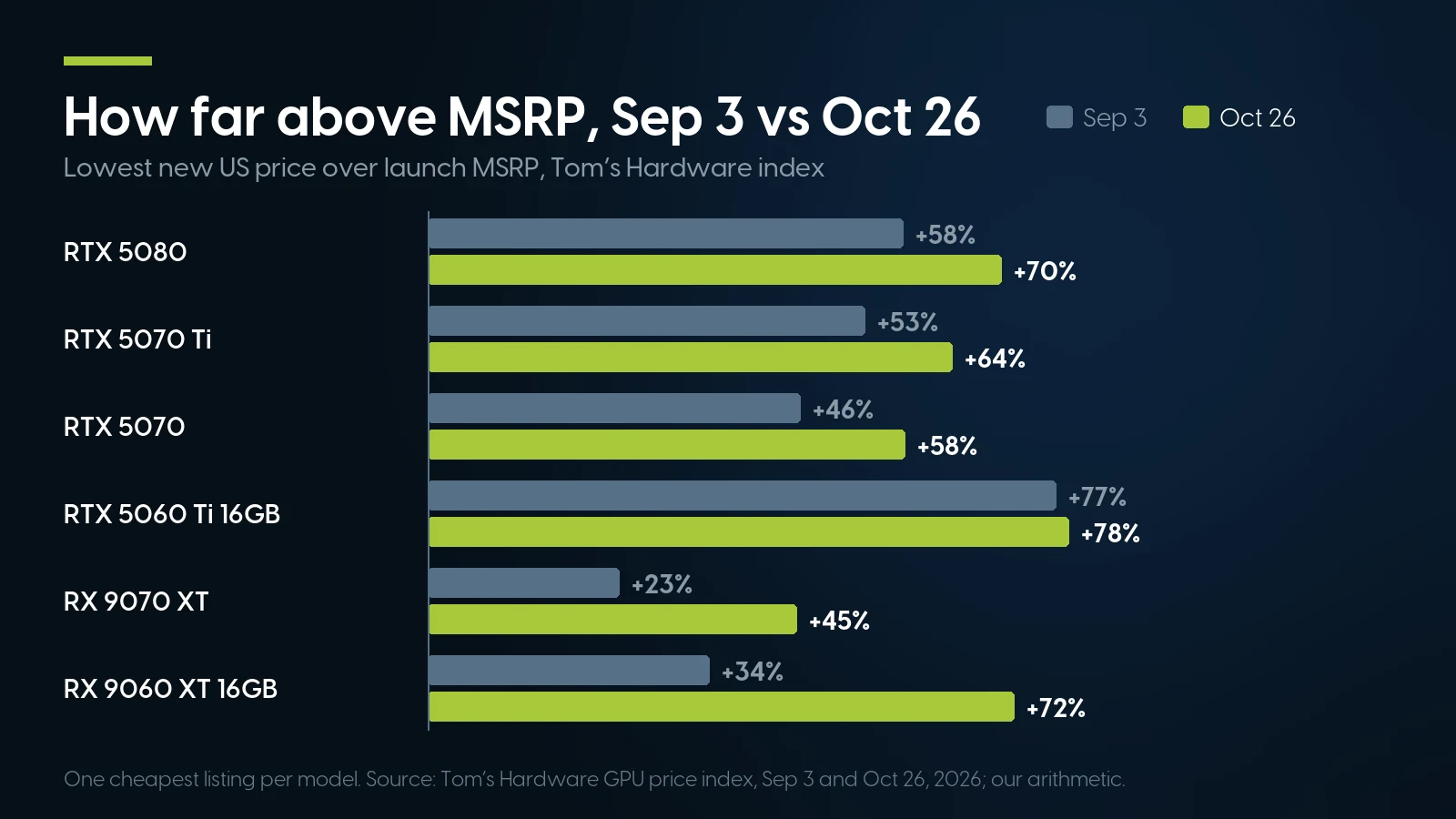
Every model sat further above its launch price in late October than in early September; the Radeon cards moved most. One cheapest listing per model, Tom’s Hardware index, September 3 and October 26, 2026; our arithmetic.
Three things stand out. The rise is broad but uneven. NVIDIA’s mid-range moved least after September (RTX 5070 +8.8%, RTX 5060 Ti 16 GB +0.9%, RTX 5060 unchanged), while AMD’s Radeon rows moved most and Intel’s Arc B580 went out of stock on October 22. The cheap end is no refuge: NVIDIA’s entry RTX 5050 went from $299 to $419, 68% over its MSRP. The premium keeps growing: across the eight RTX 50 rows the median price over MSRP was 52% on September 3 and 66% on October 26 (our arithmetic), in line with the “about 60%” Blackwell premium Tom’s reported for September 1.
Read the RTX 5090 row with its method. One cheapest listing sets it, and it moved in steps: $6,389 on September 14, $6,995 on September 28, $7,177 on October 12, $8,599 on October 22, $8,477 on October 26. The direction is real; the +63% is one seller’s price, which is why our headline numbers are the count and the median, not that row.
Why “Again”: The Second Wave Started in Late July
The Internet Archive holds captures of the same index through 2026, each carrying the page’s own “last updated” date. Read in sequence, they show two steps with a flat stretch between them.
Tom’s Hardware GPU price index, cheapest new US listing per model, by the page’s own update date; Internet Archive captures of January 25, July 6, August 10, August 29 and September 4, and the live page of October 26, 2026.
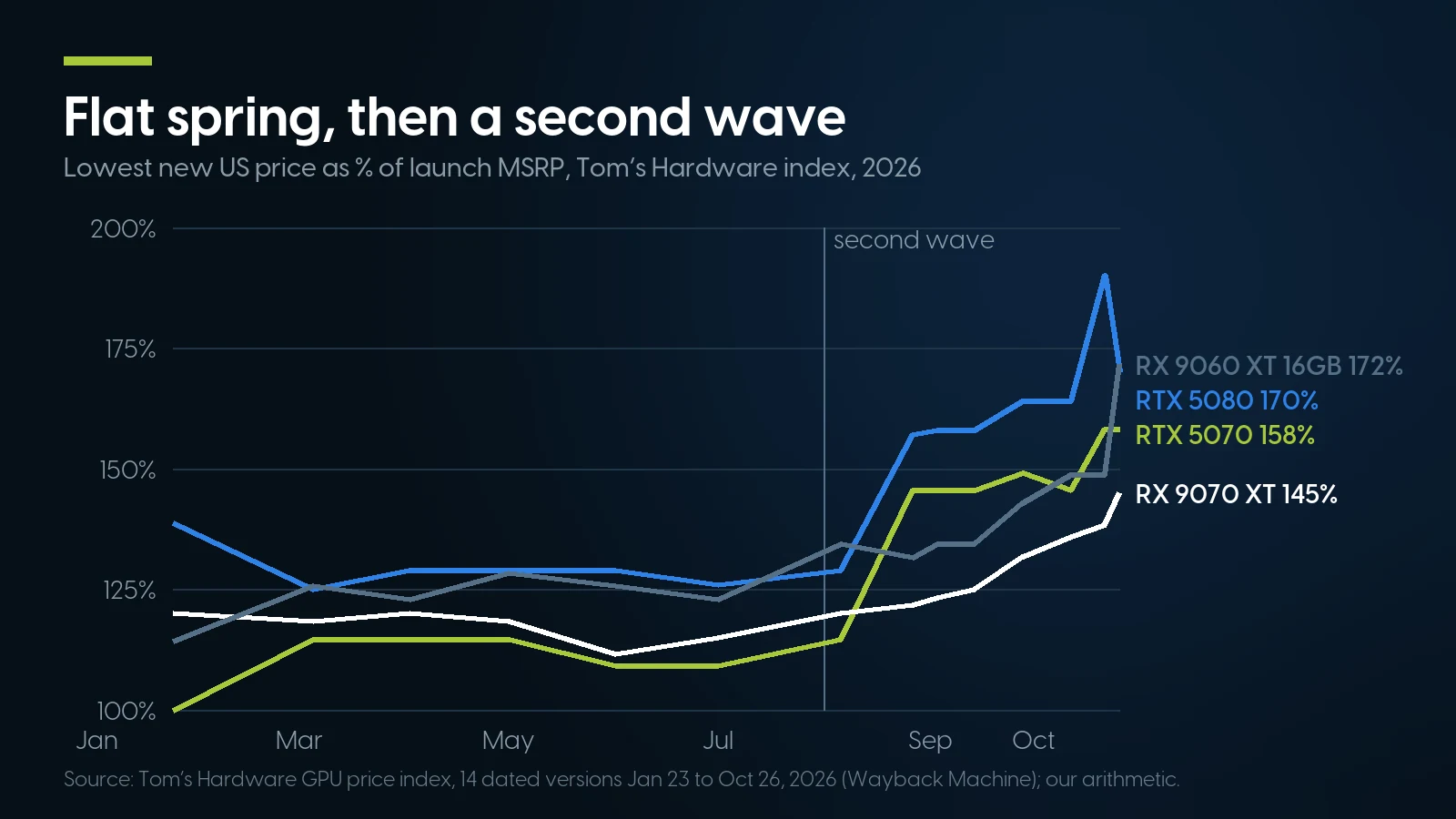
Flat from February to July, then a second step from August that had not stopped by late October. Fourteen dated versions of the Tom’s Hardware index via the Internet Archive; our arithmetic.
From January to July the mid-range barely moved: the RTX 5070 went from $549 to $599, the RX 9070 XT from $719 to $689. Then NVIDIA’s cards jumped in three weeks — between August 6 and August 27 the RTX 5070 rose 27%, the RTX 5060 Ti 16 GB 32% and the RTX 5080 22%. AMD’s followed later: flat through August, then +18% for the RX 9070 XT between September 3 and October 26. Measured from July 1, all 15 priced models are up, median +34%; from January 23, all 14 comparable models, median +48% (our arithmetic).
A second method gives the same shape. PCPartPicker’s price trends plot the average price across the US retailers it tracks, promotions and shipping included and Amazon excluded. Read from its October 28 charts, to within about $20: the RTX 5070 averaged about $750 from February to mid-July, about $1,000 by mid-August, about $940 in September and about $1,000 in late October; the RX 9070 XT about $860 in June and July, $1,000 in early September and $1,170 in late October, still climbing. Averages sit above Tom’s cheapest listings, as they should. The two series agree on timing, not on level, so never set a number from one against a number from the other.
Why GPU Prices Are Going Up: Memory, on the Record
Sort the explanations by who is speaking. What NVIDIA and the memory makers said in their own results is evidence; an analyst’s projection is a forecast; a board-partner price notice is, so far, a report.
Sources linked in the table, 2026. Partner reports: Benchlife, relayed by The FPS Review (July 23); Board Channels, relayed by TrendForce News (July 3) and PC Gamer (October 13). TrendForce News states that it operates independently of TrendForce’s research team, so we class it as press.
The chain those statements describe is short. Graphics cards use GDDR memory, and GDDR now has an AI customer: SK hynix’s half-year report (August 2026) says the graphics memory market is expanding to graphics processors “for AI data centers and servers,” and TrendForce says GDDR7 output stays limited as advanced capacity goes to server DRAM. NVIDIA’s CFO, on the call quoted above, put the cause in one line: “Memory scarcity today is being driven in large part by the AI build-out itself.” How DRAM went to AI in the first place is in our server RAM price crisis report; we do not repeat it here.
The timing fits. The NVIDIA kit report is dated July 23, and NVIDIA’s mid-range jumped between August 6 and August 27. The AMD reports are dated July 3 and October 13, and Radeon rows rose most from September to October. A matching timeline is not proof, and we do not present it as such.
What is not on the record
NVIDIA no longer reports a Gaming segment. Its August 26 results release reports Data Center and Edge Computing revenue and does not name GeForce, so there is no NVIDIA figure for GeForce volumes or prices. The CFO’s “executed price increases” sentence does not say which products; it is not evidence that NVIDIA raised GeForce prices. Tom’s index page says NVIDIA is “purportedly” allocating memory by the money it makes per gigabyte of VRAM; that is a report, and we found no NVIDIA statement saying so. We found no memory maker publishing a GDDR6 or GDDR7 contract price and no dated source for memory’s share of a graphics card’s cost, so this article prints neither.
What It Is Not: Tariffs on Graphics Cards
Two tariff actions of 2026 get blamed for GPU prices. By their own texts, neither covers a graphics card.
Section 232 on semiconductors. The proclamation signed January 14 and in force from January 15, 2026 puts a 25% duty on goods under HTS 8471.50, 8471.80 and 8473.30 that contain a logic chip in two narrow performance bands, with total DRAM bandwidth between 4,500 and 5,000 GB/s or between 5,800 and 6,200 GB/s. NVIDIA’s biggest workstation card, the RTX PRO 6000 Blackwell, lists 1,792 GB/s; every GeForce, Quadro and RTX A card is lower. The same text exempts imports “for non-data center consumer applications in the United States.” Our reading: no card in this article is covered. Our server price increases report reached the same conclusion in August.
Section 301 “forced labor” duties. In force from 12:01 a.m. ET on July 24, 2026 (USTR notice), they add duties on goods from 60 economies, China, Vietnam and Taiwan among them, but CBP’s exemption list under heading 9903.05.86 names HTS 8471 computers and 8473.30 computer parts, including 8473.30.11, where graphics cards enter. The date sits just before NVIDIA’s August jump; the exemption rules out a direct link.
The open risk is November 9. The 178 product exclusions from the 2018 China Section 301 tariffs run “through 11:59 p.m. eastern daylight time on November 9, 2026,” per USTR’s December 2025 notice, which extends all the exclusions of USTR’s May 2024 list. That list includes printed circuit assemblies “for rendering images onto computer screens (‘graphics processing modules’),” HTS 8473.30.1180: graphics cards. As of October 28, the Federal Register shows no renewal. If none comes, graphics cards made in China pay the Section 301 China duty again; we have not checked how many of today’s US-market cards are made there. That is a risk for November, not a cause of August to October.
Used GPU Prices Rose Too, a Month Behind New
ResalePrices publishes a daily mean of the last 30 days of active US eBay listings, after filtering out parts-only boards, bundles and extreme outliers. These are asking prices, not completed sales, as the site itself states. Its history for September 4 matches, to the dollar, the figures our September guide printed for all nine cards it quoted, so the comparison is like for like.
ResalePrices 30-day mean asking prices of active US eBay listings, history read October 28, 2026; changes are our arithmetic.
Every card in the table rose: twelve of the 14 by 9–24%, the RTX 5090 by 47%, and only the GTX 1080 Ti, a Pascal card on NVIDIA’s last driver branch for its generation, stood still. Across all 50 GeForce models from the GTX 10 to the RTX 50 series on ResalePrices, 48 were higher, nine of them by less than 3%, and two lower, the RTX 2070 Super and the RTX 2060 12 GB. A 30-day mean lags: the used RTX 5070’s average started climbing on August 20, after the new card’s jump; from August 10 to October 28 it rose 32%, against 38% for the cheapest new one from August 6 to October 26. Since September used rose faster; since early August, new did. A used RTX 5070’s average ask, $771, is 89% of the cheapest new listing, $869 — two methods, but a thin gap for no warranty and an unknown history.
The 24 GB cards keep climbing. The used RTX 3090 averaged $1,251 on July 30, $1,343 on September 4 and $1,559 on October 28, across 341 listings — more than twice the RTX 5070 Ti’s $749 launch price, for a card from 2020.
Used Pro Cards: Flat at the Floor, Not in the Middle
Professional cards trade differently. GPUDojo, a price tracker, records the lowest eBay offer for each card weekly and, for the RTX A4000 and A6000, a daily median that counts each seller once. Both are asking prices, and GPUDojo itself notes that buyers often pay less. A single lowest offer is noisy, so treat a 10% move as no move.
GPUDojo, eBay US used listings: weekly lowest offer (shipping excluded) and daily seller-weighted median (quoted shipping included; series starts September 13), read October 28, 2026. Changes are our arithmetic.
Print both halves. At the floor, little moved, and not in one direction: the cheapest A4000 was $850 on both dates, the 24 GB Quadro RTX 6000 moved $5 and the A5000’s floor fell 12%, while the Quadro RTX 4000 and A6000 floors rose 10–11%, single offers inside the noise. Floors are noisy, though: the Quadro RTX 5000’s sat between $399.95 and $449.99 from September 11 to October 23 before one $279.99 offer appeared. Our September guide put the lowest used A4000 offers at 81–86% of new; against the cheapest new offer on October 28, a single marketplace listing at $1,044.99, the floor is still 81%. In the middle, prices moved: the typical A4000 ask rose 17% in six weeks, and the middle half of listings went from $972–$1,185 to $1,040–$1,425. The median ask now sits above that cheapest new offer. No source we found explains why the floor held, and we will not guess.
NVIDIA’s own pro list price rose earlier and has held since. NVIDIA’s US marketplace listed the RTX PRO 6000 Blackwell at $16,000.00 on October 28, out of stock. Tom’s Hardware reported on August 12 that NVIDIA had raised it to that from $13,250, a price set in June; the card launched at $8,565. NVIDIA did not confirm either change. The same page lists the 24 GB RTX PRO 4000 Blackwell at $3,200.00 under NVIDIA’s brand and $2,939.99 as a PNY card, and the 16 GB RTX PRO 2000 at $1,725.00 and $1,594.99. NVIDIA’s flagship list-price rise happened from June to August, before our September baseline; used pro floors did not follow it.
What a Used Pro Card Buys Now: Our Shelf, Honestly
Our own catalog is the third measurement. We matched every purchasable card in our graphics cards category on September 4, by product page, against the same category on October 28, 2026: 16 at the same price, 9 at a different price — all 9 lower — and none higher; 33 are no longer on the shelf and 28 are new. The shelf did not reprice. It thinned.
PCSP catalog, September 4 and October 28, 2026; four of the nine price changes are shown, and the other five are also cuts; the P5000 is one of the 28 cards new on the shelf since September 4. “Sold out” means the listing is still visible with no stock.
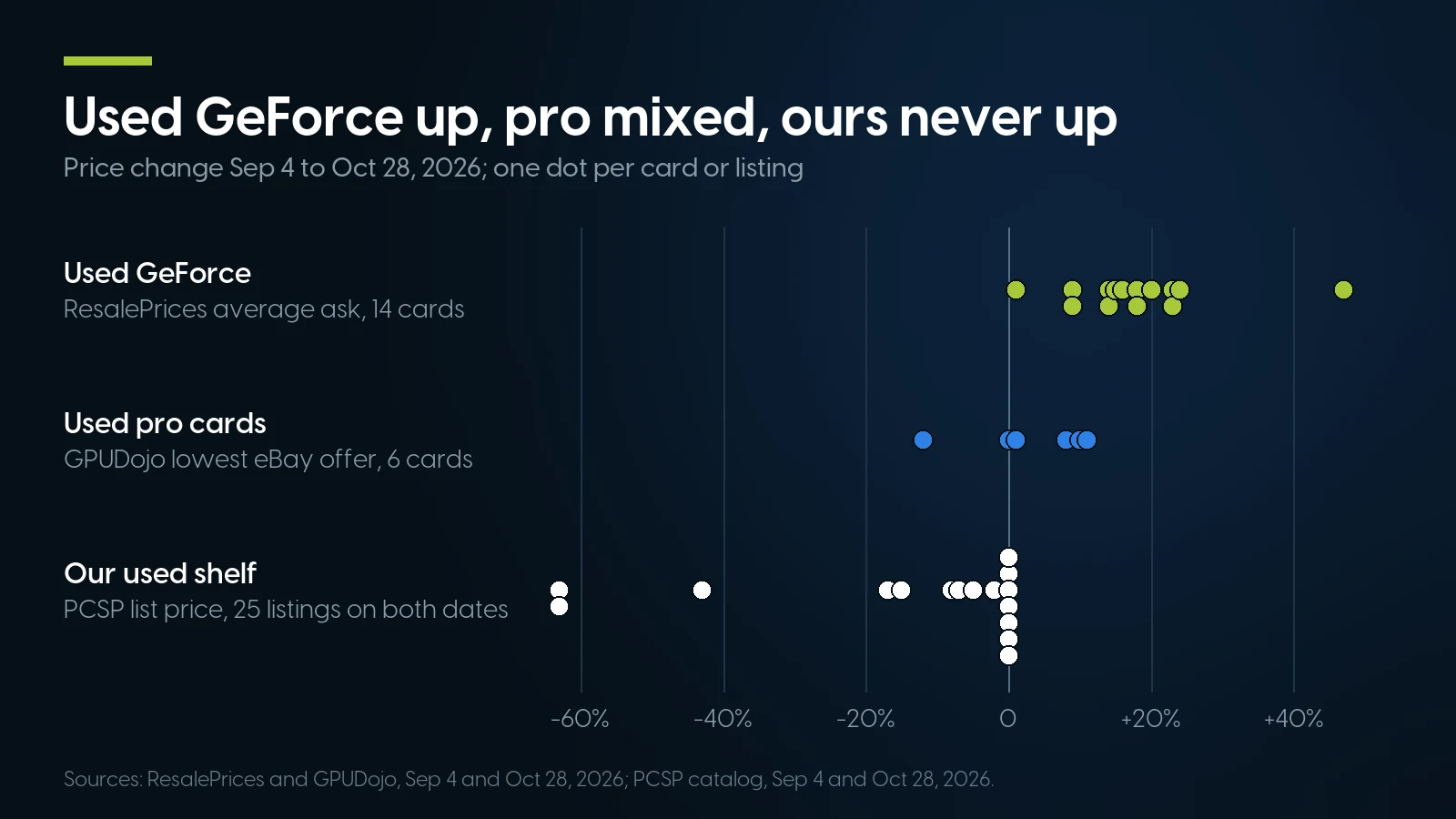
Used GeForce asks rose almost across the board, used pro-card floors split, and our own listed prices did not go up. ResalePrices and GPUDojo, September 4 and October 28, 2026; PCSP catalog on the same dates.
So the honest answer to “did used GPU prices go up at PCSP” is no — and also that the cards closest to modern have gone. What remains loose is mostly Pascal and Turing professional silicon. The 16 GB Dell Quadro P5000 at $193.02 is the only 16 GB NVIDIA card with display outputs we sell as a loose part, $12.06 per gigabyte of VRAM. Inside a configured workstation, the build-your-own configurators — the same options on every HP Z8 G4, Dell Precision T5820 and their siblings — offer a Quadro P4000 8 GB at +$159.99, a Quadro P5000 16 GB at +$344.99, an RTX A4000 16 GB at +$889.99 (two in stock for the whole store) and an RTX A6000 48 GB at +$4,499.00 (one). A configured workstation carries our one-year warranty on parts, labor and shipping, extendable up to five years; a loose card comes with 90-day returns.
Card against card, per gigabyte
Prices of October 26–28, 2026 from the sources named in each row; per-gigabyte figures are our arithmetic. The methods differ (lowest offer, average, single cheapest listing, list price), so read the column as an order of magnitude, not to the cent.
Per gigabyte, old Pascal and Turing cards are the cheapest VRAM in this table, used or from us. Above them the order is less flattering: a new RTX 5060 Ti 16 GB costs less per gigabyte than a used RTX A4000 at its typical ask, with a warranty and features no card on our shelf has. A used pro card wins on price per gigabyte clearly only at the old end — and the Pascal end has the shortest driver runway (see the last section).
Whole machine against whole machine. An HP Z6 G4 with two Xeon Gold 6136 processors, 64 GB, a 16 GB Quadro RTX 5000, a 512 GB NVMe drive plus a 500 GB SSD and Windows 11 is $1,670.17 as of October 28, 34 units on the listing. The nearest new machine we priced, in our video editing computer guide on October 27, was a Dell Tower Plus with a Core Ultra 7 265, an 8 GB GeForce RTX 5060 and 32 GB at $2,749.99 on Dell’s site, unchanged on October 28: half the VRAM and memory, a newer everything else. That Z6 G4 build was $1,590.17 on October 12 and $1,670.17 from October 20; with 64 GB of DDR4 and two processors in it, we do not count that as GPU evidence.
What we do not have. No GeForce RTX 40 or 50 card and no Ada or Blackwell professional card is purchasable from us. No 24 GB card is sold on its own; the only one in stock is a GeForce RTX 3090 inside a single pre-configured ThinkStation P620. Above 8 GB, our other Ampere cards are the two A4000 and one A6000 configurator options and GeForce RTX 3080 10 GB cards in pre-configured Precision 7920 and P620 builds. We have no datacenter GPUs in stock, and GPU servers are by quote.
A 16 GB workstation, priced as a whole machine
HP Z6 G4, 2× Xeon Gold 6136, 64 GB, Quadro RTX 5000 16 GB, 512 GB NVMe + 500 GB SSD, Windows 11 — From $1,670.17 · 34 in stock, refreshed nightly. One-year warranty covering parts, labor and shipping, extendable up to five years.
See this Z6 G4 Browse HP Z6 G4When Will GPU Prices Drop? Who Says What
Nobody with first-hand knowledge has given a date, and the companies closest to the memory supply say it gets tighter first.
Sources as linked in the “why” table above unless linked here, 2026.
The only “slowing” in that list is TrendForce’s, and it means still rising, more slowly. New memory capacity has dates, all from Micron’s September 30 call: HBM packaging in Singapore in early 2027, the first Idaho fab and the Tongluo site in Taiwan in mid-2027, the second Idaho fab and a Japan expansion in late 2028, New York in 2030. NVIDIA’s October 21 capacity announcement with its packaging and substrate suppliers is titled for AI infrastructure. None of it is described as graphics memory.
What nobody knows
- A GDDR6 or GDDR7 price, or a date for graphics-memory relief: no memory maker publishes one.
- What NVIDIA charges partners for GeForce kits, or how many it ships.
- Whether NVIDIA launches the RTX 50 Super cards rumoured since 2025. As of October 28, 2026 its newsroom has announced none — still true of what our September guide said.
- Whether USTR renews the China tariff exclusions that cover graphics cards before they expire on November 9.
We found no named source forecasting a fall in retail GPU prices in 2027. If you read one, check who said it and in which document. What the data supports is narrower: for used professional cards the floor mostly held in September and October; for almost everything else, it rose.
When a Used Pro Card Is the Wrong Buy in This Market
We sell used Quadro and RTX A cards, so here is where they lose.
Gaming. NVIDIA’s DLSS page says Multi Frame Generation is “Powered by GeForce RTX 50 Series and fifth-generation Tensor Cores.” No card we sell has it. If you buy for games, buy a GeForce — new, or used at the prices above — not a workstation card.
AV1 exports and 4:2:2 camera footage. NVIDIA’s RTX 4000 Ada page lists an eighth-generation NVENC “with AV1 encoding”; no earlier generation encodes AV1, and only Blackwell decodes 4:2:2 H.264 and HEVC, as our video editing guide sets out from NVIDIA’s support matrix. Every Ada and Blackwell card in our catalog is at zero stock.
Local AI built on new number formats. Among workstation and GeForce cards, FP8 acceleration starts with Ada’s fourth-generation Tensor Cores, per the same Ada page, and FP4 with Blackwell’s fifth generation, per NVIDIA’s RTX PRO 4000 page. If your stack depends on either, no Pascal, Turing or Ampere card is the right buy at any price.
Pascal’s driver clock. The Quadro P4000 and P5000 are Pascal. NVIDIA’s R580 branch is their last, with “1 year of full support and critical security updates through October 2028,” as our Quadro generations guide quotes. A P5000 at $12.06 per gigabyte is cheap VRAM with a known end date; Turing and Ampere cards stay on current drivers.
An older desktop. A 16 GB card needs the power, cables and slot clearance your machine may not have. Our used GPU guide covers the power-supply and connector traps; check them before buying any card, ours or not.
Buying new under warranty. The cheapest new 16 GB NVIDIA card in Tom’s index on October 26, an RTX 5060 Ti 16 GB at $765 (AMD’s RX 9060 XT 16 GB was $599, without CUDA), costs less per gigabyte than a used A4000 at its typical ask and carries its maker’s warranty and every feature above. A loose card from us comes with 90-day returns; our one-year warranty covers configured workstations.
Waiting, if you can. Nobody on record forecasts a drop, so waiting is not a bet on cheaper cards; it is keeping your options open. NVIDIA’s next quarterly results and the November 9 tariff deadline are the next data points. If the work has not started, buy when it does, and buy only the VRAM it needs.
Where we win: 16 GB of VRAM for CAD, rendering, video with proxies and compute that does not need FP8 or FP4, on Turing or Ampere drivers that are still current, inside a workstation with a one-year warranty.
Pro graphics cards and the workstations that carry them, on our shelf today
Lowest listed price in each category and what is on the shelf right now — barebones chassis included, so a complete build costs more than the figure shown. This block is the one part of the article that refreshes itself; every price in the text above is dated where it stands.
- Graphics cardsQuadro, RTX A and Radeon Pro; floor is an entry Kepler cardFrom $9.02 · 52 in stock
- HP Z6 G4Dual-socket tower · floor is a build-your-own baseFrom $334.98 · 33 in stock
- HP Z8 G4Dual-socket tower · GPU options in the configuratorFrom $734.98 · 36 in stock
- Dell Precision T5820Xeon W tower · floor is a build-your-own baseFrom $134.98 · 38 in stock
- Dell Precision T7920Dual-socket tower · floor is a build-your-own baseFrom $1,271.84 · 40 in stock
- AI & machine learning buildsPre-configured workstations with RTX cardsFrom $1,526.41 · 3 in stock
Tell us the workload and the budget
We will say which card fits — or that a new one does. A loose 16 GB Quadro P5000 is From $193.02 · 10 in stock, refreshed nightly. The RTX A4000 and A6000 are options in our build-your-own workstations. Orders ship within 1–2 business days.
Graphics cards AI & machine learning buildsThe Bottom Line
GPU prices did go up again in the autumn of 2026, and the same index that our September guide used shows where: 13 of 15 new models up between September 3 and October 26, AMD and the top end most, NVIDIA’s mid-range least. The used GeForce market followed, about a month behind. The cause on the record is memory — NVIDIA’s CFO, Micron and SK hynix describe scarce, dearer memory in their own results, though none names graphics cards — not the 2026 tariffs, which by their own texts do not cover them. Nobody who would know forecasts a drop; Micron says supply gets tighter in 2027 and 2028.
The exception is used professional cards at the floor: the cheapest A4000 has not moved, and our own card prices did not rise. That makes a used 16 GB pro card a reasonable buy for CAD, rendering and compute that does not need FP8 or FP4, in a workstation — and the wrong buy for gaming, AV1, FP8 or FP4, or anyone who wants a new card’s warranty. Compare like with like, and buy for the work in front of you.
GPU Price Increase 2026: FAQ
Why are GPU prices going up in 2026?
Memory. NVIDIA’s CFO said on August 26, 2026, of NVIDIA’s own component costs, that memory prices have exceeded NVIDIA’s expectations and are headed even higher into next year, and Micron said on September 30 that supply will be much tighter in 2027 and 2028. Board partners reportedly paid more for GPU-and-memory kits from July, which NVIDIA and AMD have not confirmed. The 2026 tariffs do not cover graphics cards.
How much have GPU prices increased since September 2026?
On the Tom’s Hardware price index, 13 of 15 new models cost more on October 26 than on September 3, none less, with a median rise of 8.8%. The RX 9060 XT 16 GB went from $469 to $599 and the RTX 5070 from $799 to $869. Average eBay asking prices for used GeForce cards rose 9–24% for most models between September 4 and October 28.
Did NVIDIA raise GPU prices?
NVIDIA has announced no GeForce price increase. Its CFO said on August 26 that “executed price increases” take effect in its next fiscal first quarter, without naming products. Kit price rises to board partners are press reports NVIDIA has not confirmed. NVIDIA’s own marketplace listed the RTX PRO 6000 Blackwell at $16,000 on October 28, a price Tom’s Hardware reported in August.
When will GPU prices drop?
No named source forecasts a fall in retail GPU prices in 2027. Micron expects memory supply to be much tighter in 2027 and 2028 and says it does not see when supply catches up with demand. TrendForce expects contract price rises to slow, not reverse. Micron’s new fabs start output from mid-2027, and TrendForce’s projection of new supply in 2027 is for server memory and HBM.
Are tariffs the reason graphics cards cost more?
No, by the texts. The January 2026 Section 232 chip tariff covers only chips in two DRAM bandwidth bands between 4,500 and 6,200 GB/s, far above any graphics card, and exempts consumer use. The July 24, 2026 Section 301 duties exempt computers and computer parts. The open risk is the China tariff exclusions covering graphics cards made in China, which expire on November 9, 2026 unless renewed.
Are used GPU prices going up too?
For GeForce cards, yes: 24 of the 28 RTX 30, 40 and 50 models on ResalePrices had a 9–24% higher average eBay asking price on October 28, 2026 than on September 4, the RTX 3090 from $1,343 to $1,559. Used professional card floors moved little, in both directions: the cheapest RTX A4000 was $850 on both dates, though its median asking price rose 17%.
Is a used Quadro or RTX A card a good buy right now?
For CAD, rendering, video with proxies and compute that does not need FP8 or FP4, often yes: a 16 GB Quadro P5000 was $193.02 at PCSP on October 28, 2026. Not for gaming, AV1 encoding or FP8 and FP4 work, and Pascal cards such as the P5000 are on their last driver branch, with critical security updates through October 2028. A new RTX 5060 Ti 16 GB costs less per gigabyte than a used A4000 at its typical ask.