

NVIDIA Quadro Generations Explained: K, M, P, T, RTX A
Posted by Konstantin Protasov, PCSP on Oct 20th 2026
The K in Quadro K2200 does not stand for Kepler. NVIDIA’s own compute-capability table lists the K620, K1200 and K2200 as compute capability 5.0, which is Maxwell, and NVIDIA’s July 30, 2026 workstation driver still lists all three as supported. The Quadro K4200 that sat beside them in NVIDIA’s 2014 launch is real Kepler, and NVIDIA ended its professional driver support on January 31, 2023. Same letter, same launch, two different support clocks.
That is the trap in every used Quadro listing: the name looks like a code, and the code mostly works. The letter usually names the architecture, the number names the tier, and the exceptions decide what a card can still do in 2026. This guide is the ladder from Kepler to Ampere built from NVIDIA’s datasheets, support bulletins, driver pages and CUDA release notes: what each generation has, how long NVIDIA will keep each one patched, which card fits which job, and what we actually have on the shelf.
The short version, checked October 18, 2026:
- Letter = architecture, number = tier, with two breaks. K is Kepler except the Maxwell K620, K1200 and K2200; T400, T600 and T1000 are Turing but list no RT or Tensor cores and carry neither “Quadro” nor “RTX” in NVIDIA’s names.
- Kepler is finished. NVIDIA ended professional support for Kepler Quadros on January 31, 2023; their last branch is R470, and CUDA 12 cannot build for them.
- Maxwell and Pascal are on their last branch. NVIDIA’s R580 gives them “1 year of full support and critical security updates through October 2028”. CUDA 13 cannot build for them; CUDA 12.x still can.
- Turing is the oldest generation on current drivers and CUDA 13 — including the cheap T400, T600 and T1000.
- Entry cards cap video encoding at 8 sessions, fewer than a GeForce’s 12. Unrestricted starts at the K2200, M2000 and P2000.
- Our shelf, as of October 20, 2026: 13 Pascal listings with 170 units from $23.70, a Quadro P1000 4 GB from $54.99, P5000 16 GB at $193.02, T1000 at $199.00, three Quadro RTX 5000 16 GB at $517.49, one RTX A2000. No RTX A4000 or above as a loose card, no Ada. P2000, P4000, M4000 and M5000 come only inside build-your-own workstations.
How to Read a Quadro Name, and Where the Code Breaks
Through Kepler, Maxwell and Pascal, NVIDIA named its desktop workstation cards with a letter and a number. The letter is the architecture: K for Kepler, M for Maxwell, P for Pascal. The number is the tier inside it: a 400 or 600 is a small, low-power display card, a 1000 or 2000 is the mainstream CAD card, a 4000 is the single-slot workhorse, a 5000 or 6000 is the flagship. A P4000 is roughly to Pascal what an M4000 was to Maxwell.
Four exceptions matter when buying used:
- Three K cards are Maxwell. NVIDIA’s legacy compute-capability table gives the K420, K600, K4000, K4200 and K5000 compute capability 3.0 and the K5200 and K6000 3.5 (Kepler), but the K620, K1200 and K2200 5.0 (Maxwell). The August 12, 2014 launch release introduced the K5200, K4200, K2200, K620 and K420 together without naming an architecture at all. NVIDIA’s Kepler end-of-support notice (updated May 24, 2022) lists the K420, K600, K2000, K4000, K4200, K5000, K5200 and K6000, and leaves the three Maxwell K’s out.
- The T-series is Turing without the RTX hardware. NVIDIA’s T1000 datasheet says the card is “built on the NVIDIA Turing™ GPU architecture” and lists CUDA cores only; the T400, T600 and T1000 sheets have no Tensor-core or RT-core rows, while every Quadro RTX and RTX A sheet has both. NVIDIA names them “NVIDIA T1000”, not Quadro and not RTX, although the market still calls them Quadro T-series and the sheets use NVIDIA’s “NVIDIA RTX professional graphics” family boilerplate. Practical meaning: no hardware ray tracing and no Tensor-core acceleration.
- The Quadro name ended with Ampere. NVIDIA’s April 12, 2021 release for the RTX A5000 and A4000 does not use the word Quadro; ServeTheHome reported in October 2020 that NVIDIA confirmed the name was being phased out for new products, after the RTX A6000 launched without it. NVIDIA’s support pages still say Quadro: the bulletin for Maxwell and Pascal is titled “NVIDIA Quadro Support Plan”.
- The same number now names three cards. Quadro RTX 4000 is Turing (2018, 8 GB), RTX A4000 is Ampere (2021, 16 GB with ECC), and RTX 4000 Ada Generation is the generation after that, with the architecture moved from a prefix to a suffix. A “Quadro RTX 6000” from 2018 and an “RTX 6000 Ada” are three generations apart.
Within Pascal, two pairs confuse buyers. The P600 and P620 share a 40 W low-profile board with four mini-DisplayPorts and a 128-bit bus; the P620 has 512 CUDA cores to the P600’s 384 and “up to 80 GB/s” against 64. The P400 is the cut-down card: 64-bit, 32 GB/s, three outputs. The P2200 is a 2019 refresh of the P2000 on the same 75 W single-slot board, with 1,280 cores instead of 1,024, GDDR5X instead of GDDR5, and 200 GB/s instead of 140.
NVIDIA Quadro Specs by Generation: K620 to RTX A6000
Every value below is from the NVIDIA datasheet of that card, except the power connector, which comes from NVIDIA’s Power Guidelines for Workstation Products (DA-07261-001 v15, July 2023). Power is the datasheet’s maximum or total board power. “None” means the card runs from the slot’s 75 W; for the T-series, which that guide does not list, it follows from board power of 50 W or less, and Lenovo’s T1000 product guide says that card “does not require an auxiliary power cable.” The K420 is left out: NVIDIA’s archive page for it mislabels its spec blocks, and we found no datasheet.
NVIDIA datasheets for each card, downloaded October 18, 2026 (sheet dates 2014–2024), linked from NVIDIA’s previous Quadro desktop GPUs page and the RTX A400 and A1000 product pages; compute capability from NVIDIA’s legacy table and its CUDA GPUs list (blank where NVIDIA does not list the card); connectors from DA-07261-001 v15. ECC is shown only where the datasheet states it.
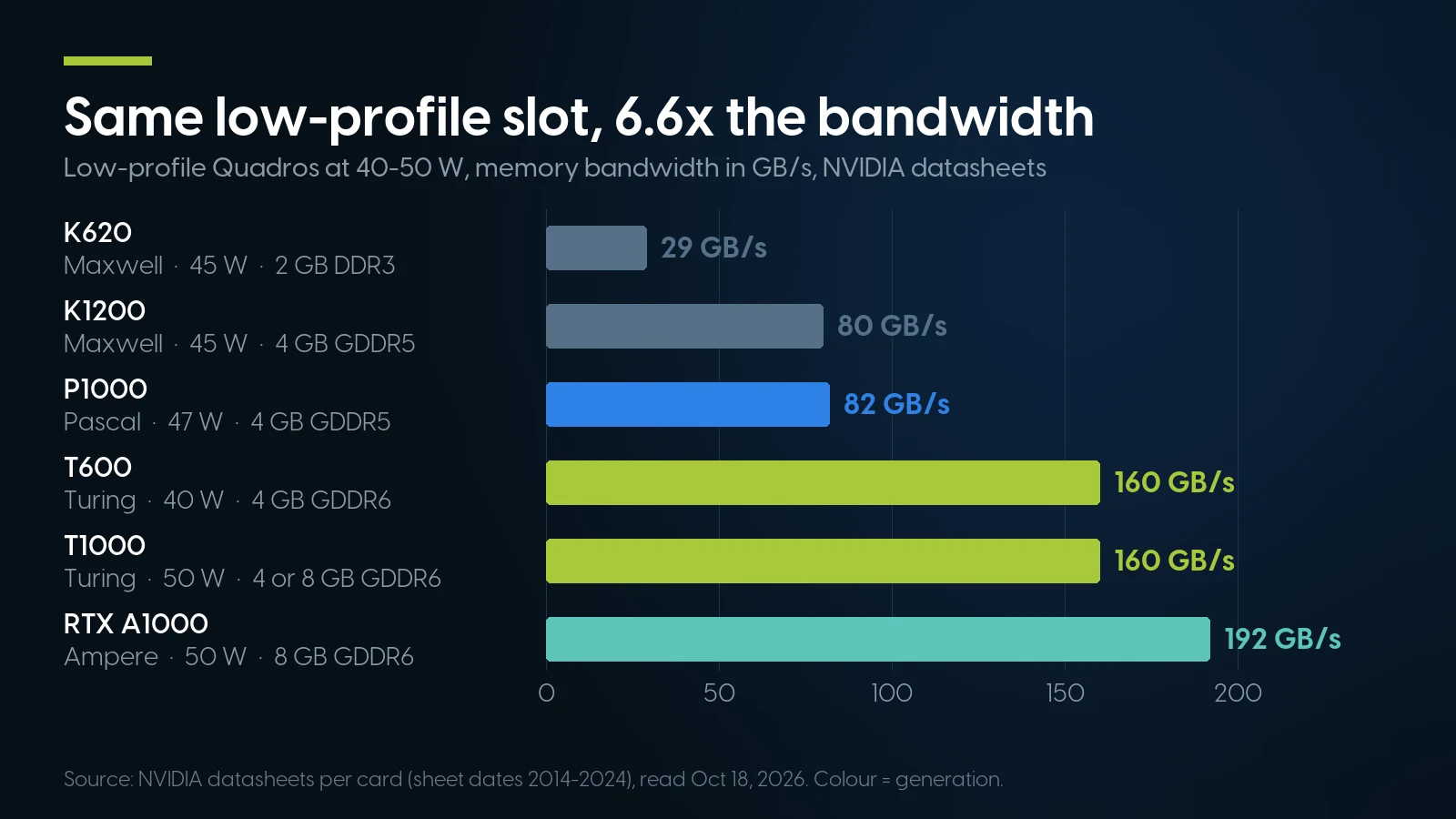
In the same low-profile, bus-powered slot, bandwidth goes from 29 GB/s on the K620 to 192 GB/s on the RTX A1000; the biggest step is Pascal to Turing, 82 to 160. NVIDIA datasheets, read October 18, 2026.
Read down the low-profile rows and the generations show plainly. At roughly the same 40–50 W, bandwidth goes 29 GB/s (K620; 80 on the K1200), 82 (P1000), 160 (T600 and T1000), 192 (RTX A1000). The T600 has exactly the P1000’s 640 CUDA cores and 4 GB, on GDDR6 at about twice the bandwidth, from a 40 W board instead of 47. Read down the 4000 rows and the single-slot workhorse goes from 8 GB (M4000, P4000, Quadro RTX 4000) to 16 GB with ECC (RTX A4000) on one 6-pin.
Two power notes from the tables. NVIDIA prints two power figures for the Turing Quadro RTX cards: total board power on the datasheet (160 W for the RTX 4000) and a lower graphics-power figure in the power guide (125 W); the gap is 35 W on each card. And the RTX A6000 takes an 8-pin CPU (EPS-12V) connector, not a PCIe 8-pin, so check the workstation’s power supply leads before ordering one.
Quadro Driver and CUDA Support in 2026, by Generation
For a used professional card, the driver branch decides more than the spec sheet. NVIDIA publishes this in support bulletins and on its driver pages, and in October 2026 the picture has three tiers.
NVIDIA support bulletins 5210 (May 24, 2022) and 5706 (February 25, 2026); NVIDIA driver pages for R470 U15, R580 U11, R595 U9 and R615 U1; CUDA 11.0, 12.0 and 13.0 release notes. All read October 18, 2026.
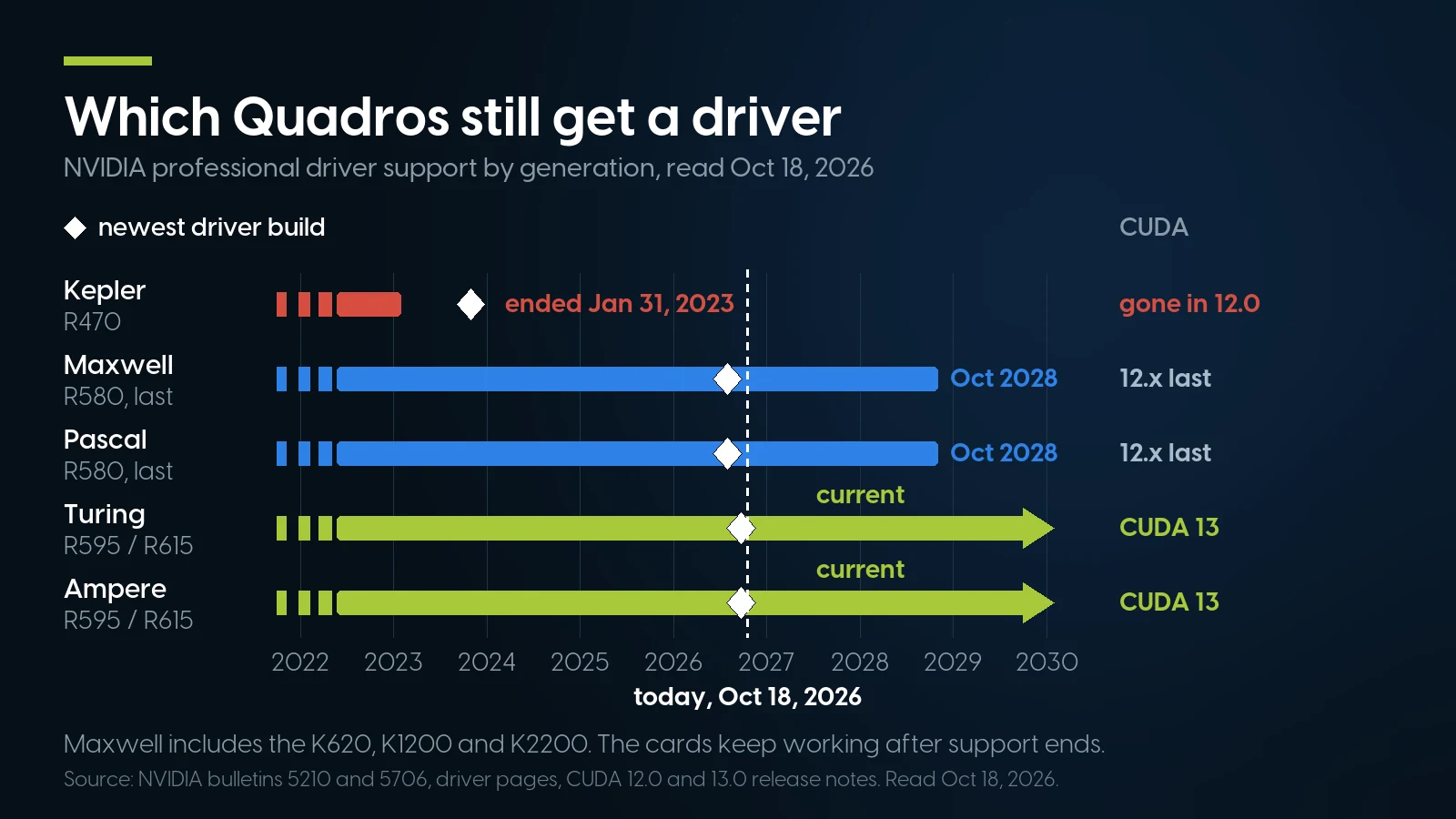
Kepler has been off support since January 2023; Maxwell and Pascal get security fixes on R580 until October 2028; Turing and Ampere are current. Diamonds mark the newest driver build. NVIDIA bulletins 5210 and 5706 and driver pages, read October 18, 2026.
Kepler. NVIDIA’s bulletin 5210 says R470 “is the last NVIDIA professional driver to provide support for the Quadro desktop GPU products based on the Kepler architecture” and that “official support will end on January 31, 2023.” The September 2024 date often quoted for Kepler belongs to a different bulletin, 5202, about GeForce cards. The newest R470 workstation build we found is 474.64 (R470 U15) of October 31, 2023, for Windows 10 and 11; it still lists the K420, K4200 and K5200. On Linux the 470.xx legacy driver ran longer: its newest build on NVIDIA’s download server, 470.256.02, is dated May 2024, and NVIDIA’s legacy GPU page lists the K600, K2000, K4200 and K5200 for it, but not the K420. A K4200 will still drive monitors; it will not get another driver.
Maxwell and Pascal. Bulletin 5706, updated February 25, 2026, in full: “NVIDIA RTX Enterprise Driver Release 580 is the last branch to support NVIDIA Quadro GPUs based on Maxwell, Pascal, and Volta architectures. Release 580 is a Production Branch type driver that will provide 1 year of full support and critical security updates through October 2028.” NVIDIA gives a month, not a day, and does not date the end of the full-support year. The R580 U11 driver of July 30, 2026 lists the P400 through P6000, M2000 through M6000, and the K620, K1200 and K2200, on Windows 10 and Windows 11. The R595 driver from September lists none of them. On Linux, NVIDIA’s legacy GPU page now carries a 580.xx section with the K2200, M2000, P1000 and P5000 in it.
CUDA. The CUDA 13.0 release notes: “Offline compilation and library support for these architectures have been removed in CUDA Toolkit 13.0 major version release. The use of CUDA Toolkits through the 12.x series to build applications for these architectures will continue to be supported.” Applications built with CUDA 12 keep running on an R580 driver only if the build includes code for the card: PyTorch’s maintainers removed Maxwell and Pascal from its CUDA 12.8 builds from release 2.8 (July 2025), and for release 2.12 (April 2026) only the CUDA 12.6 legacy build keeps them, so a default install does not run on a P5000. New releases that ship only CUDA 13 builds do not run on a Maxwell or Pascal card at all. Turing is the floor.
Windows 10. Under bulletin 5707 (August 27, 2025), RTX Enterprise drivers for Windows 10 moved to a quarterly security update after October 2025, whatever the card. That is all NVIDIA promises Windows 10.
So for a CAD seat or a display card, nothing breaks on Maxwell or Pascal before October 2028. For CUDA work you expect to keep updating, they are already out. Our used graphics card buying guide covers the same cliff for GeForce and Tesla cards.
Kepler and Maxwell: K420 to M5000
True Kepler (K420, K600, K4000, K4200, K5000, K5200, K6000) is now a display card generation only. Every K-series datasheet we read caps DisplayPort at 1.2, which means 4K at 60 Hz and no 5K or 8K. CUDA 12 cannot build for them, and the driver will not change again. The K420 is a 1 GB, 2014 card; it is the lowest price in our graphics card category.
The three Maxwell K’s are a better buy than their letter suggests, because they are on the R580 branch with security updates through October 2028. The K620 is the weakest: 2 GB of DDR3 at 29 GB/s, and two direct displays (four only through DisplayPort 1.2 multi-stream hubs). The K1200 has four mini-DP outputs on a low-profile 45 W board. The K2200 has 4 GB of GDDR5 at 80 GB/s on a full-height single-slot board and no power connector.
The M-series is Maxwell’s second chip family (compute capability 5.2). The M2000 is the useful one used: 4 GB, 106 GB/s, four DisplayPort 1.2 outputs, 75 W from the slot. The M4000 is a single-slot 8 GB card on one 6-pin; the M5000 is dual-slot, and its datasheet lists ECC support.
Pascal: P400 to P6000, the Used Market’s Workhorse
NVIDIA’s February 5, 2017 release introduced the P4000, P2000, P1000, P600 and P400 together; the P5000 and P6000 datasheets are dated September 2016, the P620 sheet 2018 and the P2200 sheet 2019. Pascal moved the display outputs to DisplayPort 1.4: four 5K monitors at 60 Hz from the P600 up, 8K at 30 Hz on the P5000 and P6000, and HDR.
The bottom four are the cards people buy for multi-monitor desks. The P400 datasheet gives three mini-DP outputs and “three 4K displays (4096x2160 @ 60Hz) with HDR” from 30 W, with VGA, DVI or HDMI “via adapter”. The P600, P620 and P1000 add a fourth output; the P1000 doubles the memory to 4 GB and reaches 82 GB/s at 47 W. All four are single-slot, low-profile and need no power cable.
The P2000 and P2200 are the most card you can run from the slot alone: 5 GB, 140 or 200 GB/s, 75 W, full height. The P4000 is the single-slot 8 GB card on one 6-pin, and our CAD workstation guide found it clears the AutoCAD and Inventor 2027 recommended graphics tiers, Inventor’s 240 GB/s by just 3. The P5000 (16 GB GDDR5X, 180 W) and P6000 (24 GB, 250 W) are dual-slot flagships on an 8-pin. Neither the P5000 nor the P6000 datasheet mentions ECC; do not assume it.
Turing and Ampere: T400 to RTX A6000
Quadro RTX (Turing, 2018). NVIDIA’s August 13, 2018 release called Quadro RTX the “world’s first ray-tracing GPU” and priced the RTX 8000 at a $10,000 estimated street price, the RTX 6000 at $6,300 and the RTX 5000 at $2,300. This line brought RT and Tensor cores (the RTX 4000 sheet lists 36 and 288), GDDR6, ECC from the RTX 5000 up, NVLink on the 5000, 6000 and 8000, and a USB-C port. Two RTX 8000s over NVLink give 96 GB, per NVIDIA’s launch table. The RTX 5000 to 8000 need an 8-pin plus a 6-pin.
T400, T600, T1000 (Turing, 2021). The small Turing cards are the cheapest way onto the current driver branch and CUDA 13: compute capability 7.5, same as a Quadro RTX 8000. They keep the low-profile, bus-powered format of the P400 to P1000, with GDDR6 and twice the bandwidth (160 GB/s on the T600 and T1000), latching mini-DP connectors and, on the T600 and T1000, two 8K displays at 60 Hz. What they lack is the RT and Tensor cores, and NVIDIA’s encode matrix puts them on the 6th-generation encoder the Pascal cards use, not Turing’s 7th.
NVIDIA RTX A (Ampere, 2021–2024). The A4000 is the card the used market chases: 16 GB with ECC, 448 GB/s, a single slot and one 6-pin, which NVIDIA’s datasheet calls “the most powerful single-slot GPU for professionals”. The A2000 is low-profile at 70 W but dual-slot, so it needs two low-profile slot openings where a P620 or T1000 needs one. The A400 and A1000, announced on April 16, 2024, are single-slot 50 W cards with RT and Tensor cores; NVIDIA’s datasheets say they use a full-length PCIe Gen 4 x8 interface. NVIDIA’s Ampere quick start guide: “the RTX A2000, RTX A1000, and RTX A400 do not use a power cable.” The A5000 and A4500 offer NVLink; the A6000 has 48 GB and the EPS-12V connector noted above.
After Ampere came the “RTX 2000/4000/5000/6000 Ada Generation” and then the RTX PRO Blackwell cards, none of which are on our shelf.
Which Quadro for Which Job: Monitors, CAD, Video Encode, CUDA
Four jobs bring people to a used Quadro, and each is decided by a different line of the spec sheet.
Multi-monitor desks (trading, dispatch, control rooms, office). Count outputs and resolution, not cores. A P400 runs three 4K screens; a P600, P620, P1000, T600 or T1000 runs four, at up to 5K; the T600 and T1000 add two 8K. Anything Kepler or Maxwell stops at DisplayPort 1.2 and 4K60, and the K620 has only two direct outputs. Low-profile mini-DP cards need adapters for HDMI or DVI monitors, and a small-form-factor desktop needs a low-profile bracket. Every datasheet in the table lists NVIDIA Mosaic; frame lock across machines with a Quadro Sync board, sold separately, is listed only from the K4200, M4000, P4000, Quadro RTX 4000 and RTX A4000 up.
CAD. Certification is per application, version, card and driver; our guide found Pascal Quadros certified for SOLIDWORKS 2026 on the R580 driver. Our CAD workstation guide matched cards against Autodesk’s 2027 tiers and Dassault’s lists in September; its short answer holds: a P400 or P620 for AutoCAD’s basic tier, a P1000 or P2000 for Inventor’s minimum tiers, a P4000 or better for the recommended tiers, and RT cores (Turing Quadro RTX or RTX A) for SOLIDWORKS Visualize’s fast mode.
Video encoding (Plex, Jellyfin, OBS, surveillance). NVIDIA’s Video Encode and Decode Support Matrix caps concurrent encode sessions on the entry cards, and the cap is lower than on a GeForce:
NVIDIA Video Encode and Decode Support Matrix, read October 18, 2026 (the page carries no update date). Kepler K420, K600, K4200 and K5200 are not listed in the current encode table.
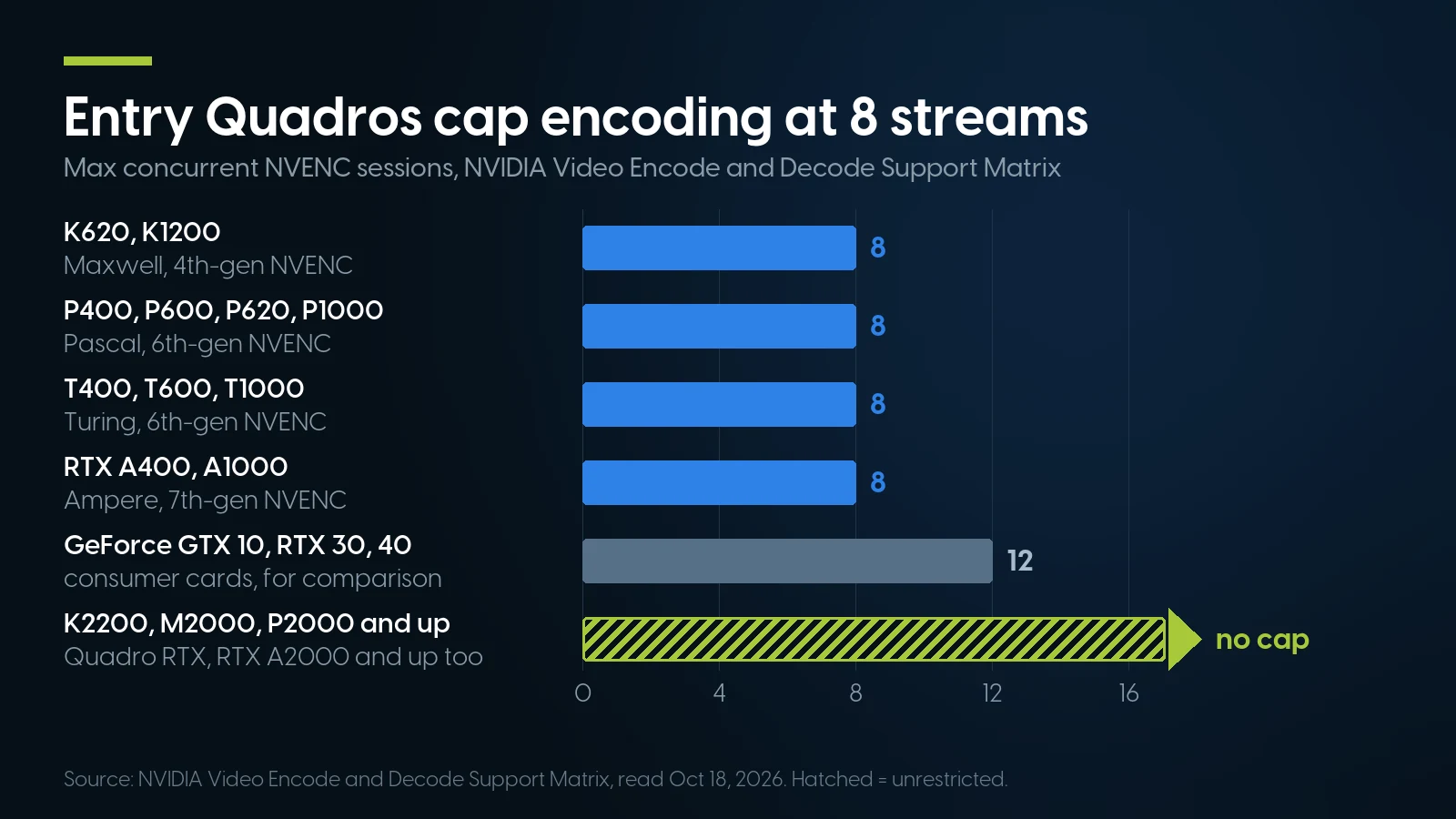
Every entry Quadro, old or new, stops at 8 encode sessions, below a GeForce’s 12; the cap lifts from the K2200, M2000 and P2000 up. NVIDIA Video Encode and Decode Support Matrix, read October 18, 2026.
So a P1000 or T1000 is capped at 8 streams, below a GeForce’s 12. The lowest-tier unrestricted cards are the K2200, the M2000 and the bus-powered P2000 and P2200; the P5000 has two encoders. The session cap and the encoder generation are separate questions: a T1000 is newer than a P2000 and still has the older encoder and the cap. “Unrestricted” is not unlimited: NVIDIA’s NVENC application note (SDK 13.1) says those cards are “limited by available system resources”, and the GeForce cap of 12 counts every GeForce in the machine together.
CUDA and AI. Here the driver table decides. Maxwell and Pascal cards run CUDA 12 software and nothing newer, so a 16 GB P5000 is cheap memory on a closed road. Turing is the floor for a toolchain that keeps moving, and the cards that make sense for local models are the large-memory ones: Quadro RTX 6000 and 8000, RTX A4000, A5000 and A6000. Our local LLM hardware guide sizes memory to models. A 4 GB T1000 runs CUDA 13 but has no Tensor cores and little memory; it is a display card that can also compute.
Four monitors from a card with no power cable
Quadro P1000 4 GB, four mini-DisplayPort 1.4 outputs, 47 W, Dell part R27V4 with a full-height bracket: From $54.99 · 30 in stock. For three screens, a Dell Quadro P400 2 GB at $29.99. Both on NVIDIA’s R580 driver; prices first checked October 18, 2026. Same-day shipping on in-stock orders before 1 pm EST, free ground shipping over $35.
See the Quadro P1000 All graphics cardsWhat We Have on the Shelf, by Generation
Our graphics card category, read from the catalog on October 20, 2026, counting only NVIDIA professional cards you can add to a cart. Units are each listing’s stock, summed per generation; prices are the lowest listing.
PCSP catalog, October 20, 2026: visible, purchasable listings in the graphics card category; build-your-own options from the graphics card lists of the HP Z6 G4, HP Z8 G4 and Dell Precision T7920 configurators, options with stock only.
The depth is Pascal: the P1000 (77 units over four listings), the P400 (43 over three) and the P620 (32 over four), plus 17 P5000s. Turing is 10 cards (seven T1000s and three Quadro RTX 5000s), Ampere one. Several well-known cards — the P2000, P4000, M4000 and M5000 — exist here only as options in the HP Z6 G4, HP Z8 G4 and Precision T7920 build-your-own pages, where a P4000 adds $159.99 and an RTX A1000 adds $399.99 to the workstation. Those pages start from a base without processor or memory ($334.98 for the dual-socket Z6 G4, as of October 20, 2026).
Every card on the shelf is an OEM pull: the listing carries a Dell, HP or Lenovo part number (Dell R27V4 on the $54.99 P1000, HP M41413-001 on the T1000, Lenovo 00FC903 on one M2000), not a retail NVIDIA box. Search by that part number when you need to match a bracket or an OEM’s spare-parts list. A card bought on its own carries our 90-day parts warranty; the same card configured into a workstation is covered by the machine’s free 1-year warranty on parts, labor and shipping, extendable to 5 years.
When a Used Quadro Is the Wrong Buy, Including Ours
We sell these cards; read this as the disclosure it is.
- Any Kepler card for more than a display. Our cheapest graphics card, the $9.02 K420, is a 1 GB Kepler board on a driver branch NVIDIA stopped supporting in January 2023. Fine for a screen on a machine you will not update; wrong for any software that wants a current driver or CUDA.
- CUDA or AI on Maxwell or Pascal. Our 16 GB P5000 at $193.02 is the cheapest 16 GB of video memory we sell, and CUDA 13 cannot target it. If the toolchain will move in the next two years, start at Turing with real memory, which we stock only a few at a time: on October 20, three Quadro RTX 5000 16 GB at $517.49, and the RTX A4000 only as a workstation build option, one or two units. Our used GPU guide found an RTX A4000 at $800–850 and a Quadro RTX 4000 at $170 on GPUDojo in early September 2026; check those prices again before buying.
- Hardware ray tracing. SOLIDWORKS Visualize’s fast mode needs RT cores, and our CAD guide covers what Enscape and D5 Render ask for. Our stock with RT cores is three Quadro RTX 5000s, one RTX A2000 6 GB, and RTX A1000, A4000 and A6000 options inside workstation builds (the last two, one or two units).
- A small-form-factor desktop. Only two Pascal listings are labelled with a low-profile bracket: a P620 (2 units) and an HP P1000 (4 units). Every T1000, P400 and A2000 listing names a full-height bracket.
- More than eight video streams on a budget. A P1000 or T1000 stops at 8 encode sessions; a GeForce gets 12. Pick an unrestricted card: an M2000 from $26.87, or a P2000 or P4000 in a workstation build.
- A card you need under warranty for a year. Loose cards get 90 days. For a year, buy the card inside a configured workstation, or buy new with the maker’s warranty: NVIDIA still lists the RTX A400 and A1000, 50 W low-profile cards with RT cores.
- A Windows 10 workstation. Any card’s driver on Windows 10 is quarterly security updates only under NVIDIA’s bulletin 5707. A newer card does not fix that; Windows 11 on a supported processor does.
Quadro cards and the workstations they go in, on our shelf today
Lowest listed price in each category and what is on the shelf right now — barebones chassis included, so a complete build costs more than the figure shown. This block is the one part of the article that refreshes itself; every price in the text above is dated where it stands.
- Graphics cardsQuadro K, M, P, T and RTX A; floor is an entry Kepler cardFrom $9.02 · 45 in stock
- Dell Precision T5820Xeon W tower · floor is a build-your-own baseFrom $142.98 · 34 in stock
- HP Z4 G4Xeon W tower · floor is a build-your-own baseFrom $209.98 · 47 in stock
- HP Z6 G4Xeon Scalable tower · Quadro options in the configuratorFrom $334.98 · 15 in stock
- HP Z8 G4Dual-socket tower · Quadro options in the configuratorFrom $734.98 · 28 in stock
Need a P4000 or RTX A1000? Configure the workstation around it.
The Quadro P4000, P2000, M4000 and RTX A1000 are options in our HP Z6 G4, Z8 G4 and Dell Precision T7920 build-your-own pages; the card is then covered by the machine’s free 1-year warranty on parts, labor and shipping, extendable to 5 years. Tell us the software and the monitors, and we will match the card and the power supply.
Configure an HP Z6 G4 Configure a Precision T7920The Bottom Line
Read a Quadro name as architecture plus tier, then check the two exceptions: the K620, K1200 and K2200 are Maxwell, and the T400, T600 and T1000 are Turing without RT or Tensor cores. After that, NVIDIA’s own bulletins set the clock. Kepler is done. Maxwell and Pascal get security updates through October 2028 on R580 and cannot be targeted by CUDA 13. Turing and Ampere are on current drivers.
That makes Pascal the sensible used buy for displays and CAD to 2028, and Turing or newer the floor for anything CUDA. Our shelf, as of October 20, 2026, is deep where that advice points for displays: Pascal cards from $23.70, a four-output P1000 from $54.99, the P5000 at $193.02, the T1000 at $199.00. For the RTX cards, it is thin, and we say so.
NVIDIA Quadro Generations: Frequently Asked Questions
What do the letters in NVIDIA Quadro names mean?
Mostly the architecture: K for Kepler, M for Maxwell, P for Pascal, T for Turing, and RTX A for Ampere, with the number giving the tier inside the generation. Two exceptions matter: the K620, K1200 and K2200 are Maxwell, not Kepler, and the T400, T600 and T1000 are Turing cards with no RT or Tensor cores listed on NVIDIA’s datasheets.
Is the Quadro K2200 Kepler or Maxwell?
Maxwell. NVIDIA’s compute-capability table gives the K2200, K1200 and K620 compute capability 5.0, which is Maxwell, and they are absent from NVIDIA’s Kepler end-of-support notice. They run on the R580 driver, which NVIDIA’s July 30, 2026 release still lists for them, with critical security updates through October 2028.
Are Quadro P-series cards still supported in 2026?
Yes, on their last driver branch. NVIDIA’s bulletin 5706 (updated February 25, 2026) says Release 580 is the last branch for Maxwell, Pascal and Volta Quadros and provides a year of full support and critical security updates through October 2028. The R580 driver of July 30, 2026 supports Windows 10 and 11. CUDA 13 cannot build for Pascal; CUDA 12.x can.
Is the NVIDIA T1000 an RTX card?
It is a Turing card without the RTX hardware. NVIDIA’s T400, T600 and T1000 datasheets list CUDA cores but no RT cores or Tensor cores, and the names carry neither Quadro nor RTX. They do get the current R595 driver and CUDA 13, have 160 GB/s of GDDR6 bandwidth on the T600 and T1000, and drive two 8K displays.
Which is better, the Quadro P1000 or the T1000?
The T1000 is newer: Turing instead of Pascal, 896 CUDA cores to 640, GDDR6 at 160 GB/s to 82, two 8K displays, and current drivers and CUDA 13. Both are low-profile, single-slot cards with four mini-DisplayPort outputs and no power cable, and both are capped at 8 encode sessions. For four monitors or AutoCAD the P1000 does the job for less.
Which Quadro cards need a PCIe power connector?
Cards up to 75 W run from the slot: the P400 to P2200, K620, K1200, K2200, M2000, the T-series and the RTX A400, A1000 and A2000. NVIDIA’s power guide lists one 6-pin for the K4200, M4000, P4000 and RTX A4000; one 8-pin for the P5000, P6000, Quadro RTX 4000, A4500 and A5000; 8-pin plus 6-pin for the Quadro RTX 5000, 6000 and 8000; and a CPU 8-pin for the RTX A6000.
Can I use an old Quadro for AI or CUDA work?
Only on CUDA 12 software. CUDA 13 removed offline compilation and library support for Maxwell, Pascal and Volta, and Kepler was removed in CUDA 12.0. Software built with CUDA 12.x for these cards still runs on a P5000 or P4000 with the R580 driver (PyTorch now only in its CUDA 12.6 legacy build), but new CUDA 13-only releases will not. Turing, compute capability 7.5, is the oldest generation CUDA 13 targets.
Did NVIDIA discontinue the Quadro brand?
For new cards, yes. NVIDIA’s 2021 release for the RTX A5000 and A4000 calls them NVIDIA RTX, without Quadro, and ServeTheHome reported in October 2020 that NVIDIA confirmed the Quadro name was being phased out for new products. Later cards are named RTX Ada Generation and RTX PRO Blackwell. NVIDIA’s support bulletins still use the Quadro name.