


Section 179 in 2026: Deduct Refurbished Servers by Dec 31
Posted by Konstantin Protasov, PCSP on Sep 5th 2026
For a calendar-year business, the 2026 tax numbers are already on paper. Under Rev. Proc. 2025-32 (October 9, 2025), the Section 179 expensing cap for tax years beginning in 2026 is $2,560,000, phasing out once the Section 179 property placed in service during the year passes $4,090,000. Beside it, 100% bonus depreciation is permanent again for property acquired after January 19, 2025 — written into §168(k) by Public Law 119-21 (the One Big Beautiful Bill Act, July 4, 2025) and restated for filers in IRS Notice 2026-11 of January 14, 2026.
What has not changed is the clock. Both deductions attach to the year the equipment is placed in service — not ordered, not paid for, not shipped — and for a calendar-year taxpayer that year ends on Thursday, December 31, 2026. With Dell telling investors on September 1 that it is “supply constrained” and HPE reporting a record order backlog on September 2, the clock is this year's whole story: a new server ordered in November may not be deductible until 2027, while a refurbished, ready-to-ship one ordered before 1 pm EST is eligible to leave our Michigan warehouse the same business day.
One sentence first: this article is general information, not tax advice. Every rule below is quoted from its IRS or statutory source so you can hand it to your CPA, and state rules differ — including in our own state of Michigan.
The short version, checked September 14, 2026:
- 2026 Section 179: $2,560,000, phasing out from $4,090,000 (Rev. Proc. 2025-32 §4.24; Publication 946). Bonus depreciation: 100%, permanent, for property acquired after January 19, 2025 (§168(k)(1)(A); Notice 2026-11).
- Refurbished qualifies for both. Section 179 tests purchase from an unrelated party, not age (Pub 946, “Property Acquired by Purchase”); bonus adds only that you never held a depreciable interest in the item (§168(k)(2)(E)(i); Treas. Reg. §1.168(k)-2).
- “Placed in service” means ready and available for its job. Pub 946's Example 1 puts a machine delivered in one year but installed in the next into the later year. A server still boxed on December 31 is a 2027 deduction.
- Buy in December without electing and year one can be 5%, not 100%. If more than 40% of the year's depreciable basis lands in the last quarter, first-year MACRS on five-year property drops from 20% to 5% (Pub 946 Tables A-1 and A-5). Bonus basis counts toward that test; Section 179 basis does not.
- Under $2,500 per item is a simpler rule. The de minimis safe harbor expenses parts, memory and inexpensive machines outright, outside Form 4562 (Treas. Reg. §1.263(a)-1(f); Notice 2015-82).
- Your state may take some of it back. California caps Section 179 at $25,000 with no bonus; Michigan uses the pre-2025 limits and its corporate tax allows no bonus; New Jersey follows the 2002 Code.
- The shelf, priced September 14, 2026: a Dell R640 with two Xeon Silver 4108 and 64 GB at $841.37 (32 in stock), a Windows 11 Precision T5820 at $511.90 (132 in stock), a two-socket R630 at $272.93 (15 in stock).
What Changed for 2026: $2,560,000, $4,090,000 and a Permanent 100%
Section 70306 of Public Law 119-21 raised the §179(b) cap from $1,000,000 to $2,500,000 and the phase-out threshold from $2,500,000 to $4,000,000 for taxable years beginning after December 31, 2024, indexed from a calendar-2024 base. Rev. Proc. 2025-32 §4.24 publishes the indexed 2026 figures: the cost a taxpayer elects to expense “cannot exceed $2,560,000,” reduced “by the amount by which the cost of § 179 property placed in service during the 2026 taxable year exceeds $4,090,000.” Publication 946 (2025 edition) repeats both numbers under “What's New for 2026,” with a $32,000 cap for sport utility vehicles.
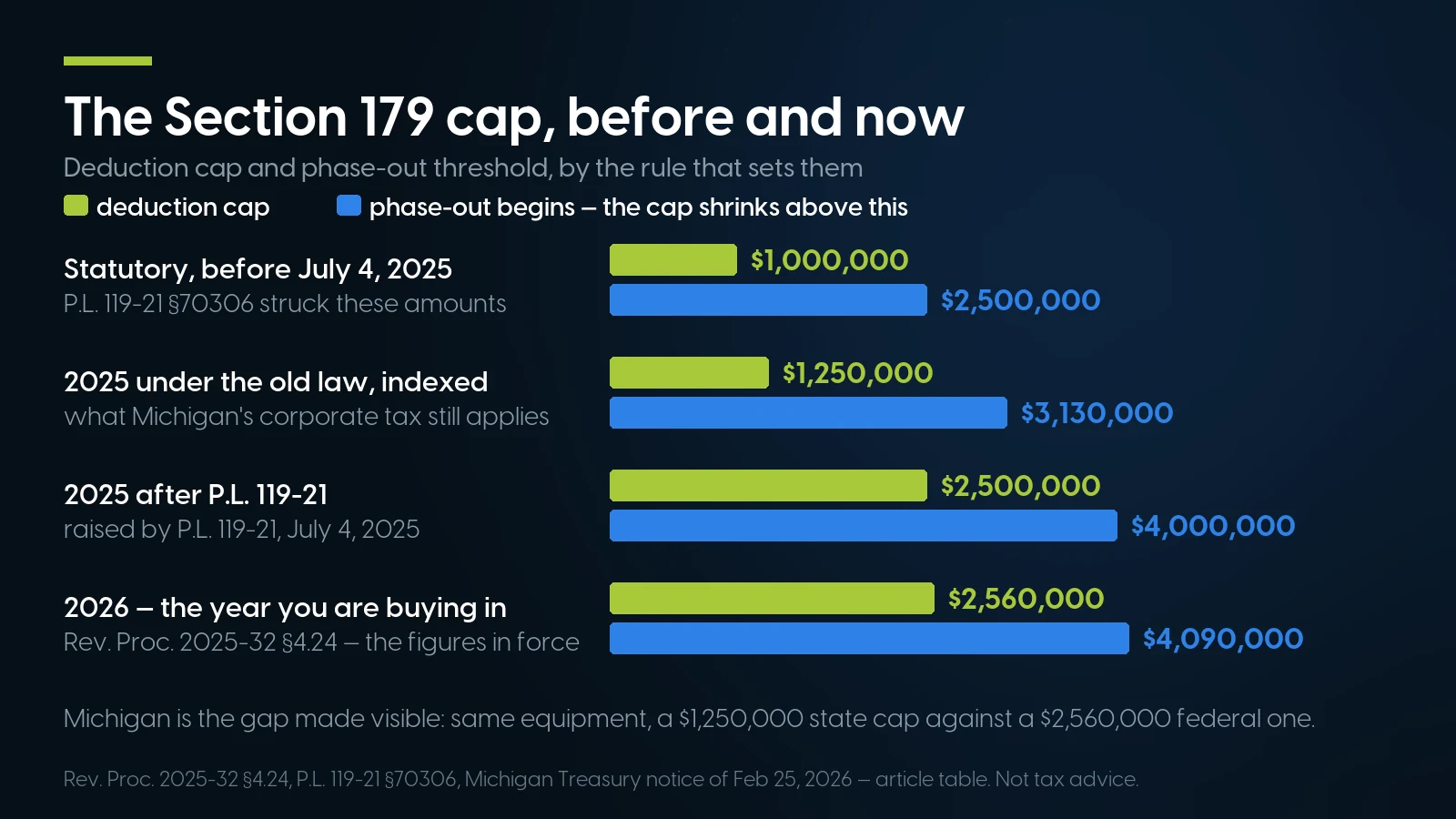
Michigan is the gap made visible: its corporate tax still works from the pre-2025 $1,250,000 cap while the federal 2026 figures are $2,560,000 and $4,090,000. Sources: Rev. Proc. 2025-32 §4.24, P.L. 119-21 §70306, Michigan Treasury notice of February 25, 2026. Not tax advice.
Bonus depreciation changed more fundamentally. After Section 70301 of the same law, 26 U.S.C. §168(k) grants “an allowance equal to 100 percent of the adjusted basis of the qualified property,” with no sunset. The cut-over is by acquisition date: per Notice 2026-11 §2.02 the amendments “apply to property acquired … after January 19, 2025.” For a fall-2026 buyer the only date left to manage is placed in service.
The 40% election you may still see recommended applied only to 2025 for calendar-year filers (IRS announcement, January 14, 2026). A 2026 buyer has two settings: 100%, or an election out of bonus for a whole class of property.
Does Refurbished or Used Equipment Qualify? The Actual Tests
Yes, for both — and the tests have nothing to do with age or condition, only with who sold it and whether you owned it before.
Section 179: the property must be “acquired by purchase.” Pub 946's “Property Acquired by Purchase” section: “To qualify for the section 179 deduction, your property must have been acquired by purchase.” Property is not “purchased” when “it is acquired from a related person” — spouse, ancestors, lineal descendants, a more-than-50%-owned entity or a controlled-group member (§179(d)(2); Pub 946). Pub 946's own illustration is a tailor buying used sewing machines from his father: not Section 179 property. A refurbished server bought at arm's length from a dealer, a liquidator or a stranger on eBay passes the test the father fails.
Bonus depreciation: new to you, bought at arm's length. Under §168(k)(2)(E)(i) a used acquisition qualifies if “such property was not used by the taxpayer at any time prior to such acquisition” and the §179(d) purchase rules are met. Treas. Reg. §1.168(k)-2(b)(3)(iii) defines “used by the taxpayer” as having held “a depreciable interest in the property at any time prior to such acquisition,” looking back five calendar years; Notice 2026-11 §3.02 carries those rules forward.
Three consequences, and the third is the one that bites:
- Refurbished from a dealer: qualifies for Section 179 and for 100% bonus. You never owned it, the seller is unrelated, the basis is what you paid.
- From a private individual or a marketplace: the same terms; what changes is the paperwork, below.
- Buying back your own decommissioned gear fails the bonus test: you held a depreciable interest inside the five-year window. Section 179 has no prior-ownership bar, but re-expensing something you already wrote off is a question for your CPA. We say this as a company that runs an IT asset buy-back program: selling us your old hardware and buying replacements are two separate transactions, and the sale of fully expensed equipment generally produces ordinary income.
Trade-ins are the related trap: for Section 179 the cost “includes only the cash you paid” (Pub 946), and since 2017 §1031(a)(1) like-kind treatment covers only real property. Sell the old rack for what it is worth; buy the new one for what it costs.
Paperwork is the real test for a used purchase. Pub 946: “You must keep records that show the specific identification of each piece of qualifying section 179 property. These records must show how you acquired the property, the person you acquired it from, and when you placed it in service.” A dealer invoice with seller, date, serial numbers and amount satisfies all three; a cash deal with no paper satisfies none. Whoever you buy from — including us — insist on that document.
Two smaller points. Section 179 requires more than 50% business use in the year the property is placed in service, and only the business-use share of cost is eligible (Pub 946, “Partial business use”). And off-the-shelf software “is qualifying property” for Section 179 (Pub 946) — a Windows Server license bought with a refurbished host sits inside the same deduction.
“Placed in Service by December 31” — What That Means in 2026
The regulation is one sentence. Treas. Reg. §1.179-4(e): “The term placed in service means the time that property is first placed by the taxpayer in a condition or state of readiness and availability for a specifically assigned function.” Pub 946 restates it and gives the example this article turns on:
“Example 1. You bought a machine for your business. The machine was delivered last year. However, it was not installed and operational until this year. It is considered placed in service this year. If the machine had been ready and available for use when it was delivered, it would be considered placed in service last year even if it was not actually used until this year.”
That separates four dates in a server order. Ordered is nothing; paid is nothing — the deduction follows ownership, not cash; delivered is not enough on its own, because the IRS puts the delivered-but-not-installed machine in the later year. Ready and available — racked, powered, configured for its job — is the date. A host booted into its hypervisor on December 29 is 2026; twelve servers on a pallet at the loading dock on December 31 are 2027.
That is why OEM supply is a tax question this year. On Dell's fiscal second-quarter call on September 1, 2026 (quoted from a third-party transcript), Jeff Clarke listed the constraints as “DRAM, DRAM, DRAM, followed by NAND, NAND NAND” and said Dell is “supply constrained.” HPE's third-quarter results of September 2, 2026 reported revenue up 34% to $12.2 billion and an “order backlog at a record level”; per Yahoo Finance's coverage of the call, management expects supply to remain “a constraint into fiscal 2027.”
Neither vendor publishes a system lead time in weeks, and we will not invent one. What exists is the integrator-reported consensus in our August analysis of server prices and lead times — roughly 6–10 weeks for a standard non-GPU build, 32–52 weeks for AI systems — on top of enterprise DRAM lead times Inventec put at over 40 weeks (DigiTimes, July 16, 2026). Those ranges are not vendor commitments — nobody in that chain is committing to your placed-in-service date.
HPE's August move to keep quotes “valid until HPE ships products” (The Register, August 6, 2026) locks the price, not the ship date — and for Section 179 only the ship date counts.
The refurbished path is dull in the way a deadline wants. Our shipping terms, as published: “only orders placed before 1:00 pm EST are eligible for same day shipping,” UPS Ground runs “1 to 5 business days within the contiguous U.S.,” and FedEx Priority Overnight delivers “the next business day by 10:30 a.m.”
Section 179 vs Bonus vs MACRS: Which Applies, in What Order
With bonus at 100%, why does Section 179 still appear in any plan? Because the layers stack. Pub 946's MACRS worksheet: cost times business-use percentage; subtract the Section 179 deduction; multiply what remains by the bonus percentage; depreciate the rest under the regular tables. The Form 4562 instructions say the same: the Section 179 expense comes off first, before any depreciation “(including any special depreciation allowance).”
Bonus is the default — Pub 946: “Unless you elect out, you must take a 100% special depreciation allowance for certain qualified property.” Servers and workstations are five-year MACRS property (Pub 946 Table B-1, class 00.12); pass the used-property tests and do nothing, and 100% of basis is deducted in the placed-in-service year. Section 179 is an election on Form 4562 Part I, and under §179(c)(1) the election must “specify the items of section 179 property to which the election applies and the portion of the cost of each of such items.”
The asymmetry that keeps Section 179 useful: the election out of bonus is not item-level. Under §168(k)(7) it applies to “any class of property for any taxable year,” by a statement attached to the return. What you can do is elect Section 179 on the servers, elect out of bonus for the class, and depreciate the workstations — useful where the state allows Section 179 but not bonus (Michigan's corporate tax, below).
The taxable-income limit is the other big difference. §179(b)(3)(A) caps the deduction at aggregate “taxable income … derived from the active conduct by the taxpayer of any trade or business,” with the excess carried forward. Bonus has no cap; what that does in a loss year is in the section against ourselves, below.
And the December trap. Pub 946: use the mid-quarter convention if “the total depreciable bases of MACRS property you placed in service during the last 3 months of the tax year … are more than 40% of the total depreciable bases of all MACRS property you placed in service during the entire year.” The deciding sentence: for that test, basis “reflects the reduction in basis for amounts expensed under section 179 … However, it does not reflect any reduction in basis for any special depreciation allowance.” A December order expensed under Section 179 disappears from the 40% test; taken as bonus it stays in and can drag every other asset depreciated that year into the fourth-quarter table — these two columns of Pub 946's Appendix A:
Years one and two from IRS Publication 946 (2025), Appendix A, Tables A-1 and A-5, five-year column. Both schedules total 100% over six tax years; only the timing differs.
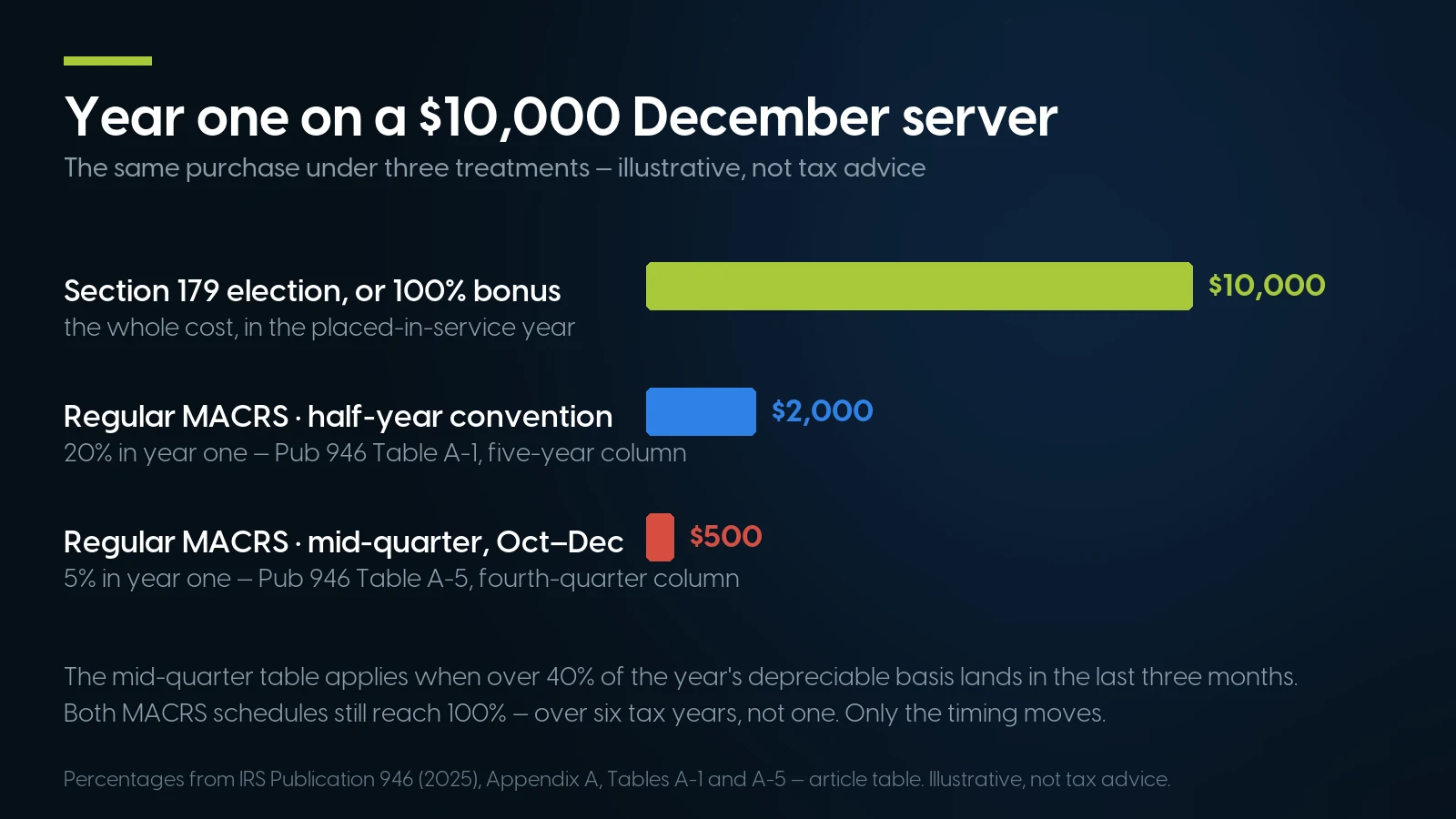
Illustrative. Electing Section 179 or taking bonus puts the whole $10,000 into 2026; buying in December and doing neither can leave $500 of it. Percentages from IRS Publication 946 (2025), Appendix A, Tables A-1 and A-5. Not tax advice.
The trap closes only on the buyer who neither elects Section 179 nor takes bonus. The rule for a December order: decide the election with your CPA before the purchase order, and if any of the year's assets will stay on regular depreciation, expense the December machines under Section 179 rather than bonus.
Worked Examples on Our September 14 Prices — Illustrative Only
Two purchases from our live inventory, checked September 14, 2026, at three rates: the 21% corporate rate of §11(b), and the 24% and 37% individual brackets a pass-through owner might sit in (2026 brackets per Rev. Proc. 2025-32 §4.01). Every line is illustrative: entity type, state, other income and business-use percentage change the number, and none of it is advice.
Illustrative. Cost × rate; prices and stock from PCSP live inventory on September 14, 2026; rates from §11(b) and Rev. Proc. 2025-32. Assumes 100% business use, enough active-business income to absorb a Section 179 election, and no state addback. Not tax advice.
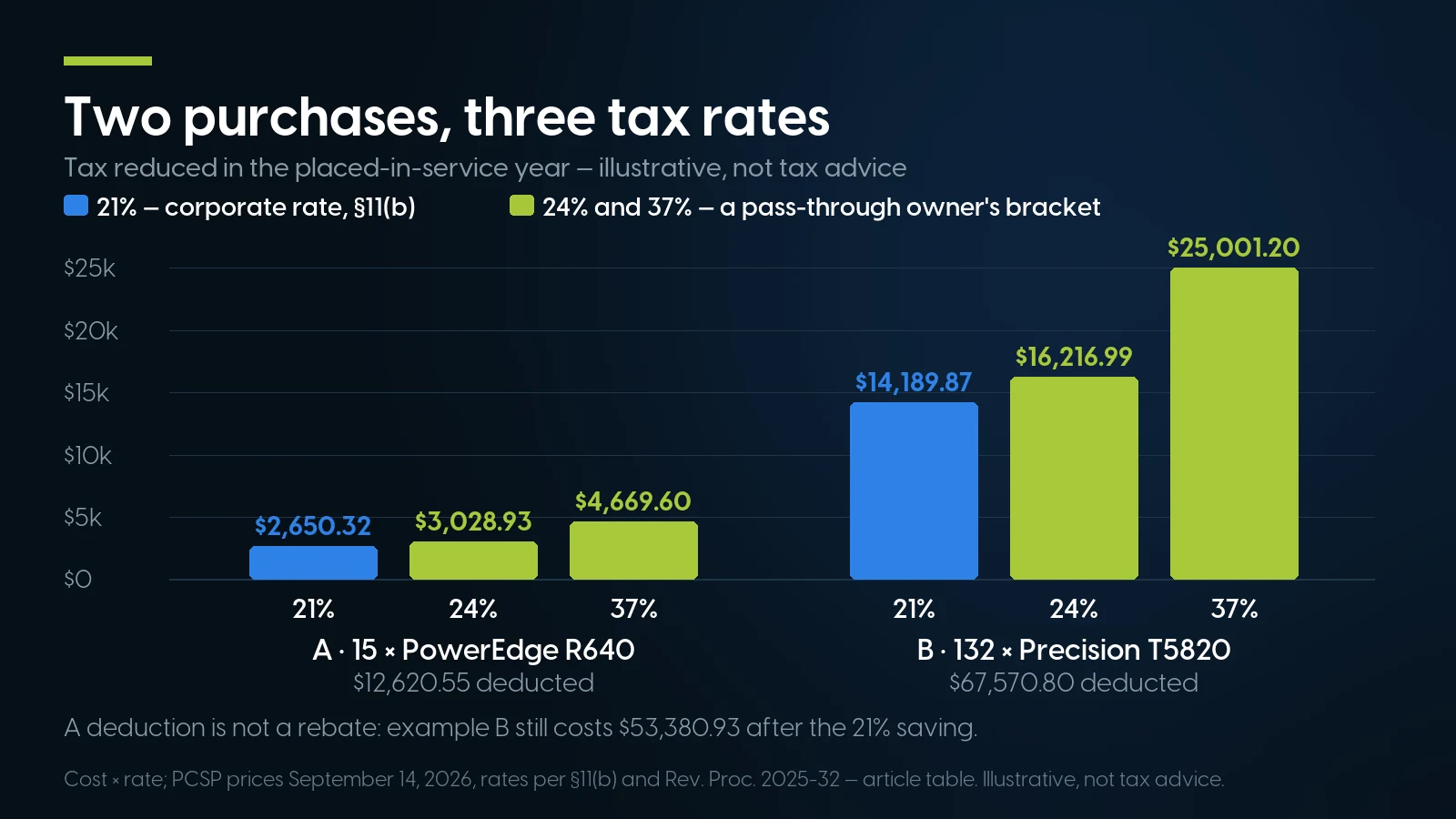
Illustrative. A higher bracket gets more from the same deduction, but it is never a rebate: purchase B still costs $53,380.93 after the 21% saving. Cost × rate on PCSP prices of September 14, 2026; rates per §11(b) and Rev. Proc. 2025-32. Not tax advice.
How to read it without fooling yourself. Cost times rate is a reduction in this year's tax, not a rebate: example B's fleet costs $67,570.80, and at 21% the business is still out of pocket $53,380.93 after the deduction. What the December buyer must not do is the second row of each example: buy, forget to elect, land in the mid-quarter convention, and deduct $631.03 of a $12,620.55 purchase in year one.
Two things that change real numbers. A sole proprietor's deduction also reduces net earnings from self-employment, taxed at a combined 15.3% per IRS Tax Topic 554 up to the 2026 Social Security wage base of $184,500, so a Schedule C filer saves more than the bracket alone. And the state return may not follow — the state section runs example B through California's $25,000 cap and shows what Michigan adds back.
The deduction needs a placed-in-service date in 2026. The hardware is on the shelf now.
Dell 13G/14G, HPE Gen9/Gen10 and Lenovo SR630 in matched quantities — tested, under a one-year warranty, quoted same day with the on-hand count and the ship date on the quote.
Browse refurbished servers Request a same-day quoteSmall Purchases: The $2,500 De Minimis Safe Harbor for Parts, RAM and Cheap Machines
Most of what we sell costs less than a Section 179 election is worth filling out for. Per the IRS's tangible-property explainer (updated August 4, 2026): “If you don't have an AFS, you may use the safe harbor to deduct amounts up to $2,500 … per invoice or item (as substantiated by invoice),” and with an applicable financial statement (audited financials) $5,000. The regulation still prints $500; the $2,500 dates from Notice 2015-82, for tax years beginning in 2016 or later.
The mechanics, from the same page and Treas. Reg. §1.263(a)-1(f): the election is annual, by a statement titled “Section 1.263(a)-1(f) de minimis safe harbor election” attached to a timely filed original return; it cannot be revoked; and it “must apply … to all expenditures meeting the criteria for the election in the taxable year.” The guardrail in §1.263(a)-1(f)(6): no safe harbor for amounts “substantiated with invoices created to componentize property” — a $6,000 server invoiced as six $1,000 lines is still a $6,000 server.
What the election buys is simplicity. A de minimis amount is an ordinary expense in the year paid, and in our reading it therefore never becomes “section 179 property placed in service”: no Form 4562, no phase-out, no income limit. It also settles the repair-versus-improvement question on upgrades: doubling a server's memory is a betterment the IRS page says to capitalize, replacing a failed drive is a repair, and under the safe harbor anything at or below $2,500 per item is expensed either way. Above it, a capitalized upgrade is its own five-year item eligible for Section 179 or bonus.
Against our shelf on September 14, 2026, the line falls here:
PCSP live inventory, September 14, 2026; ceilings per IRS tangible-property guidance and Notice 2015-82. Per-item versus per-invoice reading of a multi-unit order is your CPA's call.
Notice what that implies for December. A 15-unit fleet of $841.37 servers on one invoice is, item by item, below the ceiling; so is most of our workstation catalog. With the election in place the purchase is an ordinary expense with no placed-in-service analysis, because the safe harbor turns on amounts paid in the year. Even in this year's strange DDR4 market (our refurbished DDR4 memory analysis has the receipts), a 256 GB refurbished kit at $1,727.84 clears the ceiling with room.
Your State May Not Follow: California, Michigan, New Jersey and Others
The federal deduction does not automatically travel to the state return. Many states froze their copy of the code before July 2025, or never accepted bonus at all. Three states from their own tax agencies, and an honest note about the rest:
Not a fifty-state table. California, Michigan and New Jersey are quoted from their own tax agencies; the last row rests on a professional publisher's summary and should be verified for your state.
California is the starkest. The Franchise Tax Board's 2025 Form 3885 instructions: “For California purposes, the maximum IRC Section 179 expense deduction allowed is $25,000,” reduced once Section 179 property exceeds $200,000, and the state does not conform to §168(k) at all. Expense example B's $67,570.80 fleet federally and California allows $25,000, depreciating the other $42,570.80 under state rules.
Michigan is our state, so read this twice. Public Act 24 of 2025 (signed October 7, 2025) decoupled Michigan from several provisions the July 2025 federal law changed, and the Treasury's February 25, 2026 notice spells out the consequences. On Section 179: “taxpayers must compute the maximum deduction and applicable phase-out by applying the pre-OB3 limits ($1.25 million and $3.13 million, respectively, adjusted annually for inflation).” On bonus: “The CIT already fully decouples from IRC 168(k),” while individual and flow-through filers use “the version of IRC 168(k) in effect as of December 31, 2024,” the old phase-down, “with a 40% accelerated deduction permitted for tax year 2025.” By that schedule 2026 would be 20% (our derivation; Michigan calls 2026 guidance “forthcoming”). For a Michigan buyer under the state cap: elect Section 179 and the state follows; take bonus and Michigan adds most of it back.
New Jersey disallowed bonus “for privilege periods starting on and after January 1, 2002” and computes Section 179 under “the federal Internal Revenue Code in effect on December 31, 2002,” per the Division of Taxation. For every other state the instruction is the same: before you count the saving, ask what your state adds back.
When Section 179 Is the Wrong Reason to Buy — and When Our Shelf Is the Wrong Answer
We sell the hardware this article is about, so here is the case against buying it, made as carefully as the case for.
A deduction is a timing benefit, not a discount. A corporation that expenses $20,000 of servers saves $4,200 of 2026 tax at 21% — and gives up exactly $4,200 of depreciation it would have taken in 2027 through 2031. At the top individual rate the government funds 37 cents of every dollar; equipment bought for the deduction and not for a workload is a 63-cent loss dressed as a 37-cent gain.
In a loss year the premise fails. Section 179 is capped by §179(b)(3) at active-business taxable income; with none, the election carries forward. Bonus has no cap, so it deepens the loss into a net operating loss that §172(a)(2) lets you use later at 80% of taxable income per year — or, for a pass-through owner, an excess business loss above 2026's “$256,000 ($512,000 for joint returns)” threshold (Rev. Proc. 2025-32 §4.31), also carried forward. “Buy hardware to use up the loss” is backwards: a loss year is when the deduction is worth least and cash is worth most.
Cash flow comes before tax. A deduction reduces the tax on money already spent. Financing changes the cash answer, not the tax one — ownership, not cash, controls (Pub 946). We offer financing through a partner, Blue Street Capital; whether an agreement is a purchase or a lease for tax purposes is decided by its terms. On true leases Pub 946 is unambiguous: “if you lease property from someone to use in your trade or business … generally you cannot depreciate its cost because you do not retain the incidents of ownership.” Operating-lease rent is deductible evenly, with no year-end scramble — for some businesses the better answer.
Cloud is an operating expense, deductible as you pay it. Our cloud-versus-on-premises analysis has the month-by-month math; the tax layer adds only that OpEx never touches Form 4562, never meets a placed-in-service date, and never gets added back by California. If the workload is elastic or short-lived, a December server bought for a deduction is the wrong instrument.
And when the right purchase is new, with a vendor contract, not our shelf:
- A compliance or insurer requirement for current-generation hardware with an unbroken OEM warranty chain and a named SLA; our one-year warranty (extendable to five) does not satisfy it.
- A 7–10-year runway on one platform. The Dell 14G and HPE Gen10 machines in the examples are 2017–2019 hardware; our price-increase article is honest about how many years they have left. A host you intend to keep into the mid-2030s belongs on a current platform, deducted in whichever year it is finally placed in service.
- A workload that needs the new platform — DDR5 bandwidth, PCIe Gen5 NVMe, current-generation cores, GPU density. We stock no DDR5 modules as of September 14, 2026; our 15th- and 16th-generation Dell servers are available to order rather than on the shelf (one ready R750, 2× Platinum 8358 with 128 GB, at $9,261.72, four units); current Precision 5860/7865/7960 towers were sold out the same day.
- A December purchase that pushes the year past $4,090,000 of Section 179 property gets less from the election than the headline suggests; run the numbers before the purchase order.
One more, and it is the one buyers regret. Under Pub 946 you “may have to recapture the section 179 deduction if, in any year during the property's recovery period, the percentage of business use drops to 50% or less.” A home-office machine that becomes the household computer in 2028 is a 2028 tax problem. Deduct what the business will actually use.
A Calendar for the Fourth Quarter of 2026
Dates for a calendar-year taxpayer. A fiscal-year business substitutes its own year-end: Rev. Proc. 2025-32 applies the 2026 amounts to “taxable years beginning in 2026.”
A note on demand, because it affects the December shelf too. Gartner's July 27, 2026 forecast (via I-Connect007) put 2026 worldwide IT spending at $6.37 trillion, up 14.2%; NFIB's July 2026 small-business survey found 25% of owners planning capital outlays in the next six months, “the highest reading since December 2024.” Neither is a fourth-quarter statistic — no survey we could find measures a corporate year-end rush, and we will not invent one — but both say December's competing buyers have budgets and intent. The 132 workstations in example B are a September 5 count, not a promise for December 18.
What a December purchase looks like today
Lowest listed price in each category and what is on the shelf right now — barebones chassis included, so a complete build costs more than the figure shown. This block is the one part of the article that refreshes itself; every price in the text above is dated where it stands.
- Refurbished serversDell PowerEdge, HPE ProLiant, ThinkSystemFrom $69.99 · 340 in stock
- Dell PowerEdge R640The deepest server shelf we holdFrom $372.49 · 116 in stock
- HPE ProLiant DL380 Gen102U · Xeon ScalableFrom $303.74 · 42 in stock
- Refurbished workstationsHP Z, Dell Precision, ThinkStationFrom $74.99 · 539 in stock
- DDR4 server memoryRegistered ECC modules and kitsFrom $45.98 · 89 in stock
Windows 11-ready workstations, in matched quantities, shipped this week
Dell Precision T5820 with Windows 11 Pro from $511.90 (132 in stock), Lenovo ThinkStation P520 from $633.91 (117), HP Z2 G4 from $425.03 (45) — priced September 14, 2026, one-year warranty, free ground shipping over $35 in the contiguous U.S.
Browse refurbished workstations Precision T5820 in stockThe Bottom Line
The 2026 rules are unusually clean: a $2,560,000 Section 179 cap, a $4,090,000 phase-out threshold, and 100% bonus depreciation with no sunset — each traceable to Rev. Proc. 2025-32, Public Law 119-21 and Notice 2026-11. Refurbished equipment qualifies for both on the same terms as new, because the tests are purchase from an unrelated party and no prior ownership, not age.
What is not clean is the calendar. The deduction belongs to the year the machine is ready and available for its job, the IRS's own example puts a delivered-but-uninstalled machine into the following year, and the OEMs told investors in September that they are supply constrained with record backlogs. A December buyer needs three things at once: hardware that exists, an election decided before the purchase order, and the placed-in-service evidence in a folder.
And the standing reminder: this is general information, not tax advice. Talk to your CPA before relying on any of it, and ask specifically what your state does — California allows $25,000, New Jersey follows 2002, and Michigan, where these servers ship from, adds back most bonus depreciation and caps Section 179 at the old limits. The federal arithmetic is the ceiling on what the deduction is worth, not the floor.
Section 179 and Refurbished IT Equipment: FAQ
What is the Section 179 deduction limit for 2026?
$2,560,000, reduced dollar for dollar once Section 179 property placed in service during the year exceeds $4,090,000 — per Rev. Proc. 2025-32 §4.24 and IRS Publication 946, for taxable years beginning in 2026 (2025: $2,500,000 and $4,000,000). Separately, 100% bonus depreciation is permanent for property acquired after January 19, 2025. General information, not tax advice.
Does refurbished or used equipment qualify for Section 179 and bonus depreciation?
Yes. Section 179 requires property “acquired by purchase” from an unrelated party, with no age or condition test (Pub 946; §179(d)(2)). Bonus covers “certain used property”: property in which you held no depreciable interest within the prior five years, bought at arm's length (§168(k)(2)(E)(i); Treas. Reg. §1.168(k)-2). Buying back your own former equipment fails the bonus test; buying from a relative fails both.
What if I bought the server on eBay or from a private seller?
Neither rule cares whether the seller is a business; what matters is that the seller is unrelated to you and that you can prove the purchase. Pub 946 requires records identifying each piece of Section 179 property, how you acquired it, from whom, and when you placed it in service. Get a document with the seller's name, the date, the serial numbers and the amount paid.
Does a financed purchase or a lease qualify?
A financed purchase does: the deduction follows ownership and cost, not cash paid — Pub 946's example is a van bought on five years of payments that the owner “can depreciate.” A true lease generally does not: Pub 946 says that if you lease property to use in your business, generally you cannot depreciate its cost because you do not retain the incidents of ownership; lease payments are deducted as rent instead. Whether a lease with a nominal buyout is really a purchase is a question for your CPA.
Is a build-your-own configured server one asset, and do RAM or drive upgrades qualify?
A configured server invoiced as one machine is one unit of property (Treas. Reg. §1.263(a)-3), and §1.263(a)-1(f)(6) bars splitting the invoice into sub-$2,500 lines. Upgrades at or below $2,500 per item can be expensed under the de minimis safe harbor if you make the annual election; above it, an upgrade that adds capacity is a betterment, capitalized as a five-year item eligible for Section 179 or bonus.
Can I deduct a server that is delivered on January 2, 2027?
Not on a 2026 calendar-year return. The deduction belongs to the year the property is placed in service — ready and available for its assigned function (Treas. Reg. §1.179-4(e)). Pub 946's Example 1 puts a machine delivered in one year but not installed until the next into the later year. A machine racked, powered and configured by December 31 is a 2026 asset; document the date.
Do I have to elect bonus depreciation, or is it automatic?
Automatic. Pub 946: “Unless you elect out, you must take a 100% special depreciation allowance” for qualified property. The election out is a statement attached to the return and covers a class of property for the year (§168(k)(7)). Section 179 is elected item by item on Form 4562 Part I, is capped by active-business taxable income, and is excluded from the 40% mid-quarter test.
Does my state allow the federal Section 179 and bonus amounts?
Often not in full. California caps Section 179 at $25,000 and allows no bonus (FTB Form 3885 instructions). Michigan's corporate tax has never allowed bonus, and Public Act 24 of 2025 puts all Michigan filers on the pre-2025 Section 179 limits, individual and flow-through filers on the old §168(k) phase-down (Treasury notice, February 25, 2026). New Jersey follows the 2002 Code. Ask your CPA what your state adds back.