

Best AI Server for Business 2026: Dedicated On-Prem Guide
Posted by Konstantin Protasov, PCSP on Mar 13th 2025
The AI bill arrives from two directions at once. Per-seat assistants multiply across the org chart — ChatGPT Business alone runs $25 per user per month on monthly billing, so twenty employees is $500 a month before anyone touches an API. And the workloads you would most like to automate — contracts, patient notes, financials — are exactly the ones your counsel does not want leaving the building at all.
That is the 2026 case for a dedicated AI server: a machine you own, running open-weight models on your network, billed once. This guide is the full rewrite of our March 2025 article on the subject, and this time it shows receipts — live cloud GPU rates, our own shelf prices with quantities, and honest break-even math, including the cases where the right answer is don't buy one. One disclosure up front: we sell refurbished servers and GPUs, so check our arithmetic — every number links to its source or carries the date we pulled it from our live inventory.
The short version, priced August 28, 2026:
- The entry ticket is under $800. A configure-to-order Dell PowerEdge R740 base starts at $291.99 and an NVIDIA Tesla T4 16 GB accelerator is $499.99 with 11 in stock — a real inference pilot for $791.98 in core hardware, before you finish the configuration.
- Renting one serious card 24/7 costs $8,700–16,300 a year. On RunPod's published rates, an L40S 48 GB is $0.99/hour — ~$8,672 per year at 24/7. The same card on AWS (g6e.xlarge, $1.861/hour) is ~$16,300 per year.
- Used 24 GB gaming cards now trade above their launch price — listing trackers put RTX 4090 asks at roughly $2,100–2,800 against a $1,599 MSRP — because NVIDIA's RTX 50 Super refresh is reportedly on hold over 3 GB GDDR7 costs. Datacenter cards in a refurbished host are the saner route to VRAM.
- The honest crossover: below roughly 15–20% utilization — occasional jobs, experiments — cloud and API pricing wins and you should not buy anything. Steady daily inference is where ownership pays.
- L40S/A100-class builds are configured to order. We do not stock those cards; GPU platforms like the R7525 and R760xa are built to spec through a quote, with the math to justify them below.
What Is a Dedicated AI Server?
A dedicated AI server is a server whose hardware is provisioned for one job: running machine-learning workloads — usually large language model inference, retrieval-augmented generation (RAG), or fine-tuning — for your organization alone. In practice that means a rack platform with one or more GPUs sized so the model's weights fit in video memory, enough system RAM and NVMe to feed them, and nothing else competing for the box. “Dedicated” is doing real work in that sentence, in three directions:
- Dedicated versus shared cloud. A cloud GPU instance is metered by the hour and lives in someone else's datacenter under their terms of service. A dedicated server is a capital purchase: the meter stops, and prompts, documents and embeddings never leave your network.
- Dedicated versus a GPU workstation. A workstation under a desk serves the person at the desk. A dedicated AI server sits in a rack with redundant power, out-of-band management (iDRAC/iLO), and server airflow designed to cool passive datacenter cards — which mostly have no fans of their own and rely on chassis airflow — so it can serve a team over the network at 24/7 duty cycles. Our local LLM hardware guide covers when a workstation is genuinely enough.
- Dedicated versus your existing virtualization host. You can pass a GPU through to a VM on a general-purpose host, and for a pilot you should. The reason dedicated boxes exist is that inference eats the whole card and RAG indexing eats disk and RAM in bursts; production AI sharing a host with your ERP is how both end up slow.
What a dedicated AI server is not, for most businesses, is an H100 supercomputer. The workloads companies actually run in 2026 — internal chatbots, document Q&A over a knowledge base, summarization, extraction, code assist — run on open-weight models in the 7–70 billion parameter range, and those fit on hardware measured in hundreds or a few thousands of dollars, not hundreds of thousands. The sizing logic — which model needs how much VRAM at which quantization — is a guide of its own; we keep the full VRAM tables there rather than duplicating them here.
Does Your Business Actually Need One?
Start from the workload, not the hardware. Three patterns cover most of what SMBs deploy in 2026, and they size very differently:
- Internal chatbot or document Q&A (RAG) on a 7–13B model. The default first project: a quantized open-weight model answering questions over your own documents. A single 16–24 GB GPU handles a small team's traffic. This is the tier a sub-$1,000 build serves.
- Heavier inference — bigger models, more users, agents. Once you want 70B-class quality, longer contexts, or a department hitting the box all day, you are in 48 GB-and-up territory — one L40S-class card or several 24 GB cards. This is where the cloud-versus-owned math gets decided, and it usually decides in favor of owning.
- Fine-tuning and batch jobs. Adapting a model to your data (LoRA-style fine-tunes) or overnight batch extraction is bursty. If it runs occasionally, rent the hours; if the queue never empties, the same 48 GB+ hardware serves both this and inference.
The industry list from our 2025 version still holds — healthcare notes, legal review, financial analysis, manufacturing QC, retail forecasting — but the pattern behind it has sharpened: the businesses buying dedicated AI servers in 2026 are overwhelmingly the ones whose data cannot leave. On that, two honest statements. First, the compliance one: no model and no server is “HIPAA compliant” out of the box — compliance is something your organization achieves, not something hardware ships with. What self-hosting actually changes is that protected data is no longer disclosed to a model vendor at all, so there is no third-party processor and no business-associate chain on the inference path — while every Security Rule obligation (access control, encryption, audit) stays yours. The same logic drives legal privilege and financial-data deployments.
Second, the market context, with its bias labeled: a March 2026 survey commissioned by Cloudian — an on-prem storage vendor with an obvious stake in the answer — reported 93% of surveyed enterprises repatriating AI workloads from public cloud, in the process of doing so, or evaluating it, citing data sovereignty, unpredictable cloud costs and latency. Treat the percentage as vendor-commissioned research; treat the direction as consistent with what our own quote requests look like this year.
The Cloud Math: What Renting a GPU Really Costs
Before pricing any server, price the alternative honestly. These are on-demand rates pulled on August 28, 2026 — RunPod from its published price list, AWS us-east-1 from the Vantage tracker of AWS's own pricing API. The annual column is simple arithmetic: rate × 8,760 hours.
Three notes so this table is not misread. RunPod's cheaper “Community Cloud” tier runs lower still (L40S at $0.79, A100 at $1.19) on peer-hosted capacity. The AWS instance prices include the host around the GPU — vCPUs, RAM, local NVMe — plus AWS reliability guarantees, so it is not a pure per-card markup; spot and reserved pricing cut it substantially (p4d drops to $15.885 spot, $9.374 on a 3-year commitment, per the same tracker). And CoreWeave's tracker-published rates ($2.25/hr L40S, $2.70 A100, $6.16 H100, per aggregators of its list prices) mostly describe capacity that is actually sold on multi-year contracts.
Now the break-even, using our shelf prices from the next section. At 24/7 utilization: an under-$800 T4 pilot recovers its cost against even the cheapest cloud GPU row in about two months of runtime. A ~$4,900 mid-tier build (R750 base plus a 24 GB card) crosses over against the $0.49 L4 row in about 14 months — and against the L40S row in about seven. An A100-class build — used 80 GB cards were asking roughly $4,000–9,000 on the open market in August 2026 (asking prices, not confirmed sales) plus a host — lands within roughly a year against RunPod and about six months against AWS on-demand. The caveats run both ways: the rented L4 is a newer, more efficient card than a T4, and your owned box also needs power, rack space and someone to administer it — but cloud adds storage and egress fees we have not counted either. The full TCO treatment, including the electricity line, is in our cloud versus on-premise cost comparison.
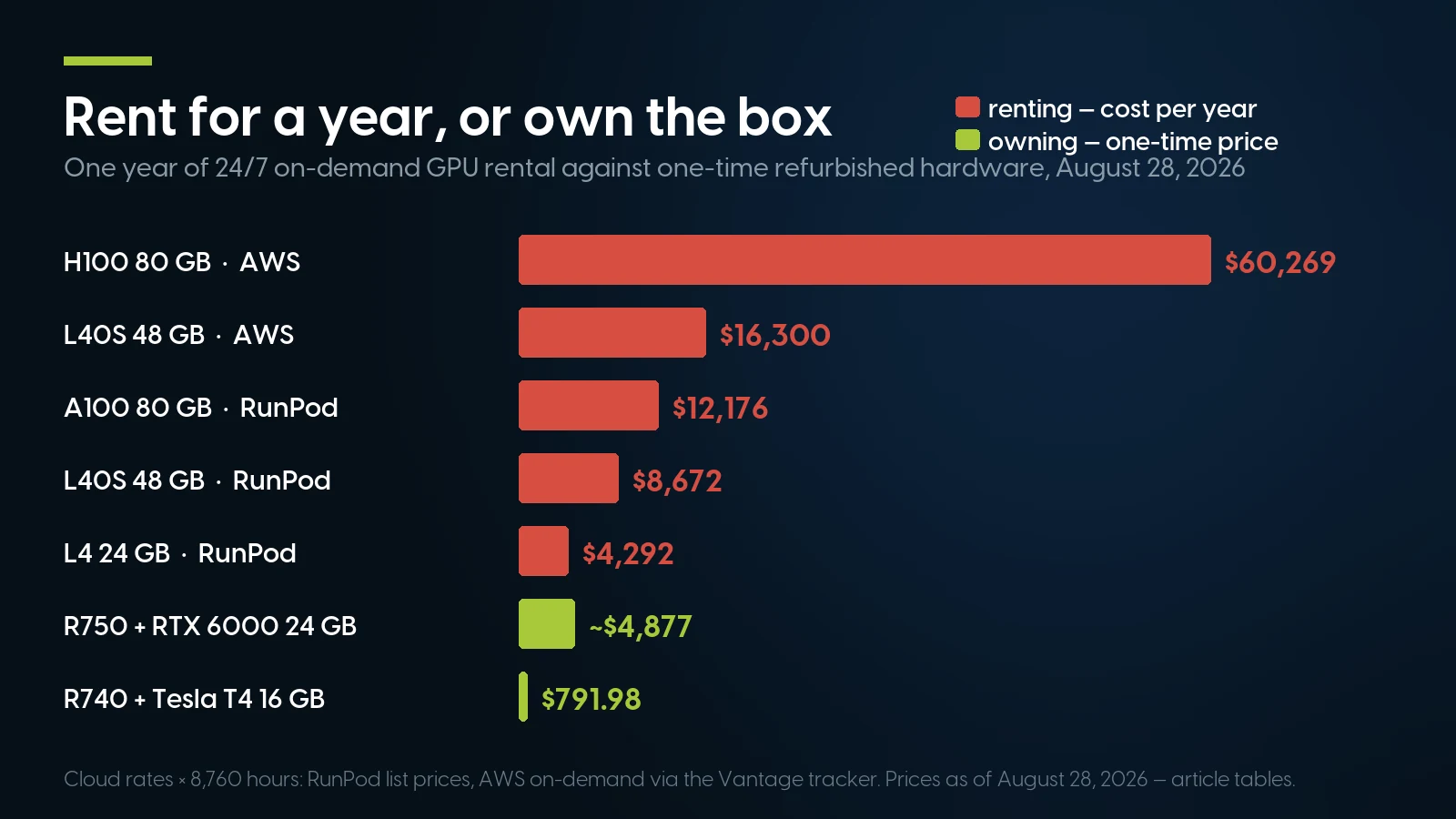
One year of 24/7 on-demand GPU rental against buying the hardware once. Cloud rates × 8,760 hours; hardware is core price before configuration. Source: article tables, August 28, 2026, PCSP.
The utilization flip deserves its own sentence, because it is the honest half of the math. At 20% utilization — call it 1,752 hours a year — that L40S rents for about $1,735/year, and a five-figure configured host takes most of a decade to pay back. Ownership wins on duty cycle, not on principle. If the machine will not run most days, rent the hours or pay the API.
What to Buy: Three Tiers of Business AI Server
Every price and quantity below is our live inventory as of August 28, 2026 — the GPU shelf currently holds 70 models in stock from $9.02, and the numbers change daily, so treat them as a dated snapshot rather than a promise. GPU spec figures are from NVIDIA's own product pages.
Tier 1 — the pilot: prove the workload for under $1,000 in core hardware. The platform is the Dell PowerEdge R740, a dual-socket 2U with the PCIe slots, power headroom and airflow to host accelerator cards — configure-to-order bases start at $291.99 (16-bay SFF) and $384.99 (8-bay LFF). The card is the NVIDIA Tesla T4: 16 GB of GDDR6, Turing tensor cores, 65 TFLOPS FP16 / 130 TOPS INT8 at just 70 W, drawing all its power from the slot — no auxiliary cables, no cooling drama, which is why it also anchors our edge computing picks. We hold 11 at $499.99 — under the ~$599 the same card was asking on eBay in late August 2026. Chassis base plus card: $791.98, then spec CPUs, RAM and drives in the configurator. It will run quantized 7–13B models for a small team's chatbot or RAG pilot; it will not be fast at anything bigger, and that is the point of a pilot.
Two even cheaper experiment cards deserve a mention with their caveats attached: the 16 GB HBM2 Tesla P100 at $128.65 (26 in stock) and the 32 GB Tesla M10 at $94.99 (14 in stock). Both are older architectures with aging software support — the M10's 32 GB is split across four separate 8 GB GPUs, so it is a VDI card, not a 32 GB LLM card. Fine for a sandbox; do not build production on them.
Tier 2 — the team box: 24 GB of VRAM, $4,000–6,000 all in. The platform steps up to the Dell PowerEdge R750 — Ice Lake Xeons, PCIe Gen4, configure-to-order from $3,784.99 on the 24-bay SFF base (our R750 review covers the platform in depth), or a ready-built R750 with two 32-core Platinum 8358s and 128 GB at $9,261.72 (4 in stock) if the same box must also carry general compute. For the card, the quiet bargain on our shelf is the NVIDIA Quadro RTX 6000: 24 GB of GDDR6 with ECC, blower cooling built for chassis use, $1,092.49 with 3 in stock — roughly half the tracker-reported street price of a used RTX 4090 with the same memory capacity (more on that below). Budget alternative at volume: the 8 GB RTX 3070 at $299.99 — we hold 134 — runs small quantized models and embedding workloads; buy two builds' worth and A/B them. This tier serves a 5–20-person company running a daily-driver internal assistant on 7–13B models with headroom for 20B-class quantized weights — the exact model-to-VRAM fits are tabled in the local LLM hardware guide.
Tier 3 — the department box: 48 GB+, configured to order. Here honesty beats a price tag: we do not stock L40S, A100 or H100 cards, and any refurb dealer telling you those are sitting on a shelf deserves a skeptical read — hyperscale demand absorbs them. What we build to order are the platforms engineered to host them: the AMD EPYC Dell PowerEdge R7525, the GPU-dense Dell R760xa, and the HPE ProLiant DL380a Gen11 / Gen12 — fourteen build-to-order GPU platforms in all under GPU servers, priced by configuration through a quote. For scale: Dell's own technical guide for the R750xa, the R760xa's predecessor, rates the class at up to four double-width 300 W accelerators per 2U. The 48 GB NVIDIA L40S (1,466 FP8 TFLOPS with sparsity, 350 W) is the workhorse spec here — it is the card renting for $8,672–16,300 a year in the table above, which is the number your quote competes with. Occasionally the middle rung surfaces on our own shelf as listed-to-order stock — 48 GB A40s and 24 GB A30s at $2,499.99–$5,299.99 were listed with zero on hand on August 28 — so if that tier fits, ask. Which datacenter card earns its keep at which price is the whole subject of our used GPU server buying guide.
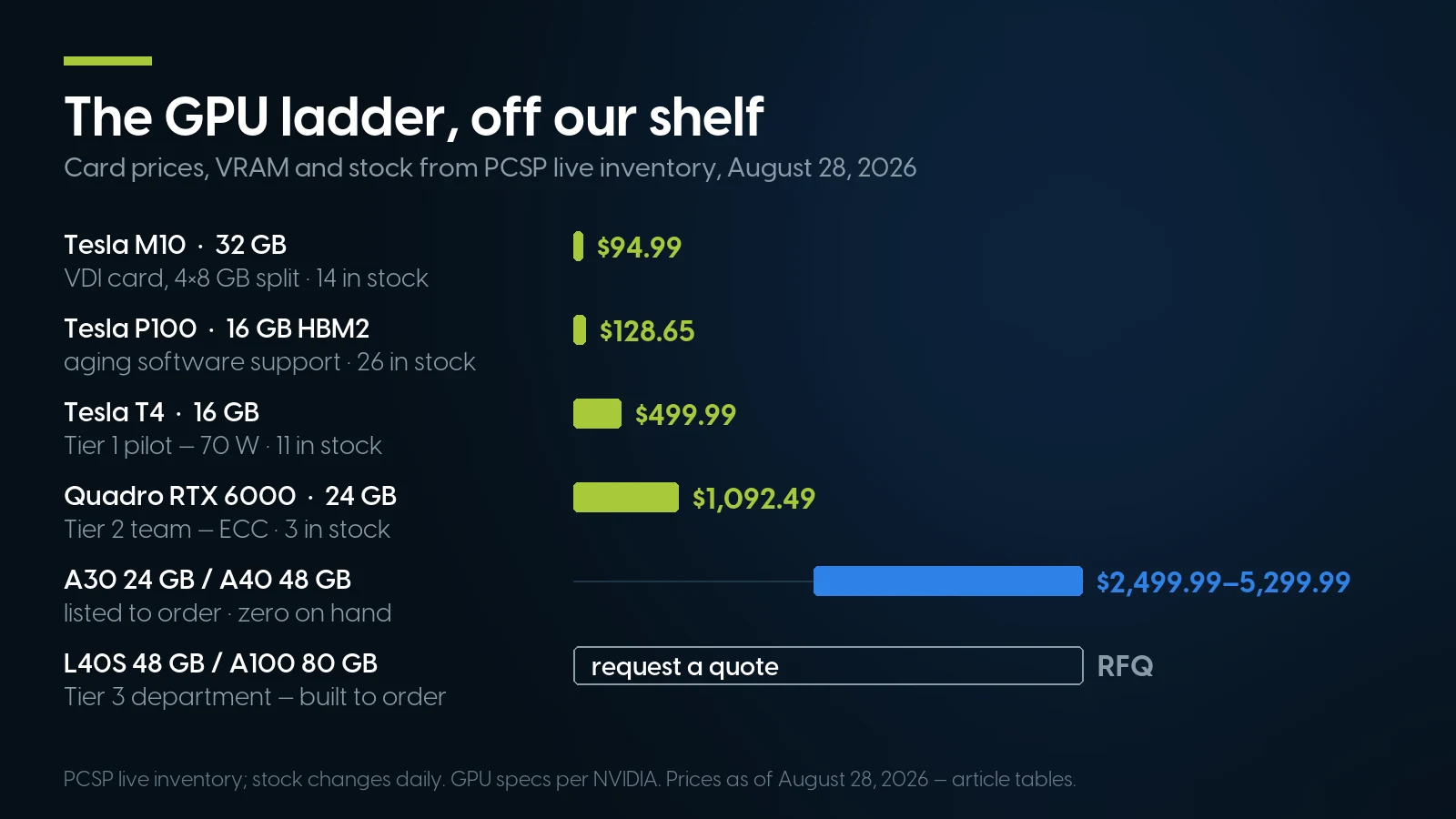
The GPU buying ladder, with VRAM and stock on every rung: in-stock cards from $94.99 to $1,092.49, A30/A40 listed to order, L40S/A100-class by quote. Source: article tables, August 28, 2026, PCSP.
Whichever tier, the platform rules are the same: a GPU-capable riser and the high-power cabling for anything above 75 W, redundant PSUs sized for the card's draw, and enough system RAM to stage models — with DRAM contract prices still climbing (TrendForce forecast server DRAM up a further 13–18% quarter-over-quarter for Q3 2026, with a server DRAM shortage already anticipated for 2027), a refurbished server that already carries its memory is quietly one of the better hedges in this market — the argument our DDR4 server memory piece makes in full.
Spec the box against your workload, not a spec sheet
Tell us the model you want to run and the number of users — we'll match it to in-stock hardware or quote a built-to-order GPU platform, with real availability and a ship date.
Browse GPU servers GPU cards in stockThe RTX 50 Super Freeze, and Why 24 GB Cards Cost What They Cost
If you have priced used graphics cards for AI this year, you have seen something economically strange: RTX 4090s trading above their original launch price. Price trackers listed an eBay RTX 4090 at $2,073 on August 28, 2026, with used asking prices typically $2,200–2,800 on listing trackers — roughly 30–75% above the card's $1,599 MSRP, and all of these are listing prices, not confirmed sales. RTX 3090 trackers disagree with each other more (roughly $1,000–1,400 asking) — still under that card's $1,499 launch price, but trending up, not down. A discontinued gaming card has become an appreciating asset.
The reason traces back to the memory market. NVIDIA's planned RTX 50 Super refresh — the cards that would have put 18–24 GB of VRAM into mainstream retail price brackets — is reportedly on hold: TrendForce's July 2026 digest of the reporting puts the 3 GB GDDR7 modules those cards need at roughly $60–70 each against about $20 for standard 2 GB modules, with NVIDIA telling partners to postpone launches pending price normalization; August reports say finished silicon has reached board partners while headquarters holds the launch. None of this is NVIDIA speaking on the record — treat the specifics as channel reporting — but the shelf price behavior it predicts is exactly what the trackers show.
Draw the practical conclusion, and label it as ours: if no new affordable high-VRAM cards arrive at retail this cycle, used 24 GB cards keep trading above list, and chasing them is a bad deal for a business buyer. A blower-cooled 24 GB Quadro RTX 6000 at $1,092.49 in a proper server chassis is roughly half the money of a used 4090 with the same VRAM and none of the consumer-card compromises — no 450 W power draw, no open-fan cooler fighting server airflow, ECC memory. And a step above, quote-built datacenter cards stop looking expensive the moment the comparison is a gaming card priced like a collectible. The consumer-versus-datacenter trade-offs get the full treatment in the used GPU server guide.
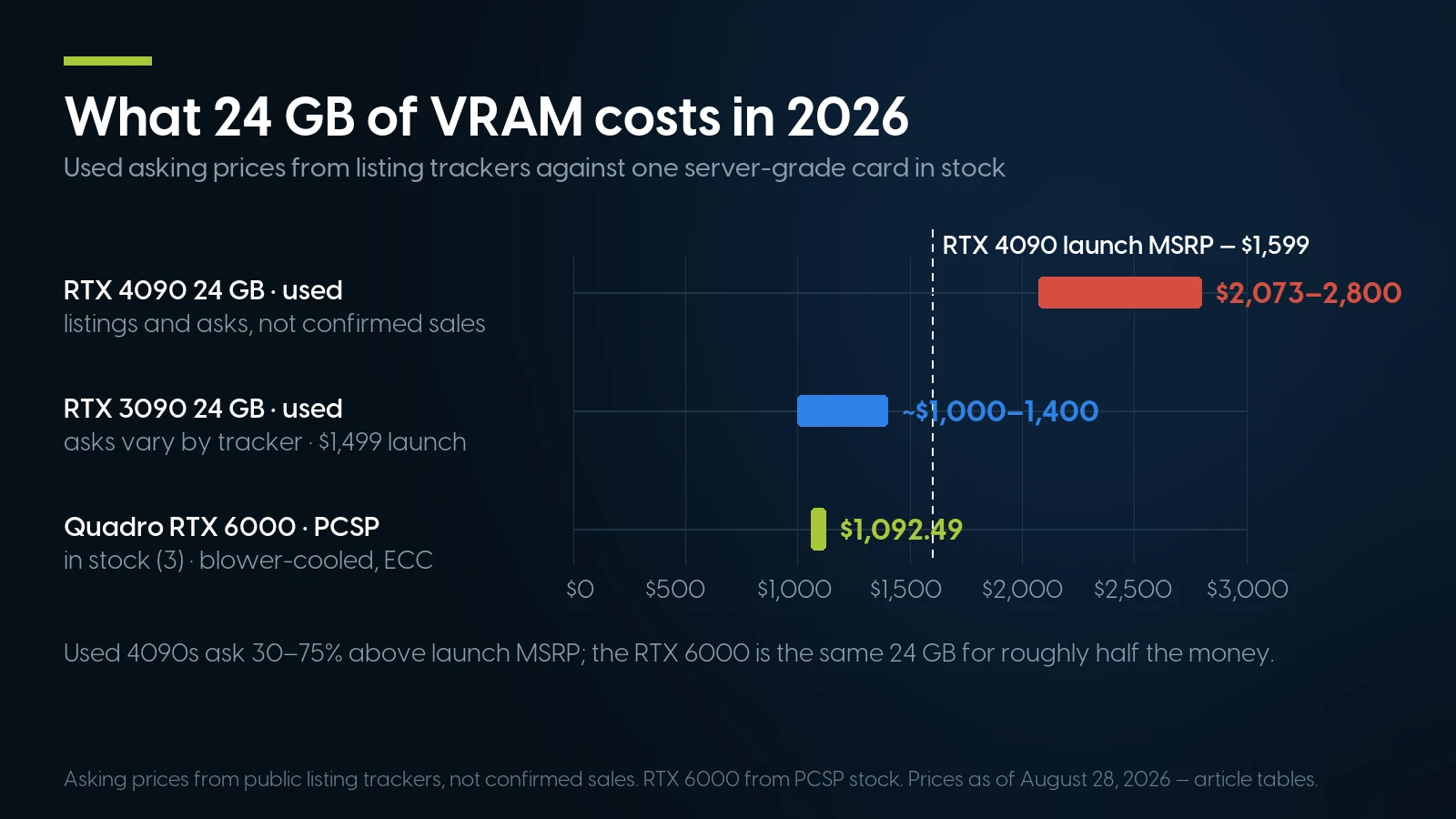
What 24 GB of VRAM costs used, August 28, 2026: tracker-reported asking prices for RTX 4090 and RTX 3090 (not confirmed sales) against a server-grade Quadro RTX 6000 in stock. Source: article tables, PCSP.
When an On-Prem AI Server Is the Wrong Answer
We sell the hardware this article recommends, so here is the section our sales team likes least. Four situations where you should not buy a dedicated AI server — from us or anyone:
- Your volume is small and bursty. A few hundred queries a day, experiments, a prototype that might ship next quarter — below that 15–20% utilization line, per-token API pricing or a $0.49/hour rented L4 beats any purchase. Buy hardware after the workload proves it runs daily, not before.
- Nobody owns the box. A dedicated server needs what the cloud quietly includes: someone to patch the OS and the serving stack, monitor thermals and disks, and restart the model runtime at 2 a.m. If there is no IT owner — on staff or on an MSP contract — the cloud's markup is buying you something real, and you should keep paying it.
- You need frontier-model quality. An open-weight 7–70B model on your server is remarkably capable in 2026, but if your use case genuinely demands the strongest proprietary models, no on-prem box runs them. Many businesses land on a hybrid: sensitive and high-volume work local, frontier calls by API for the hard 5%.
- Your jobs are big, rare and latency-tolerant. A quarterly fine-tune or a once-a-month batch extraction is the textbook case for spot cloud capacity — the same tracker shows AWS p4d dropping from $21.958 to $15.885/hour on spot, and interruption barely matters for a batch queue. Owning idle A100s to serve four weekends a year is how AI budgets die.
If two or more of those describe you, close this tab with our blessing and revisit when the usage curve says otherwise. The break-even math above does not care which direction it points.
What Changed Since the 2025 Version of This Guide
This article replaces the version we published on March 13, 2025, and the honest thing is to say what that version got wrong, not just paper over it. The old guide recommended a 16 GB VRAM minimum with 32 GB preferred for cutting-edge work — in 2026, with businesses running local LLMs rather than the classic ML of early 2025, 24 GB is the realistic entry ticket for the models teams actually deploy, and 48 GB is the sweet spot for 70B-class quantized weights. It recommended DDR4-3200 and 256 GB of RAM with no mention of the memory price cycle that now dominates every server bill of materials. It suggested a 1U DL360 Gen10 Plus as a GPU host — a chassis limited to low-profile 75 W cards, which this version corrects to proper 2U+ GPU platforms. It contained no prices, no cloud comparison and no break-even — the three things every reader actually came for. And two of its server blurbs were, embarrassingly, the same paragraph pasted twice. What survives from 2025: the industry use cases, the server-versus-workstation logic, and the core advice to size hardware to workload — now with numbers attached.
AI Servers for Business: FAQ
What is the best AI server for business in 2026?
The one sized to your workload, and for most SMBs that is smaller than the marketing suggests. For a first chatbot or RAG pilot: a refurbished Dell PowerEdge R740 (bases from $291.99) with a $499.99 Tesla T4 — under $800 in core hardware as of August 28, 2026. For a daily-driver team assistant: a PowerEdge R750 with a 24 GB card, roughly $4,900 before configuration. For 70B-class models, production RAG or fine-tuning: a built-to-order GPU platform — Dell R7525 or R760xa, HPE DL380a — carrying L40S- or A100-class accelerators, priced by quote.
What is a dedicated AI server?
A server provisioned exclusively for machine-learning workloads — LLM inference, RAG, fine-tuning — rather than shared duties. In practice: a rack platform with one or more GPUs whose VRAM fits your model, fed by adequate system RAM and NVMe, running on your network so prompts and documents never leave your control. It differs from a cloud GPU instance (rented by the hour, data off-premises), and from a GPU workstation (single-user, desk-side, no redundant power or out-of-band management).
What AI server should my company buy?
Answer three questions. Model size: quantized 7–13B needs 16–24 GB of VRAM, 70B-class needs 48 GB or more. Duty cycle: daily production use justifies owning; occasional jobs favor renting cloud hours. Users: a handful of people can share one mid-range card, a department needs L40S-class or several cards. Map the answers to the tiers above — R740 + T4 pilot, R750 + 24 GB team box, or a quoted GPU platform — and pressure-test the choice against the VRAM tables in our local LLM hardware guide.
Is cloud or on-prem cheaper for business AI?
Utilization decides. At 24/7 duty, on-demand cloud GPUs cost more per year than owning comparable hardware: an L40S runs about $8,672/year on RunPod's published rates or about $16,300/year as an AWS g6e.xlarge, checked August 28, 2026 — while a mid-tier owned build costs roughly $4,900 once plus power and administration. Below roughly 15–20% utilization the ranking flips and renting or API pricing wins. Spot and reserved cloud pricing narrows the gap for batch and committed workloads.
How much VRAM does a business AI server need?
As a 2026 rule of thumb from our hardware guides: 16 GB runs quantized 7–13B models for pilots, 24 GB is the comfortable entry point for daily-driver assistants with room for 20B-class quantized weights, and 48 GB — one L40S-class card or paired 24 GB cards — is the sweet spot for 70B-class quantized models. Fine-tuning needs more headroom than inference at the same model size. Our local LLM hardware guide carries the full model-by-model tables.
Can a regular rack server work as an AI server?
Often, yes — that is the cheapest path in. A dual-socket 2U like the Dell R740 or R750 has the PCIe lanes, power capacity and airflow to host accelerators; you need a GPU-capable riser, auxiliary power cabling for cards above 75 W, and PSUs sized for the draw. Slot-powered 70 W cards like the Tesla T4 drop into almost any 2U with no extra cabling at all. What does not work well: 1U chassis limited to low-profile 75 W cards, and desktop towers without server airflow for passive datacenter GPUs.
Do I need an H100 for business AI?
Almost certainly not. H100-class hardware exists for training and for inference at a scale most businesses never reach — and its pricing shows it: $2.89/hour rented on RunPod, $6.88 per GPU-hour on AWS on-demand (about $60,000 per GPU-year), checked August 28, 2026. Business inference on 7–70B open-weight models runs well on T4, 24 GB RTX-class and L40S-class cards at a fraction of the cost. If a genuine H100-scale need appears, rent it first and let the utilization data argue for ownership.
Are refurbished GPUs reliable enough for production AI?
Datacenter cards — Tesla, Quadro, the A-series — were engineered for sustained 24/7 datacenter duty: passive cooling driven by chassis airflow, ECC memory on most models, validated server firmware. That design brief is exactly the production-inference workload, which makes tested refurbished datacenter cards a reasonable production choice, and our stock ships tested and warrantied. Used consumer gaming cards are the riskier class — unknown mining or thermal history, coolers that fight server airflow — and in August 2026 the RTX 4090 class trades above its launch MSRP anyway. Our used GPU server guide covers card-by-card judgment calls.
Does an on-prem AI server make us HIPAA compliant?
No — nothing you buy does. HIPAA compliance is a property of your organization's safeguards, not of any server or model. What self-hosting changes is architectural: protected health information is no longer sent to a model vendor, so there is no third-party processor and no business-associate agreement on the inference path. Access controls, encryption, audit logging and the rest of the Security Rule remain your responsibility on your hardware. The same reasoning applies to legal privilege and confidential financial data.
How much does an AI server cost in 2026?
From our live pricing on August 28, 2026: a pilot-grade build starts under $800 in core hardware (R740 base at $291.99 plus a $499.99 Tesla T4). A team-grade box lands around $4,000–6,000 (R750 base at $3,784.99 plus a 24 GB card at $1,092.49). Department-grade L40S/A100-class builds are configured to order — five figures, quoted by configuration. For calibration, renting the department tier costs $8,672–16,300 per GPU per year at 24/7 on-demand rates. General server pricing beyond AI lives in our what-does-a-server-cost guide.
A pilot this week, a quote for the real thing
Eleven Tesla T4s and the R740s to host them are on the shelf as of August 28. For L40S- and A100-class builds, send the model and user count — we'll quote a built-to-order platform with a ship date.
GPU cards in stock Build a GPU serverThe Bottom Line
The 2026 question is not whether your business could use AI — the subscription line items already answer that. It is where the compute should live, and that is a math problem with your numbers in it: seats times $25, GPU-hours times $0.49–$6.88, against a one-time hardware price and the duty cycle you honestly expect. Run at 24/7, the serious cloud cards bill $8,700–60,000 per GPU per year; run at a few hours a week, no purchase pencils out. Both halves of that sentence are this article's thesis.
The buying ladder is short. Prove the workload on a sub-$800 R740-plus-T4 pilot. Graduate to a $5k-class R750 with 24 GB of VRAM when the team uses it daily — skipping the collector-priced used gaming cards on the way. Go to a quoted L40S- or A100-class platform when a department depends on it, knowing those cards are built to order, not pulled from a shelf. And keep the exit honest at every rung: if utilization stays low, the cloud was the right answer, and the receipts above will say so without embarrassment.
Your data staying home is the part no hourly rate prices in. The hardware to keep it there costs less than a year of renting the equivalent — as of August 28, 2026, with quantities on the shelf and the trackers cited. That is the whole pitch, and every number in it is checkable.