

Hard Drive Shortage 2026: Nearline Is Sold Out. Here's What Ships
Posted by Konstantin Protasov, PCSP on Sep 4th 2026
A year ago, a manufacturer-recertified Seagate Exos 24 TB sat in stock at a large US recert reseller for $298.99. On August 28, 2026, the same SKU on the same product page reads $699.00 — and out of stock. That is the 2026 hard drive shortage in a single listing: the price up 134%, and then the drive left the shelf anyway.
The people who make the drives are not pretending otherwise. Seagate CEO Dave Mosley, on the January 28, 2026 earnings call: “Our nearline capacity is fully allocated through calendar year 2026, and we expect to begin accepting orders for the first half of calendar year 2027 in the coming months.” By the July 28 call, that had become: “Based on the long-term supply agreements in place today, the vast majority of our nearline exabytes are now allocated into calendar 2028.” Western Digital CEO Irving Tan, the same week in January: “We're pretty much sold out for calendar 2026. We have firm POs with our top seven customers” — plus long-term agreements with two of them for calendar 2027 and one reaching into 2028.
This article is the HDD half of a story we have been tracking all year — the flash half, with its own price receipts, is in our companion piece on enterprise SSD prices in 2026. Here we cover what happened to hard drives, what a terabyte actually costs this week in every channel we can check, and how to buy from the one channel that still ships — used and recertified enterprise drives — without getting burned.
The short version, checked August 28, 2026:
- New nearline is allocated, not just expensive. Seagate: the vast majority of nearline exabytes “allocated into calendar 2028” (July call). WD: “pretty much sold out” for 2026, LTAs into 2027–2028. TrendForce measured lead times going from a few weeks to over 52 weeks back in September 2025.
- The recert channel repriced under everyone's feet. Same-SKU receipt: recert Exos 24 TB $298.99 → $699.00 and out of stock in 12.5 months (+134%). Per terabyte, the channel moved from roughly $12–16/TB to $24–31/TB.
- Consumer retail jumped 46% in four months (September 2025 → January 2026) per Tom's Hardware, working from ComputerBase price tracking — a 24 TB BarraCuda that sold at $239–249 in 2025 hit $499.
- Morgan Stanley's model says this runs through 2028: demand growing 40–50% a year against supply growth of 30–35%, with makers targeting $25–30/TB — a band street prices already trade in today. A bank's estimate, marked as such throughout.
- Our shelf, dated: 14 HDD SKUs, 1,302 drives in stock — the headline row is a 12 TB enterprise Exos at $299.99 × 35 units, exactly $25.00/TB, at the bottom of today's recert-channel band. Also 218 units of 3.84 TB enterprise SATA SSD at $489.99 for the flash tier.
- The honest gaps: nothing above 16 TB on our shelf today, and effectively no enterprise NVMe. If you need 24 TB-class density, we say so below and tell you where it lives.
Where the Drives Went: AI Bought the Production Line
The mechanism is not complicated, and the primary sources describe it themselves. AI datacenters generate and retain data at a rate that made nearline hard drives — the high-capacity 7.2K drives that hold the cold and warm layers of every storage pyramid — a strategic commodity. Seagate shipped 165 EB into the data center market in its December 2025 quarter, up 31% year over year, on company revenue of $2.83B (+22%), per its own earnings call. Cloud customers are 89% of Western Digital's revenue; consumer is 5%. And Blocks & Files' framing puts hyperscalers at an estimated 60–70% of global HDD output. When buyers that size decide to lock supply, they lock it with instruments small buyers do not have: firm purchase orders a year out and multi-year long-term agreements.
The supply side did not flex to meet them — deliberately. Both large makers run build-to-order models and are adding density per drive (HAMR), not greenfield unit capacity. Seagate said on its July call that it initiates drive production only against contracts “that define both product configuration and pricing terms covering the entirety of calendar 2027.” The squeeze arrived with dates attached: Western Digital sent customers a letter dated September 12, 2025, signed by VP & CMO Scott Davis, announcing price increases across all HDD products effective immediately, citing “unprecedented demand” — and, in the same letter, a shift from air to ocean freight that added 6–10 weeks to delivery times. Three days later, TrendForce reported nearline lead times stretching “from just a few weeks to over 52 weeks.”
What is left for everyone else is close to nothing. Analyst Sid Nag of Tekonyx, quoted in The Register's February 2026 round-up of both earnings calls, put it plainly: “no meaningful open production remains for discretionary buyers except the hyperscalers.” Omdia's Vlad Galabov called 2026 “a very tough year for the standard enterprise general purpose server and for enterprise storage” — and IDC's Andrew Buss noted the HDD squeeze lands on top of the memory and CPU shortages already running, each compounding the others.
The escape hatch is partly real and fully priced. Hyperscalers are moving some cold-data tiers to high-capacity QLC SSDs: TrendForce flagged CSPs evaluating QLC for exactly this in September 2025 and projected QLC SSD shipments “could see explosive growth in 2026,” and Pure Storage landed a QLC flash design win at Meta (Blocks & Files, April 2025), with a second top-five hyperscaler win reported by Computer Weekly in 2026. Note the interest alignment, though: the loudest “year of the flash crossover” arguments run in SSD vendors' own sponsored placements. For a buyer, the flash exit costs roughly 18.6× more per terabyte (that figure comes from an index published by VDURA — itself a storage vendor — via Tom's Hardware; Coughlin Associates independently puts SSD capacity pricing at over 20× HDD), and QLC supply is committed too. The two shortages reinforce each other — which is why our enterprise SSD price article reads like this one with different part numbers.
One more thing the makers say out loud: they like the new equilibrium. Seagate CCO Ban-Seng Teh told the South China Morning Post in March 2026 that storage price hikes are “the new normal” and that this cycle is “very unusual because in the past we went through cycles of shortage and oversupply.” Plan on that sentence, not on nostalgia for 2024 pricing.
The Price Evidence: Dated, Same-SKU, Checkable
Shortage articles usually run on adjectives. This one runs on receipts. Here is the year, event by event, with the class of each source labeled — a vendor letter is not an analyst model, and neither is a price we captured ourselves.
Press reports in November 2025 also put some enterprise backlogs at “up to two years.” We could not trace who actually measured that, so we are not leaning on it — the load-bearing lead-time number in this article is TrendForce's 52-plus weeks, which is bad enough.
The same-SKU receipt
The cleanest way to measure a market is the same product, same seller, a year apart. We pulled archived copies of a large US recert reseller's product pages (ServerPartDeals; archived versions retrievable through the Internet Archive's Wayback Machine) and compared them with the live pages on August 28, 2026:
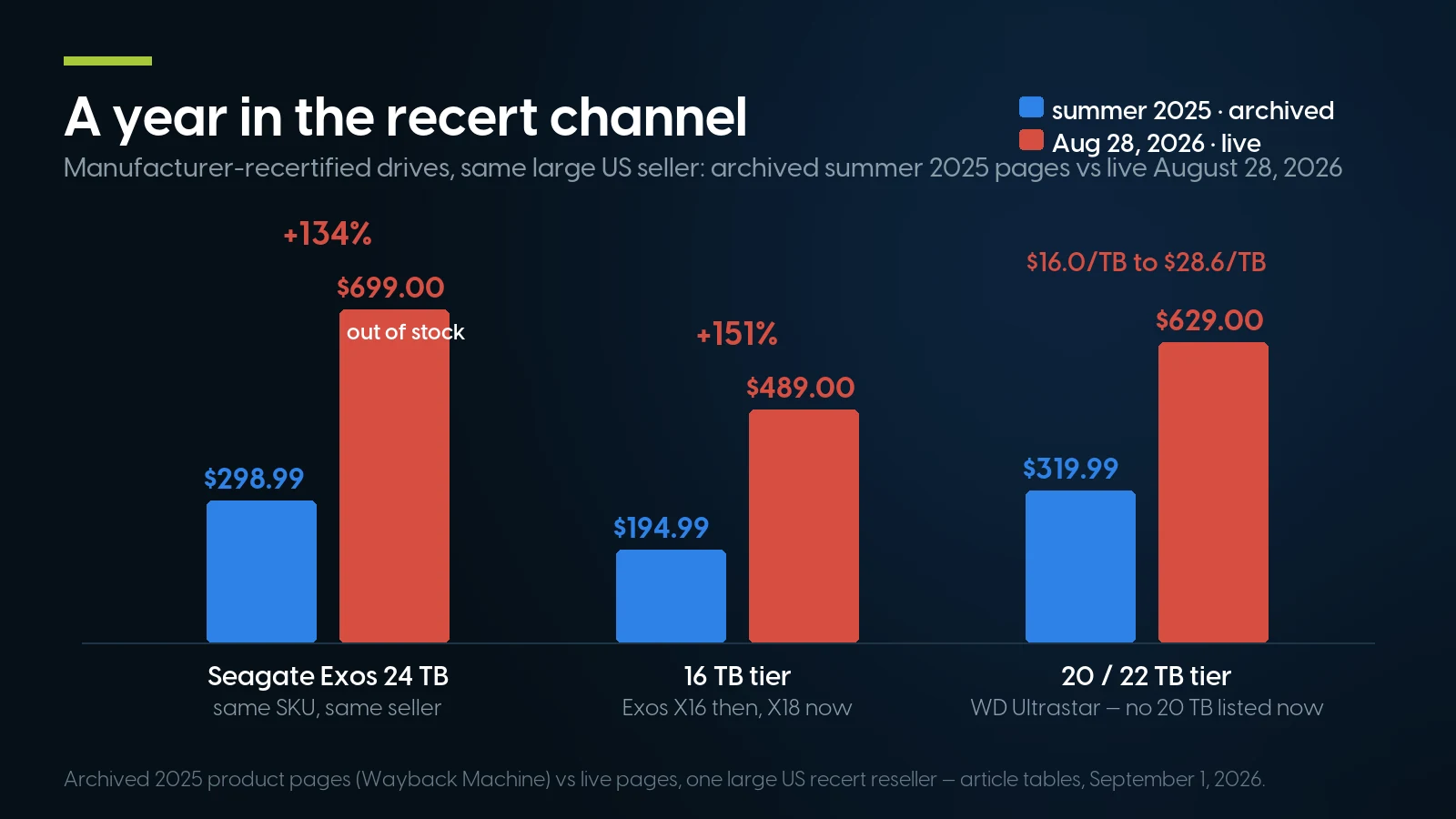
Same seller, one year apart: the recert channel repriced from roughly $12–16/TB to $24–31/TB, and the 24 TB SKU sold out anyway. Archived summer 2025 pages (Wayback Machine) vs live pages, August 28, 2026. Source: article tables, PCSP.
Do the division and the story gets sharper: in per-terabyte terms, the recert channel went from $12.2/TB (16 TB) and $12.5/TB (24 TB) in summer 2025 to $24–31/TB across the 16–28 TB range on August 28, 2026. The “cheap refurb escape hatch” a lot of 2025 advice pointed to did not survive the year at 2025 prices — it repriced, and its top SKUs sell out anyway. It is still the only channel where high-capacity drives ship this week, which is exactly why it repriced.
Where every channel sits today, in $/TB
One table, all channels, all dated. The Morgan Stanley rows are a bank's estimates from its June 2026 note, not vendor-published figures; our rows are live listings you can click.
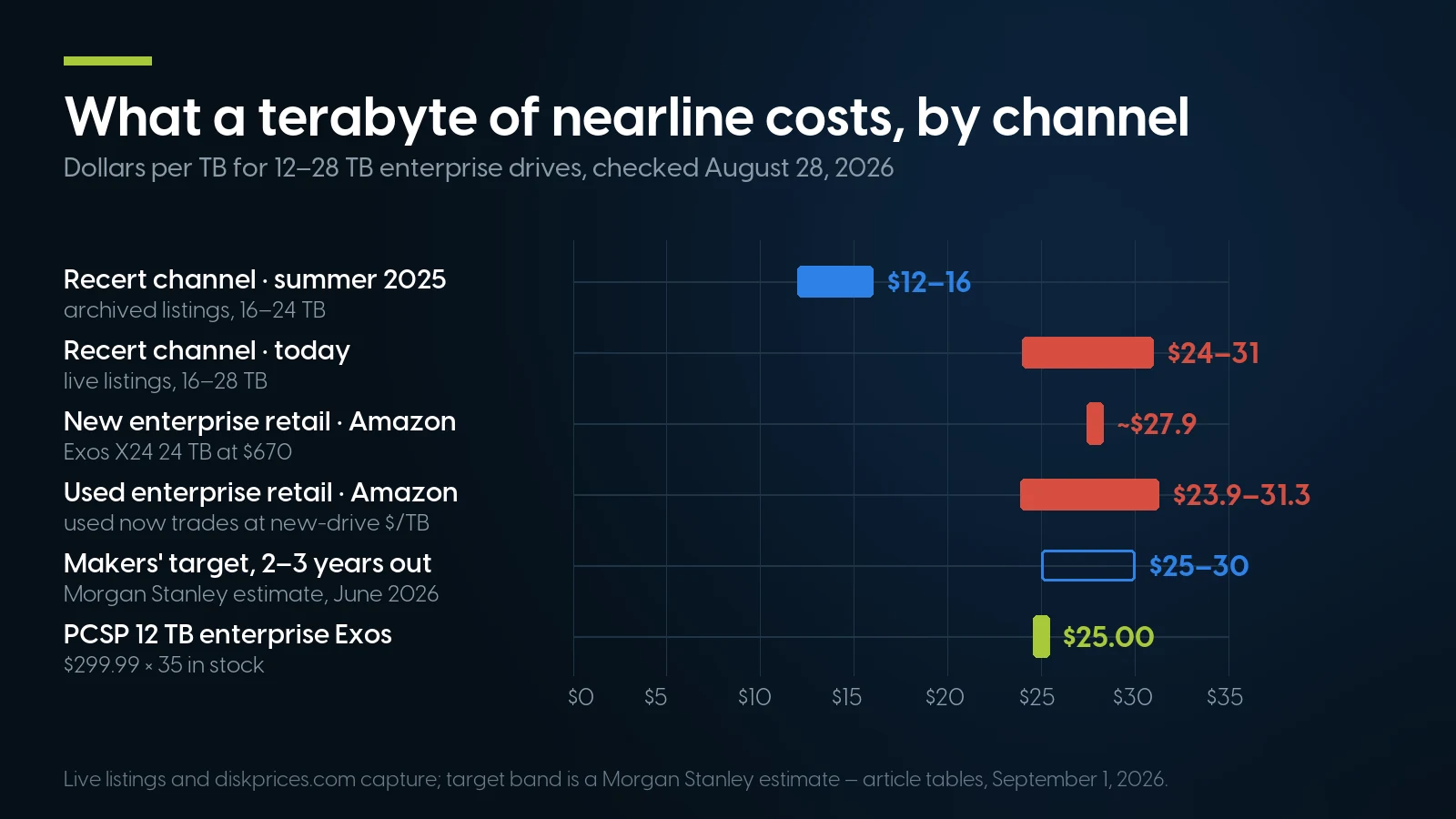
Where a terabyte trades on August 28, 2026: street prices already sit inside the $25–30/TB band Morgan Stanley says the makers are targeting two to three years out. The lime marker is our 12 TB Exos at $25.00/TB, 35 units in stock. Source: article tables, PCSP.
Read the second and third rows together, because that is the finding of this article: street prices already trade inside the $25–30/TB band Morgan Stanley says the makers are targeting two to three years out. The repricing did not wait for contract renegotiations to trickle down — the open market cleared at the target immediately, because that is what allocation does to the spot layer. Meanwhile the consumer tier kept climbing after its 46% jump: a 4 TB WD Blue that sold at $67–85 in 2025 was $99 by February 2026 and $140+ by June 2026 per DigiTimes-reported pricing.
And the makers? They are having their best year in a decade at lower unit volumes: Coughlin Associates estimates in Forbes that 2026 HDD industry revenue will top $30B — the highest since 2014 — on Q2 shipments of 504.3 EB (+5.6% QoQ) and revenue up 14.9% QoQ. Exabytes up single digits, dollars up double digits: that gap is your price increase, measured from the other side of the counter.
What Is Actually on Our Shelf — With the Gaps Left In
Every number in this section is our live inventory as of September 4, 2026 — SKU counts, unit counts and prices from the same catalog the website sells from. The weak rows are printed along with the strong ones — a stock list with only highlights is an ad, not information.
Across refurbished hard drives we hold 14 SKUs and 1,302 drives, starting at $12.58. The rows that matter for a capacity buyer:
The row to hold against everything in the previous section is the first one. A used enterprise Exos at exactly $25.00 per terabyte, 35 units deep, sits at the bottom of the $24–31/TB band the recert channel now charges for high-capacity drives, below new-drive Amazon $/TB — and inside the $25–30 band the makers reportedly want for new drives in 2028. Smaller working capacities are where refurb still beats the market outright: hundreds of 1–1.2 TB SAS and SATA spares for arrays and BYO server builds at $32–56 a drive.
Now the honest rows. Our 16 TB stock is three units at $41.50/TB — above the recert channel's per-terabyte price for that capacity ($30.6/TB on our same-day capture). Small-lot scarcity pricing, and we would rather print that than have you discover it. We hold nothing above 16 TB today. If your build needs 20–28 TB per spindle, the honest answer is the manufacturer-recert channel (Seagate's own recert store and the large recert resellers) at $24–31/TB — when their stock cooperates, which this month it did not for the 24 TB SKU we tracked.
On the flash side of the same shelf: the deep row is an SK Hynix SE5110 3.84 TB enterprise SATA SSD at $489.99 with 218 units, flanked by a Toshiba PM5-R 3.84 TB SAS at $487.11 (15 units) and a Dell EMC 3.84 TB SATA read-intensive at $449.99 (10 units) — roughly $117–128/TB, all read-intensive class; large write-intensive SSDs we do not hold today. And the bluntest gap: our enterprise NVMe shelf is effectively empty — one 4 TB NVMe-plus-adapter kit SKU ($524.98, 49 units) and a handful of 1 TB M.2 modules. If your storage plan is U.2 NVMe, our SSD price guide maps that market honestly, including why it is worse than the HDD one. The full flash shelf is at solid state drives, and everything storage lives under storage components.
Drives with the hours printed on the listing
Every refurbished enterprise drive we sell is SMART-tested, lists its power-on hours, and carries a 1-year warranty. Tell us the array and the capacity target — we'll quote from the 1,302 drives actually on the shelf.
Browse hard drives in stock Enterprise SSDsHow to Buy a Used Enterprise Drive Without Getting Burned
The instinctive objection to a used hard drive is “it's a mechanical part somebody already wore.” The largest public dataset on drive mortality says the fear is measurable, and smaller than assumed. Backblaze's Q1 2026 Drive Stats cover 341,263 drives: lifetime annualized failure rate 1.39%, quarterly AFR 1.24%, and the fleet is getting healthier — the 2025 annual report put the year's AFR at 1.36%, down from 1.55% in 2024. The nearline models closest to what ships refurbished do better still: WD 14 TB at 0.33% AFR, Seagate 16 TB models at 0.52% (one 16 TB model logged zero failures in the quarter), the whole 20 TB+ cohort at 0.85%. Some models in that fleet are still in service at an average age of 112 months — nine-plus years of continuous duty.
That endurance is designed in, and the spec sheet is public. Seagate's Exos X24 product manual rates the drive for a 2.5-million-hour MTBF, a 550 TB/year workload, and a designed AFR of 0.35% over a five-year, 24/7 service life. Five years of continuous power-on is 43,800 hours — simple arithmetic, not a vendor promise, but it gives you the yardstick the “how many hours is too many” question actually needs: a drive showing 30–40 thousand hours is inside its design envelope, not past it. Which is why we print the hours instead of hiding them.
The five SMART attributes that predict failure
Backblaze's operational shortlist, from its fleet's failure data: 76.7% of failed drives showed a non-zero raw value in at least one of these five attributes before failing. The buying rule is binary — any raw value above zero means investigate or walk away.
Two practical notes on top of the table. First, hours without health are meaningless in both directions — a 20,000-hour drive with pending sectors is a worse buy than a clean 35,000-hour one, which is why a seller quoting only “low hours” and no SMART dump is telling you half the story. Second, on helium drives — which is most nearline at 12 TB and up — the sealed design cuts platter drag and spindle power (Backblaze measured roughly 20% lower wattage), and its long-running helium-vs-air comparison found no consistent failure-rate difference once drive ages matched. The trade-off: a sealed drive cannot be opened or serviced, so SMART 22 (helium level) should read 100 — and any decline is a walk-away. These mechanics date to Backblaze's 2018 write-up; the physics has not changed since.
What the warranty actually covers, channel by channel
The recertified and refurbished market is not one market — the same drive family ships with anything from 6 months to 3 years of coverage, and the label on the drive does not tell you which. As of August 28, 2026: Seagate's own factory-recertified store — official Exos SKUs from 16 to 28 TB, per Seagate's recertified-drive support page — carries a 6-month limited warranty. The large recert resellers (ServerPartDeals and similar) advertise up to 3 years on manufacturer-recertified stock. Generic marketplace refurb sellers run anywhere from 30 days to a year, and you find out which after the checkout. Our terms: every refurbished enterprise drive is SMART-tested before listing, the power-on hours are printed on the listing, and coverage is a 1-year warranty. Not the longest paper in the channel — the difference we sell is that you see the drive's test evidence before the money moves, not after.
Interface, briefly: nearline capacity drives come in both SAS and SATA. SAS buys you dual-port paths and deeper queues for arrays and shared backplanes; SATA buys universal compatibility. The full decision tree — including when NVMe is worth its 2026 premium — is in our SAS vs SATA vs NVMe guide.
When a Refurbished Hard Drive Is the Wrong Answer
We sell refurbished drives, and there are four buyers below who should not buy one from us or anyone else. Check yourself against the list before the price tables talk you into anything.
- The drive would hold the only copy of data you cannot lose. Then the purchase decision is not the real problem. Backblaze's fleet numbers — 1.39% lifetime AFR — describe drives in redundant arrays with monitored replacements; a single spindle, of any age and condition, fails at some rate that rounds to “eventually.” A used drive without a backup plan is the wrong buy at any price, and a new one is only a slower version of the same mistake. Fix the backup first; then the used drive becomes a rational way to make the backup affordable.
- Your bottleneck is IOPS or latency, not terabytes. Databases, VM boot storms, hot indexes — no 7.2K spindle solves those in 2026, at any price. That workload is an SSD workload; the honest accounting of what that costs now (roughly 18.6× the per-TB price of disk, per the VDURA index) is in our enterprise SSD price guide, and our own read-intensive 3.84 TB shelf is at solid state drives. Buy the flash for the hot tier, spinning rust for the capacity tier — the pyramid did not stop working just because both layers got expensive.
- You need maximum density — 20 TB and up per bay. We do not stock it as of August 28, 2026; our shelf tops out at 16 TB, and we would rather send you to the right channel than upsell you three 12 TB drives that burn your bays. That capacity class lives in Seagate's factory-recert store (6-month warranty) and at the big recert resellers — at $24–31/TB and with the stock-outs this article documented. Budget accordingly and buy when the SKU you need surfaces.
- Compliance requires new with a full OEM warranty. Some procurement rules mandate new drives with the maker's 5-year enterprise warranty, full stop. Then you are in the allocation queue with everyone else — get the purchase order in early, because the queue is the product this year. Our overview of the whole 2026 procurement squeeze — memory, CPUs, servers, drives — is in what every IT buyer needs to know right now.
And a fifth, structural honesty: at hyperscale, QLC flash genuinely is replacing some nearline tiers — that is a real engineering shift, not just vendor marketing, even if the loudest numbers come from interested parties. If you operate at the scale where a 150 TB QLC module amortizes — you are not reading a refurb shop's blog for purchasing advice. For everyone else, the math above stands.
When Does It End? The Forecasts, With Names Attached
Every forecast below is labeled with who is doing the forecasting, because they do not agree — and the disagreement is the useful information.
- The optimistic case — “sometime in 2027.” The analyst view carried in DigiTimes-reported coverage (June 2026) expects supply improvement sometime in 2027 — with the explicit caveat that AI demand may absorb the new capacity as it lands.
- The bearish case — through 2028, with prices doubling at the maker level. Morgan Stanley's June 2026 model: demand growing 40–50% per year against supply growth of 30–35%, shortage persisting through at least 2028, and supplier pricing targeted at $25–30/TB within two to three years — roughly double the current ~$15/TB blended ASP. A bank's estimate; the bank also raised both makers' price targets on the strength of it, so it is not a disinterested one either.
- The makers' own structure — no relief designed in. Seagate starts production only against contracts that fix configuration and pricing for all of calendar 2027, the vast majority of its nearline exabytes are “allocated into calendar 2028” (July 2026 call), and WD holds LTAs reaching 2028. Capacity growth comes from density — Seagate plans to qualify 50 TB HAMR drives in 2027 and demoed 8 TB-per-disk density this year per Coughlin — not from new unit volume. Denser drives help exabytes; they do not put loose drives back on shelves.
- One caveat on scope: the on-record “sold out / fully allocated” statements come from the two largest makers. We found no equivalent public statement from Toshiba — so we say “the two largest makers,” not “everyone.”
The synthesis we would plan against: nobody credible promises relief before 2027, the most bearish reputable call says 2028-plus, and the sellers are on record calling the new price level normal. That reframes the refurb channel: it is not a place to wait out a blip. It is the one channel where high-capacity enterprise drives ship inside a week instead of inside a 52-plus-week allocation — repriced, but available, and with the test evidence new-drive retail never gave you anyway.
Hard Drive Shortage 2026: FAQ
Why is there a hard drive shortage in 2026?
AI datacenter demand met a supply base that deliberately does not flex. Hyperscalers — an estimated 60–70% of global HDD output per Blocks & Files — locked nearline production with firm purchase orders and multi-year agreements: Seagate said in January 2026 that nearline capacity was fully allocated through calendar 2026, and by July 2026 that the vast majority of its nearline exabytes were allocated into calendar 2028; Western Digital said it was “pretty much sold out” for calendar 2026 with LTAs into 2027 and 2028. Both large makers run build-to-order models and grow density per drive rather than unit capacity, so surplus demand becomes allocation and price, not extra drives.
How long will the hard drive shortage last?
No credible forecast promises relief before 2027. DigiTimes-reported analyst commentary from June 2026 expects improvement sometime in 2027, with the caveat that AI demand may absorb new capacity. Morgan Stanley's June 2026 model — the most bearish reputable call — has the shortage running through at least 2028, with demand growing 40–50% a year against 30–35% supply growth. Seagate's own July 2026 call had the vast majority of nearline exabytes already allocated into calendar 2028, and its CCO has called the higher prices “the new normal.”
How much have hard drive prices actually gone up?
By channel, dated: consumer retail rose 46% on average in four months (September 2025 to January 2026, Tom's Hardware working from ComputerBase tracking), and DigiTimes-reported trade pricing added another 10% quarter over quarter in Q2 2026. The manufacturer-recertified channel roughly doubled in a year: the same recert Seagate Exos 24 TB SKU at the same reseller went from $298.99 in August 2025 to $699.00 — and out of stock — in August 2026, +134%, and the channel overall moved from roughly $12–16 to $24–31 per terabyte.
Are refurbished enterprise hard drives reliable?
The fleet data says the risk is real but small and measurable. Backblaze's Q1 2026 report covers 341,263 drives at a 1.39% lifetime annualized failure rate, with the 2025 annual rate at 1.36% and improving; nearline models like those sold refurbished run 0.33–0.85%, and some models still serve at an average age of nine-plus years. Enterprise drives are engineered for it: 2.5-million-hour MTBF, 550 TB/year workload, five years of 24/7 duty per Seagate's own product manual. The variable is the seller — buy where SMART results and power-on hours are disclosed and warrantied, and run drives in redundant arrays with backups regardless.
What SMART attributes should I check on a used hard drive?
Five predict most failures, per Backblaze: 5 (Reallocated Sectors), 187 (Reported Uncorrectable Errors), 188 (Command Timeout), 197 (Current Pending Sectors) and 198 (Offline Uncorrectable). In Backblaze's fleet, 76.7% of failed drives showed a non-zero value in at least one of the five before failing — so the buying rule is that any raw value above zero means investigate or reject. Also read attribute 9 (power-on hours) for context and attribute 22 (helium level, should be 100) on sealed helium models.
How many power-on hours are too many for a used enterprise drive?
There is no universal cutoff, so use the design envelope as the yardstick: enterprise nearline drives are rated for five years of 24/7 operation — 43,800 hours — so a drive at 30–40 thousand hours is inside its designed service life, and Backblaze runs some models at a 112-month average age. Hours also matter less than health: a 20,000-hour drive with pending sectors is a worse buy than a clean 35,000-hour one. Judge the SMART table first, the hours second, and distrust any listing that quotes neither.
Should I just buy SSDs instead of hard drives right now?
Only where the workload is performance-bound. For hot data, databases and boot volumes, yes — no 7.2K spindle competes. As a capacity replacement, the math fails: enterprise SSD trades at roughly 18.6 times the per-terabyte price of enterprise HDD (VDURA index, Q3 2026 — a storage vendor's index; Coughlin Associates independently estimates over 20×), SSD prices rose through 2026 too, and QLC supply is largely committed to hyperscalers. Keep the tiering: flash for the hot layer, disk for capacity.
What warranty do refurbished hard drives come with?
It varies more than buyers expect, as of August 2026: Seagate's own factory-recertified store covers its 16–28 TB recert Exos drives for 6 months; large manufacturer-recert resellers advertise up to 3 years; generic marketplace refurb sellers run 30 days to a year. PCSP refurbished enterprise drives carry a 1-year warranty, are SMART-tested before listing, and publish power-on hours on the listing — ask any seller for the SMART dump before paying, and treat a refusal as the answer.
Are used helium drives safe to buy?
Yes, with one extra check. Sealed helium drives — which is most nearline capacity at 12 TB and up — run cooler and draw roughly 20% less spindle power, and Backblaze's helium-versus-air comparison found no consistent failure-rate difference once drive ages were matched. The trade-off is that a sealed drive cannot be opened or serviced, so verify SMART attribute 22 (helium level) reads 100; any decline means walk away.
Should I wait for hard drive prices to come back down?
If you need the terabytes within a year, waiting is a bet against everyone quoted in this article: the makers' own allocation statements reaching into 2028, build-to-order supply discipline with no greenfield capacity, Morgan Stanley's through-2028 model, and street prices already trading inside the $25–30/TB band the makers reportedly target for 2028. Buy the verifiable drive at today's price for capacity you need now, right-size per-spindle capacity to what is actually in stock, and revisit in 2027 with the article's sources rather than hope.
1,302 drives on the shelf, hours disclosed, 1-year warranty
Send us the array spec — bays, interface, capacity target — and we'll quote against live stock with the SMART evidence attached. No allocation queue.
All storage in stock Request a quoteThe Bottom Line
Strip the adjectives and the 2026 hard drive market is four dated facts. The two largest makers are on record that nearline capacity is spoken for years out — “fully allocated,” “pretty much sold out,” “allocated into calendar 2028,” their words. Lead times for new enterprise drives stretched past 52 weeks a year ago and never came back. Prices moved in every channel that still transacts: +46% at consumer retail in four months, +10% more at trade level in Q2, and +134% on the same recertified SKU at the same reseller in twelve months — which then sold out anyway. And the street already pays the $25–30 per terabyte that Morgan Stanley says the makers were hoping to reach two or three years from now.
What to do is less dramatic than the numbers. Decide which of your data actually needs flash, and pay the flash premium only there. Cover the capacity tier from the one channel that ships this week — used and recertified enterprise drives — but buy them like an engineer, not like a bargain hunter: five SMART attributes at zero, hours read against the 43,800-hour design envelope, helium at 100, a warranty from someone who showed you the test output before charging you. Right-size per-spindle capacity to what is really in stock instead of waiting for the 24 TB that is allocated to somebody with a firm PO and a seven-figure LTA.
Our shelf as of August 28, 2026 is what it is, printed above with the gaps left in: deep at 12 TB and $25.00/TB, thin at 16 TB, empty above it, 276 enterprise SSDs for the hot tier, honest about NVMe. When the stock changes, the category page changes with it — and if the wider squeeze is what you are budgeting against, the companion pieces on enterprise SSD prices and the full 2026 procurement picture carry the same receipts for the rest of the bill of materials.