

HP Z Workstations Explained: Z420 to Z8 G4, Specs & PSUs
Posted by Konstantin Protasov, PCSP on Sep 14th 2026
A 525 W HP Z440 and a 700 W HP Z440 are the same computer with two different ceilings on what can go in the graphics slot. HP prints both in its Z440/Z640/Z840 Maintenance and Service Guide (c04823811): “Up to 225 W graphics or compute card in the primary graphics slot (700 W PSU)” against “Up to 75 W graphics in primary slot (525 W PSU)”, with combined ceilings of 335 W and 140 W. The 700 W unit comes with “two auxiliary dongles”; the 525 W unit with none.
That is the useful thing about this brand: for the six big towers of 2012 and 2014 HP prints a graphics-watt ceiling beside each power supply option, and from the 2015 Z240 onward it gives the cable count instead. It also publishes declared ISO 7779 noise for every tower here, which Dell does for no Precision tower. This covers every Z tower from the 2012 Z420 to the current Z8 G5 — dates, sockets, memory ceilings, power supplies, Windows 11 per model, HP's published idle noise and September 2026 prices. The Dell side is in our Precision tower article.
One correction first, because most “HP Z generations” lists get it wrong: the Z420/Z620/Z820 and the Z440/Z640/Z840 are not one generation. They are three years and a memory standard apart.
The short version, checked September 15, 2026:
- Three rungs, not two. Z420/Z620/Z820: March 2012, LGA2011, DDR3. Z440/Z640/Z840: September 9, 2014, LGA2011-3, DDR4. Z4/Z6/Z8 G4: September 2017, LGA2066 and LGA3647.
- The power supply decides the graphics card, in HP's words. Z640: 375 W of cards on its 925 W unit. Z840: “one 150 W or two 75 W” on 850 W, “two 300 W or three 225 W” on 1125 W. Z4 G4: zero 6-pin cables at 465 W, four at 1000 W.
- Windows 11 splits the ladder at 2017. Microsoft's general processor list carries Xeon W-2100, W-2200 and Xeon Scalable and no Xeon E5 of any version; HP's tested table does not list the Z440, Z640, Z840, Z240, Z420, Z620 or Z820 at all.
- The 26H1 column is a trap. Every Z workstation reads “Hardware Not Supported” there, including HP's current Z4 G6i, because 26H1 is a Snapdragon X2-only release that Microsoft says “isn't offered through Windows Update”.
- Last critical BIOS is the honest age test: January 23, 2024 for the Z440/Z640/Z840 against August 2025 for the Z4 G4.
- 13 dB is a configuration, not a machine. HP measured it on a Z4 G4 with a Quadro P400 and the 465 W supply; with a P6000 it is 22 dB.
- Our shelf, priced September 15, 2026: Z440 from $173.99 barebones and $567.87 complete; Z840 from $354.99 and $850.86; Z4 G4 from $169.98 and $437.85; Z8 G4 from $734.98 and $1,437.84. The 2012 DDR3 rung is now entirely sold out — Z420, Z620 and Z820 together hold 79 listings and not one can be ordered — as are the Z2 G5, Z2 G8 and Z6 G5, and the only buyable Z640 is one Grade D chassis.
The HP Z Family Tree, 2012 to 2023
Specs from the HP documents linked below; dates from HP's launch coverage and each QuickSpecs change log. “Complete” means processor, memory, storage and an operating system are all named on the listing.
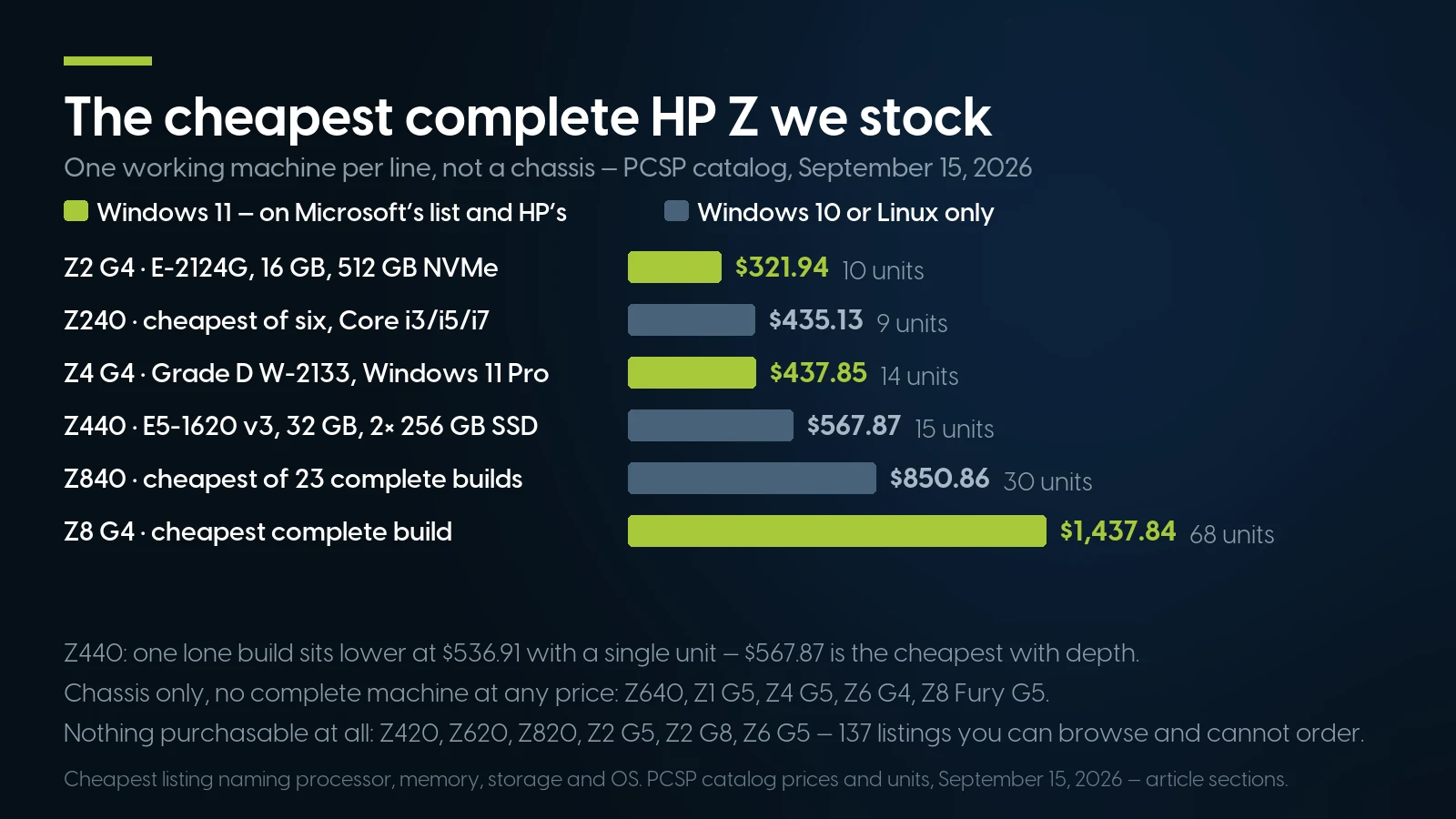
The cheapest working machine per line, with the Z440 shown at its cheapest build that has more than one unit — a single one sits lower at $536.91. Five more lines sell only a chassis and six sell nothing. PCSP catalog, September 15, 2026.
Two things the table hides. Six lines have nothing purchasable at all — Z420, Z620, Z820, Z2 G5, Z2 G8 and Z6 G5 — 137 listings you can browse and cannot order, and the Z640's own 28 take that to 165. And five have only a chassis, no complete machine: Z640, Z1 G5, Z4 G5, Z6 G4, Z8 Fury G5.
Z420, Z620 and Z820: the 2012 DDR3 Rung
Announced March 2012 at reported list prices of $1,169, $1,649 and $2,299 (launch coverage, not an HP release). Their limits live in HP's Z220/Z420/Z620/Z820 Maintenance and Service Guide, c04205252.
The Z420 is single-socket with eight DIMM slots and a restriction that surprises people: “Unbuffered ECC DIMMS only”, 64 GB maximum — the registered modules a Z440 takes do not work in it. Its 600 W supply allows 225 W in the primary slot and 270 W combined; its 400 W supply allows 75 W and 75 W. The Z620 has one 800 W supply good for 225 W primary and 300 W combined, and a ceiling where two HP documents disagree: the Z620 QuickSpecs (c04111527) says it “Supports up to 192GB with two processors and (12) 16 GB DIMMs”, while the service guide's table caps it at 96 GB, written around the 8 GB modules HP sold at launch.
The Z820 takes all three module types across sixteen slots — 128 GB unbuffered, 256 GB registered, 512 GB load-reduced, never mixed — and its QuickSpecs (c04111526) is where HP first printed this brand's most useful rule: “E5-2697 v2 REQUIRE the 1125W Power Supply Option.”
On our shelf, September 15, 2026: nothing at all. The Z420, Z620 and Z820 categories hold 25, 24 and 30 listings between them and not one of the 79 can be ordered. The last DDR3 machine we could sell — a Z620 with an eight-core E5-2680, 128 GB and a 2 TB drive, at $302.89 with 2 units, and no graphics card in front of a processor that has none of its own — was on the shelf when we priced this article on September 14 and was gone the next morning. This rung has stopped being a machine tier and become a parts tier, and the shelf finished that argument a day after we wrote it.
Z440, Z640 and Z840: the 2014 DDR4 Rung
HP announced all three on September 9, 2014 at “$1,299 (U.S.) for the Z440, $1,759 (U.S.) for the Z640, and $2,399 (U.S.) for the Z840”; HP's QuickSpecs for all three carry a first version dated August 21, 2014.
Z440: one socket, and a shorter processor list than people assume. HP's QuickSpecs (c04400038, version 36, July 8, 2019) lists all seven E5-1600 v3 and all seven v4 parts, every one 140 W, then exactly three E5-2600 processors: E5-2630 v3, E5-2623 v4 and E5-2637 v4 — with HP's note that “Although the Intel Xeon E5-2600 processor family supports dual processors, the HP Z440 Workstation does not support dual processor configurations.” Owners run other E5-2600 chips in that socket; that is community practice, not an HP statement. Our Z440 support hub has the full list.
The rest, from the service guide: eight DIMM slots, “Registered ECC DIMMS only”, 128 GB across four channels; five PCIe slots plus a legacy PCI slot, two of them Gen3 x16; 4U rackable; TPM 1.2 “Upgradable to TPM 2.0 through Firmware v5.51 upgrade”. One Z440 number is ambiguous and we print both halves: HP documents DDR4-2133, while the processor table in the same QuickSpecs lists E5-1600 v4 parts, which are 2400 MT/s chips. HP never revised the memory line, so we do not assert 2400 operation.
Z640: two sockets, eight slots — and four are on a riser. The board carries four DIMM slots; the rest arrive with the optional second-CPU-and-memory riser, so a single-processor Z640 is a four-slot machine. The Z640 QuickSpecs (c04400040) says “up to 256GB with two processors”; the service guide is more specific — 64 GB with one processor and 128 GB with two using registered modules, 128 and 256 GB using load-reduced ones. One supply, 925 W, with this rung's most generous total: “Combined power consumption of all cards cannot exceed 375 W”.
Z840: sixteen slots, eight SAS ports, two HP answers about memory. The Z840 QuickSpecs (c04400043, version 34, June 5, 2017) gives “256 GB using RDIMMs” and “1024 GB using LRDIMMs”; the service guide says “up to 1 TB” with one processor and “up to 2 TB” with two, both “(128 GB DIMMs)”. The module reconciles them: 256 GB is the registered ceiling, and the terabyte figures need 128 GB load-reduced modules HP no longer sells. Two of its seven PCIe slots exist only with the second processor installed.
On our shelf, September 15, 2026. The Z440 has 20 purchasable listings of 71 visible: barebones at $173.99 (20 units) and 16 complete machines. One of those sits alone at $536.91 with a single unit; the cheapest you can buy more than one of is $567.87 — an E5-1620 v3 with 32 GB, two 256 GB SSDs, a Quadro K2200 and Windows 10 Pro, 15 units — and the line tops out at $921.95. The Z840 has 28, from a $354.99 barebones (32 units) through 23 complete configurations from $850.86 (30) to $2,200.93, including 22-core E5-2699 v4 builds from $1,033.90. The Z640 is the blunt one: 28 listings, none purchasable, and the only buyable Z640 in the catalog is one Grade D chassis at $169.98 in clearance, 1 unit.
HP Z Power Supplies: Every Option and the Graphics Ceiling Beside It
Most vendors publish a wattage and leave you to guess what it allows. HP does not.
Every figure is HP’s own, from the document linked beside it, read September 14, 2026; the QuickSpecs links point at HP’s PDFs as we host them in our free library. The Z2 Tower G8 row is the exception: HP’s host refused us that document and its figures come from a third-party mirror of c07065867, version 18.
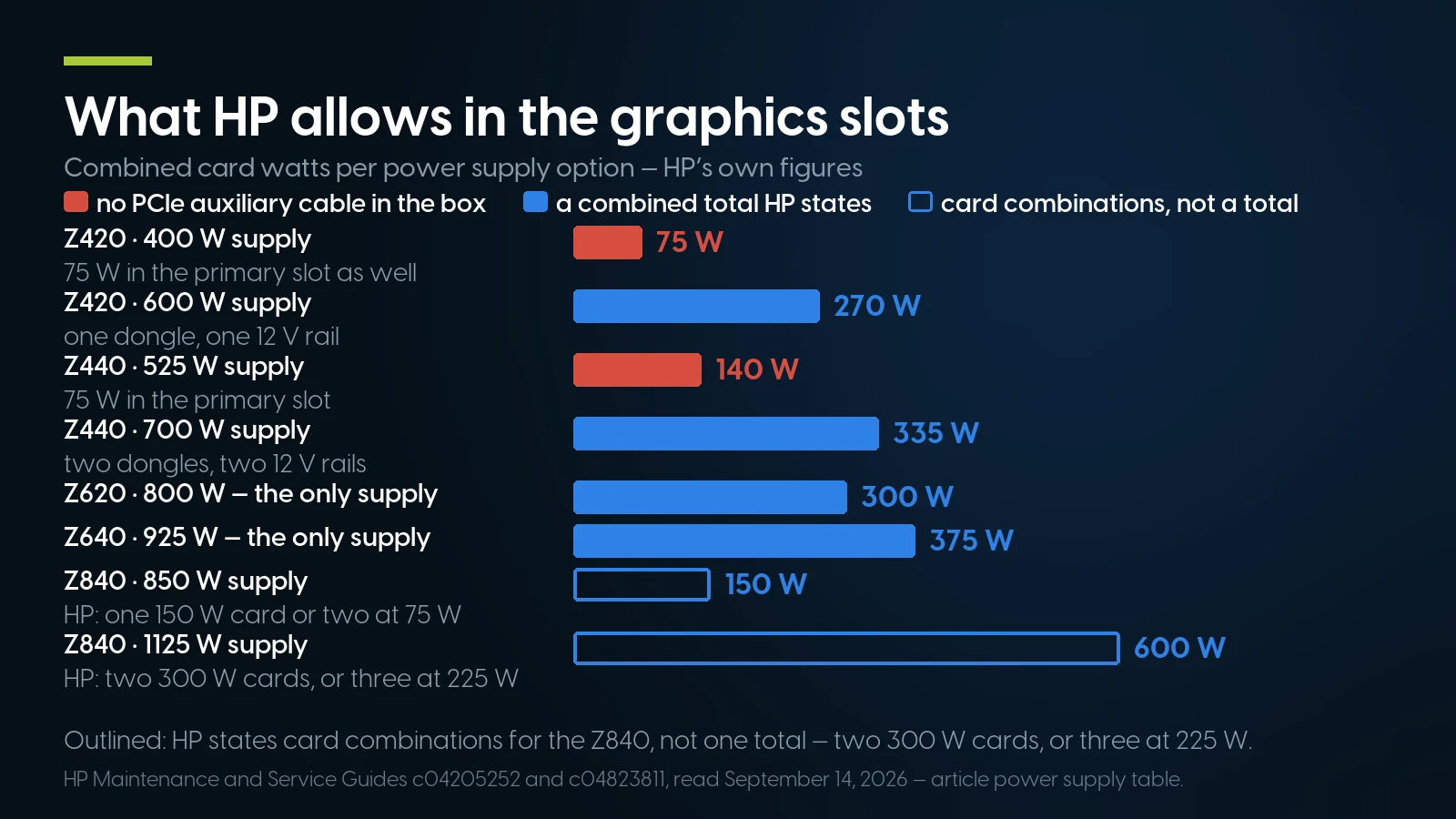
Same tower, two supplies, two different graphics slots. HP service guides c04205252 and c04823811, September 14, 2026.
Three rules come out of that table.
1. The cheapest listing of a model is often the one that cannot take your card. A 525 W Z440 and a 400 W Z420 are 75 W machines in the primary slot with no PCIe auxiliary cable in the box, and HP describes the 350 W Z2 Tower G5 the same way. The fix is a different chassis, not an adapter — our used GPU buying guide covers the card side.
2. High-line derating is printed, and in the US it bites. HP on the Z840's 1125 W supply: it “can also supply 1275W of output power when the input voltage is greater than 105V…An uninterruptible power supply (UPS) is highly recommended”. Worse on the Z8 G4, whose 1450 W/100V/20A chassis “requires a 20A outlet in an environment with 100V/110V. Site modification may be required.”
3. HP names the processors that force the bigger supply. On the Z840 the E5-2643 v3 “REQUIRES the 1125W”, and ten v4 parts — E5-2637, E5-2643, E5-2667, E5-2680, E5-2683, E5-2687W, E5-2690, E5-2695, E5-2697 and E5-2699 v4 — “require the 1125W…Power Supply Option”. That is most of the Broadwell chips anyone wants, so a Z840 advertised at 850 W excludes them.
What we can sell as a spare, and the awkward part. Of 101 purchasable listings in our power supply category, exactly five name an HP Z platform and two have depth: a 925 W Z640 unit at $29.99 (22 units) and a 1125 W Z8 G4 unit at $54.99 (20). So we stock the Z640's supply in depth with no Z640 to put it in, while the Z440 is our deepest line and we hold no Z440 supply at all — nor any Z420, Z620, Z240, Z2, Z4 G4 or G5-era unit.
Z4 G4, Z6 G4 and Z8 G4: the 2017 Rung That Still Has a Future
Announced September 2017 at $2,439 for the Z8, $1,919 for the Z6 and $1,239 for the Z4 (launch coverage) — the oldest rung Microsoft and HP both still acknowledge.
The Z4 G4 is two machines sharing a name. HP's warning opens its Z4 G4 QuickSpecs (c05527757, version 52, February 1, 2023): “Features and Supported Configurations will differ between the Z4 G4 Workstations with Intel Xeon W Processors and the Z4 G4 Workstation with Intel Core X Processors.” Xeon W builds are C422 with registered ECC memory to 512 GB; Core X builds are X299 with non-ECC memory to 256 GB and fewer usable lanes, and no processor swap crosses between them. HP ties 2933 MT/s and 64 GB modules to the W-2200 family, so 512 GB is a W-2200 number — a W-2100 machine tops out at 2666 and 256 GB.
The Z6 G4 is single-socket as shipped: six DIMM slots on the board, the second processor and six more on an optional riser. HP's Z6 G4 QuickSpecs (c05527761) asterisks its own ceiling: “Supports up to 768 GB DDR4-2933 ECC RAM”, with “768 GB configuration requires 2 CPUs”. One supply, 1000 W, two 6-pin cables.
The Z8 G4 is the one with the memory: two sockets, 24 slots, “up to 1.5TB with two processors, using RDIMMs” and 3 TB with modules HP notes “are no longer sold by HP” — so 1.5 TB is the real figure. All four supplies ship four 6+2-pin cables, and its 5U chassis is still the Z8 G5's.
On our shelf. The Z4 G4 is the deepest G4 line: chassis at $184.98 (Core) and $209.98 (Xeon), the cheapest complete a Grade D W-2133 with Windows 11 Pro at $437.85 (14 units), the cheapest full-grade one $454.71 (40); almost all of it is W-2100. The Z8 G4 runs from a $734.98 chassis through $1,437.84 complete to a 36-core, 1.5 TB machine at $10,426.68. The Z6 G4 is the trap: 86 listings visible, one purchasable, $334.98, 3 units.
Z240 to Z2 G9: the Small Tier, and the Cheapest Windows 11 Seat
Every machine here is single-socket with four unbuffered DIMM slots; what changes is the socket, the memory speed and whether the processor is on Microsoft's list. Z240 (QuickSpecs c04760707, from October 8, 2015): LGA1151 on C236, Xeon E3-1200 v5/v6 or 6th/7th-generation Core, “up to 64GB…2133 MT/s or 2400 MT/s speed depending on the CPU selection”, one 400 W supply at 92%, TPM 1.2 — resellers claim 128 GB, HP says 64 GB. Z2 Tower G4 (c05987463, July 23, 2018) is the first here to ship TPM 2.0 rather than a firmware upgrade to it: C246, Xeon E-2100/E-2200 or 8th/9th-generation Core, DDR4-2666 to 128 GB. Z2 Tower G5 moves to LGA1200 on W480 with DDR4-2933, Z2 Tower G8 to W580 with DDR4-3200.
Z2 G9 Tower (c08109687) is the first DDR5 machine here and the only HP Z QuickSpecs in this set HP was still revising in 2026 — version 51, July 2, 2026. LGA1700 on W680, four DDR5 slots “up to 192GB non-ECC or up to 128 GB ECC”, 4400 MT/s dropping to 3600 MT/s with four dual-rank DIMMs. The Z1 Entry Tower G5 we will not pretend to know: its QuickSpecs was not obtainable, so no processor list, memory ceiling or wattage appears here.
On our shelf. The Z240 starts at a $99.98 chassis — the floor of our HP Z catalog — with six complete machines from $435.13, all Core i3/i5/i7. The Z2 G4 is the cheapest complete Windows 11 machine we sell in this brand at $321.94 (Xeon E-2124G, 16 GB, 512 GB NVMe, 10 units); twelve of its listings are variants of one i7-9700 machine all reporting 45 units, which is one shared pool shown twelve times, not 540 computers. The Z2 G9 has eight listings from $124.99 to $1,397.92, every complete one an i5-12600. Z2 G5 and G8 are sold out.
Which HP Z Is a 2029 Machine and Which Is a 2027 Machine
Three dated documents answer this.
One: Microsoft's processor list. The general page, “Windows 11 supported Intel processors”, document date October 16, 2025, has rows for Xeon W-2100 through W-3300, Xeon Scalable 1st to 3rd generation, Xeon E-2100 to E-2400, Core 7000X/9000X/10000X and 8th- to 14th-generation Core. It has no Xeon E5 of any version, no Xeon E3 v5 or v6 and no 6th- or 7th-generation Core, and adds that “Subsequently released and future generations of processors which meet the same principles will be considered as supported, even if not explicitly listed.”
A second family of Microsoft pages — per-version lists for 24H2 and 25H2 — omits Xeon W-2100, W-2200, W-3100 and Core X while keeping W-1200, W-1300, W-2400, W-2500, W-3400, W-3500 and Xeon Scalable through its 5th generation. The 24H2 page — and only that one — carries Microsoft's editor's note: “It is intended for OEMs and ODMs to understand the following CPUs may be used for new Windows 11 devices.” The 25H2 page prints no such note. No page says which list governs an upgrade of a machine you already own, so we will not say it either.
Two: HP's tested list. “HP Business PCs and Workstations tested with Windows 11” opens with the sentence that does the work: “Any PC product that is not listed in the table was not tested by HP for this update and is not supported by HP for Windows 11.” The G4 towers, the Z2 towers from G4 on, the Z1 Entry Tower G5 and every G5 machine are in it. The Z420, Z620, Z820, Z440, Z640, Z840 and Z240 do not appear at all. HP also states its clock, in the footnote behind the asterisk on every Z row: “Each newly introduced General Availability Channel of HP Z branded desktop workstations are tested for five years after the end of manufacturing.”
Three: the last critical BIOS. HP publishes no end-of-support date per model, so firmware is the proxy. Z440, Z640 and Z840: BIOS 02.62, effective January 23, 2024, critical, fixing a row of 2022–2023 CVEs. Z6 G4 and Z8 G4: 02.95, January 3, 2025. Z4 G4: 02.97 of August 13, 2025 (Xeon) and 02.96 of August 20, 2025 (Core X). These are the newest SoftPaqs we could find, not proof that nothing newer exists.
Microsoft’s general processor list (October 16, 2025) and its 24H2/25H2 lists; HP’s tested-with-Windows-11 document, read September 14, 2026. Every Z row there carries HP’s five-year workstation testing asterisk.
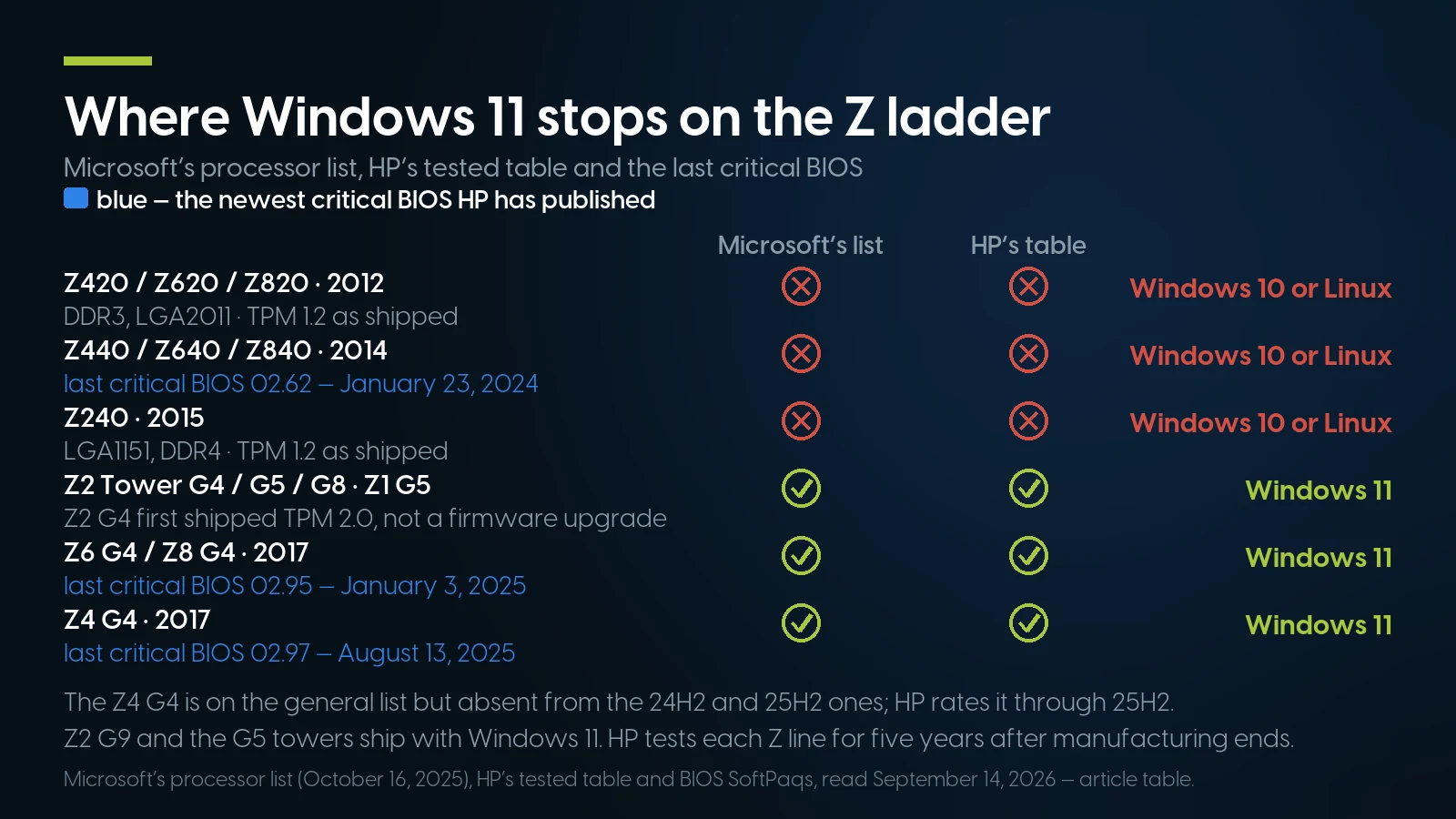
Windows 11 splits the ladder at 2017, and the firmware clock says the same. Microsoft’s list and HP’s tested table, September 14, 2026.
Now the 26H1 column, because it is about to be misread everywhere. In it, every Z workstation reads “Hardware Not Supported” — the Z8 G5, the Z2 G9 and HP's own Z4 G6i and Z8 Fury G6i included. That is not HP dropping your workstation. Microsoft's release page for version 26H1, dated February 10, 2026, calls it “a specialized Windows release”, “available only preinstalled on select new devices” whose first examples “launch with Qualcomm Snapdragon X2 Series processors”, and says “version 26H1 isn't offered through Windows Update. This means that it can't be installed as an in-place update on existing devices.” Its processor list has three rows, all Qualcomm. Read HP's ratings through 25H2 and ignore the 26H1 column for any Intel workstation of any age.
We are firm about this because we got the neighbouring question wrong ourselves: in August 2026 one of our articles read the per-version list instead of the general one and called several Xeon W workstations, the Z4 G4 among them, ineligible. The error reached two later posts; all three were corrected in September 2026 with dated notes, and our workstation compatibility list carries the corrected verdicts.
For a Z440, Z640, Z840, Z240, Z420, Z620 or Z820 the answer is Linux, or Windows 10 with paid Extended Security Updates — our ESU Year 2 article has the per-seat cost against replacing the hardware. Converting the TPM to 2.0 does not help: the blocker is the processor. Note the surprise in the table too — within HP's 2017 generation the dual-socket machines have cleaner Windows 11 paperwork than the single-socket one.
The HP Z machines on both Windows 11 lists, in stock this week
Z2 G4 with Windows 11 Pro from $321.94, Z4 G4 from $437.85, Z8 G4 from $1,437.84 — priced September 15, 2026, tested, one-year warranty, free ground shipping over $35 in the contiguous U.S.
Browse refurbished HP workstations HP Z4 G4 in stockIdle Noise, Measured by HP — and What “13 dB” Actually Is
HP publishes declared noise to ISO 7779 for every Z tower here, always with the configuration it measured. We have quoted “HP's declared 13 dB” ourselves, in our music production article; here is the receipt.
Declared idle noise from each model's HP QuickSpecs, measured to ISO 7779. The Z440 is missing on purpose: only part of its QuickSpecs was obtainable and the acoustics pages were not in it, so we have no HP figure and will not estimate one.
The graphics card is the loudest component here, not the processor: the Z4 G4 moves 13 → 22 dB on a P400-to-P6000 swap alone. HP's caveat matters for a used purchase — “Higher noise levels may be experienced with non-HP approved graphic card(s)”, whose side-blowing fans make the chassis fans ramp. One row does not add up: the Z240's 14 dB configuration names a Core i7-4770, a Haswell part its LGA1151 board cannot take.
What They Cost, and Why the Memory Is the Purchase
Every price here is ours, dated September 15, 2026. We could not capture dealer or auction prices this week — a sign-in wall and two blocked dealer sites — so there is no side-by-side here. Not sure which rung you want? Start at refurbished HP workstations, which rolls up 119 of our 125 purchasable HP Z listings — it misses five clearance builds and the Z4 G5 configurator, while the Z8 Fury G5 appears there and in no model category at all.
The most useful price fact about a 2014 HP Z tower has nothing to do with the tower. Two live listings of the same Z840 — two E5-2680 v4 processors, no graphics card, no drive, no operating system — sat on a third-party marketplace on September 14, 2026, both sold by us: $486.95 with 16 GB of memory and $1,866.89 with 256 GB. The difference is $1,379.94 for 240 GB of DDR4, or $5.75 per gigabyte. Two checks: the 16 GB machine is on our own site at $486.93 with 24 units, two cents apart; and a 256 GB kit of DDR4-2400 registered modules on our parts shelf is $1,471.68, the same $5.75 per gigabyte. The chassis is cheap and the sticks are the purchase — our DDR4 memory analysis has the reasons.
Speed sets the rate: registered DDR4 at 2133/2400 — Z440, Z640, Z840 — is $5.75 per GB, 2666 for a W-2100 Z4 G4 or a 1st-generation Scalable Z6/Z8 G4 is $6.75, and 2933 for the W-2200 and 2nd-generation Scalable machines is $8.75. A 128 GB fill runs $735.84, $863.84 or $1,119.92 depending only on the processor in the socket.
What we cannot price, and it is a real gap. Four of the newest lines are DDR5 machines and we hold no DDR5 module at all. Of the sixteen listings on our processor shelf, not one fits a G5-era or Z2 G5/G8/G9 machine and none is a Core X part — so no upgrade can be quoted for a Z2 G9, Z4 G5, Z6 G5 or Z8 Fury G5. The older rungs fare better: a Xeon W-2235 at $64.99 drops into a Z4 G4, an E-2246G at $114.99 into a Z2 G4. The graphics shelf has its own hole, and it widened while we were checking: a second RTX A2000 6 GB that was orderable at $348.99 on September 14 was gone a day later. Above a $296.01 Quadro T600 the entire professional range is now one A2000 at $544.50, a headless Tesla T4 at $499.99, an Apple MPX module no Z chassis takes, and then a jump to a Quadro RTX 6000 24 GB at $1,092.49 — one, four, one and two units respectively.
When a Used HP Z Is the Wrong Buy
We hold 125 purchasable HP Z listings, about 40% of every workstation listing we sell, so read this as the disclosure it is.
- Anything that must run Windows 11 and is a Z420, Z620, Z820, Z240, Z440, Z640 or Z840. Microsoft does not list the processor and HP does not list the model. Linux or Windows 10 with ESU are the honest answers; the cheapest machine we sell that is on both lists with Windows 11 installed is the $321.94 Z2 G4.
- A modern graphics card in a cheap chassis. We hold no Z440, Z420, Z620, Z240, Z2 or Z4 G4 power supply to fix a 75 W chassis with. Dell's line is better documented here: the Precision 5820 has a factory 950 W upgrade sold as a part, priced in our Precision article.
- Three big cards on a US wall socket. See the derating and the 20 A outlet above: HP's own words are “Site modification may be required”.
- VMware ESX 9. Broadcom's KB 318697 puts the Xeon E5-1600 v4 and E5-2600 v4 series, the E3-1200 v6 series and the Xeon W-2100 series in its Discontinued table, where “the ESX/VCF installer will block or prevent the installation”. Skylake-SP in a Z6/Z8 G4 is discontinued from 9.2; Cascade Lake runs 9.x with a warning. Broadcom names the W-2100 and says nothing about the W-2200, so neither will we. Our Proxmox article covers the platform with no such floor.
- Memory bandwidth, AVX-512 or AMX work. A Z440 is four channels of 2014-era DDR4-2133; the 2012 rung predates AVX2, which current Adobe releases require.
- A quiet room with the wrong card inside. HP's 13 dB is a Quadro P400 in a 465 W chassis; a P6000 makes it 22 dB.
- A factory warranty or a vendor firmware promise. Ours carry our own one-year warranty, extendable to five, not HP's. If a contract or an insurer requires manufacturer coverage, the answer is a new Z4 G5, Z6 G5 or Z8 G5; our buying guide works the same decision from the workload end.
HP Z workstations on our shelf today
Lowest listed price in each category and what is on the shelf right now — barebones chassis included, so a complete build costs more than the figure shown. This block is the one part of the article that refreshes itself; every price in the text above is dated where it stands.
- HP Z440Single Xeon E5-1600/2600 v3/v4 · 700 WFrom $173.99 · 28 in stock
- HP Z840Dual Xeon E5-2600 v3/v4 · 1,125 WFrom $354.99 · 36 in stock
- HP Z4 G4Xeon W-2100/W-2200 · Core XFrom $184.98 · 32 in stock
- HP Z8 G4Dual Xeon Scalable · multi-GPUFrom $734.98 · 16 in stock
- HP Z2 G4Core i7 8th/9th gen or Xeon E-2100From $119.98 · 17 in stock
- All HP workstationsEvery Z generation we stockFrom $99.98 · 149 in stock
Every HP Z line in this article, on one shelf
Z240 from $99.98, Z2 G4 from $119.98, Z4 G4 from $184.98, Z440 from $173.99, Z840 from $354.99, Z8 G4 from $734.98 — these six figures refresh nightly from our catalog; tested, one-year warranty, same-day shipping before 1 pm EST.
Refurbished HP workstations Request a quoteThe Bottom Line
Three rungs, and they are not interchangeable. The 2012 Z420, Z620 and Z820 are DDR3 machines whose primary slot HP rates at 75 W to 300 W depending on the supply fitted, with no Windows 11 path. The 2014 Z440, Z640 and Z840 are the cheap registered-ECC tier, firmware-frozen since January 2024. The 2017 G4 towers are the oldest HP Z machines Microsoft and HP both still acknowledge.
Inside a rung the power supply decides what the machine can ever become, and HP prints the rule: 75 W in the primary slot on a 525 W Z440 against 225 W on a 700 W one.
And ignore the 26H1 column: it reads “Hardware Not Supported” beside every Z workstation HP has made, including the ones it sells today, because that release is for a different processor architecture. The prices here were true on September 15, 2026; the documents will outlast them.
HP Z Workstations: Frequently Asked Questions
What are the HP Z440 specs?
Single-socket LGA2011-3 on Intel C612, announced September 9, 2014. Eight DIMM slots, registered ECC only, 128 GB, documented by HP at DDR4-2133. Five PCIe slots, two Gen3 x16. Power supply 525 W Bronze or 700 W Gold. TPM 1.2, upgradable to 2.0 by firmware. 4U rackable.
What processors does the HP Z440 support?
HP’s QuickSpecs list all seven Xeon E5-1600 v3 and all seven v4 parts, plus exactly three E5-2600 processors: E5-2630 v3, E5-2623 v4 and E5-2637 v4. HP also states the Z440 does not support dual processor configurations. Other E5-2600 chips are owner practice, not an HP statement.
When were the HP Z440, Z640 and Z840 released?
September 9, 2014, for October availability, at $1,299, $1,759 and $2,399. HP’s QuickSpecs for all three carry a first version dated August 21, 2014. The Z420, Z620 and Z820 came in March 2012; the Z4, Z6 and Z8 G4 in September 2017.
Can the HP Z440 run Windows 11?
Not with vendor support. No Xeon E5 appears on Microsoft’s Windows 11 supported Intel processors list, and the Z440 is absent from HP’s tested-with-Windows-11 table, whose opening sentence says an unlisted product is not supported by HP for Windows 11. Converting the TPM to 2.0 does not change it: the blocker is the processor.
What power supply does the HP Z840 have?
A choice of two: 850 W at 88% efficiency with a single auxiliary dongle, or 1125 W at 90% with three 6-pin graphics cables. HP allows one 150 W or two 75 W cards on the 850 W unit, and two 300 W or three 225 W on the 1125 W one, which eleven processors require.
What is the max RAM of the HP Z640?
HP’s Z640 QuickSpecs says up to 256 GB with two processors; HP’s service guide says 64 GB with one processor and 128 GB with two using registered DIMMs, 128 and 256 GB using load-reduced ones. Four of its eight DIMM slots sit on the second-processor riser.