

Dell PowerEdge Generations Explained: R620 to R760 (2026)
Posted by Konstantin Protasov, PCSP on Oct 1st 2026
Dell does not publish an end-of-life date for a PowerEdge server. Asked on Dell’s own forum, a Dell community moderator answered on August 24, 2023: “There isn’t any documented information for End of Life and End of Support Life on PowerEdge servers.” What Dell does publish, for some generations, is the date its engineers stop fixing the management controller inside the server. For the 14th generation — the PowerEdge R640 and R740 that make up the largest part of our own Dell rack shelf — that date is February 1, 2027, four months after this article.
That date says more about which generation to buy than the model number does. This guide is built from what Dell prints — technical guides, support pages, VMware and Windows Server matrices — plus asking prices from our shelf and three other stores. It runs from the 2012 R620 and R720 to the 16G R660 and R760, with the 2025 R670 and R770 in one paragraph. The processors inside each rung have their own guide.
The short version — Dell and Broadcom documents read September 27, our shelf priced October 1, 2026:
- The only end date Dell prints is the iDRAC’s. iDRAC9 on 14G: feature development ended June 30, 2023, software maintenance ends February 1, 2027. iDRAC8 on 13G: maintenance ended February 2024 at firmware 2.86.86.86. Dell has published no date for iDRAC9 on 15G or 16G.
- The model number is the generation. In Dell’s rule the second digit is the generation and the last the CPU maker: an R640 is a 14th-generation Intel server, an R7525 a 15th-generation AMD one.
- Software support ends before the hardware does. Dell lists 12G up to ESXi 6.5 U3 and 13G up to 7.0 U3, both past Broadcom’s end of general support; 14G runs 8.0 U3. For Windows Server 2025 on an R640 or R740, Dell’s BIOS adds support while its support matrix and its RAID driver leave 14G out.
- The price cliff is between 14G and 15G, not between old and new. Three other stores ask $79.95–$461.84 for a 13G or 14G chassis and $2,999.95–$4,937.07 for a 15G one; configured 64 GB 13G/14G builds run $811.43–$1,126.83, the cheapest configured R650 $7,877.06.
- Our shelf, as of October 1, 2026: 12G sold out; 14G is 37 of our 77 priced Dell rack listings, 20 of them R640; the cheapest complete machine with drives is an R640 at $1,050.38; a complete two-socket 16G starts at $7,274.99; we stock no DDR5 memory, and 17G is quote-only.
- What to buy: 14G for budget virtualization with February 2027 in the plan; 15G for NVMe, PCIe 4.0 and a Dell-listed Server 2025; 13G only where you own the patching; 12G not at all.
How to Read a PowerEdge Model Number, in Dell’s Words
Dell explains its naming in support article 000137343, last modified June 3, 2026. The letter is the form factor — R for rack, T for tower, M or MX for modular — and for three-digit names Dell’s own sentences do the rest:
“The first number after the letter indicates the class of the system. With 1-3 being single CPU systems, 4 - 7 are dual CPU systems, 8 can be two or four CPUs and 9 is four CPUs. The second number indicates the generation, with 0 for 10th generation, 1 for 11th generation and so on. The third number indicates the make of the CPU, 0 for Intel and 5 for AMD. Example, the R740 model is a Rack 2 CPU system from the 14th generation of servers with Intel Processors.”
So the R620 is 12G, the R630 13G, the R640 14G, the R650 15G and the R660 16G. AMD models add a digit: in Dell’s four-digit convention the third number “often indicates the number of CPU sockets” and the fourth is the maker, so the R7525 is a two-socket 15th-generation AMD server and the R6615 a one-socket 16th-generation one. They are siblings inside a generation, not a separate ladder: the same Dell article files the R7525 beside the R750 at 15 and the R7625 beside the R760 at 16.
Two things the rule does not say. It does not make 6 mean 1U and 7 mean 2U; that holds in practice — Dell’s guides give the R640’s form factor as “1U rack” and the R740’s as “Rack (2U)” — but class is about sockets. And a generation is a board, not a year: the August 2022 revision of the R740 guide lists second-generation Xeon Scalable chips on the board that launched with the first, just as 12G took the E5 v2 and 13G the E5 v4.
The Ladder, 12G to 17G, From Dell’s Own Documents
Every cell below comes from a Dell technical guide, spec sheet or press release; where Dell prints nothing, the cell says so. Refreshes inside a generation kept the board and raised the numbers, so each row gives the ceiling of the last revision Dell documents.
Dell technical guides: R720 (December 2013), R730/R730xd (June 2015) with the December 2016 v4 spec sheets, R640 and R740/R740xd (August 2022), R650 (September 2021), R750 (November 2022) and its December 2024 service manual, R660, R760 and R770 (June 2026); five links open Dell’s PDFs archived in our spec-sheet library. On-sale dates from Dell releases of March 6, 2012, September 8, 2014, July 11, 2017, March 17, 2021, January 17, 2023 and April 8, 2025. All read September 27, 2026.
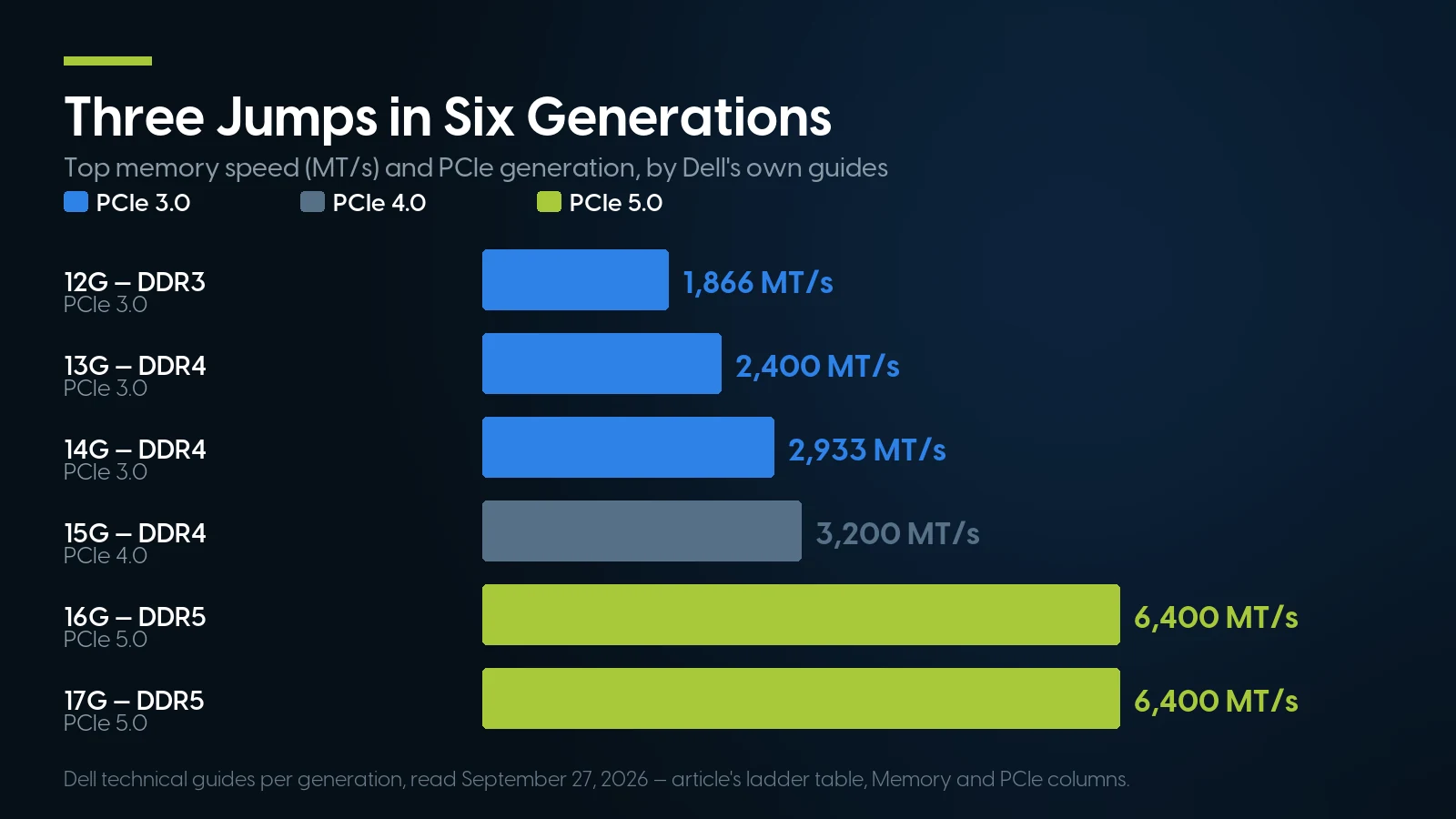
Three breaks in six generations: DDR3 to DDR4 at 13G, PCIe 4.0 at 15G, DDR5 and PCIe 5.0 at 16G — 16G and 17G share the same 6,400 MT/s ceiling. Dell technical guides, read September 27, 2026.
Read down the columns and there are three breaks: DDR3 to DDR4 at 13G, PCIe 3.0 to 4.0 at 15G, DDR5 and PCIe 5.0 at 16G. 14G changed the platform — Scalable processors, M.2 boot, 25 GbE, ten NVMe bays in 1U — but not the bus, and the used price steps at the generation that did.
No End-of-Life Date for the Server, but One for Its iDRAC
Dell’s moderators send people to the service tag instead, where Dell’s support site shows an end-of-service-life date for that one machine, based on its warranty — not a date for the model. The dates Dell publishes per generation belong to the management controller, the iDRAC:
Dell knowledge-base articles 000178016 (iDRAC9, last modified August 28, 2026) and 000178044 (iDRAC8, September 9, 2026); controller per generation from article 000137343. Dell’s own iDRAC7 article returned “not currently available”. Read September 27, 2026.
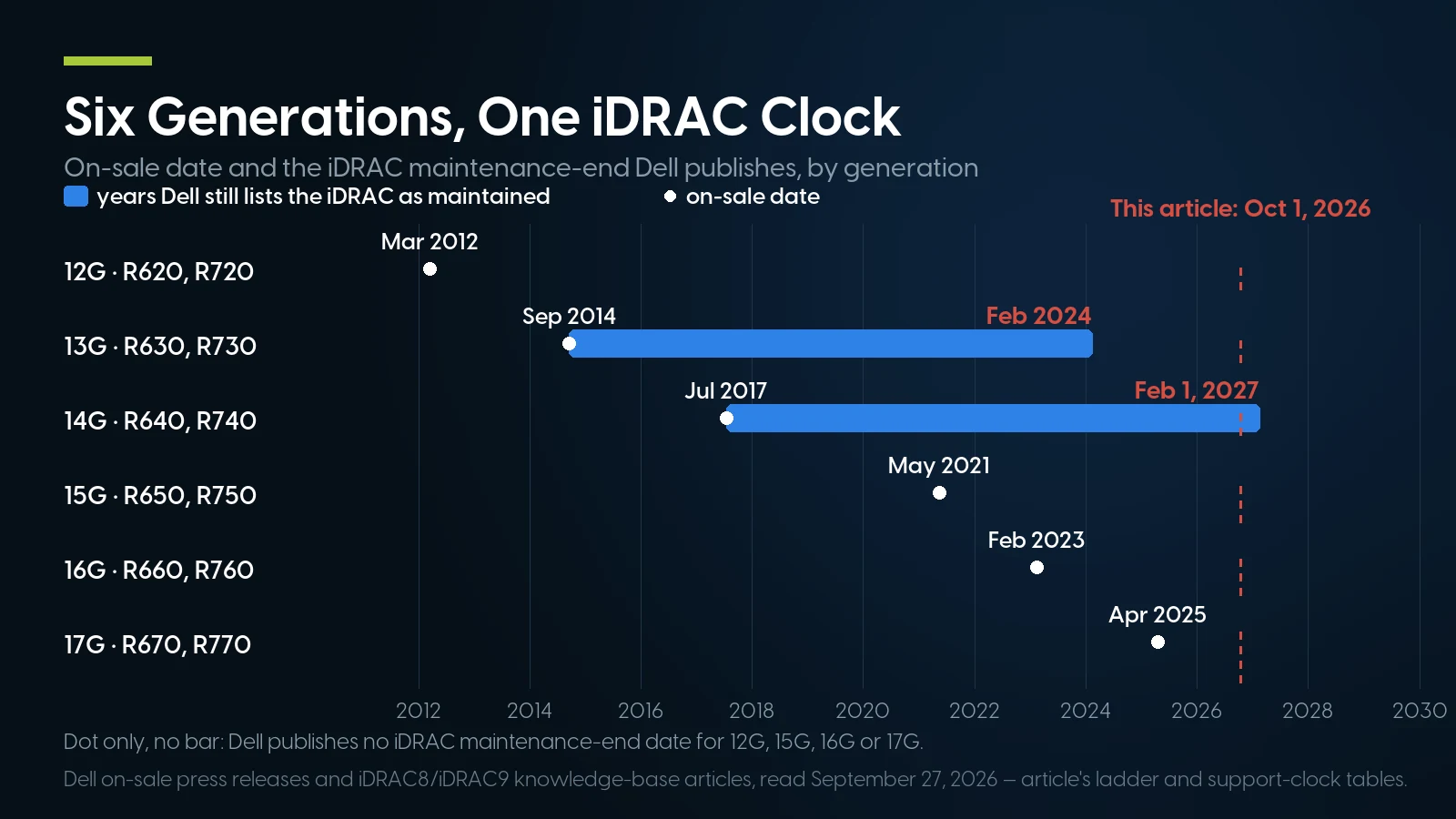
Only 13G and 14G have a published iDRAC end date. On a 14G bought today, that clock reads four months: iDRAC9 maintenance on the R640 and R740 ends February 1, 2027.
Dell defines the end of software maintenance as “the last date for Dell Technologies iDRAC Engineering to release any software maintenance releases, security updates, or issue fixes. After this date, iDRAC Engineering is no longer obligated to maintain or repair the firmware.” On 14G the reduced mode already runs: since the July 2023 feature freeze every release has been a security fix. After February 1, 2027 even those stop being an obligation.
Two things soften it for a second owner. Dell’s iDRAC8 page states that “iDRAC firmware support is not tied to the hardware support contract” and that released updates “are available regardless of support contract”, so a second owner can install it without paying Dell. And the BIOS keeps its own clock: 14G received BIOS 2.26.1 on March 17, 2026, carrying security update DSA-2026-040, while the newest 13G BIOS on Dell’s download pages is 2.19.0 of March 18, 2024 — nothing newer posted, which is not the same as Dell saying nothing will come. What does not soften it is paying Dell later: its Post Standard Support description (v1.4, October 2025) states that “Hot fixes including security patches are not available” under it for firmware. Logins, licences and firmware without a contract are covered in our iDRAC guide.
What Dell lists each generation to run
Hypervisor and Windows Server support end sooner than the hardware; Dell publishes both as matrices.
Dell ESXi compatibility matrices 6.5.x (Rev. A17), 7.x (June 2024) and 8.x (March 2026); Broadcom KB 326984, KB 428874 (updated September 18, 2026) and KB 318697; Dell’s PowerEdge Windows Server support matrix (December 2025). “—” = not addressed by the Broadcom articles cited. Read September 27, 2026.
The 14G row holds the contradiction worth knowing. Dell’s BIOS 2.22.2 (October 1, 2024) lists “Support for Microsoft Windows Server 2025 Operating System for R740 and R640.” Dell’s December 2025 matrix has no Server 2025 column for 14G, and Dell’s Server 2025 PERC driver (7.730.02.00, June 20, 2025) names only 15G and newer systems and no H330, H730 or H730P. Dell’s BIOS adds Server 2025; Dell’s support list and its RAID driver do not include 14G.
Two other rows bite in practice. ESXi 8 drops SD-card boot: the 7.x matrix ticks “Flash (SD) card” for 13G, while every 8.x row lists only “Hard Drive, BOSS”. And VCF 9 moves: on September 18, 2026 Broadcom extended first-generation Scalable “in Deprecated Mode for VCF 9.x”, adding that support “will not be extended to VCF releases beyond VCF 9.x”, while its deprecation table warns that customers with a discontinued CPU such as the E5-2600 v4 “will not be able to proceed with the installation.”
12G and 13G: Skip the R620 and R720, Budget With the R630 and R730
12G: why not, even cheap
Dell’s R720 technical guide of December 2013 opens with “This is final documentation for R720. This product is eol.” Everything since agrees: DDR3, TPM 1.2 only, ESXi 6.5 U3 as Dell’s last listing, Windows Server 2012 R2 at the top of Dell’s matrix. Dell’s own SPECpower_ssj2008 submissions put 12G at 4,446–5,506 ssj_ops per watt against 9,749–11,423 for 13G: about half the work per watt, or less. Both our R620 and R720 categories are sold out, 0 purchasable of 23 and 49 listings, and there is no price argument for chasing one elsewhere: TechMikeNY asked $79.95 for a 13G R730 chassis on September 27, 2026.
13G: the budget floor, past every support date
13G brought DDR4, the PERC 9 controllers (H330, H730, H730P) and iDRAC8, and its 2016 refresh took the same boards to 22-core E5-2600 v4 chips and 2400 MT/s memory. Dell’s v4 spec sheets give the R630 1.5 TB of memory and the R730 and R730xd 3 TB, on 128 GB modules, and the R630’s NVMe stops at four drives behind a bridge card.
Every clock above has run out on it. The iDRAC8 left maintenance in February 2024; Dell’s matrices stop at ESXi 7.0 U3, out of general support since October 2, 2025; VCF 9 will not install on an E5-2600 v4; Dell files 13G under discontinued platforms. None of that stops an R730 running Proxmox, Linux or a backup target where you own the patching, which is what 13G is still good for; noise and real idle watts for these boxes are in our home lab server guide.
Our 13G shelf as of October 1, 2026: 14 priced listings, though the R730 and R730xd categories share five of their six, so nine distinct products. The floors are an R730 barebones chassis at $104.99 and an R630 build-your-own base at $119.99. The cheapest complete machine with drives is an R730xd at $1,186.69: two 12-core E5-2680 v3, 128 GB, an H730 and five 1 TB SAS drives. The R630 is down to two listings: the build-your-own base and a $272.93 machine with no drive.
14G (R640, R740, R740xd): the Used Sweet Spot, With a Date on It
14G is where the modern PowerEdge starts. Xeon Scalable replaced the E5 with six memory channels per socket instead of four (Intel’s figures, tabulated in our Xeon guide), up to 28 cores, and 2933 MT/s once the second-generation chips arrived. Boot moved to BOSS M.2 cards, networking to rNDCs with 25 GbE options, NVMe from four bridged drives in the R630 to ten in the R640. And no generation here stayed Dell’s newest Intel rack line longer: 46 months, from July 2017 to 15G’s planned May 2021 availability, which is our reading of why 14G leads our shelf.
The controller list is longer than most listings suggest. Dell’s later guide revisions add the H350, H750 and HBA350i to the launch-era H330, H730P, H740P and HBA330; the plain H730 belongs to 13G. Arrays import one PERC generation forward and never back, which our RAID controller guide covers in Dell’s wording.
Then the date. iDRAC9 security fixes on 14G run until February 1, 2027, while the BIOS got a security release as recently as March 2026. Broadcom keeps 14G inside VCF 9.x in deprecated mode and Dell’s ESXi 8 matrix lists both processor families, but only the first-generation chips have their end written down: nothing beyond 9.x. For a VMware estate, pay for second-generation (Cascade Lake) chips; on our shelf they appear in one R640 listing (Gold 6226R, $1,555.55) and three R740xd machines (Silver 4210, Gold 6240 and 6248R) from $5,280.22.
Our 14G shelf, as of October 1, 2026, is the deep one: 37 priced listings, 20 of them PowerEdge R640, from a $372.49 build-your-own base. The cheapest complete R640 with drives is $1,050.38: two 12-core Gold 6126, 64 GB, two 300 GB SAS drives, an HBA330 and iDRAC Enterprise, 15 in stock. The R740 category holds ten listings, six of them build-your-own pages, and every configured machine in it is an R740xd; the cheapest with drives is $1,873.91 (two Gold 6130, 192 GB, two 1 TB SSDs, H730P). The R740xd adds seven: two build-your-own chassis from $404.99 and five machines from $5,280.22 to $8,061.37.
The R640 is our deepest model shelf
20 priced R640 listings as of October 1, 2026, the lowest listed at $372.49 — refreshed nightly; a complete machine costs more. Build one on the 10-bay configurator, or take two 20-core Gold 6148 with 128 GB, rails and bezel, drives not included — From $1,535.27 · 22 in stock. One-year warranty on every configured server; free ground shipping over $35.
Browse the PowerEdge R640 Build your own R64015G (R650, R750): PCIe 4.0, and the Price Cliff
15G is the last DDR4 generation and the first with PCIe 4.0. Third-generation Xeon Scalable brought up to 40 cores at 270 W, eight memory channels per socket at 3200 MT/s across 32 slots, and 16 GT/s lanes; the R750’s eight slots include six at x16, against four on the R740. Networking moved to OCP 3.0 and the PERC to the front of the chassis. The R650’s memory ceilings are 2 TB in RDIMMs, 8 TB in LRDIMMs and 12 TB with Optane PMem 200; the R650 guide’s own “around 10 TB” describes a configuration that adds up to 12.
NVMe changed as well. Dell’s R650 guide counts “10 x direct attach in front, and 2 x direct attach in rear”; the R640’s own technical guide gives its ceiling as “up to 10 CPU Direct Attach PCIe SSD” in total, with no bridge card the way the R630 needed for its four. On the R750, per Dell’s service manual, the 16-drive NVMe layout is direct-attached through paddle cards in riser slots 1 and 3, and the 24-drive layout runs through a PCIe-switched backplane: faster lanes than the R740xd’s bridge cards, still shared.
This is where used prices jump. On September 27, 2026 three other stores asked $2,999.95 to $4,937.07 for a bare 15G chassis, against $79.95 to $461.84 for 13G and 14G ones, and the cheapest configured R650 we found was $7,877.06 — two 8-core Silver 4309Y, 32 GB, two 600 GB drives. Our own build-your-own bases say the same: $372.49 for an R640, $2,884.90 for an R650. We have no complete Intel R650 with a drive at any price — both configured listings, $4,854.85 and $5,948.79, ship without storage — and the cheapest complete R750 is $9,261.72: two 32-core Platinum 8358, 128 GB, eight 600 GB SAS drives. The AMD sibling, an R6525 with two EPYC 7513, 1 TB and two 960 GB SSDs, is $8,924.99.
What the difference buys, in Dell’s terms: PCIe 4.0, a third more memory channels, more direct-attached NVMe, Server 2025 on Dell’s list, and Secured-core, which Dell’s matrix supports “from 15G and above”. That is worth it for NVMe-heavy databases, vSAN or Ceph, memory-bandwidth-bound work and certified Server 2025. For general virtualization, file, backup and directory servers a 14G does the same job, which is also where our R750 review lands.
16G (R660, R760): DDR5 and PCIe 5.0 — and 17G in One Paragraph
16G is where the platform changes again. Fourth- and fifth-generation Xeon Scalable, up to 56 and 64 cores at 350 W, sit on DDR5 — 4800 MT/s, or up to 6400 with fifth-generation chips at one module per channel and 4400 at two — and PCIe 5.0 at 32 GT/s. RDIMM is the only module type Dell lists, up to 8 TB in the R660. E3.S drives, NVMe boot on BOSS-N1 and the PERC 12 H965i arrive; TPM 1.2 goes. One quiet removal: the R660 has no 3.5-inch option, which the R640 and R650 both had, while the 2U R760 still takes twelve.
Our 16G shelf, as of October 1, 2026: 16 priced listings across the Intel and AMD models. The cheapest complete two-socket machine is an R760 at $7,274.99 — two Gold 5416S, 256 GB of DDR5, a 480 GB BOSS drive and a 960 GB U.2 NVMe — below the cheapest complete R660 at $9,749.99 (two Gold 6438Y, 128 GB, BOSS plus two 480 GB SATA SSDs). That is an accident of which listings carry drives, not a rule that 2U costs less. It is also below every two-socket 15G machine we list with a drive: past the 14G cliff, the configuration sets the price more than the generation does. We stock no DDR5 memory at all, not one module, so buy a 16G here with all the memory it will ever need.
17G (R670, R770), in one paragraph
Dell put the R670 and R770 on general sale on April 8, 2025: Xeon 6 with up to 86 performance or 144 efficiency cores, DDR5-6400, PCIe 5.0, DC-MHS modular boards, no 3.5-inch front bays on the R770, no software RAID, and management by “iDRAC10 or Open Server Manager”, Dell’s OpenBMC-based alternative. Dell’s two SPECpower results for the R770 are 20,516 and 21,232 ssj_ops per watt, against 11,542–12,831 for its 14G submissions, and the launch release claims five R740xd servers match one R770 on SPEC CPU — Dell’s own test. It is not a used-market product yet: all six 17G categories on our site hold only $1 quote placeholders.
What a Used PowerEdge Costs: Our Shelf and Three Other Stores
The first table is our own shelf on October 1, 2026, counted by priced listing in each model category: a listing count, not a machine count, since many listings are memory or drive variants of one chassis.
PCSP catalog, October 1, 2026. “Priced” excludes $0, $1 and “(RFQ)” configurator placeholders; 77 listings in all, counted by the model category a listing is filed under. The R730 and R730xd categories share five listings, and three listings in the R6615 category carry an R6515 title.
The second table is three other stores’ asking prices on their own pages on September 27 — chassis without processors, memory or drives unless marked configured.
Asking prices on each store’s own pages, captured September 27, 2026; not sale prices. SaveMyServer “configured” figures are its saved builds, unchanged on October 1; “—” = not captured.
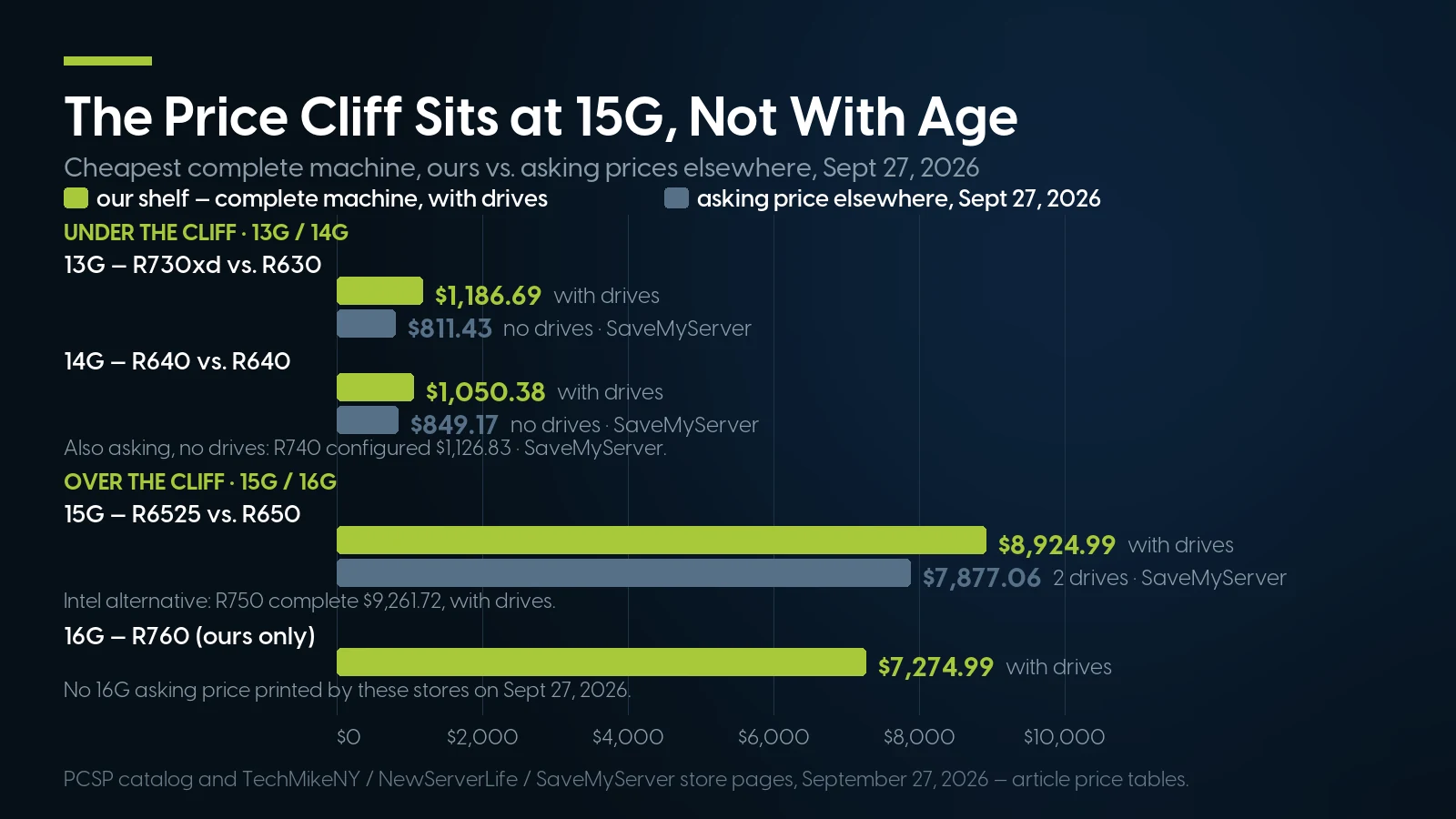
Complete machines from us beat competitors’ asking prices at 13G and 14G; the real jump is 15G, where every price — ours or theirs — passes $7,800. The cliff sits at 15G, not between old and new.
Our own cheapest complete machines follow the other stores’ line: $1,186.69 for 13G and $1,050.38 for 14G, then $8,924.99 for 15G and $7,274.99 for 16G. The step sits between 14G and 15G, not between old and new.
Where we are not the cheapest. SaveMyServer’s saved R640 with the same two Gold 6126 and 64 GB as our $1,050.38 machine listed at $849.17, without drives and with a 180-day default warranty; ours adds two 300 GB SAS drives, an HBA330, iDRAC Enterprise and our one-year warranty on configured systems. TechMikeNY includes a one-year warranty too. Compare drives, controller, iDRAC licence and warranty before the headline number.
When a Used PowerEdge Is the Wrong Buy — Including From Us
Most of our Dell rack shelf is 13G and 14G, so here is the case against both, and against the shelf.
Anything new that must stay patched should not be 12G or 13G. 12G is DDR3 and TPM 1.2, and its newest Dell-listed hypervisor lost general support in October 2022. 13G’s iDRAC8 left maintenance in February 2024, its last Dell-listed ESXi lost general support in October 2025, VCF 9 will not install on its v4 chips, and Dell does not list Server 2022 for it. A 13G is still a sound Proxmox, Linux or backup box where you own the patching; it is the wrong machine for a VMware 8 cluster, a Server 2022 estate or anything audited against vendor-maintained firmware.
If policy requires vendor-maintained management firmware, a 14G bought now has four months of it. After February 1, 2027 Dell is “no longer obligated to maintain or repair” iDRAC9 on 14G. On an isolated management network in a lab that may not matter; for a regulated environment, an iDRAC reachable from the internet or an auditor who asks, it does. 15G and 16G run iDRAC9 with no end date published, which is not a promise either.
Buy 15G or 16G, new or by quote, when the work needs what 14G lacks: PCIe 4.0 or 5.0 for NVMe arrays, DDR5 bandwidth, Server 2025 on a platform Dell lists, Secured-core, or a Dell warranty and support contract. New has a price: Dell listed the R660 from $21,360 in August 2026, per our server cost guide. Our own 15G and 16G categories are short and mostly quoted to order.
17G is not a used product yet. We list it only as $1 quote placeholders; for Xeon 6, DDR5-6400 or iDRAC10 today, buy new.
And where our shelf is thin. No 12G at all, and no DDR5 memory, so a 16G from us cannot be upgraded from our memory shelf. There is no complete plain R740 right now, only build-your-own pages and R740xd machines, and no complete Intel R650 with a drive. And our 20 R640 listings are many memory and drive variants of the same chassis, not 20 different machines.
Dell PowerEdge by generation on our shelf today
Lowest listed price in each category and what is on the shelf right now — barebones chassis included, so a complete build costs more than the figure shown. This block is the one part of the article that refreshes itself; every price in the text above is dated where it stands.
- PowerEdge R63013G · 1U · Xeon E5 v3/v4From $119.99 · 2 in stock
- PowerEdge R73013G · 2U · Xeon E5 v3/v4From $104.99 · 6 in stock
- PowerEdge R64014G · 1U · Xeon ScalableFrom $372.49 · 20 in stock
- PowerEdge R74014G · 2U · Xeon ScalableFrom $291.99 · 22 in stock
- All Dell PowerEdgeEvery generation we stockFrom $104.99 · 124 in stock
Tell us the hypervisor and the drive count. We will tell you the generation.
R630 listings start at $119.99 and R640 listings at $372.49 — lowest listed prices, refreshed nightly, build-your-own bases included, so a complete machine costs more. 15G and 16G are mostly quoted to order. One-year warranty on every configured server, extendable to five years; free ground shipping over $35.
Browse Dell PowerEdge servers Ask for a quoteThe Bottom Line
A PowerEdge model number gives the generation, and the generation gives three dates that matter more than the launch year: when Dell stops fixing the iDRAC, which ESXi Dell last listed, and which Windows Server Dell certifies. On those, 12G is finished, 13G is a budget machine for owners who patch it themselves, and 14G is the used sweet spot with February 1, 2027 written into the plan. The price does not step with age but between 14G and 15G, where PCIe 4.0, eight memory channels and a Dell-listed Server 2025 cost thousands of dollars more.
Our shelf has the same shape: 12G sold out, 14G deep and mostly R640, 15G and 16G short and largely quoted, 17G not stocked, and no DDR5 memory. As of October 1, 2026, a complete R640 with drives starts at $1,050.38 here.
Dell PowerEdge Generations: Frequently Asked Questions
What generation is my Dell PowerEdge server?
Read the model number. In Dell’s rule the first digit after the letter is the class, the second is the generation — 2 for 12th, 3 for 13th, 4 for 14th and so on — and the last is the CPU maker, 0 for Intel and 5 for AMD. An R640 is a 14th-generation Intel server, an R750 a 15th-generation one, an R7525 a 15th-generation AMD machine. Dell’s support site also identifies any server by its service tag.
What is the difference between the Dell PowerEdge R640 and R740?
Same 14th generation, same Xeon Scalable processors, 24 memory slots and iDRAC9, different box. The R640 is 1U with up to three PCIe slots and ten 2.5-inch bays plus two at the rear, or four 3.5-inch. The R740 is 2U with up to eight PCIe slots, sixteen 2.5-inch or eight 3.5-inch front bays and room for three 300 W GPUs. For 24 NVMe drives, Dell’s 2U answer is the R740xd.
When were the Dell PowerEdge R720, R730, R740 and R750 released?
Per Dell’s press releases, the R720 was announced on March 6, 2012, the day Dell put its first 12th-generation servers on sale; the R730 and R630 began shipping on September 8, 2014; the R740 and R640 became available worldwide on July 11, 2017; and the R750 and R650 had planned availability in May 2021. The R760 followed in February 2023 and the R770 on April 8, 2025.
Is the Dell PowerEdge R640 or R740 end of life?
Dell publishes no end-of-life date for PowerEdge models; its forum moderators point to the service tag. What Dell publishes is the iDRAC date: feature development for iDRAC9 on 14th-generation servers ended June 30, 2023, and software maintenance continues until February 1, 2027. The R640 and R740 BIOS got a security update, version 2.26.1, in March 2026. Dell’s December 2025 Windows matrix calls almost all 14G platforms discontinued but does not mark the R640 or R740.
Does the Dell PowerEdge R640 or R740 support Windows Server 2025?
Dell says two things. BIOS 2.22.2 of October 1, 2024 adds “Support for Microsoft Windows Server 2025 Operating System for R740 and R640.” Dell’s December 2025 Windows Server matrix has no Server 2025 column for 14G, and its Server 2025 PERC driver lists no 14G system and no H330, H730 or H730P. The firmware enables it; the support list and the RAID driver do not include 14G. Dell lists Server 2025 for the R650, R750 and 16G.
Can a Dell PowerEdge R630 or R730 run ESXi 8?
Not on Dell’s lists. Dell’s ESXi 8.x compatibility matrix of March 2026 covers 14th-generation servers and newer; its 7.x matrix lists the R630, R730 and R730xd up to ESXi 7.0 Update 3, whose general support Broadcom ended on October 2, 2025. VMware Cloud Foundation 9 will not install on their E5-2600 v4 processors. The oldest generation Dell lists for ESXi 8 is 14G, booting from a drive or a BOSS card.
Is a used Dell PowerEdge R750 worth it over an R740?
When the work needs what 15G added: PCIe 4.0, eight memory channels of DDR4-3200 instead of six of 2933, more direct-attached NVMe and a Dell-listed Server 2025. It costs far more. On September 27, 2026 three other stores asked $2,999.95–$4,937.07 for a bare 15G chassis against $79.95–$461.84 for 13G and 14G, and our cheapest complete R750 was $9,261.72 against $1,873.91 for our cheapest complete R740xd. For general virtualization, file and backup work, a 14G does the job.