

Intel Xeon Generations Explained: What to Buy Used in 2026
Posted by Konstantin Protasov, PCSP on Sep 5th 2026
As of September 8, 2026, a 14-core Intel Xeon Gold 6132 costs $14.99 on our shelf, 157 units deep — and Broadcom's knowledge base, updated September 18, 2026, keeps its Skylake-SP silicon only “in Deprecated Mode for VCF 9.x” and says support “will not be extended to VCF releases beyond VCF 9.x.” That is the used-Xeon question in one sentence: the hardware is nearly free; the software vendors decide how long you may run it. Below: the ladder from the Xeon E5 v3 of 2014 to the Xeon 6 of 2024–2026, what each rung costs, what still runs on it, and where an old socket is the wrong buy.
Sources: Intel ARK, the Dell, HPE and Lenovo technical guides, Broadcom, Microsoft and Proxmox documentation (opened September 4–5, 2026), published SPEC results and PassMark. Our prices are the live catalog on September 8, 2026; other dealers' figures are asking prices captured on September 4, labelled as such. Linked, not repeated: how to inspect a used server, why DDR4 platforms are the 2026 value pocket, home-lab wattage and noise.
The short version, checked September 8, 2026:
- The second digit of a Scalable model number is the generation (8180 = 1st gen, 8280 = 2nd … 8592+ = 5th), the first digit the tier. E5 “v3” is Haswell (2014), “v4” Broadwell (2016).
- Only two neighbouring generations share a socket: 1st/2nd on LGA3647, 4th/5th on LGA4677. Every other step is a new board; from the 4th gen, DDR5.
- Software sets the deadline. Broadcom blocks E5 v4 in VCF 9.x and keeps Skylake-SP and Cascade Lake only in deprecated mode, neither beyond 9.x (correction, October 5, 2026: this line first named only Skylake-SP). Dell's OS matrix stops 13G at Server 2019 and 14G at 2022; Microsoft's Windows 11 list carries 1st- to 3rd-gen Scalable and Xeon W-2100/W-2200, no Xeon E5.
- Intel has ended servicing for the older rungs. Its servicing page dates the end of servicing updates to December 2021 for E5 v3, June 2022 for E5 v4, December 2023 for 1st-gen Scalable and June 2025 for 2nd-gen. Its 2026 microcode touches 3rd gen and newer; its own table marks Haswell, Broadwell and Skylake server silicon “Not Affected” by every 2025–2026 issue.
- Memory decides the bill. Our DDR4 RDIMMs run $5.75–$11.75 per GB by speed; a 32 GB DDR5 RDIMM was $999.99–$1,268.99 at other dealers' asking prices on September 4 — 4.6 to 5.9 times our $215.99 DDR4-2666 module.
- The shelf, priced complete: Dell R630, 2× E5-2650 v4, 16 GB, $272.93; HPE DL360 Gen10, 2× Silver 4110, 64 GB, $652.89; Dell R640, 2× Silver 4114, 64 GB, $867.29. Third gen starts at $9,261.72; 4th/5th gen are to order.
How to Read a Xeon Name
Intel's support article 000059657, “Understanding Intel Xeon Processors: Numbers and Suffixes” (last reviewed June 16, 2026), warns that numbers and suffixes “are used to differentiate features within each processor family, not across different families”: a Gold 6132 and a Xeon W-2135 share a brand and nothing else. Inside the Scalable family the digits are a code, and a suffix can change meaning between generations:
| Element | Meaning, in Intel's words | Examples |
|---|---|---|
| First digit | Level: 8 and 9 = Platinum; 6 and 5 = Gold; 4 = Silver; 3 = Bronze | Gold 6132, Silver 4114, Platinum 8280 |
| Second digit | Generation: 1 = 1st Gen … 5 = 5th Gen Intel Xeon | 6132 = 1st gen (Skylake); 6246 = 2nd (Cascade Lake); 6338 = 3rd (Ice Lake); 6448Y = 4th (Sapphire Rapids) |
| Third and fourth digits | SKU number — “These numbers do not represent any specific feature.” | 5118 and 5218: same tier, one generation apart |
| Suffix R | “SKU has been refreshed from prior generation” | 2nd gen only: Gold 6248R, 6226R, Silver 4210R (Q1’20 refresh) |
| Suffix + | “Feature plus SKU”: DSA, DLB, QAT and IAA accelerators enabled | 4th and 5th gen: Platinum 8480+, 8592+ |
| Suffix M / L | “Large Memory Tier”: 1.5 TB per socket (1st gen), 2 TB (2nd, per HPE QuickSpecs) / up to 4.5 TB | Platinum 8180M, 8280M / 8280L |
| Suffix H, F, N, P, T, U, Y | 4/8-socket only; Omni-Path fabric; networking, cloud, long-life thermal, single-socket, Speed Select variants | Cooper Lake 8380H; F on 1st gen only; T from 1st gen, N/U/Y from 2nd, P from 3rd |
Source: Intel support article 000059657 (June 16, 2026), condensed to the letters on used-market parts; examples from Intel ARK, September 4, 2026; the 2 TB figure from HPE's DL380 Gen10 QuickSpecs.
The second digit also fixes memory speed, PCIe generation and, as the tables below show, the hypervisor floor. Three families sit outside the scheme:
- Xeon E5-2600 v3 / v4 (2014–2016). E5-2600 is the two-socket line, E5-1600 the workstation line; v3 is Haswell (Q3 2014), v4 Broadwell (Q1 2016), per the ARK page of the E5-2699 v4. Both: LGA2011-3, four DDR4 channels, 40 PCIe 3.0 lanes, no AVX-512 (ARK lists AVX2 as the top extension).
- Xeon W (single-socket workstation). W-2100 (Skylake, Q3 2017) and W-2200 (Cascade Lake, Q4 2019) use LGA2066, four channels, 48 lanes; W-3200 (Q2 2019) uses LGA3647, six channels, 64 lanes; from 2023 the Sapphire Rapids parts are w3/w5/w7/w9-2400 and -3400.
- Xeon 6 (2024). The digits change meaning: 6900-series parts use the twelve-channel LGA7529 socket, 6700/6500-series the eight-channel LGA4710; a trailing P is a Performance-core part (6980P), E an Efficient-core part (6780E) — different chips, not bins.
The Generation Ladder, 2014 to 2026
Hardware cells come from each flagship's ARK page (opened September 4, 2026) or the OEM guide that names it; the last column is our live inventory the same day — “complete” means CPUs and memory included, stock in parentheses.
| Generation (code name) | Launch (ARK) | Socket | Flagship cores / threads | Memory: type · channels · top speed · max per socket | PCIe | Vector / AI ISA | Platforms (Dell / HPE / Lenovo) | Cheapest complete server, PCSP, Sept 8, 2026 |
|---|---|---|---|---|---|---|---|---|
| Xeon E5-2600 v3 (Haswell-EP) | Q3’14 | LGA2011-3 | 18 / 36 (E5-2699 v3) | DDR4 · 4 ch · 2133 · 768 GB | 3.0 ×40 | AVX2 (no AVX-512) | Dell 13G R630/R730/T630; HPE Gen9 DL360/DL380; Precision T5810–T7910, HP Z440–Z840, ThinkStation P510–P910 | R630 2× E5-2650 v3, 96 GB — $806.26 (2) |
| Xeon E5-2600 v4 (Broadwell-EP) | Q1’16 | LGA2011-3 | 22 / 44 (E5-2699 v4) | DDR4 · 4 ch · 2400 · 1.5 TB | 3.0 ×40 | AVX2 (no AVX-512) | Same 13G / Gen9 boards, 2016 refresh | R630 2× E5-2650 v4, 16 GB — $272.93 (16) |
| 1st Gen Scalable (Skylake-SP) | Q3’17 | LGA3647 | 28 / 56 (Platinum 8180) | DDR4 · 6 ch · 2666 (Silver/Gold 5: 2400) · 768 GB (M: 1.5 TB) | 3.0 ×48 | AVX-512 (1 FMA unit on Silver/Gold 5, 2 on Gold 6/Platinum) | Dell 14G R440–R740/T640; HPE Gen10 DL360/DL380; Lenovo SR630/SR650; Precision 7820/7920, Z6/Z8 G4, P720/P920 | R640 2× Silver 4108, 16 GB — $596.37 (15); DL360 Gen10 2× Silver 4110, 64 GB — $652.89 (62) |
| 2nd Gen Scalable (Cascade Lake-SP) | Q2’19; R refresh Q1’20 | LGA3647 | 28 / 56 (Platinum 8280) | DDR4 · 6 ch · 2933 (Silver: 2400; Gold 5: 2667) · 1 TB (L: 4.5 TB); Optane PMem | 3.0 ×48 | AVX-512 + DL Boost | Same 14G / Gen10 / SR630 boards, 2019 refresh | DL380 Gen10 Platinum 8268, 64 GB — $1,385.80 (5) |
| 3rd Gen Scalable (Ice Lake-SP) | Q2’21 | LGA4189 | 40 / 80 (Platinum 8380) | DDR4 · 8 ch · 3200 · 6 TB | 4.0 ×64 | AVX-512 | Dell 15G R450–R750; HPE Gen10 Plus; Lenovo SR630/SR650 V2 | R750 2× Platinum 8358, 128 GB — $9,261.72 (4) — our only 3rd-gen machine |
| 4th Gen Scalable (Sapphire Rapids) | Q1’23 | LGA4677 | 56 / 112 (Platinum 8480+) | DDR5 · 8 ch · 4800 (1 DPC) · 4 TB | 5.0 ×80 | AVX-512 + AMX | Dell 16G R660/R760; HPE Gen11; Lenovo SR630 V3; Xeon W-2400/3400 towers | R760 2× Gold 5416S, 128 GB DDR5 — $5,899.99 (to order) |
| 5th Gen Scalable (Emerald Rapids) | Q4’23 | LGA4677 | 64 / 128 (Platinum 8592+) | DDR5 · 8 ch · 5600 (1 DPC) · 4 TB | 5.0 ×80 | AVX-512 + AMX | Same 16G / Gen11 / V3 platforms | R660 2× Gold 6526Y, 512 GB DDR5 — $19,999.99 (to order) |
| Xeon 6 (Granite Rapids P-core / Sierra Forest E-core) | Q2’24 (6780E); Q3’24 (6980P) | LGA4710 (6700/6500) / LGA7529 (6900) | 128 / 256 (6980P); 144 / 144 (6780E, no HT) | DDR5 · 12 ch · 6400, MRDIMM 8800 · 3 TB (6900); 8 ch · 6400 · 4 TB (6700) | 5.0 ×96 (6900); ×88 (6700) | AMX + AVX-512 (P-core); AVX2 only (E-core) | Dell 17G R670/R770; HPE Gen12; Lenovo SR630/SR650 V4 | None on the shelf — quote only |
Sources: Intel ARK pages for the Platinum 8180, 8280, 8380, 8480+, 8592+, Xeon 6980P, 6780E, E5-2699 v3 and E5-2699 v4, opened September 4, 2026; OEM guides for the platform column, including Lenovo Press LP1049 and LP1971 (also in our spec-sheet library); PCSP live inventory, September 8, 2026. 16G is untracked stock, quoted to order.
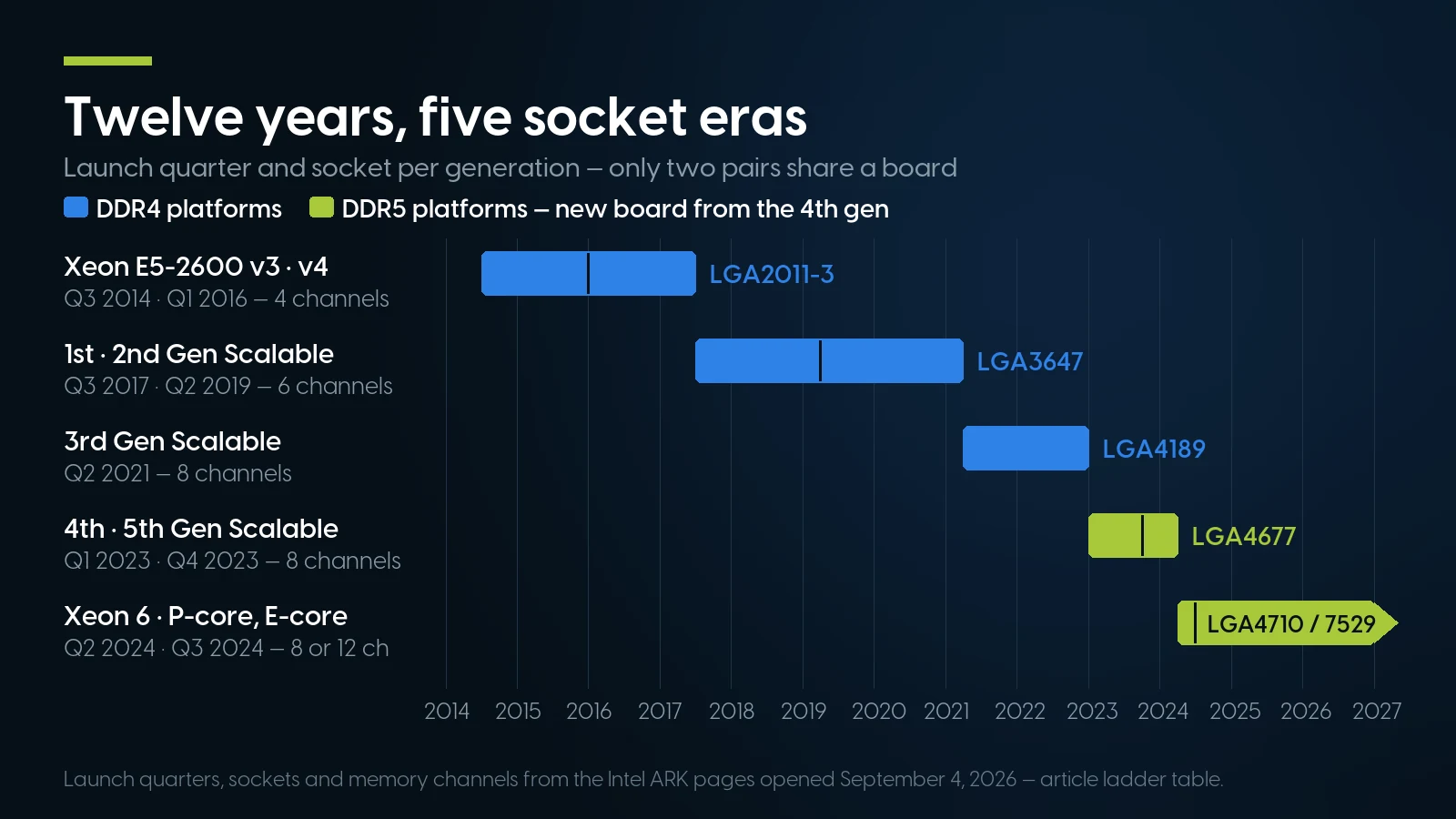
Only the 1st→2nd and 4th→5th steps keep the socket; DDR5 arrives with the 4th gen. Intel ARK, September 4, 2026.
Only the 1st → 2nd and 4th → 5th steps keep the socket, and even then HPE's DL360 Gen11 QuickSpecs (document a50004306enw, version 48, September 8, 2026) state that a field upgrade from 4th- to 5th-gen processors is not supported: the 5th-gen firmware does not run on the system board shipped with 4th-gen parts, so a new server order is required (correction, October 5, 2026: this line first cited document a00128934, an HPE customer advisory the QuickSpecs refers to). Cooper Lake (Platinum 8380H, Q2 2020) is printed as “3rd Gen” on its ARK page but is a 4/8-socket, six-channel, PCIe 3.0 part, not the Ice Lake-SP platform.
What Each Generation Is Actually Good At: Throughput, Price, Power
Core counts sell servers; per-core throughput and memory bandwidth run them. The yardstick is SPEC CPU2017 Integer Rate — published results on spec.org, index as served September 4, 2026, two-socket systems, base result; “per core” is base ÷ enabled cores, bandwidth the theoretical ARK figure (channels × MT/s × 8 bytes).
| Generation | CPU (2-socket system, test sponsor) | Cores | SPECrate2017_int_base | Per core | Memory bandwidth per socket (theoretical) |
|---|---|---|---|---|---|
| E5 v4 | E5-2680 v4 (HPE DL380 Gen9) | 28 | 149 | 5.3 | 76.8 GB/s (4 × 2400) |
| 1st gen | Silver 4114 (ASUS / Cisco) | 20 | 97.5 / 95.4 | 4.9 | 115.2 GB/s at DDR4-2400 |
| 1st gen | Gold 6132 (ASUS / Cisco) | 28 | 165 / 162 | 5.9 / 5.8 | 128 GB/s (6 × 2666) |
| 2nd gen | Gold 6246 (Cisco) | 24 | 186 | 7.8 | 140.8 GB/s (6 × 2933) |
| 2nd gen, R refresh | Gold 6248R (ASUS / Altos) | 48 | 367 / 321 | 7.6 / 6.7 | 140.8 GB/s |
| 3rd gen | Platinum 8380 (Cisco / Fujitsu) | 80 | 549 / 531 | 6.9 / 6.6 | 204.8 GB/s (8 × 3200) |
| 4th gen | Platinum 8480+ (ASUS / Fujitsu) | 112 | 959–969 / 900 | 8.6 / 8.0 | 307.2 GB/s (8 × 4800) |
| 5th gen | Platinum 8592+ (ASUS / Cisco) | 128 | 1,130 / 1,040 | 8.8 / 8.1 | 358.4 GB/s (8 × 5600) |
| Xeon 6 P-core | Xeon 6980P (Giga Computing) | 256 | 2,440 | 9.5 | 614.4 GB/s (12 × 6400); 844.8 with MRDIMM-8800 |
Sources: SPEC CPU2017 published results, spec.org index as served September 4, 2026; per core = base ÷ enabled cores (PCSP arithmetic); bandwidth theoretical from Intel ARK; the 4114 row uses ARK's DDR4-2400 ceiling for Silver.
Now our September 5 prices against PassMark CPU Mark, which is user-submitted, so we print the sample count. $/core = price ÷ cores; $ per 1,000 points = price ÷ (CPU Mark ÷ 1,000).
| CPU | Generation | Cores | PCSP price, Sept 8 (units) | $/core | PassMark CPU Mark (samples) | $ per 1,000 points | Single-thread |
|---|---|---|---|---|---|---|---|
| Gold 6132 | 1st gen | 14 | $14.99 (157) | $1.07 | 22,509 (44) | $0.67 | 2,128 |
| Gold 5118 | 1st gen | 12 | $14.99 (37) | $1.25 | 16,699 (28) | $0.90 | 1,763 |
| E5-2660 v4 | E5 v4 | 14 | $14.99 (61) | $1.07 | 15,411 (104) | $0.97 | 1,778 |
| E5-2699 v3 | E5 v3 | 18 | $20.78 (15) | $1.15 | 20,044 (681) | $1.04 | 1,876 |
| E5-2680 v4 | E5 v4 | 14 | $19.99 (41) | $1.43 | 17,160 (2,658) | $1.16 | 1,930 |
| Gold 6126 | 1st gen | 12 | $29.99 (162) | $2.50 | 17,492 (19) | $1.71 | 2,140 |
| Gold 6154 | 1st gen | 18 | $69.99 (65) | $3.89 | 27,672 (26) | $2.53 | 2,203 |
| Gold 6246 | 2nd gen | 12 | $99.99 (3) | $8.33 | 22,571 (5) | $4.43 | 2,487 |
| W-2235 | Xeon W-2200 | 6 | $64.99 (159) | $10.83 | 14,180 (318) | $4.58 | 2,603 |
Sources: PCSP /refurbished-cpu/ live prices, September 8, 2026 (the Gold 5218 at $19.99 sold out on September 4 and is omitted, as is the single-unit E5-2697 v4); PassMark scores and sample counts read September 5, 2026; derived columns are PCSP arithmetic.
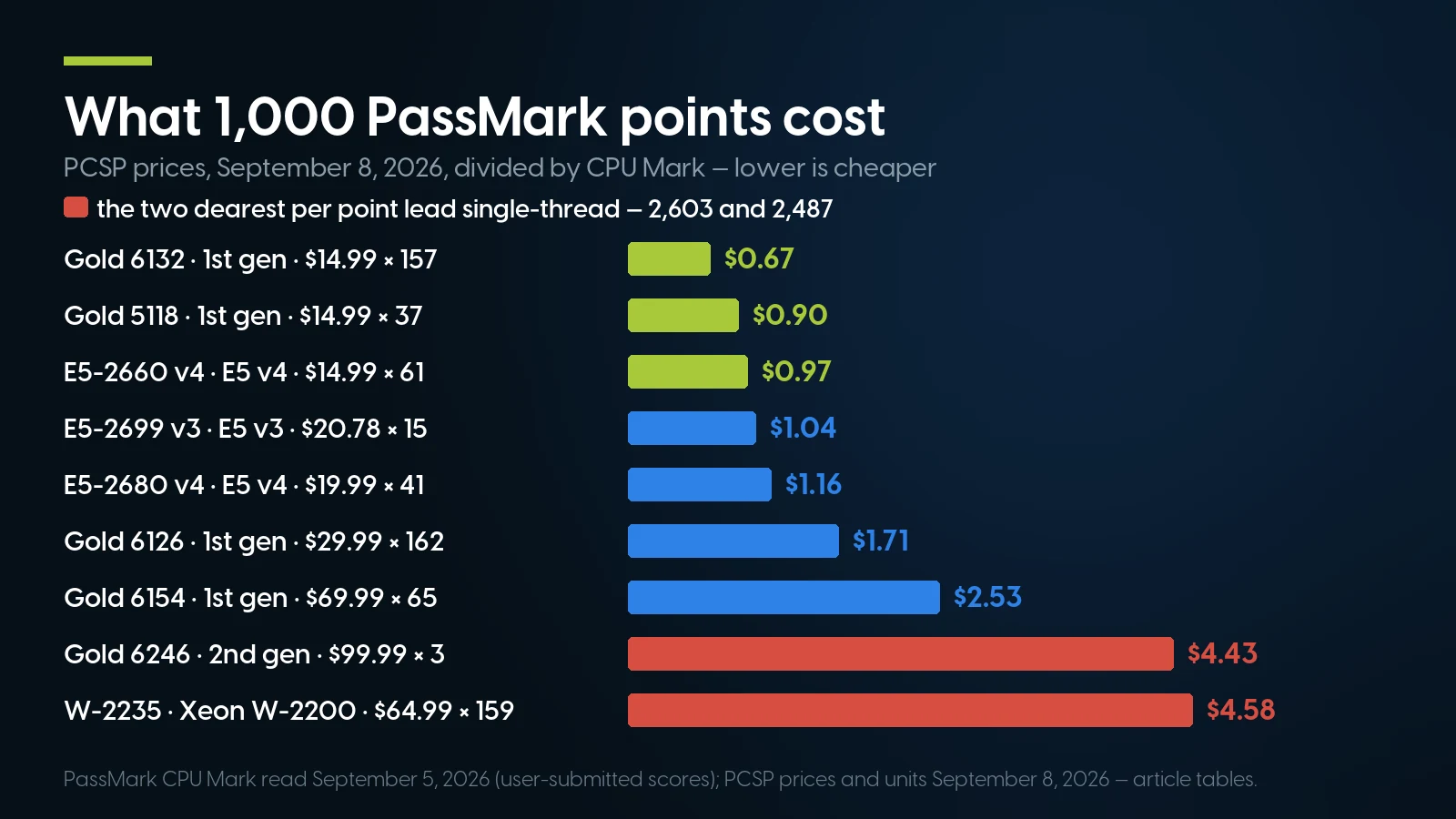
The $14.99 Gold 6132 costs $0.67 per 1,000 points; the $4.58 W-2235 is priced for clocks. PCSP prices September 8; PassMark scores September 5, 2026.
The Gold 6132 at $0.67 per 1,000 points is the cheapest compute on the shelf, while the two highest single-thread parts we stock, the W-2235 and Gold 6246, are the dearest per multi-thread point: the used market prices clocks, not cores. Above 2nd gen there is no used market yet: on September 4 a Gold 6338 was $1,199.95 at TechMikeNY, and the Platinum 8480+ and 8592+ appeared only at CloudNinjas, at $25,167.19 and $28,384.69 (asking prices), roughly twice Intel's recommended $11,995 and $12,992 on ARK.
The R line is the value line, not the Skylake Gold. A Gold 6248R (24 cores, 205 W, Q1 2020, per ARK) was $342.04 at SaveMyServer and $499.95 at TechMikeNY on September 4 (asking prices) against the $14.99 Gold 6132; SPEC per core 7.6 against 5.9 and PassMark 36,067 (10 samples) against 22,509 explain the gap, and ServeTheHome (March 26, 2020) measured the refresh “20-30% higher” than its predecessor. It drops into the same LGA3647 socket, but check the vendor's processor list for your board revision: HPE's DL380 Gen10 (version 77, June 16, 2025) and DL360 Gen10 QuickSpecs say “Field upgrades from 1st generation processors (x1xx) to 2nd generation processors (x2xx) not supported.” (Correction, October 5, 2026: this line first left out HPE's rule.)
Power: Idle and Peak by Platform Generation
A TDP is a cooling specification, not a power bill. SPECpower_ssj2008 publishes whole-server watts at active idle and at 100% load for tuned submissions (minimal drives, power-saving BIOS), so idle figures are floors; index as served September 4, 2026, one two-socket result per generation.
| Generation | System (2 × CPU, memory) | Published | Active idle, W | W at 100% load | Overall ssj_ops/W |
|---|---|---|---|---|---|
| E5 v3 | Dell R730, 2× E5-2699 v3, 64 GB | 2014–15 (index shows month only) | 46.9 | 272 | 10,206 |
| E5 v4 | Dell R730, 2× E5-2699 v4, 128 GB | 2016 | 44.9 | 269 | 10,802 |
| 1st gen | Dell R640, 2× Platinum 8180, 192 GB | Sept 13, 2017 | 55 | 469 | 11,542 |
| 2nd gen | Dell R740, 2× Platinum 8280, 192 GB | 2019 | 49.8 | 432 | 12,831 |
| 3rd gen | Fujitsu RX2530 M6, 2× Platinum 8380, 256 GB | Apr 28, 2021 | 131 | 580 | 11,533 |
| 4th gen | HPE DL380 Gen11, 2× Platinum 8480+, 256 GB | Feb 9, 2023 | 201 | 689 | 13,296 |
| 5th gen | Fujitsu RX2540 M7, 2× Platinum 8592+, 512 GB | Apr 9, 2024 | 163 | 920 | 16,260 |
| Xeon 6 E-core | Dell R770, 2× Xeon 6780E, 512 GB | Aug 13, 2025 | 197 | 831 | 20,516 |
| Xeon 6 P-core | Dell R770AP, 2× Xeon 6980P, 768 GB | Jan 27, 2026 | 241 | 1,185 | 22,805 |
Source: SPECpower_ssj2008 published results (spec.org), index as served September 4, 2026; where a platform has two runs the earlier is shown; the E5 v3/v4 rows carry only the month in the index.
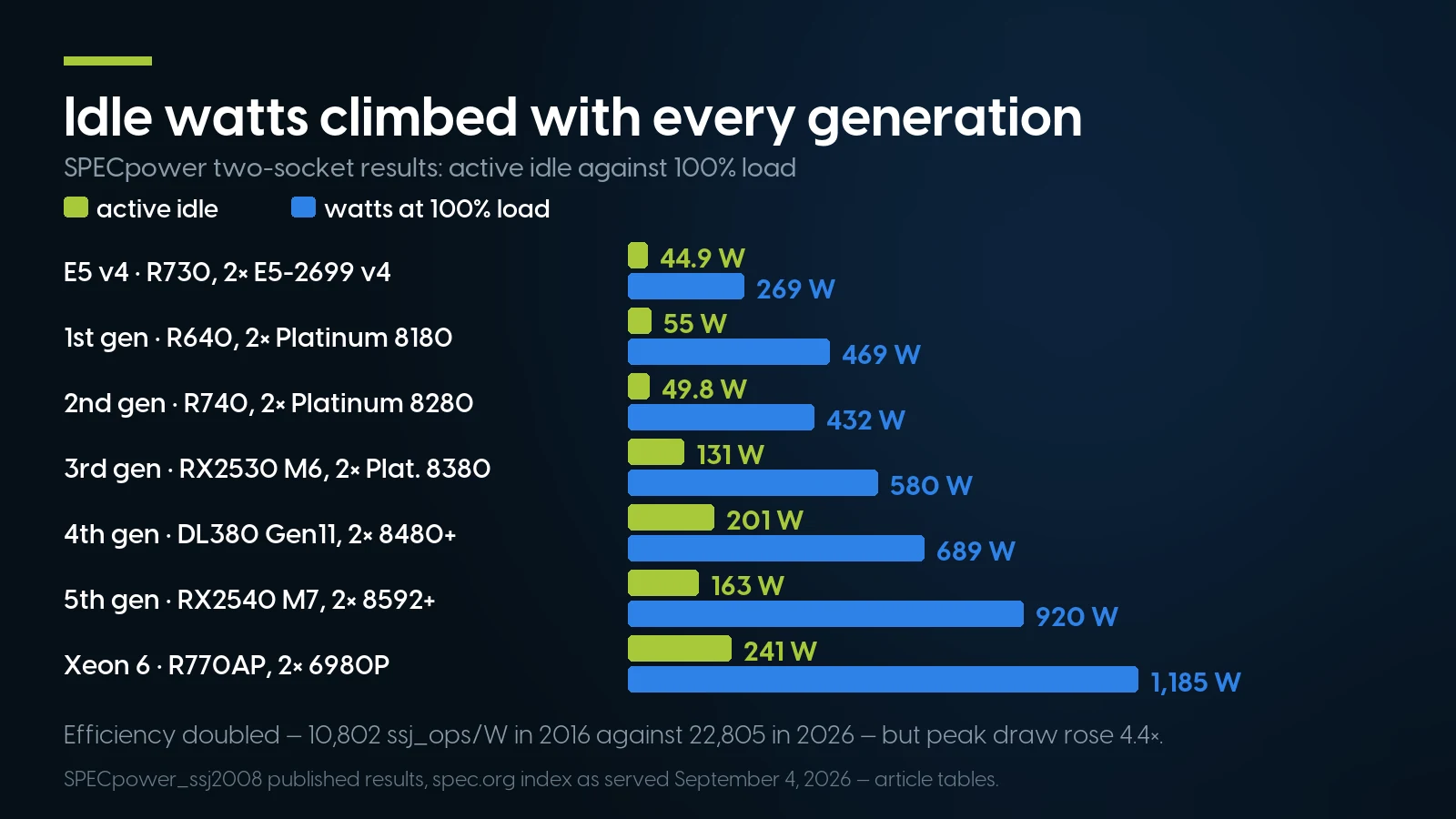
Idle rose from 44.9 W on E5 v4 to 241 W on Xeon 6; full load more than quadrupled. SPECpower_ssj2008, September 4, 2026.
The old platforms idle at 45–55 W, Ice Lake at 131 W, the DDR5 generations at 163–241 W. Efficiency roughly doubled (ssj_ops/W from about 11,000 in 2016 to 20,500–22,800 in 2025–2026) while work per box moved far more: the R770AP's 31.4 million ssj_ops at 100% load is 9.4 times the R730's 3.3 million, for 4.4 times the peak watts. At our home-lab article's $1.61 per watt per year, 45 W of idle costs about $72 a year, 241 W about $388; the rack that is 15% busy belongs to the old generation.
What Still Runs on It: Hypervisors and Windows, by Generation
Here the second digit turns into a date; every cell is vendor wording from the documents in the caption. Proxmox VE is absent because it publishes no CPU-generation floor — “64-bit x86 (Intel 64 or AMD64)” with “Intel VT or AMD-V” — so every row runs it.
| Generation | VMware VCF 9.x / ESX 9 (Broadcom) | Windows Server on Dell PowerEdge (Dell OS matrix) | Windows 11 (Microsoft's general Intel list) |
|---|---|---|---|
| E5 v3 (Haswell-EP) | Absent from both 9.x tables; for ESXi 8.0 Broadcom states only a rule (below) | 13G R630/R730/R730xd/T630: Server 2019, 2016, 2012 R2 only — no 2022 or 2025 column; footnoted “13G and older discontinued platforms” | Not listed (no Xeon E5 of any version is) |
| E5 v4 (Broadwell-EP) | Discontinued: “Xeon E5-2600-V4 Series … Broadwell-EP — Discontinued”; the installer blocks it | Same 13G row | Not listed |
| 1st gen (Skylake-SP) | Deprecated through 9.x only: KB 428874 (updated September 18, 2026): “now supported in Deprecated Mode for VCF 9.x” and “will not be extended to VCF releases beyond VCF 9.x”; install and upgrade paths in the KB's attached document. Xeon W-2100: Discontinued | 14G R640/R740 (also R440/R540/R740xd/T640): Server 2022, 2019, 2016 Qualified — no Server 2025 column; Server 2022+ “require TPM 2.0 installed and enabled, UEFI and Secure Boot” | Listed: “Xeon Scalable Processors” and “Xeon W-2100 Series” |
| 2nd gen (Cascade Lake-SP) | Deprecated in 9.x — installer warning, still supported; slated “Discontinued” in a future major release | Same 14G row | Listed: “2nd Generation Xeon Scalable Processors” and “Xeon W-2200 Series” |
| 3rd gen (Ice Lake-SP) | Absent from both tables — no warning | 15G R650/R750 (also R450/R550): Server 2025 “Qualified (8)” — “not available as a factory-installed OS” — plus 2022, 2019, 2016 | Listed: “3rd Generation Xeon Scalable Processors” |
| 4th / 5th gen | Absent from both tables | 16G R660/R760: Server 2025, 2022, 2019 Qualified | Listed on the 24H2/25H2 pages; the general page adds “subsequently released and future generations … will be considered as supported” |
| Xeon 6 | Absent from both tables | 17G R670/R770: Server 2025, 2022 — note 9: “Windows Server OS is not enabled on SRF CPUs” (the E-core parts) | Workstation Xeon 6 (“Xeon 600 Processors for Workstation”) on the 25H2 list |
Sources: Broadcom KB 318697 (VCF 9.x, updated September 22, 2026) and KB 428874 (updated September 18, 2026); VMware vSphere 8.0 release notes (October 11, 2022); Proxmox VE System Requirements (wiki, November 28, 2024); Dell PowerEdge / Windows Server OS support matrix (PDF, December 17, 2025); Microsoft Windows 11 supported Intel processors (October 16, 2025) and the 25H2 / 24H2 pages. All opened September 4–5, 2026; the two Broadcom articles re-read September 27, 2026.
VMware, in Broadcom's definitions. KB 318697: “Deprecated mode means it is still Supported by VMware” — the installer prints “CPU_SUPPORT_WARNING: The CPUs in this host may not be supported in future VCF releases” — while “In the Phase 2 Discontinued phase, the ESX/VCF installer will block or prevent the installation.” An upgrade showing the warning may proceed (KB 413002). For ESXi 8.0 the only live statement is the release notes' rule that 8.0 “no longer supports CPUs which have been marked as End of Support or End of Life from hardware vendors” (the old per-family KB 82794 now redirects into the 9.x article). The alternative is leaving VMware: our VMware-to-Proxmox guide covers the move, and Proxmox VE 9.2 (released May 21, 2026) installs on anything with VT-x.
Windows Server: Microsoft's processor list and the OEM matrix are the gates. Microsoft's hardware requirements page (updated August 10, 2026) adds only SSE4.2 and POPCNT for Server 2025, present on every processor in the ladder, but Microsoft's processor list, “a prerequisite for system certification”, starts Server 2025 at 2nd-gen Xeon Scalable (x2xx): the E5 v3/v4 and 1st-gen Silver 41xx, Gold 51xx/61xx and Platinum 81xx are not on it. On an R640 Dell's missing column stops it as well. HPE's certification matrix, checked August 28, 2026 for our Windows Server 2012 exit-plan article, lists the DL360 and DL380 Gen10 through Server 2025, and HPE's Server 2025 white paper (February 2026) supports 2nd- to 5th-gen Xeon Scalable, “so this excludes x1xx processors”. (Correction, October 4, 2026: this paragraph first called Microsoft's floor trivial and said HPE takes the same silicon Dell stops at 2022 to Server 2025; 1st-gen Scalable is off Microsoft's Server 2025 list, and HPE excludes it.)
Windows 11 for the workstation towers. By CPU, Microsoft's general list clears the W-2100/W-2200 towers (Precision 5820, HP Z4 G4, ThinkStation P520) and the two-socket 7820/7920, Z6/Z8 G4 and P720/P920; the per-version 24H2 and 25H2 pages omit the W-2100 to W-3200 series. No Xeon E5 or E3 v5/v6 is on any list, so the T5810/T7810/T7910, Z440/Z640/Z840 and P510/P710/P910 towers are out by CPU. An earlier compatibility list of ours used the narrower per-version list for W-2100/W-2200 machines and is being corrected; TPM 2.0 is required either way.
Security Updates: What Intel Still Patches
The forum premise that E5 v4 or Skylake-SP is “end of life for security updates” is, in Intel's own terms, right. Intel's servicing page, read September 27, 2026, dates End of Servicing Updates to December 31, 2021 for the E5 v3, June 30, 2022 for the E5 v4, December 31, 2023 for 1st-gen Xeon Scalable and June 30, 2025 for the 2nd gen, with the 3rd gen scheduled for June 30, 2027. At that milestone, in Intel's lifecycle paper, “Intel concludes servicing the broad market”; the servicing page adds that systems “may still be serviced and supported by hardware and software vendors”. Intel's “End of Servicing Update for Skylake Products” (July 27, 2022), which said “this ESU does not apply to Skylake server products (1st Generation Intel Xeon Scalable Processors)”, predates those server dates. The release record fits them: the microcode-20260811 release updates ICX-SP (3rd gen), SPR-SP (4th), EMR-SP (5th) and GNR (Xeon 6 P-core), and neither it nor the May 12, 2026 release touches family 06-55 (Skylake-SP, Cascade Lake), 06-4F (Broadwell-EP) or 06-3F (Haswell-EP). Intel's affected-processors table, read September 5, 2026, marks those three families “Not Affected” on every issue disclosed in 2025–2026.
The older issues decide performance, and there the same table reads the other way. Haswell-EP, Broadwell-EP and Skylake Server take Spectre v2, L1TF, MDS and the 2022 MMIO class as “MCU + Software” — microcode plus OS mitigations — where Ice Lake-SP is “Not Affected” by L1TF and MDS, Sapphire and Emerald Rapids also by the MMIO class, and both fix Spectre v2 in hardware; Haswell-EP and Broadwell-EP additionally show “No planned mitigation” for Snoop-assisted L1D Sampling, LVI and RAPL. Downfall is the one with a number attached. INTEL-SA-00828 (August 8, 2023; CVE-2022-40982) covers “certain vector execution units”, and Intel's Gather Data Sampling paper says the microcode mitigation is on by default and that “specific workloads may show performance impacts of up to 50%” — gather-heavy HPC and graphics code. It lands on Skylake-SP (stepping 4), Cooper Lake and Ice Lake-SP, not on E5 v3/v4 or the 4th and 5th gen. We print no percentage for Spectre, L1TF and MDS: no Intel page with a figure was opened for this article.
Intel's Own Calendar: The Discontinuation Notices
Intel retires a family with a Product Change Notification fixing last-order and last-ship dates; its discontinuance policy page says the schedule “varies by product family”. The dated record:
| Family | Notification | Last order | Last ship | Source |
|---|---|---|---|---|
| 2nd gen Cascade Lake (68 SKUs) | PCN119680-01 (Oct 4, 2023) | Apr 26, 2024 (press-reported) | Oct 23, 2026 (press-reported; a second trade report gives different milestones and the PCN PDF could not be retrieved) | Tom's Hardware; ServeTheHome |
| 4th gen Sapphire Rapids (18 SKUs) | PCN 842299, rev 02 (Jan 14, 2026) | Sept 26, 2025 | Mar 31, 2028 | PCN PDF; Xeon W-2400/3400/2500/3500 unaffected per Tom's Hardware, Jan 21, 2026 |
| Xeon 6 6533P-B | PCN 869595-00 (Dec 1, 2025) | June 26, 2026 | Dec 25, 2026 | PCN PDF |
Sources as linked; PCN PDFs opened September 4, 2026. “Press-reported” marks milestones we could not confirm against the PCN itself. No PCN was found for 1st-gen Scalable (other than the 2019 notice on -F Omni-Path SKUs) or for Ice Lake-SP.
Intel's calendar is about new-chip sales, not your server: used supply comes from decommissioned fleets, and our 157 Gold 6132s show Skylake-SP arriving in volume six years after Cascade Lake replaced it. Above the ladder, Intel's June 1, 2026 blog introduced Xeon 6+ (Clearwater Forest) and ServeTheHome reports Diamond Rapids as a 2027 part: no new wave pushes 3rd/4th-gen parts into the used market this year.
The Memory Bill Decides More Than the CPU
The generation sets memory type and speed, and memory, not the processor, moves the invoice. Our DDR4 RDIMM shelf on September 8, 2026, priced almost flat per gigabyte within each speed:
| DIMM speed (platform) | 8 GB | 16 GB | 32 GB | 64 GB | $/GB, single module | Best kit $/GB |
|---|---|---|---|---|---|---|
| DDR4-2133 / 2400 (E5 v3 / E5 v4) | $45.99 | — (kit 2× 8 GB $91.98) | — | — (64 GB LRDIMM-2400 $335.99) | $5.75 | $5.75 (8 GB modules, 16–256 GB kits) |
| DDR4-2666 (1st gen Gold 6/Platinum; Silver and Gold 5 run 2400) | $53.99 | $107.99 | $215.99 | — (64 GB LRDIMM-2666 $495.99) | $6.75 | $6.75 (2× 16 GB $215.98; up to 1 TB kits) |
| DDR4-2933 (2nd gen Gold 6/Platinum) | $53.99 | $139.99 | $279.99 | $559.99 | $8.75 (8 GB: $6.75) | $8.75 (2× 16 GB $279.98; up to 256 GB kits) |
| DDR4-3200 (3rd gen) | $93.99 | $187.99 | $375.99 | $751.99 | $11.75 | $11.75 (8 and 16 GB modules, 16 GB–2 TB kits) |
| DDR5-4800 / 5600 RDIMM (4th/5th gen, Xeon 6) | none on our shelf | $699.95 (TechMikeNY, asking) | $999.99 Kingston DDR5-5600 to $1,268.99 NEMIX (DatacenterDisk tracker); 2× 32 GB kit $2,779.85 (SaveMyServer) | — | $31.25–$39.66 (32 GB modules, asking prices) | — |
Sources: PCSP /components/ram-memory/ live prices, September 8, 2026, single ECC RDIMMs; kits are lots of 8 or 16 GB modules; $/GB = price ÷ capacity — on this date the kits priced at the same $/GB as single modules. DDR5 figures are other dealers' asking prices and a price tracker's listings the same day.
For one server: 128 GB in a 1st-gen R640 at DDR4-2666 is an 8× 16 GB kit at $863.92 ($6.75 per GB); the same 128 GB at DDR4-3200 for a 3rd-gen R750 is $1,503.84 ($11.75 per GB); for a 4th-gen R760, four 32 GB DDR5 RDIMMs at the cheapest asking price we found come to $3,999.96. Per 32 GB module, DDR5 at $999.99–$1,268.99 is 4.6 to 5.9 times our $215.99 DDR4-2666 part — the ratio that keeps LGA3647 and LGA4189 rational in 2026 for everything not bandwidth-bound. TrendForce's July 9, 2026 forecast (an analyst estimate) says “a server DRAM shortage is already anticipated for 2027”; refurbished DDR4 is already built, so its price rises while its supply does not vanish — our refurbished DDR4 memory article works through buy-now-or-wait.
Which Generation to Buy in 2026, by Workload
The ladder, the compatibility table and the memory bill collapse into one decision table; every example is a live listing on September 4, 2026.
| Workload | Buy this generation | Why | Our example, Sept 8, 2026 (units) |
|---|---|---|---|
| File, print, Active Directory | E5 v4 (13G / Gen9) where Windows Server 2019 is enough; 1st gen (14G / Gen10) for Server 2022; 2nd gen on HPE Gen10 for Server 2025 | Dell: 13G to Server 2019, 14G to 2022; HPE: Gen10 to 2025 with 2nd-gen Xeons (correction, October 4, 2026: first said Gen10 runs 2025 with any CPU). Idles at 45–55 W on SPECpower | R630 2× E5-2650 v4, 16 GB — $272.93 (16); DL360 Gen10 2× Silver 4110, 64 GB — $652.89 (62) |
| Virtualization, SMB (Proxmox, Hyper-V) | 1st gen — 14G, Gen10 or SR630 | No Proxmox CPU floor; six DDR4-2666 channels at $6.75/GB; stock depth R640 695 units, DL380 Gen10 578, SR630 329 | R640 2× Silver 4114, 64 GB — $867.29 (13); SR630 same spec — $938.03 (7) |
| Virtualization on VMware VCF 9 | 2nd gen at minimum (deprecated, installs with a warning); 3rd gen for no warning | Broadcom KB 318697 / 428874: E5 v4 blocked; Skylake-SP deprecated through 9.x on a documented install path, no further; Cascade Lake deprecated | DL380 Gen10 Platinum 8268, 64 GB — $1,385.80 (5); R750 2× Platinum 8358, 128 GB — $9,261.72 (4) |
| Database, per-core licensed | 2nd-gen R refresh, or a high-clock Gold 6246 in a 14G / Gen10 board | SPEC per core 7.6 (6248R) and 7.8 (6246) vs 5.8–5.9 for the Skylake Gold 6132; single-thread 2,487 on the 6246 | Gold 6246 12C — $99.99 (3); R740xd 2× Gold 6248R, 512 GB, 6× 1.92 TB SSD — $6,546.88 (2) |
| VDI, many small VMs | 1st gen with 20–24 cores per socket | At 128 GB a Gold 6148 (20C) or Platinum 8168 (24C) R640 runs 16–20% over the Silver 4114 build ($1,235.37) for twice the cores | R640 2× Gold 6148, 128 GB — $1,438.37 (13); DL380 Gen10 same spec — $1,399.63 (22) |
| AI inference on the CPU, bandwidth-bound analytics | 4th / 5th gen only — or a GPU in an older box | AMX from the 4th gen (ARK); 307–358 GB/s per socket vs 128–141 on LGA3647 | R760 2× Gold 5416S, 128 GB DDR5 — $5,899.99 (available to order) |
| Workstation, single socket | Xeon W-2100 / W-2200 (LGA2066) rather than an E5 v3/v4 tower | On Microsoft's Windows 11 general list; E5 towers on none. Deepest shelves: T5820 4,486 units, P520 5,392 | Precision T5820 W-2135, 16 GB — $271.96 (238); ThinkStation P520 W-2133 — $291.74 (124) |
Source: PCSP live inventory, September 8, 2026 (units are the listing's stock pool shared by several configurations; 16G quoted to order).
Home labs have their own row in our home-lab article, from a $104.99 R730 barebones; our SR630 vs R640 comparison and the R750 review go deeper on two rows above; the used-server buying checklist is the same for every generation.
Every CPU in the price table ships from stock — tested, 90-day warranty
Gold 6132 from $14.99, matched pairs on request, and the LGA3647 hosts to put them in. Tell us the board and the workload and we will spec the CPU and the DIMM speed that actually runs on it.
Browse refurbished CPUs Request a quoteWhen an Old Xeon Is the Wrong Buy
We sell up to the 2nd gen at volume, the 3rd barely at all; here the cheap socket is wrong:
- VMware Cloud Foundation 9. E5 v4 will not install; Skylake-SP runs only in deprecated mode and ends with 9.x; Cascade Lake is warned now, discontinued next major release: buy 3rd gen or newer, or budget the migration.
- Windows Server 2025 on Dell 13G/14G. Dell's support matrix lists neither, although a 2024 BIOS enables Server 2025 on the R640 and R740; the routes are HPE Gen10 with 2nd-gen Xeon Scalable and a Smart Array card, Dell 15G, or Server 2022 on 14G, patched to October 2031 (correction, October 4, 2026: first said “HPE Gen10 (carried to 2025)” without the CPU condition) — priced in our WS2012 exit-plan article.
- AVX-512 or AMX software. No E5 v3/v4 has AVX-512, AMX starts at the 4th gen, 1st-gen Silver and Gold 5 have one FMA unit, and Downfall's mitigation costs Skylake-SP and Ice Lake-SP Intel's own “up to 50%” on gather-heavy code.
- Bandwidth-bound work. 128–141 GB/s per socket on LGA3647 against 307–358 on LGA4677 and 614 on Xeon 6900P; in-memory databases feel it first.
- Power- or space-capped racks. New generations are about twice as efficient per unit of work and one R770AP does the 100%-load work of roughly nine E5 v4 R730s: consolidation wins even at DDR5 prices.
- OEM lifecycle rules. Dell publishes no end-of-support-life schedule but already brackets 13G, R440, R540, R740xd and T640 as “discontinued platforms”; Lenovo's SR630/SR650 guides read “withdrawn product”, and Lenovo publishes end-of-service dates per model. Our one-year warranty (extendable to five) is not a manufacturer SLA.
- DDR5 expansion. We hold none; a 4th/5th-gen host from us ships with its memory and grows at new-market prices — price 1 TB per host new first.
- When new is right. Mercury Research's Q2 2026 estimate (The Register, August 21, 2026) puts AMD at 34.5% of server CPU units and 46.4% of revenue; our nine EPYC configurations against 184 complete 1st-gen Intel machines show where used supply sits, not what to run in 2030.
Our own gaps: one complete 3rd-gen machine (R750, 4 units); 4th/5th gen to order only, a lead time, not a shelf; no loose CPU newer than the Gold 6246 (3 units) since the Gold 5218 sold on September 4; the DL360 Gen10 Plus, our only 3rd-gen HPE, sold out.
Frequently Asked Questions
What is the maximum number of threads on a single Xeon E5 CPU?
44 threads: the E5-2699 v4 is 22 cores / 44 threads (Intel ARK); the E5 v3 ceiling is the E5-2699 v3 at 18 / 36, $20.78 on our shelf on September 8, 2026. The bigger E7-8890 v4 (24 / 48) needs a 4- or 8-socket board. Later sockets reach 56 (Platinum 8180/8280), 112 (8480+) or 256 threads (Xeon 6980P).
Is the Xeon Silver 4114 still good in 2026?
For file servers, Proxmox or Hyper-V hosts, yes; for VMware VCF 9, only in Broadcom's deprecated mode. It is a 1st-gen part: 10 cores, 85 W, DDR4-2400, one AVX-512 FMA unit, PassMark 13,167. Complete hosts on it start at $867.29 (R640, 64 GB) as of September 8, 2026. Dell qualifies the R640 to Windows Server 2022; Broadcom supports Skylake-SP in deprecated mode through VCF 9.x and no further.
Xeon Gold 6132 vs Gold 6154: which one to buy?
Both are 1st-gen Skylake-SP, LGA3647: 6132 = 14 cores, 2.60 GHz, 140 W; 6154 = 18 cores, 3.00 GHz, 200 W; PassMark 22,509 versus 27,672. September 8, 2026: we list the 6132 at $14.99 (157 units), the 6154 at $69.99 (65), so $0.67 versus $2.53 per 1,000 points. Buy the 6132 unless a per-core licence justifies the clock.
What generation is the Xeon W-2235, and what does it fit?
Cascade Lake-W, the Xeon W-2200 series (Q4 2019): 6 cores, 130 W, LGA2066, four DDR4-2933 channels, 48 PCIe lanes, AVX-512. A single-socket part for the Precision 5820, HP Z4 G4 and ThinkStation P520; its 2,603 PassMark single-thread score is the highest we stock, and Microsoft's general Windows 11 list includes W-2200. $64.99, 159 units, September 8, 2026.
Xeon E5-2687W v4 vs a Xeon Gold: is the Gold faster?
Per core, yes. The E5-2687W v4 (Broadwell, LGA2011-3) is 12 cores, 160 W, no AVX-512; a 2nd-gen Gold 6246 (LGA3647) scores 7.8 per core on SPEC CPU2017 against 5.3 for the E5-2680 v4, the nearest Broadwell-EP with a published two-socket result (the 2687W v4 has none). The 6246 needs a 14G, Gen10 or P720/P920-class board, while the 2687W v4 drops into a Z640, T7810 or P710. The 6246 is $99.99 on our shelf, September 8, 2026.
Can a 1st-gen Skylake-SP server run ESXi 8 or VCF 9?
Yes, for now. ESXi 8.0 installs with a CPU_SUPPORT_WARNING; Broadcom's only stated 8.0 rule concerns CPUs marked end of life by their hardware vendor. For VCF 9, KB 428874 (updated September 18, 2026) says Skylake-SP is “now supported in Deprecated Mode for VCF 9.x”, with install and upgrade paths in a document attached to the article, and “will not be extended to VCF releases beyond VCF 9.x”; KB 318697 now points its Skylake-SP row to that update.
Does a Dell PowerEdge R640 support Windows Server 2025?
Dell's firmware enables it; Dell's support list does not. BIOS 2.22.2 (October 1, 2024) adds “Support for Microsoft Windows Server 2025 Operating System for R740 and R640”, but Dell's OS matrix (December 2025) qualifies the R640 and R740 for Server 2022, 2019 and 2016 only, its Server 2025 PERC driver lists no 14G system, and Server 2025 begins at 15G (R650/R750). Microsoft's floor (SSE4.2, POPCNT) is met by every Xeon Scalable, but its Server 2025 processor list, a prerequisite for system certification, starts at 2nd-gen Xeon Scalable, and HPE takes DL360/DL380 Gen10 to Server 2025 only with 2nd-gen or newer CPUs. On an R640 the supported path is Server 2022, patched to October 2031. (Correction, October 4, 2026: this answer first said HPE takes the same silicon to Server 2025.)
Does Intel still patch Xeon E5 v4 and 1st-gen Scalable processors?
Not in the broad market. Intel's servicing page ended servicing updates for the E5 v4 on June 30, 2022 and for 1st-gen Xeon Scalable on December 31, 2023; after that, Intel says, systems “may still be serviced and supported by hardware and software vendors”, so later fixes come, if at all, through the server's BIOS. The 2026 microcode releases (May 12, August 11) update 3rd-gen and newer only, and Intel's affected-processors table marks Haswell-EP, Broadwell-EP and Skylake Server “Not Affected” by every 2025–2026 issue. Older mitigations (Spectre, L1TF, MDS, MMIO) are in BIOS and OS microcode.
The generations on our shelf today
Lowest listed price in each category and what is on the shelf right now — barebones chassis included, so a complete build costs more than the figure shown. This block is the one part of the article that refreshes itself; every price in the text above is dated where it stands.
- Dell PowerEdge R63013G · 1U · Xeon E5 v3/v4From $119.99 · 60 in stock
- Dell PowerEdge R64014G · 1U · Scalable 1st/2nd genFrom $372.49 · 116 in stock
- HPE ProLiant DL380 Gen9Gen9 · 2U · Xeon E5 v3/v4From $109.99 · 13 in stock
- HPE ProLiant DL380 Gen10Gen10 · 2U · Scalable 1st/2nd genFrom $303.74 · 42 in stock
- Lenovo ThinkSystem SR6301U · Scalable 1st/2nd genFrom $134.99 · 32 in stock
- Loose Xeon processorsE5 v3/v4, Scalable 1st/2nd gen, Xeon WFrom $14.99 · 16 in stock
The deepest LGA3647 shelves in the catalog, priced and counted above
R640 from $372.49 and DL380 Gen10 from $303.74 — 695 and 578 units on September 8 — configured with the CPU generation and DIMM speed your software actually supports, tested, warrantied for a year, shipped this week.
R640 in stock DL380 Gen10 in stockThe Bottom Line
The second digit tells you the socket, the memory speed, the PCIe generation and, since July 2026, the hypervisor deadline. The used market prices generations unlike the benchmarks: Skylake Golds at $14.99 and Cascade Lake refresh parts at $342–$500 share a socket and differ by about 30% per core on SPEC and 60% on PassMark, while the step to DDR5 multiplies the memory bill by four to six.
For most of what small and mid-size IT runs — file and directory services, Proxmox or Hyper-V, per-core-licensed databases, home labs — a 1st- or 2nd-gen Scalable host at $652.89 to $1,385.80 complete, idling at 45–55 W, is the rational 2026 purchase; E5 v4 at $272.93 still is where Server 2019 or Proxmox is the target. Where it is not — VCF 9, Server 2025 on Dell 14G or on any 1st-gen Scalable (correction, October 4, 2026: first said only “on Dell”), AMX and AVX-512 software, bandwidth-bound analytics, power-capped racks — the generation is the specification: 3rd gen, new Xeon 6 or EPYC, or a different hypervisor. Intel has already ended servicing updates for everything up to the 2nd gen; Broadcom and, by omission, Dell set the rest of the schedule above.