

Lenovo ThinkSystem Generations: SR630, SR650 V1 to V4 (2026)
Posted by Konstantin Protasov, PCSP on Oct 19th 2026
Lenovo does something HPE does not: it publishes the date it stops servicing each server. Its End of Service lookup (last modified July 24, 2026) returns a date per machine type, per model and per region, and for a first-generation ThinkSystem SR630 in North America the answer runs from April 30, 2026 to March 31, 2029, depending on the model code on the pull-out label. Lenovo also lets anyone download the firmware: on October 7, 2026 its download server answered a request for the current SR630 UEFI and XClarity Controller packages with HTTP 200 and no sign-in.
Those two clocks, and the licence on the management chip, say more about which generation to buy than the launch year. Every fact below comes from Lenovo, Microsoft or Broadcom documents. It follows the 1U SR630 and the 2U SR650 from the IBM-era System x3550 and x3650 M5 through ThinkSystem V1, V2, V3 and V4, with the AMD models and the towers in a paragraph each. The processors inside each rung have their own guide; the Dell and HPE ladders are in our PowerEdge guide and our ProLiant guide.
The short version, checked October 7, 2026:
- Lenovo publishes end-of-service dates, model by model. In North America most SR630 and SR650 V1 models end in April or June 2028, the V2 machine types on December 31, 2030 and the V3 on September 30, 2031. Every System x M5 is already past its date.
- The XClarity Controller licence decides whether you can install an operating system from your desk. On V1 and V2, Standard has no remote console, Advanced adds the console, and only Enterprise mounts an ISO. V3 folds both upgrades into XCC2 Platinum; V4 runs XCC3 with a Premier upgrade.
- Windows Server 2025 starts at V2 on Lenovo’s lists. No V1 configuration has a Server 2025 row, and the SR630 V1 stops at ESXi 8.0 U3 with either processor generation.
- V1 is two servers in one box: the same machine types take first-generation (Skylake) and second-generation (Cascade Lake) Xeon Scalable, once the firmware is at UEFI 2.11 and XCC 2.50 or later.
- Firmware is free, and V1 and V2 have gone quiet: no V1 or V2 UEFI or XCC release since September 2025, while V3 and V4 got releases in August and September 2026.
- Our shelf, as of October 19, 2026, is one model, the SR630 V1: 48 ready configurations, each listed with 12 in stock, from $942.03 for two 10-core Silver 4114, 64 GB and a hardware RAID card.
- What we do not have: no SR650 V1, no SR630 V2, nothing from V3 or V4, no AMD ThinkSystem, no towers; our SR650 V2 and x3650 M5 listings stand at zero units. Where a Lenovo rung is empty, the Dell R640 and R650 and the HPE DL380 Gen10 are on our shelf.
Lenovo ThinkSystem Generations: SR630 and SR650 Specs, System x M5 to V4
Every cell comes from the Lenovo Press product guide for that generation’s SR630 or SR650. The date is the guide’s “first published”; for V1 that was July 11, 2017, the day Intel launched Xeon Scalable. Machine types come in pairs, and the two numbers of a pair differ only in base warranty: the first carries one year, the second three.
Lenovo Press product guides: x3550 M5 and x3650 M5 (updated February 6, 2019); SR630 Xeon SP Gen 1 (July 20, 2021), SR630 Gen 1 / Gen 2 (July 19, 2024) and SR650 (June 17, 2024); SR630 V2 and SR650 V2 (September 18, 2025); SR630 V3 (August 27, 2026) and SR650 V3 (September 21, 2026); SR630 V4 and SR650 V4 (September 24, 2026). M5 dates are the E5 v4 machine types. “—” = not in the guide sections we used. Read October 7, 2026.
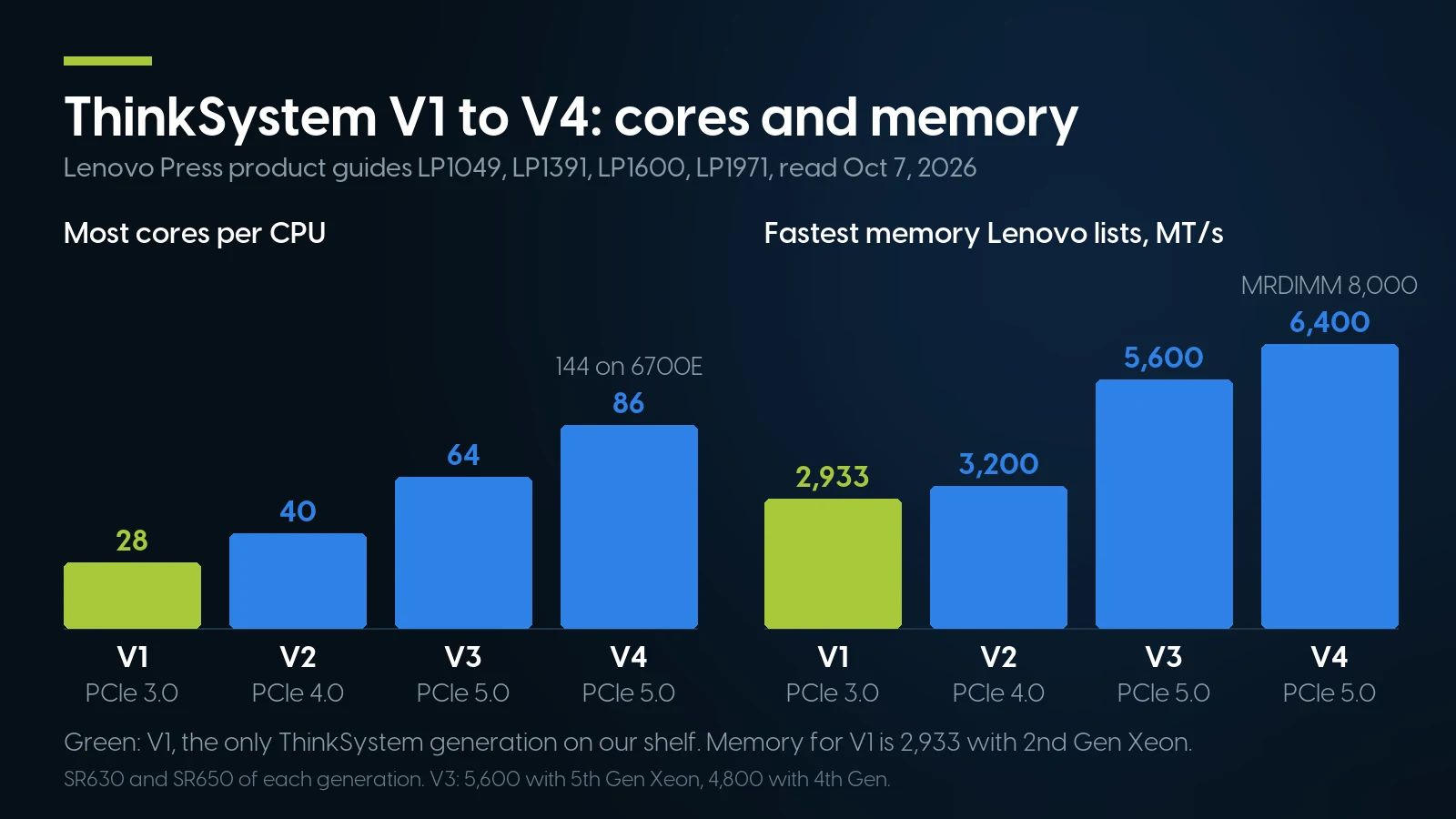
Source: Lenovo Press LP1049, LP1391, LP1600, LP1971, read October 7, 2026.
Read down the columns and there are three breaks: six memory channels and the XClarity Controller at V1; PCIe 4.0, eight channels and OCP 3.0 at V2; DDR5 and PCIe 5.0 at V3. V4 is the first rung without a separate chipset, which LP1971 lists as “Integrated into the processor”.
How to read a ThinkSystem model and machine type
The first generation has no suffix; Lenovo’s V1 guides call it the SR630 “Xeon SP Gen 1 / Gen 2”. The reliable marker is the machine type on the pull-out label: 7X01 or 7X02 is a V1 SR630, 7Z70 or 7Z71 a V2. A listing that says “v2” may not be one. Lenovo sold a V1 SR630 base named “ThinkSystem SR630 2.5″ Chassis with 10 Bays v2”, which, per LP1049, adds the air duct “required if a RAID 9350 adapter is to be configured”.
By processor family the rungs line up with Dell and HPE: System x M5 with Dell 13G and HPE Gen9, V1 with 14G and Gen10, V2 with 15G and Gen10 Plus, V3 with 16G and Gen11, V4 with 17G and Gen12. Only the processors line up; licences, power supplies and controllers do not cross brands.
SR630 and SR650 End of Life: Lenovo Publishes the Date, Per Model
Lenovo’s lookup states its rule: “Lenovo has historically provided service and support for at least five years following a product’s withdrawal from marketing,” subject to change, with dates posted “at least 90 days before the actual EOS date.” Dates vary by region; these are North America, queried October 7, 2026.
Lenovo End of Service Date Lookup (HT504708, last modified July 24, 2026), North America, queried per machine type and model October 7, 2026; withdrawal dates from the change history of each product guide linked above and of SR635 and SR645.
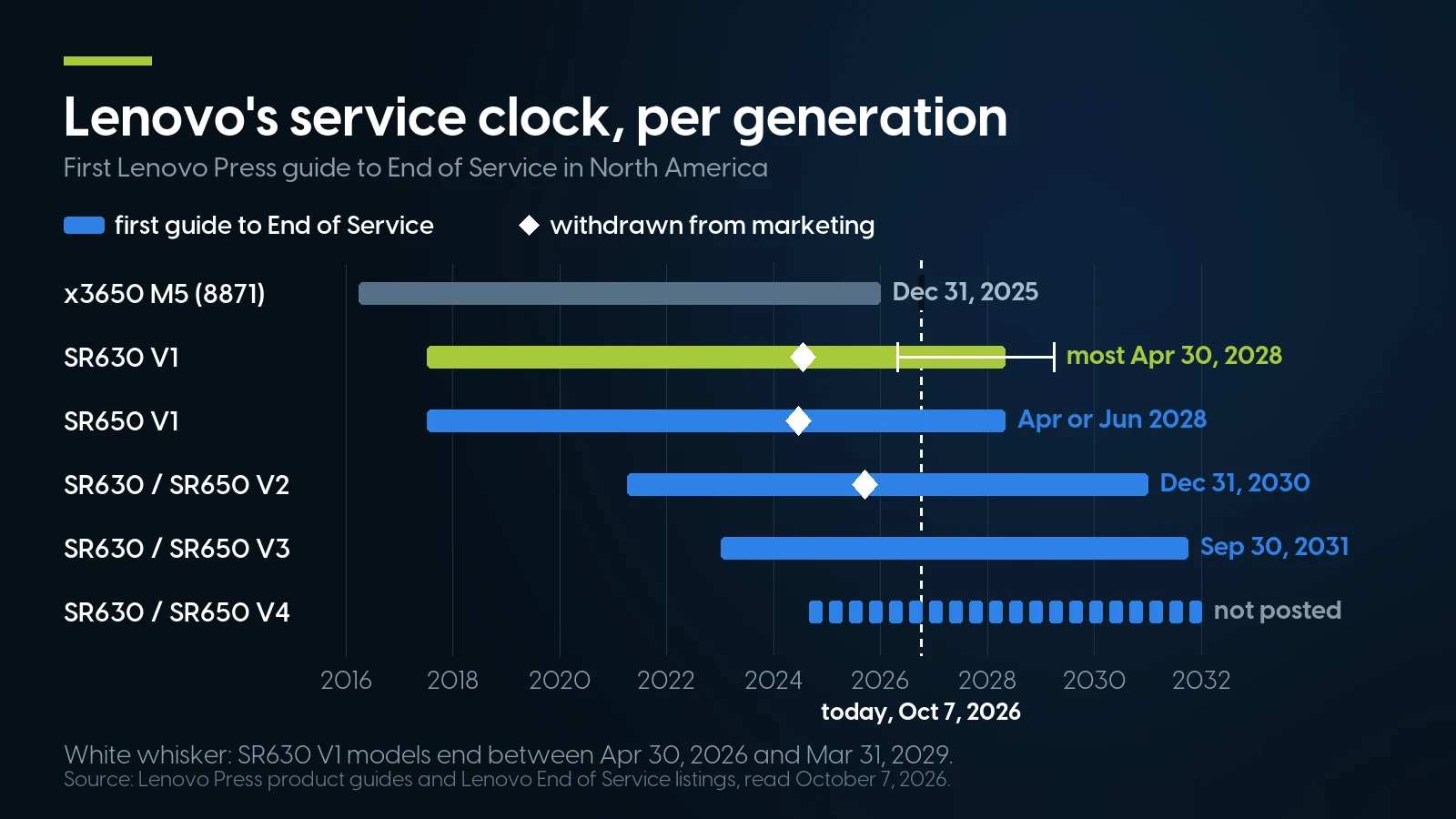
Most V1 models have about 18 months of Lenovo service left. Source: Lenovo, October 7, 2026.
The SR630 row is why the model code matters. Lenovo gives dates for seven North American models of the 7X02, and they end on four different dates: one on April 30, 2026, already past; three on April 30, 2028; two on June 30, 2028; one on March 31, 2029. The 1-year-warranty 7X01 has no North American entry at all. So “SR630 end of life” means: withdrawn from marketing in 2021 for first-generation Xeon models and July 2024 for the rest, serviced in North America mostly into 2028, and the exact date is whatever the lookup returns for the model on your label.
The firmware clock: V1 and V2 quiet since September 2025
Lenovo Data Center Support download pages for each model, read October 7, 2026; V1 notes from the UEFI 4.30 and XCC 10.40 change histories.
Lenovo has not said V1 firmware ended; it has posted nothing newer than UEFI 4.30, with Intel’s 2025.3 platform update, and XCC 10.40, with fixes for 13 CVEs. Lenovo’s stated promise, in HT511292 (October 20, 2025), is firmware and driver updates “for up to eight years after the product has reached the end of production” — a ceiling, not a schedule.
Can you download ThinkSystem firmware without a warranty?
Yes, as of October 7, 2026. The V1 UEFI and XCC packages sit on download.lenovo.com, and an anonymous request with no cookies and no sign-in got HTTP 200 for both. Lenovo’s own how-to, HT515891 (March 7, 2026), describes getting server firmware with no warranty, serial-number or login step. Lenovo prints no sentence saying a warranty is not needed, so treat this as what we observed, not a policy. The exception is licence keys: re-downloading a lost XClarity key needs an account on Lenovo’s key management site.
What Lenovo certifies each generation to run
Operating-system tables in the Lenovo Press guides linked above, which Lenovo generates from its OS Interoperability Guide at download time, so they are dated by our download, October 7, 2026. SR630 rows; SR650 differences noted where we read its guide. Microsoft Windows Processor Requirements (August 31, 2026); Broadcom KB 428874 (updated September 18, 2026).
Certification is a list, not a lock. Microsoft says its processor list “does not in itself determine Microsoft support” but is “a prerequisite for system certification.” A V1 with Cascade Lake chips passes that prerequisite and still has no Server 2025 entry from Lenovo, so drivers and support for 2025 on V1 are yours to solve. Broadcom extended Skylake-SP to all of VCF 9.x in Deprecated Mode and “will not” extend it further.
Lenovo XClarity Controller: Which Licence Opens the Console and the ISO
Every ThinkSystem here carries an XClarity Controller, XCC on V1 and V2, XCC2 on V3 and XCC3 on V4, except the AMD SR635 and SR655, which run ThinkSystem System Manager on an AST2500. The System x M5 had its predecessor, IMM2.1. What the controller does depends on a Features on Demand licence.
Lenovo Press LP1049 and LP1391 (XClarity Controller sections), the XCC Standard, Advanced and Enterprise feature pages (user guide 18th edition, September 2025), the XCC2 product guide (July 31, 2025) and LP1971 for XCC3. Read October 7, 2026.
The middle column is the trap. Lenovo’s V1 guide puts “Mapping the ISO and image files located on the local client as virtual drives” under the Enterprise upgrade. Advanced gets you the screen, keyboard and mouse but not the installer, so the equivalent of an iDRAC Enterprise licence on a V1 or V2 ThinkSystem is XCC Enterprise, as our iDRAC, iLO and IPMI guide also says. On V1 the two upgrades are separate keys, and the field Enterprise key needs Advanced already active. V3 and V4 have one upgrade each. Lenovo’s V4 guide calls the V3 tier “XCC2 Premium”; every V3 document says Platinum.
The key belongs to the serial number, not the board
Lenovo’s key management site generates an XClarity key against a machine type and serial number. Its hardware-replacement page adds: “It is ultimately the client’s responsibility to reinstall their FoD keys.” After a system-board swap, the SR630 maintenance manual (May 2023) has the technician write the machine type and serial back into the new board’s vital product data; then the key goes back on, from a saved copy or from the site’s history search by serial, which needs an account. A used unit whose board was swapped without that step will not take its old key. Whether a factory reset deletes keys, the XCC guide does not say.
On arrival, the XCC licence screen shows the installed level, and a lock icon on the remote console means you cannot use it. Update the controller too. Lenovo advisory LEN-172051 (September 10, 2024, severity High) covers command-injection flaws exploitable by an authenticated privileged user, fixed in V1 XCC 9.97 or 9.98 and V2 XCC 4.71 or 5.10; the current 10.40 and 5.70 are later. Keep any XCC off public addresses.
System x M5 and SR630/SR650 V1: From IBM to Two CPU Generations on One Board
System x M5: past every clock
The M5 is the last IBM-designed rung. IBM’s filing with the SEC records that “On October 1, 2014, IBM and Lenovo completed the initial closing” of the sale of IBM’s x86 server business. The x3550 M5 and x3650 M5 shipped with E5-2600 v3 chips under IBM machine types 5463 and 5462, then E5-2600 v4 under Lenovo’s 8869 and 8871. Their IMM2.1 controller needs a separate paid key, the IMM Advanced Upgrade, for any remote console or virtual media. Lenovo’s guide lists Windows Server up to 2019, and every M5 machine type is past its North American service date. Our nine x3650 M5 listings in Lenovo servers stand at zero units as of October 19, 2026.
V1: Skylake or Cascade Lake, same machine type
The first ThinkSystem SR630 and SR650 launched with Intel’s first-generation Xeon Scalable (x1xx, Skylake-SP) in 2017. In April 2019 Lenovo published new guides, LP1049 and LP1050, for the same machine types with “Up to two 2nd Gen Intel Xeon” processors (x2xx, Cascade Lake) and the line “1st Gen Intel Xeon processors are also supported.” One UEFI image serves both. Its April 2019 release, 2.11, added “Support Cascade Lake processor”, 2933 MHz memory and Optane persistent memory, and must be installed over UEFI 1.41 or later with XCC 2.50 or later. Lenovo also sold second-generation processors as SR630 option kits, such as 4XG7A15867, a Platinum 8280.
HPE sold second-generation kits for the Gen10 too, yet its QuickSpecs call the x1xx to x2xx field upgrade unsupported. Lenovo prints no such line, so a V1 ThinkSystem moves to Cascade Lake on Lenovo’s own documents, though we found no Lenovo sentence certifying the swap in so many words, and none against it. The conditions: update UEFI and XCC before the processors go in; both sockets identical; LRDIMMs work with first-generation chips only, persistent memory with second-generation only; with second-generation chips the RDIMM ceiling doubles from 768 GB to 1.5 TB. The hottest processors carry restrictions: 200–205 W parts lose the rear drive kit, the 10-bay NVMe backplane, flash adapters and GPUs and are held to 35 °C (LP1049), and the SR630 maintenance manual allows no front drives at all with the small heat sink.
Storage on V1: a controller in every server
“The SR630 does not offer onboard SATA functionality,” LP1049 says, so every SAS or SATA drive hangs off a card, normally in slot 4, a PCIe 3.0 x8 slot reserved for the internal controller; NVMe bays can use the board’s own NVMe ports. Lenovo’s SR630 list runs from the RAID 530 to the 9350, including the 930-8i and 930-16i, plus 430-, 440- and 4350-series HBAs. Lenovo’s RAID 930 guide (April 28, 2026, now marked withdrawn from marketing) gives that family RAID 0, 1, 10, 5, 50, 6 and 60 plus JBOD, with flash-backed cache. Read the controller in the XCC inventory, not a listing title, ours included. For NVMe, V1 has Intel VROC: the standard offering, enabled at the factory, builds RAID 0, 1, 10 and 5 on Intel-branded SSDs only, “not supported with Solidigm or any other brand”, and the Premium key, delivered as a Features on Demand licence activated in XCC, extends it to non-Intel drives. Under ESXi, Lenovo supports VROC RAID 1 only.
What a Used SR630 Costs, Next to a Dell R640 and an HPE DL380 Gen10
As of October 19, 2026, the 10-bay SR630 V1 is the only Lenovo server we can sell. The cheapest of each kind, beside same-generation Dell and HPE machines in stock:
Our catalog, BigCommerce API, October 19, 2026. All five use first-generation Xeon Scalable (x1xx).
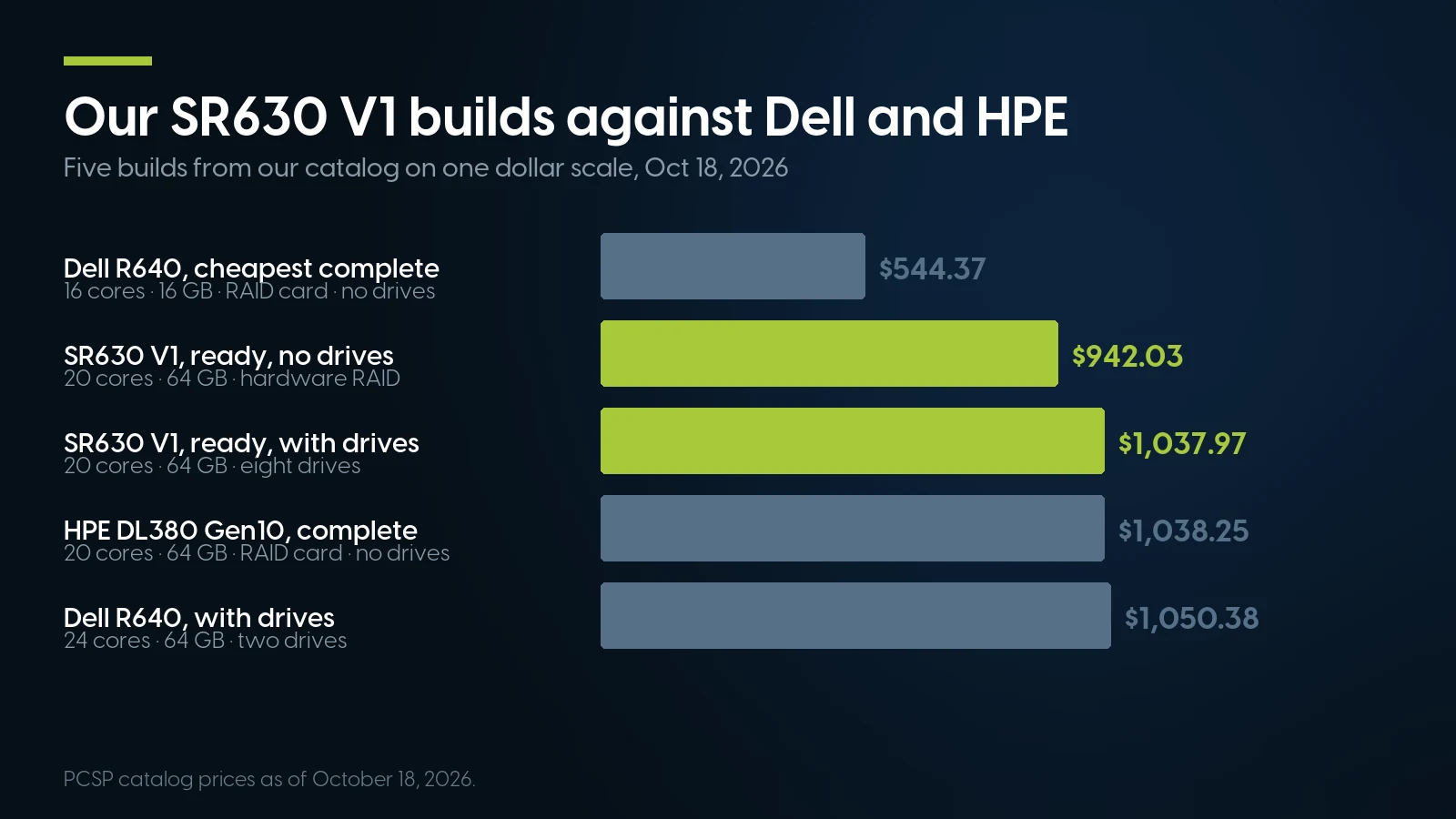
PCSP catalog prices as of October 19, 2026.
The ready SR630 at $942.03 costs more than the cheapest complete R640 at $544.37, which has the same processor generation but 16 GB and no drive; the SR630 adds 20 cores, 64 GB, four 10 GbE ports and a hardware RAID card. With drives the two meet: $1,037.97 for the SR630 with eight 600 GB drives and 20 cores, $1,050.38 for the R640 with two 300 GB drives and 24 cores. The cheapest complete HPE DL380 Gen10, at $1,038.25, has the same 20 cores and 64 GB as the SR630 but empty trays, and only three are in stock. The head-to-head with the Dell is in our SR630 vs R640 comparison.
The 48 ready SR630 configurations, each listed with 12 in stock, run from $942.03 at 64 GB, $1,310.03 at 128 GB, $2,046.03 at 256 GB and $4,989.79 at 768 GB, up to $5,453.85; 17 carry two 960 GB SSDs, 16 eight 600 GB SAS drives and 15 come with empty trays. Every one runs first-generation Silver 4114, Gold 5118, Gold 6148 or Gold 6154 processors, so on Lenovo’s lists they are Server 2022 and ESXi 8.0 U3 hosts. We have no second-generation SR630 in stock.
There is no competitor build to set beside ours. The used market for ThinkSystem is thin and mostly quote-based: on October 19, 2026 none of TechMikeNY, SaveMyServer or NewServerLife listed a priced SR630 or SR650 build, and SaveMyServer lists the V2 and V3 by quote. The Dell and HPE rows are the priced alternatives at the same generation.
The SR630 V1 is our whole Lenovo shelf
48 ready SR630 V1 configurations, each listed with 12 in stock, from $942.03 as of October 19, 2026, all with first-generation Xeons. One-year warranty on every configured server; free ground shipping over $35.
Browse the ThinkSystem SR630 Compare the Dell R640SR630 V2 and SR650 V2: Ice Lake, PCIe 4.0 and the First Server 2025 Rung
V2 is a different platform under a familiar name. Lenovo’s SR630 V2 guide puts it on Intel’s “Whitley” platform with the C621A chipset (V1 used the C624) and third-generation Xeon Scalable, Ice Lake, up to 40 cores and 270 W. Its own comparison table with the SR630 lists what moved: 48 PCIe 3.0 lanes per processor became 64 PCIe 4.0 lanes, the LOM and ML2 slots became an OCP 3.0 slot, and memory went to eight channels and 32 slots of DDR4-3200, up to 8 TB with 256 GB 3DS modules. The controller chip changed too, to a Pilot4 XE401, with the same Standard, Advanced and Enterprise tiers.
Storage got cheaper to start. V2 has 12 onboard SATA ports with Intel VROC SATA RAID 0, 1, 5 and 10 for up to eight drives, so a Windows or Linux boot mirror no longer needs a card (Lenovo does not support VROC SATA RAID under ESXi, KVM, Xen or Hyper-V), and VROC NVMe RAID works on Intel drives with the Premium key extending it to others. Many V2 models shipped with a RAID 9350-8i. The power supplies are a new family: none of the V1 part numbers appears in the V2 guide.
On Lenovo’s lists V2 is the first rung for Windows Server 2025 and for ESXi 9.0 and 9.1. Lenovo withdrew both models from marketing on September 18, 2025 and services them in North America to December 31, 2030, about two and a half years longer than most V1 models, although V2 firmware has been as quiet as V1’s since September 2025. It is also the rung where our Dell and HPE guides found used prices stepping up, with PCIe 4.0.
We cannot supply a V2 from stock. There is no SR630 V2 in our catalog, and our 18 SR650 V2 24-bay listings stand at zero units as of October 19, 2026; ask us for a quote. The same-generation Dell is thin too, three priced PowerEdge R650 listings on the same date, and the R750 is covered in our Dell guide.
SR650 V3 and SR650 V4: DDR5, XCC2, XCC3 and No Used Shelf Yet
V3 arrived with Lenovo Press guides on January 10, 2023: fourth- or fifth-generation Xeon Scalable (Sapphire or Emerald Rapids), up to 64 cores and 385 W, 32 slots of DDR5 at two modules per channel, 4800 MHz with fourth-generation chips and 5600 with fifth at one module per channel but 4400 at two, which the 8 TB maximum needs. The XClarity Controller moved to XCC2 on an ASPEED AST2600 with a single Platinum upgrade, and the SR650 V3 takes power supplies up to 2400 and 2600 W. Lenovo has not withdrawn either model, yet its lookup already posts September 30, 2031 as their North American end of service. HPE rules out a fourth- to fifth-generation chip upgrade on Gen11; Lenovo’s SR630 V3 guide does not address it, so ask before paying for that headroom.
V4 is the Xeon 6 rung: the SR630 V4 guide dates from September 3, 2024 and the SR650 V4 from February 24, 2025. Performance-core 6700P and 6500P chips reach 86 cores, efficiency-core 6700E chips 144; there is no chipset; memory runs DDR5-6400, or 8000 with MRDIMMs, and up to eight CXL 2.0 memory modules. The controller is XCC3, which Lenovo describes as “based on an OpenBMC design”, with a Premier upgrade. Power moves to CRPS supplies of 800, 1300 and 2000 W, up to 3200 W on the SR650 V4.
We have neither. No V3 or V4 is in our catalog. For an SR650 V3 or V4, buy new through Lenovo or a partner, or take the same generation from another brand: Dell 16G, in our PowerEdge guide, and HPE Gen11, by quote in our ProLiant guide.
AMD ThinkSystem, one row
The SR635 (1U) and SR655 (2U) take one AMD EPYC 7002 or 7003 and the AST2500 controller with ThinkSystem System Manager instead of XCC; the SR645 and SR665 take one or two EPYC 7002 or 7003 chips and carry XCC. Lenovo withdrew all four between March 2025 and April 2026 and services them in North America to June 30, 2033, the longest date in this guide. Lenovo lists ESXi 9.1 for the SR645, and Server 2025 only with EPYC 7003 chips, and stops the SR635 at Server 2022 and ESXi 8.0 U3. We list none of them.
Towers, one line
The ST550 is the two-socket Xeon Scalable tower of the V1 era, serviced to June 30, 2029; the smaller ST250 runs to September 30, 2028. We list neither.
Power Supplies, Network Slots and Controllers That Do Not Cross Generations
Lenovo’s guides list a different set of power-supply part numbers for each family, and the wattage on the label does not tell you which family you hold:
Power-supply tables in LP1049, LP1050, LP1391, LP1392, LP1600, LP1601, LP1971 and LP2127. Read October 7, 2026.
Match the part number in your server’s guide, not the wattage. V2 and V3 share several supplies; V1 shares none with V2, and V4 starts over. Network cards follow the board the same way: V1 has a LOM slot for up to four 1 or 10 GbE ports plus an optional ML2 mezzanine, and Lenovo’s V2 comparison table replaces both with an OCP 3.0 slot, so V1 network cards stay with V1. RAID cards are listed per server: check any card against the support table in its own Lenovo Press guide before you order it for a different model or generation.
Lenovo parts on our own shelf are thin as of October 19, 2026: the only SR630-named power supply is a 550 W unit, and no Lenovo 930-series RAID card is in stock as a part.
When a Used ThinkSystem Is the Wrong Buy — Including From Us
Our Lenovo shelf is one first-generation server, so here is the case against it and against the rungs around it.
A Windows Server 2025 host, or a VMware estate planning past VCF 9.x, should not be a V1. No V1 configuration has a Server 2025 row in Lenovo’s guides, and Broadcom stops Skylake-SP at 9.x. Every ready SR630 we list runs first-generation chips, which Lenovo takes to Server 2022 and ESXi 8.0 U3. For 2025, start at V2, new or by quote, or take a Dell 15G.
If nobody will stand in front of the server, check the licence before you buy, ours included. Our listings name the XClarity Controller but not its licence level. On XCC Standard there is no remote console, and on Advanced no way to mount an installer ISO.
If policy requires current vendor firmware, V1 and V2 are a risk. Neither has had a UEFI or XCC release since September 2025, while V3 and V4 got builds in September 2026.
If you need Lenovo service past 2028, buy V2 or later. Most V1 models end Lenovo service in North America in 2028, and one SR630 model already ended on April 30, 2026. V2 runs to the end of 2030, V3 to September 2031. A refurbished server carries the seller’s warranty, not Lenovo’s: ours is one year on configured systems, extendable to five, and 90 days on parts bought on their own. Lenovo sells post-warranty service on such machines, subject to inspection and, after a coverage gap, a reserved right to refuse service for the first 30 days.
And where our shelf is thin. All 48 ready SR630s are first-generation, and the SSD builds carry two 960 GB drives, not a full front. Their listings say rail kit and bezel are not included and name redundant power supplies without a wattage. And Lenovo limits the Gold 6154 in this chassis: LP1049 allows it with no drive backplane, or with the 10-bay AnyBay backplane and at most four drives, at 35 °C or below; the Gold 6148 has no such limit. Check the drive count before buying any 6154 build. There is no SR650 of any generation in stock, no SR630 V2, V3 or V4, no AMD model and no tower.
Dell and HPE peers of the SR630 V1 on our shelf today
Lowest listed price in each category and what is on the shelf right now — barebones chassis included, so a complete build costs more than the figure shown. This block is the one part of the article that refreshes itself; every price in the text above is dated where it stands.
Tell us the operating system and who manages the server. We will tell you the generation.
SR630 V1 from stock; other ThinkSystem generations by quote; Dell and HPE where Lenovo is empty. One-year warranty on every configured server, extendable to five years; free ground shipping over $35.
Browse Lenovo servers Ask for a quoteThe Bottom Line
A ThinkSystem’s generation sets four things that matter more than its launch year: Lenovo’s published service date, what Lenovo lists it to run, whether its firmware still moves, and which XClarity licence a remote install needs. On those, the System x M5 is finished; V1 is a Server 2022 and Linux machine with Lenovo service mostly into 2028, two processor generations on one board, and an Enterprise key between you and a remote ISO; V2 is the first rung for Server 2025 and ESXi 9; V3 and V4 are still bought new.
Our shelf is the first of those rungs only. As of October 19, 2026, a ready SR630 V1 with a RAID card and 64 GB is $942.03; for the other rungs we quote, or point you to Dell and HPE.
Lenovo ThinkSystem Generations: Frequently Asked Questions
Is the Lenovo ThinkSystem SR630 end of life?
Lenovo withdrew the SR630 V1 from marketing on July 19, 2024, and its models with first-generation Xeons on February 2, 2021. Its End of Service lookup gives North American dates per model: one model ended April 30, 2026, most end in April or June 2028, and one runs to March 31, 2029. The SR630 V2 runs to December 31, 2030 and the V3 to September 30, 2031. Check the machine type and model on your label in Lenovo’s lookup.
What is the difference between the SR650 V2 and the SR650 V3?
The V2 runs third-generation Xeon Scalable (Ice Lake) on DDR4-3200 and PCIe 4.0, with the XClarity Controller in Standard, Advanced and Enterprise tiers. The V3 runs fourth- and fifth-generation Xeon Scalable on DDR5 and PCIe 5.0, with XCC2 and a single Platinum upgrade, and power supplies up to 2600 W. Lenovo lists both generations for Windows Server 2025 and ESXi 9.1; Lenovo services the V2 to December 31, 2030 and the V3 to September 30, 2031 in North America.
Which XClarity Controller licence gives remote console and virtual media?
On ThinkSystem V1 and V2, XCC Advanced adds the remote console, and XCC Enterprise adds mounting an ISO from your computer or a network share. XCC Standard has no console and only a 50 MB upload area. On V3, XCC2 Platinum covers both; on V4, XCC3 Premier does. The key is tied to the machine type and serial number and must be reinstalled after a system-board replacement.
Can a ThinkSystem SR630 V1 take second-generation Xeon Scalable processors?
On Lenovo’s documents, yes: the same 7X01 and 7X02 machine types support first- and second-generation Xeon Scalable, one UEFI image serves both, and Lenovo sold second-generation SR630 option kits. Update to UEFI 2.11 or later with XCC 2.50 or later before the swap, fit two identical processors, and note that LRDIMMs work only with first-generation chips.
Can a Lenovo SR630 run Windows Server 2025 or ESXi 8?
Lenovo lists no Windows Server 2025 support for any first-generation SR630; its list stops at Server 2022. For ESXi it lists up to 8.0 Update 3 with first- or second-generation Xeons, and no ESXi 9 for the SR630 V1. That is certification, not a promise that setup fails. The SR630 V2 and later are listed for Server 2025 and ESXi 9.0 and 9.1.
Do I need a Lenovo warranty to download ThinkSystem firmware?
Not as of October 7, 2026: Lenovo’s download server returned the current SR630 UEFI and XClarity Controller packages without a sign-in, and Lenovo’s firmware how-to describes no warranty step. Lenovo does not state this as a policy. Re-downloading a lost XClarity licence key does need an account on Lenovo’s key management site.
Is the Lenovo SR630 the same as a Dell R640 or an HPE DL360 Gen10?
By processor family, yes: all three are 1U two-socket servers on first- and second-generation Xeon Scalable with six memory channels and PCIe 3.0. Management licences, power supplies, controllers and support dates are each vendor’s own, and unlike HPE, which calls a first- to second-generation field upgrade on the Gen10 unsupported, Lenovo prints no such restriction for the SR630.
Which used Lenovo ThinkSystem generation should I buy?
V1 for Windows Server 2022, Linux, Proxmox and labs, ideally with second-generation Xeons and an XCC Enterprise licence if you manage it remotely; Lenovo services most V1 models into 2028. V2 if you need Windows Server 2025, ESXi 9 or Lenovo service to 2030. Skip the System x M5. No used store we checked priced a V3 or V4 on October 18, 2026; buy them new, or look at Dell or HPE equivalents.